
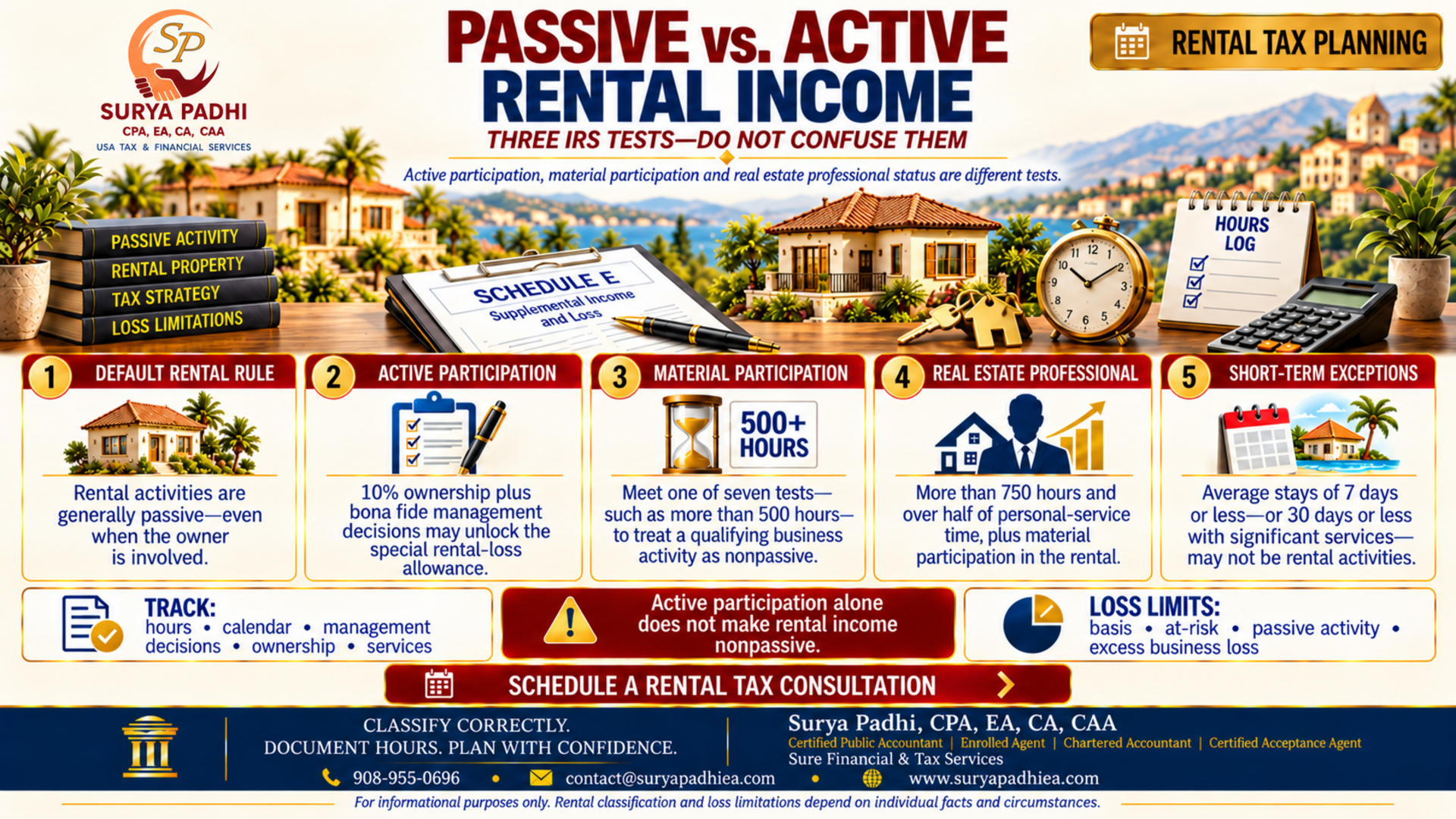
Rental activity is passive by default, even if you work on it every week. It becomes nonpassive only if you qualify as a real estate professional, with more than 750 hours and more than half your working time, and materially participate. Owners who actively participate can deduct up to $25,000 of loss, phased out between $100,000 and $150,000 of income.
6:57. The written version, the figures and the sources are all below.
| Special allowance (active participation) | $25,000 | Rental real estate loss. $12,500 if married filing separately and living apart all year; none if you lived with your spouse at any time. |
|---|---|---|
| Allowance phase-out (MAGI) | $100,000 to $150,000 | Reduced by 50 cents per dollar over $100,000. $50,000 to $75,000 if married filing separately and living apart. |
| Active participation ownership | 10% or more | By value, counting your spouse. Limited partners generally do not qualify. |
| Real estate professional | 750+ hours and over half | Both required, in real property trades or businesses where you materially participate. |
| Material participation (common test) | 500+ hours | One of seven tests. Others include substantially all the work, or over 100 hours and at least as much as anyone else. |
| Short-term rental line | 7 days | An average stay of 7 days or less is not a rental activity. Up to 30 days with significant personal services also qualifies. |
Rental losses start out passive. Which kind of “active” you can prove decides whether they deduct this year or wait.
The passive vs active rental income question decides what a rental loss is worth. Passive losses can only offset passive income. Nonpassive losses can offset wages, business profit and the rest of the return, subject to the other loss limits that apply.
The sorting rule is not intuitive, because the word “active” is used for two different tests. Active participation is a low bar tied to ownership and management decisions. Material participation is a high bar measured in hours. This article walks through the determination in the order the rules apply it, with the figures for tax year 2026, and shows where claims most often fall apart.
Key takeaways
- Rental activity is passive by default, even if you work on it every week.
- Active participation (10% ownership plus management decisions) earns up to a $25,000 loss allowance, phased out between $100,000 and $150,000 of modified adjusted gross income.
- Real estate professional status needs more than 750 hours and more than half of all your working time, plus material participation.
- A property with an average stay of seven days or less is not a rental activity, which changes both the test and the allowance.
- Hours are counted by tax year, so the time to document them is before December 31.
Why rentals start out passive
Section 469 splits income into passive and nonpassive. A passive activity is a trade or business in which you do not materially participate, and the statute adds that any rental activity is passive, whether or not you materially participate. IRS Publication 925 makes the same point: a rental is passive even if you worked on it all year, unless you qualify as a real estate professional.
Passive losses are not forfeited. They are suspended, tracked on Form 8582, and carried forward. They can be used against passive income in any later year, and when you dispose of your entire interest in a fully taxable transaction, the remaining loss is generally freed up.
A second reason the category matters
Passive rental income is generally subject to the 3.8% net investment income tax, while income from a rental that is a nonpassive trade or business generally is not. The IRS explains the line in Topic 559.
Two meanings of “active”
This is where most of the confusion starts. Active participation and material participation sound like cousins. They are different tests, with different thresholds and different rewards.
| Active participation | Material participation | |
|---|---|---|
| What it measures | Ownership and management decisions | Hours of work |
| Threshold | 10% or more of all interests, by value, counting your spouse | Pass any one of seven tests, most commonly more than 500 hours |
| Typical evidence | Approving tenants, setting rents, approving repairs and expenses | A calendar, emails and a time summary showing the hours |
| What it earns | Up to $25,000 of rental loss against other income | With real estate professional status, nonpassive treatment |
| Who usually fails | Limited partners and owners under 10% | Anyone whose hours fall short, or whose time is investor-type work |
Passive vs active rental income: the four questions, in order
The rules apply in a sequence. Ask the questions in this order, and stop when one settles the category.
- Is it a rental activity at all? If the average stay is seven days or less, or thirty days or less with significant personal services, the property is not treated as a rental activity. The test then becomes material participation alone.
- Are you a real estate professional? You need more than 750 hours in real property trades or businesses in which you materially participate, and those hours must be more than half of all the time you work. If you qualify and materially participate in the rental, the loss is nonpassive.
- Do you actively participate? If you own at least 10% and make management decisions, up to $25,000 of rental loss can offset other income, subject to the income phase-out.
- If none of these fit, the loss is passive. It is suspended and carried forward.
The $25,000 allowance and the income phase-out
The allowance is for individuals who actively participate in rental real estate. It starts at $25,000 and is reduced by 50 cents for every dollar your modified adjusted gross income exceeds $100,000, so it reaches zero at $150,000. If you are married filing separately and lived apart from your spouse all year, the amounts are halved: $12,500, phasing out between $50,000 and $75,000. If you lived with your spouse at any point in the year and file separately, there is no allowance.
| MAGI | Allowance | Reduction |
|---|---|---|
| $100,000 or less | $25,000 | $0 |
| $110,000 | $20,000 | $5,000 |
| $120,000 | $15,000 | $10,000 |
| $130,000 | $10,000 | $15,000 |
| $140,000 | $5,000 | $20,000 |
| $150,000 or more | $0 | $25,000 |
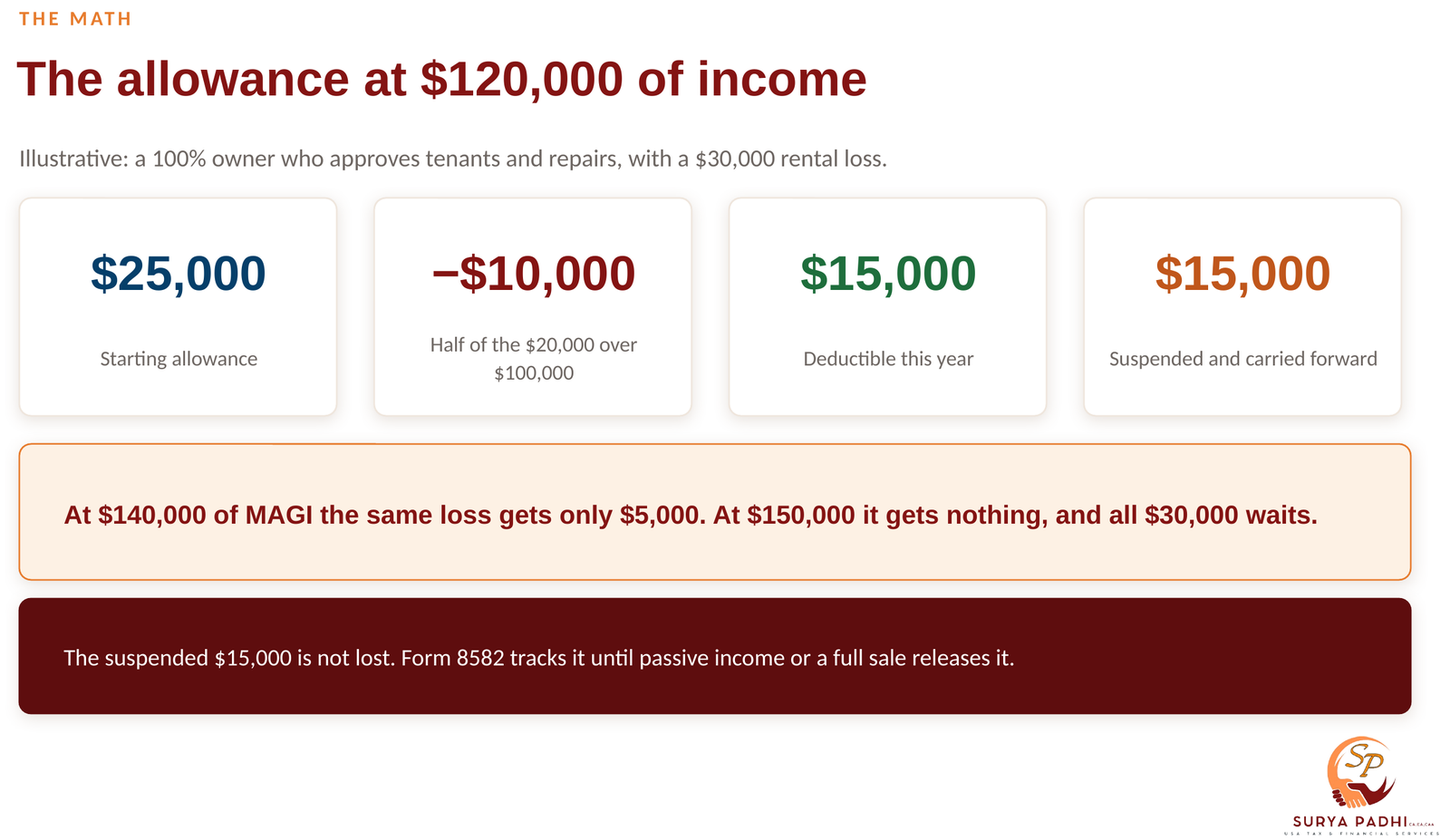
Illustrative: a $30,000 loss at $120,000 of MAGI
| Rental loss | $30,000 |
| Starting allowance | $25,000 |
| Reduction: 50% × ($120,000 − $100,000) | −$10,000 |
| Allowance | $15,000 |
| Deductible this year | $15,000 |
| Suspended and carried forward | $15,000 |
Illustrative figures for an owner who actively participates. The suspended amount is tracked on Form 8582.
Material participation: seven tests, and you need one
Material participation is measured by hours and involvement. You pass if you meet any one of these:
- You work more than 500 hours in the activity during the year.
- Your participation is substantially all of the participation by anyone, including people who do not own it.
- You work more than 100 hours, and no one else works more than you do.
- The activity is a significant participation activity, and your hours across all such activities exceed 500.
- You materially participated in the activity in any five of the last ten years.
- It is a personal service activity, and you materially participated in any three earlier years.
- Based on all the facts, you participate on a regular, continuous and substantial basis.
Two details matter. Your spouse’s participation counts as yours, whether or not your spouse owns any of the property and whether or not you file jointly. And work done in an investor capacity, such as reviewing financial statements or monitoring finances, does not count unless you are directly involved in day-to-day management or operations.
For perspective, 500 hours over a full year is about 9.6 hours a week.
Real estate professional status: two halves
Real estate professional status is what lifts the automatic passive label from rentals. The test has two parts, and both must be met in the same year. More than half of the personal services you perform in all trades or businesses must be in real property trades or businesses in which you materially participate, and you must perform more than 750 hours in those businesses. On a joint return, the requirements must be met by one spouse separately. Two spouses’ hours are not combined.
Employee hours are treated differently. Services performed as an employee generally do not count as a real property trade or business unless you own at least 5% of the employer.
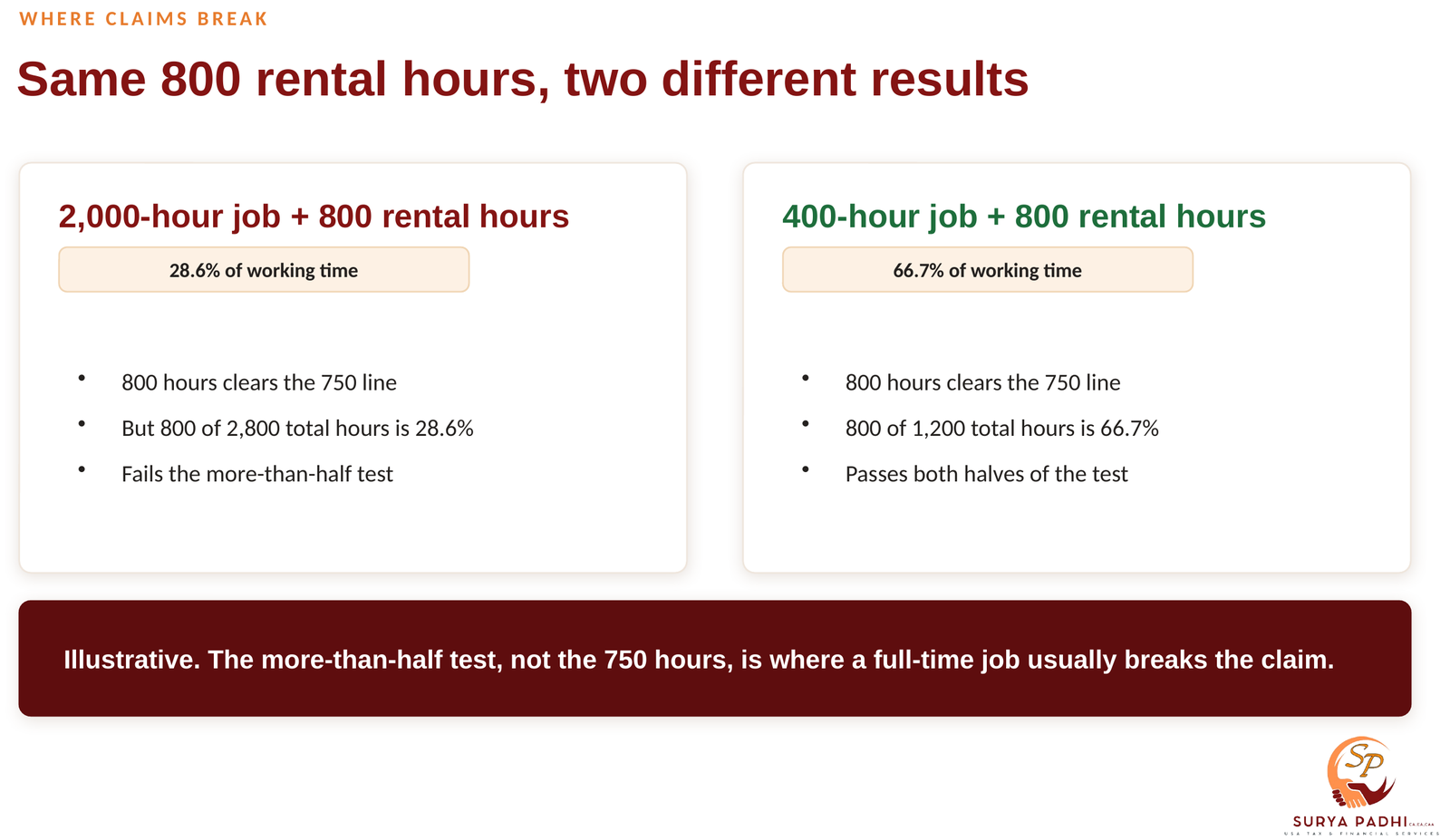
The more-than-half requirement is where claims most often break. Suppose someone works 2,000 hours at a W-2 job and 800 hours on rentals. The 800 hours clear the 750 line, but they are only 28.6% of the 2,800 total hours. Someone with a 400-hour part-time job and the same 800 rental hours is at 66.7%, and passes.
Qualifying is not the finish line
Even a qualifying real estate professional must materially participate in each rental, unless the one-activity election is made. Qualifying only removes the rule that rentals are passive automatically.
Short-term rentals: when the property stops being a rental
The regulations carve several situations out of the definition of a rental activity. Two matter for most owners. If the average period of customer use is seven days or less, the property is not a rental activity. If the average is thirty days or less and you, or someone on your behalf, provide significant personal services, it is also not a rental activity.
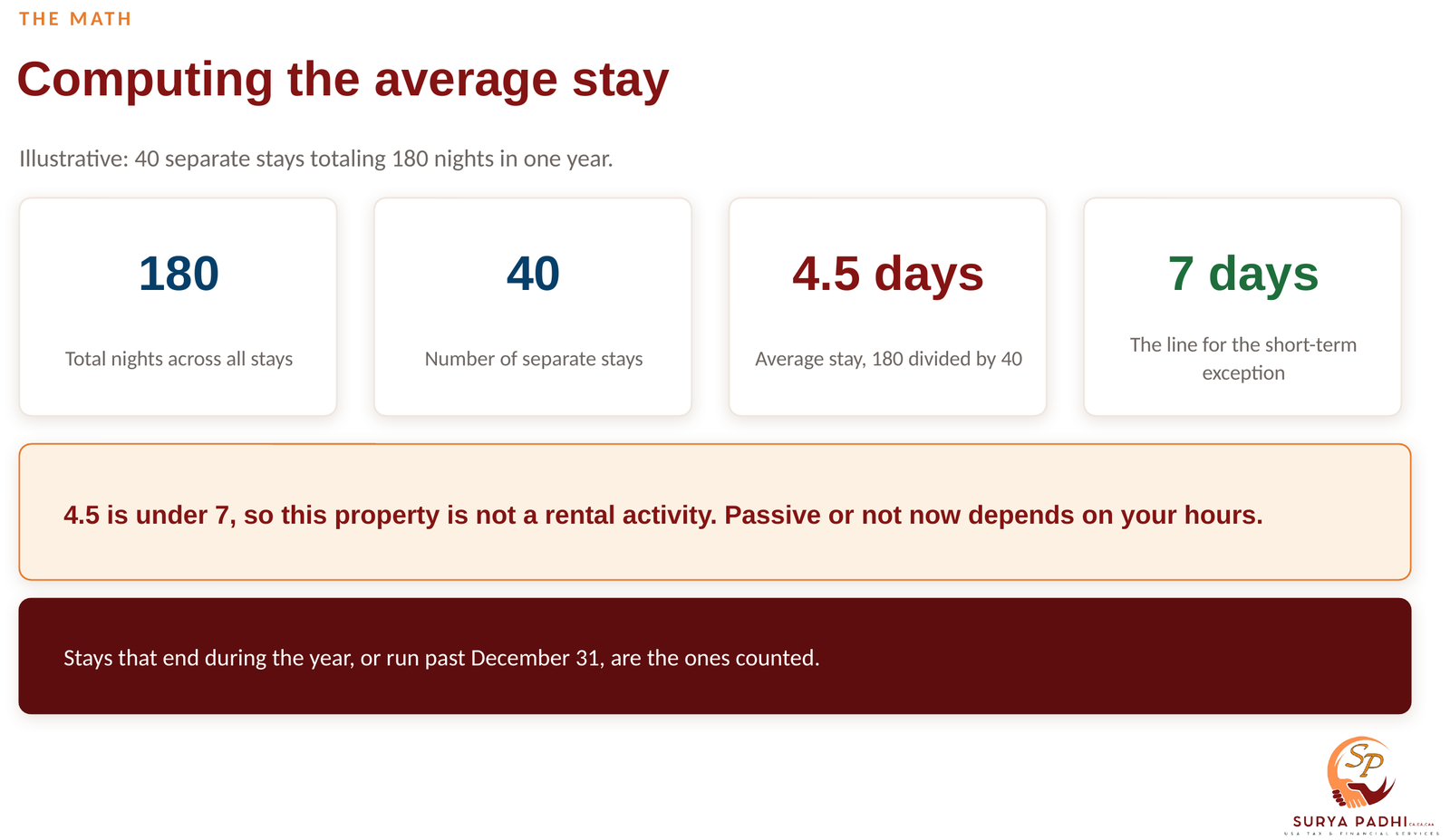
The average is total days of use divided by the number of stays. Only stays that end during the tax year, or that run through its last day, are counted. Properties whose daily rents differ significantly belong in separate classes, which are weighted by their share of rental income.
Illustrative: the average stay
| Total nights across all stays | 180 |
| Number of separate stays | 40 |
| Average stay | 4.5 days |
| Short-term exception line | 7 days or less |
At 4.5 days the property is not a rental activity. Passive or not now depends on material participation.
The trap in short-term rentals
Once a property is outside the rental definition, it is passive only if you fail the material participation tests. It also generally cannot use the $25,000 allowance. An owner who counted on the allowance for a short-term rental loss can end up with a suspended loss.
One activity or many: the grouping election
Each rental property is generally its own activity, which means material participation is tested property by property. A qualifying real estate professional can elect to treat all interests in rental real estate as a single activity by filing a statement with the original return for the year. The statement must say that the taxpayer is a qualifying taxpayer making the election under section 469(c)(7)(A).
The election is binding for the year it is made and for every later year in which you qualify. Not electing in one year does not prevent electing later. Revoking it requires a material change in facts and circumstances and a revocation statement filed with the original return.
Proving your hours
The regulations do not require a contemporaneous daily log. You can establish participation by any reasonable means, including appointment books, calendars or narrative summaries that identify the services performed and the approximate hours. In practice, a record built as you go is far more persuasive than one reconstructed later, and that is the habit worth building before the year ends.
- A weekly time log showing the date, the property and the task.
- Emails and texts showing tenant, vendor and repair decisions.
- Calendar entries for showings, inspections and site visits.
- For a real estate professional claim, the same kind of records for every other job or business, to support the more-than-half test.
A year-end checklist
- Tally your 2026 hours to date by property, separating hands-on work from investor-type work.
- Estimate the hours you can still work before December 31, because hours are counted by tax year.
- If you rent short term, compute the average stay for the year before it closes.
- Confirm your ownership share and who makes the management decisions.
- If you may qualify as a real estate professional, decide on the one-activity election before the 2026 return is filed.
- Gather last year’s Form 8582 so any suspended losses are carried correctly.
Frequently asked questions
Is rental income passive or nonpassive?
Rental activity is passive by default, whether or not you materially participate, unless you qualify as a real estate professional under section 469(c)(7). A property whose average stay is seven days or less is not a rental activity, so its status depends on whether you materially participate.
How many hours do I need to be a real estate professional?
You need more than 750 hours in real property trades or businesses in which you materially participate, and those hours must be more than half of all the personal services you perform in all of your trades or businesses for the year.
What is the difference between active participation and material participation?
Active participation is a lower standard based on owning at least 10% and making management decisions, and it supports an allowance of up to $25,000 of rental loss. Material participation is measured in hours, usually more than 500, and it is the standard that supports nonpassive treatment.
Not sure which category your rentals fall into?
We review your ownership, your hours and your income, then plan the year-end moves around the test you actually meet.
This article is general tax education and does not constitute individualized tax, legal or financial advice. Figures are stated for the tax year shown and are subject to IRS adjustment. Consult a qualified professional about your own facts.