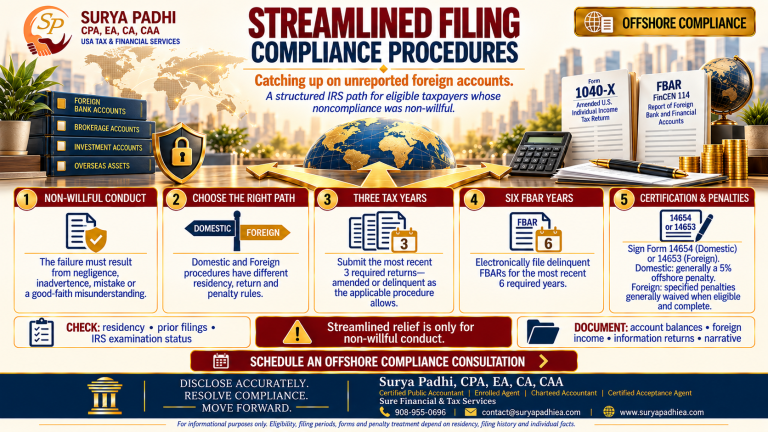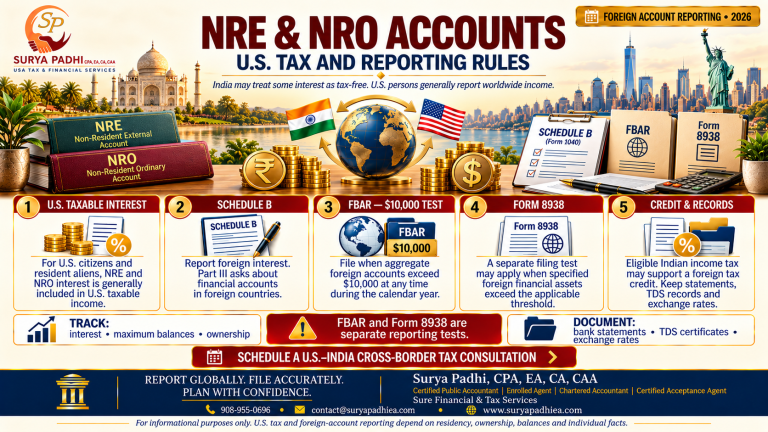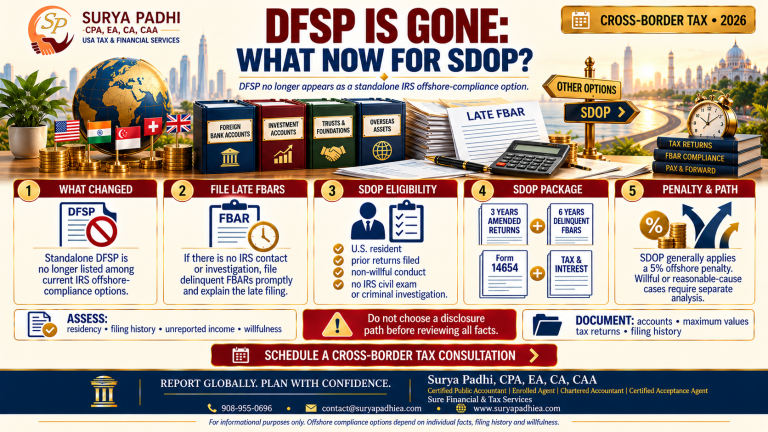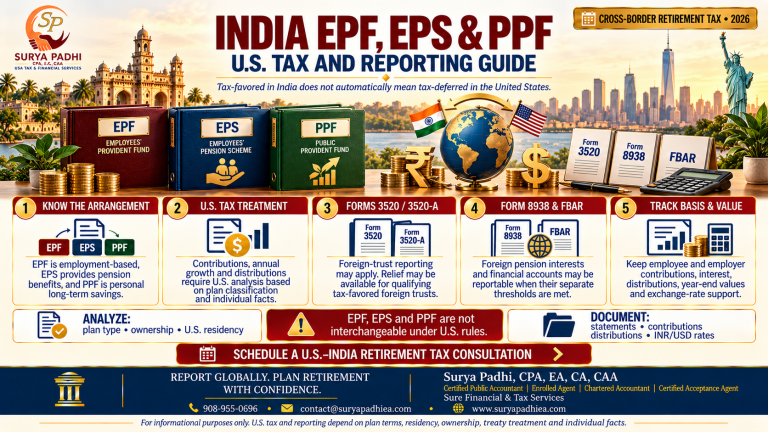
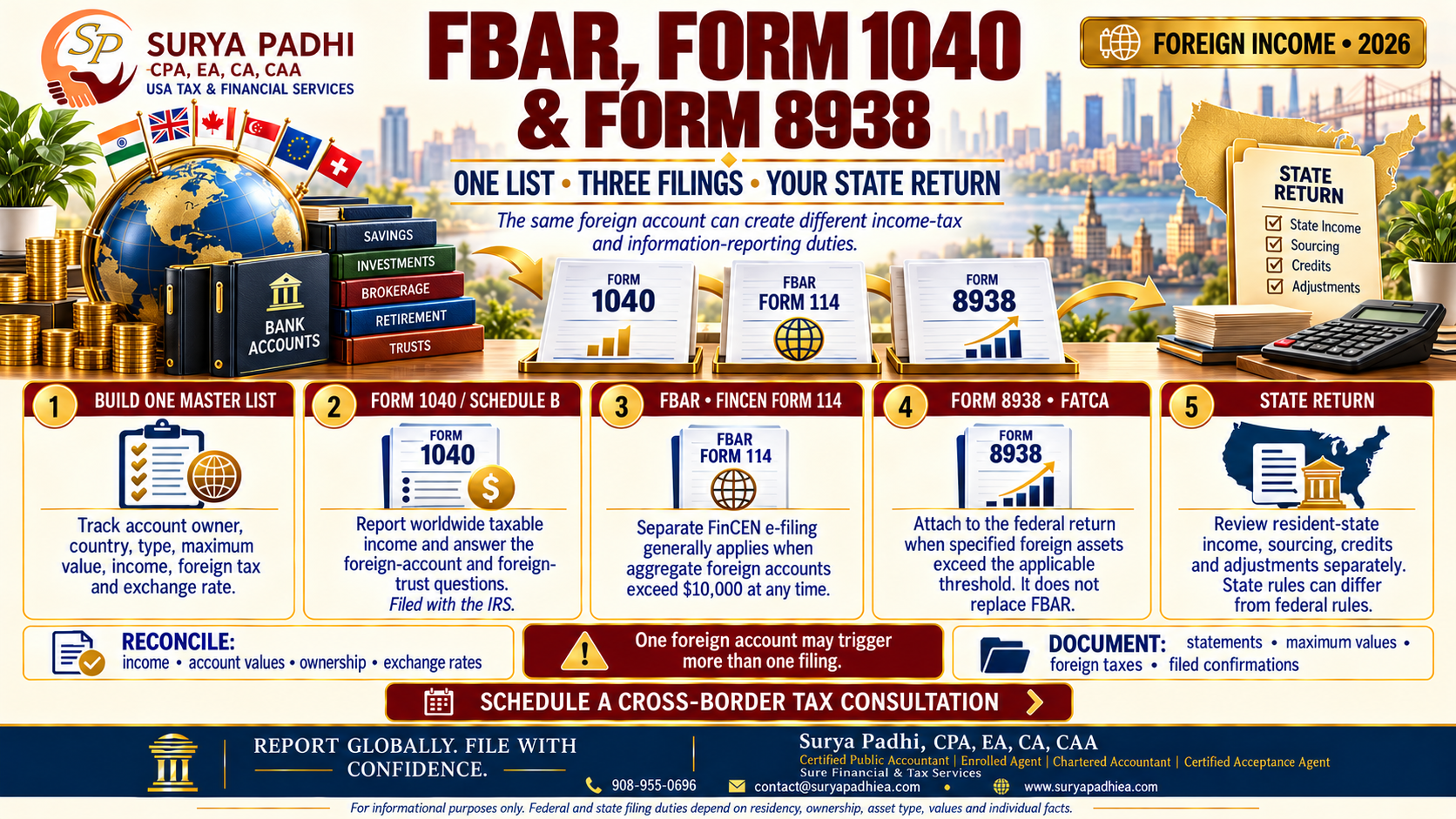
FBAR, Form 1040 and Form 8938 are separate federal filings built on one list of foreign accounts. The FBAR goes to FinCEN, not with your return, and no state has its own. The foreign income on your Form 1040 usually flows into your state return too, often with little or no credit for foreign tax.
6:55. The written version, the figures and the sources are all below.
| FBAR threshold | $10,000 | All foreign financial accounts combined, at any time during the calendar year. |
|---|---|---|
| FBAR due date | April 15 | Automatic extension to October 15. Filed with FinCEN, not with your return. |
| Form 8938, single in the U.S. | $50,000 | On the last day of the year, or $75,000 at any time during the year. |
| Form 8938, joint in the U.S. | $100,000 | On the last day of the year, or $150,000 at any time during the year. |
| Form 3520 gift trigger | $100,000 | Gifts or bequests from a nonresident alien individual or foreign estate. |
One list of foreign accounts feeds three federal filings, and the income behind it usually reaches your state return too.
If you have a bank account, a fund or a property overseas, your tax life now involves more than one form. FBAR and Form 1040 are the two names people hear first, then Form 8938 comes up, and soon it feels like three agencies asking the same question three different ways.
In a sense, they are. The same list of foreign accounts feeds every one of these filings, but each filing has its own test, its own threshold and its own destination. There is a fourth place the same facts land, and it is easy to overlook: your state tax return. This guide maps how the FBAR and Form 1040 connect with Form 8938 and the other foreign reporting forms, and how all of it affects your state return, so you can see which ones apply to you and where each one goes.
Key takeaways
- The FBAR goes to FinCEN, not with your tax return. Filing one never files the other.
- The FBAR test is $10,000 across all foreign accounts combined at any time. Form 8938 uses higher tiers by filing status and residence.
- Schedule B, Part III on your Form 1040 asks the foreign account question. Answer it to match your FBAR.
- No state has its own FBAR or Form 8938, but the foreign income on your Form 1040 usually reaches your state return, and many states give little or no credit for foreign tax.
- Foreign funds, companies, partnerships and large gifts bring forms of their own.
One foreign account, three different questions
Start with a single foreign account, say a savings account at a bank in another country. That one account can raise three separate questions. Your tax return asks whether you have it and what it earned. The FBAR reports the account itself to the Treasury Department’s Financial Crimes Enforcement Network, known as FinCEN. Form 8938 reports it again to the IRS, but only if your foreign assets pass higher thresholds.
| Filing | The question it answers | Where it goes |
|---|---|---|
| Form 1040, with Schedule B, Part III | Did you have foreign accounts, and what did they earn? | IRS, with your tax return |
| FBAR (FinCEN Form 114) | Do your foreign accounts together pass $10,000? | FinCEN, filed online |
| Form 8938 | Do your foreign assets pass the higher IRS thresholds? | IRS, attached to your return |
Each answer stands on its own. Passing the test for one form tells you nothing about the others, which is why people who file one of them correctly still miss the second.
The FBAR and Form 1040 are separate filings
The most common misunderstanding is that the FBAR travels with the return. It does not. The FBAR, formally FinCEN Form 114, is filed electronically through FinCEN’s BSA E-Filing System, and the IRS states that it is not filed with your federal tax return. Your Form 1040 goes to the IRS.
The due dates also behave differently. The FBAR is due April 15 following the calendar year reported, with an automatic extension to October 15 that you do not have to request.
Filing one does not file the other
A filed Form 1040 with no FBAR leaves an open compliance gap, even if every number on the return is right. Treat them as two filings that happen to share a calendar.
How the Form 1040 connects
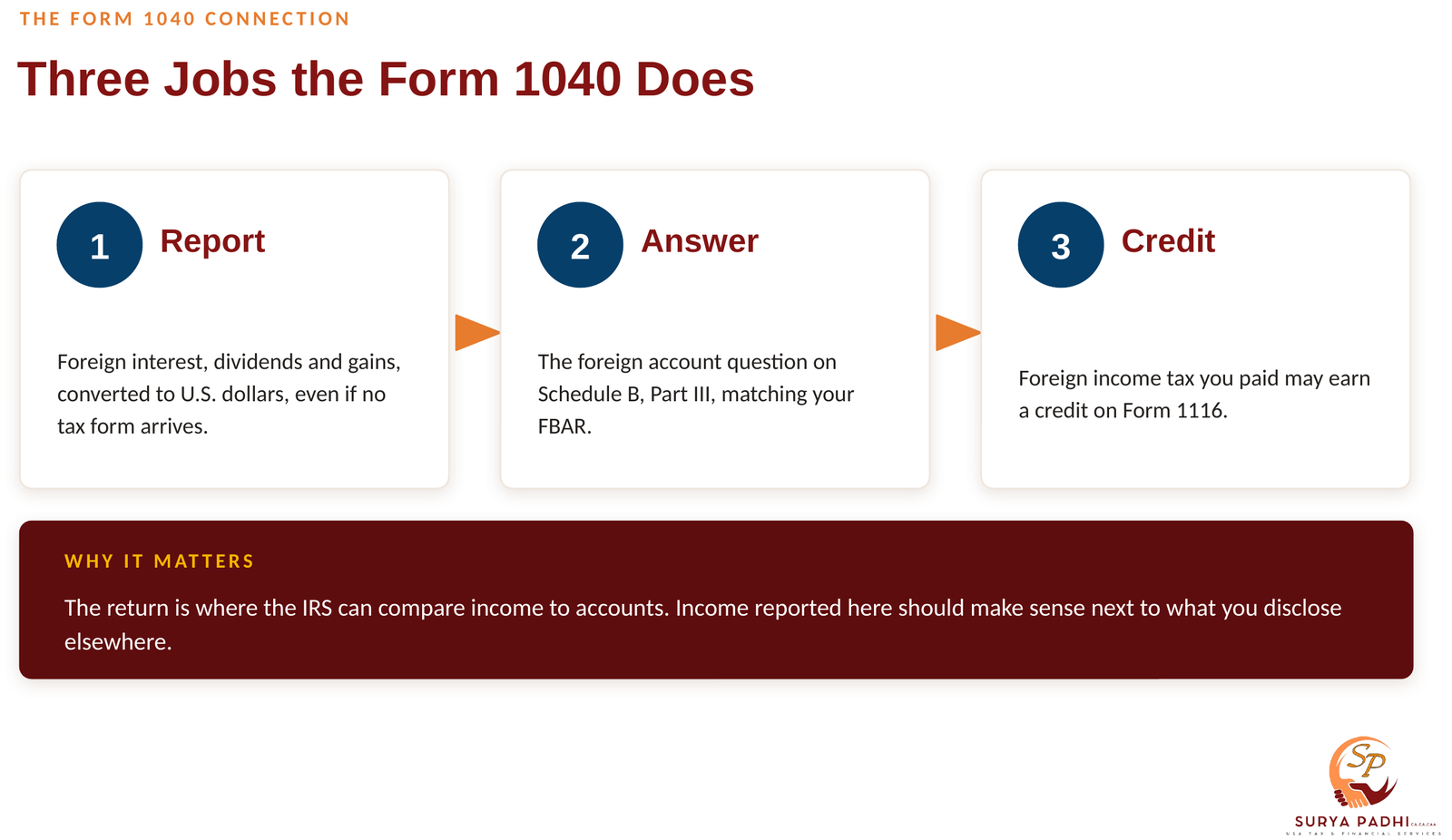
For foreign accounts, your Form 1040 does three jobs. First, it reports the income. Foreign interest, dividends and gains are reported in U.S. dollars whether or not a foreign bank sent you a tax form. Second, it asks the foreign account question on Schedule B, Part III. Third, if you paid income tax to another country on that income, you may be able to claim a credit on Form 1116.
Schedule B, Part III is the bridge
Line 7a asks whether you had a financial interest in, or signature authority over, a financial account located in a foreign country. The instructions tell you to check Yes even if you are not required to file an FBAR. A follow-up question asks whether you are required to file FinCEN Form 114, and line 7b asks you to name the countries if you are. Answer these so they match what your FBAR shows.
Line 8 sits next to them and covers foreign trusts. If you received a distribution from a foreign trust, or were its grantor or a transferor to it, more reporting follows, including Form 3520 in many cases.
How this affects your state tax return
Everything so far is federal. The FBAR goes to FinCEN and Form 8938 goes to the IRS with your return, and neither is filed with a state. The state effect comes through the income. The interest, dividends and gains from your foreign accounts are reported on your Form 1040, and most states then tax that same income on your state return.
| Item | Federal filing | State return |
|---|---|---|
| FBAR (FinCEN 114) | Filed with FinCEN | No state equivalent |
| Form 8938 | Attached to Form 1040 | No state equivalent |
| Foreign interest, dividends and gains | Reported on Form 1040 in U.S. dollars | Generally taxed again by states that have an income tax |
| Foreign income tax paid | May earn a credit on Form 1116 | Many states give no credit, or limit it |
| Federal exclusions and elections | Follow federal rules | Some states do not follow them |
Most states start from your federal adjusted gross income, so foreign income that is on the federal return flows straight through. Some states, New Jersey among them, build their own income categories instead, but foreign interest, dividends and gains are generally taxable there as well. States with no income tax, such as Texas and Florida, are the exception.
The credit is where people get caught. The Form 1116 credit for foreign tax is a federal credit, and a state does not simply copy it. Where a state allows no credit, the same income can be taxed by the foreign country, by the federal government and by your state. Some states also do not follow federal exclusions such as the foreign earned income exclusion, and California is the best-known example. Check your own state’s instructions before you assume a federal position carries over.
Moving abroad does not always end state residency
Your state can keep treating you as a resident if you stay domiciled there, for example by keeping a home, a driver’s license or voter registration. Settle that question before you file, because it decides whether your foreign income is taxed by the state at all.
Two habits keep the state side clean. Report the same foreign income on the state return that appears on the federal return, so the figures agree. And if the IRS changes your federal return, most states require you to report that change to them as well.
Where the thresholds differ
The FBAR has one test. You must file when the combined value of your foreign financial accounts exceeds $10,000 at any time during the calendar year and you have a financial interest in, or signature authority over, them. There are no tiers by filing status or residence. Form 8938 does use tiers.
| Filing status and residence | Last day of the year | Any time during the year |
|---|---|---|
| Single, living in the U.S. | More than $50,000 | More than $75,000 |
| Married filing jointly, living in the U.S. | More than $100,000 | More than $150,000 |
| Single, living abroad | More than $200,000 | More than $300,000 |
| Married filing jointly, living abroad | More than $400,000 | More than $600,000 |
Form 8938 is attached to your tax return, so it follows the return’s due date including extensions, and you file it only if you are required to file a return for the year. It also reaches further than the FBAR, because it covers certain foreign assets held outside an account. The IRS is explicit that Form 8938 does not replace the FBAR. You check each form’s requirements, and you may owe both.
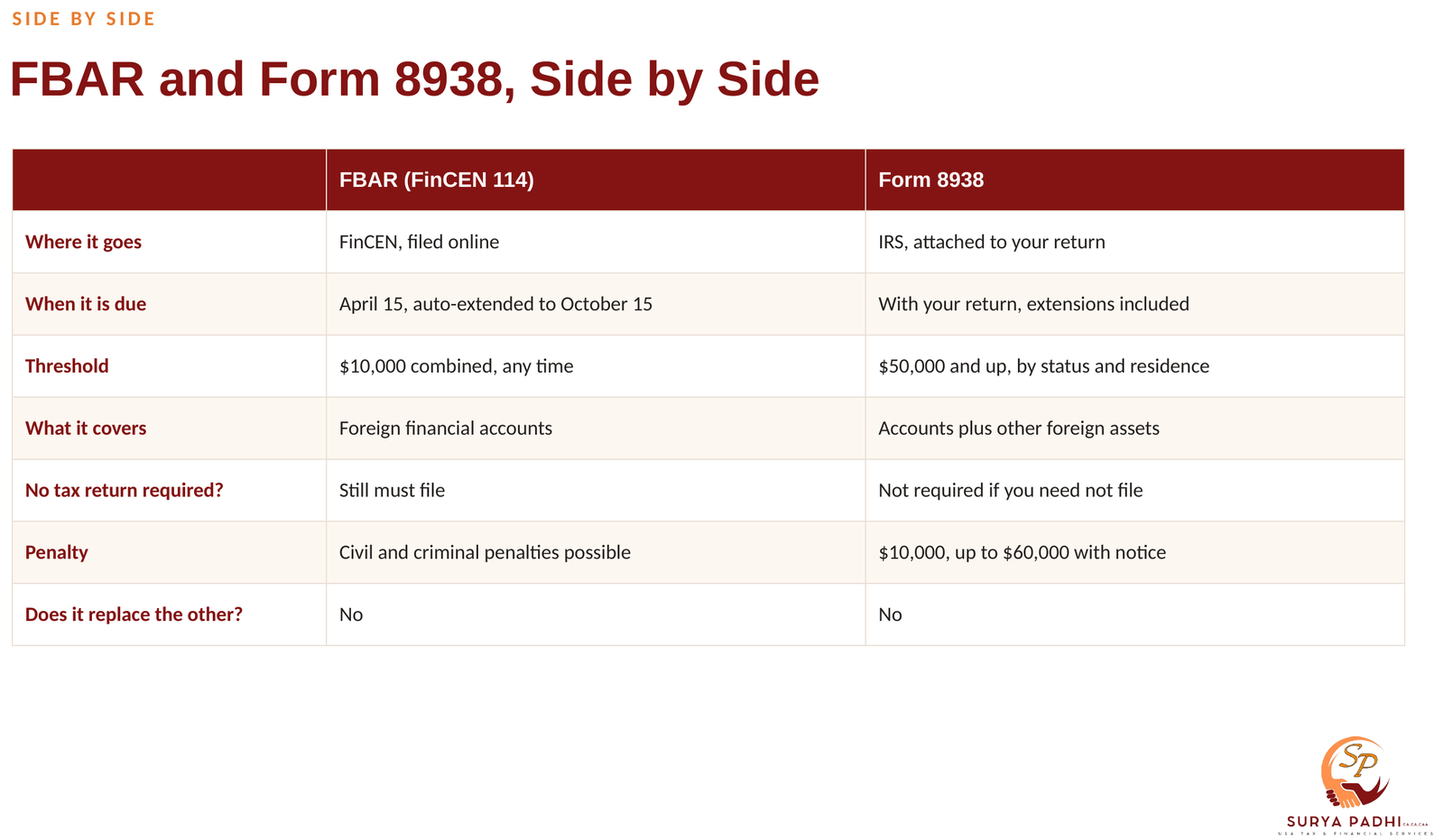
The stakes differ too. The IRS describes a $10,000 penalty for failing to file Form 8938, with additional penalties if you keep failing to file after IRS notice, up to a maximum of $60,000. FBAR civil penalties are set by statute and adjusted each year for inflation, and they are higher for willful violations than for non-willful ones. Check the current amounts before relying on any number, and do not assume a small account means a small risk.
Worked example (illustrative): two accounts at an Indian bank
| Savings account, highest balance | $4,200 |
| Fixed deposit, highest value | $9,500 |
| Combined | $13,700 |
| FBAR line | $10,000 |
| Form 8938 line (single, living in the U.S.) | $50,000 at year-end |
Result: an FBAR is required and Form 8938 is not, on these facts. Schedule B, Part III is answered Yes, with India named on line 7b, and the interest from both accounts goes on the Form 1040 in U.S. dollars. The figures are illustrative, not advice.
Some assets bring their own forms
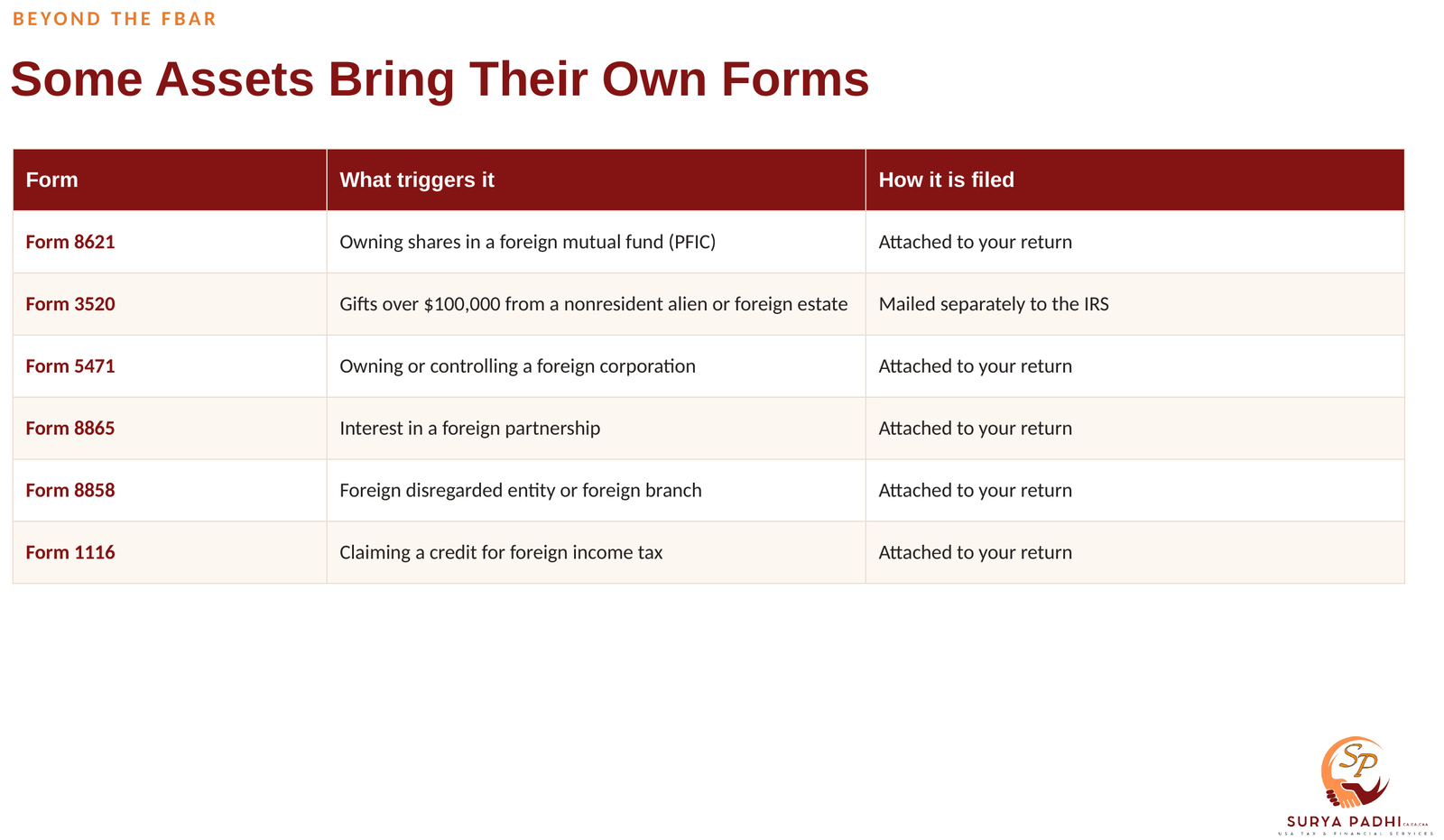
Certain assets carry forms of their own, in addition to the FBAR rather than instead of it.
| Form | What triggers it | How it is filed |
|---|---|---|
| Form 8621 | Owning shares in a foreign mutual fund (a PFIC) | Attached to your return |
| Form 3520 | Gifts over $100,000 from a nonresident alien or foreign estate, or foreign trust activity | Mailed separately to the IRS |
| Form 5471 | Owning or controlling a foreign corporation | Attached to your return |
| Form 8865 | Interest in a foreign partnership | Attached to your return |
| Form 8858 | Foreign disregarded entity or foreign branch | Attached to your return |
| Form 1116 | Claiming a credit for foreign income tax | Attached to your return |
A U.S. person who owns shares in a passive foreign investment company, which includes many foreign mutual funds, files Form 8621 with the return when certain events occur, such as a distribution, a gain on disposition or an election, or when the annual reporting requirement applies. The IRS instructions say annual reporting is not required if the shareholder’s PFIC stock is worth $25,000 or less ($50,000 or less for joint filers) and no excess distribution or gain occurs.
Form 3520 is required for more than $100,000 in gifts or bequests from a nonresident alien individual or foreign estate, and for certain foreign trust transactions. Its due date is the 15th day of the fourth month after the year ends, with an extension to October 15, and the IRS instructions direct you to mail it separately to Ogden, Utah, not with your return.
Five mistakes behind most problems
- Assuming the return filed the FBAR. They go to different agencies through different systems.
- Reporting only the year-end balance. FinCEN’s instructions ask for a reasonable approximation of the greatest value in the account during the calendar year, rounded up to the next whole dollar.
- Using the wrong exchange rate. The instructions call for the Treasury Financial Management Service rate for the last day of the calendar year.
- Leaving out accounts that earn nothing, or accounts you only sign on. Signature authority alone can create a reporting obligation.
- Forgetting the forms tied to foreign funds, entities and gifts.
Joint accounts deserve a note. A spouse who has only jointly owned accounts to report can skip a separate FBAR if the filing spouse timely files an electronically signed FBAR reporting those accounts and both spouses have signed Form 114a, which you keep in your records. If those conditions are not met, each spouse files separately and reports the full value of the joint accounts.
Keep the numbers aligned
The same account appears on several filings. Numbers that disagree between them invite questions, so build one account list and use it for every form.
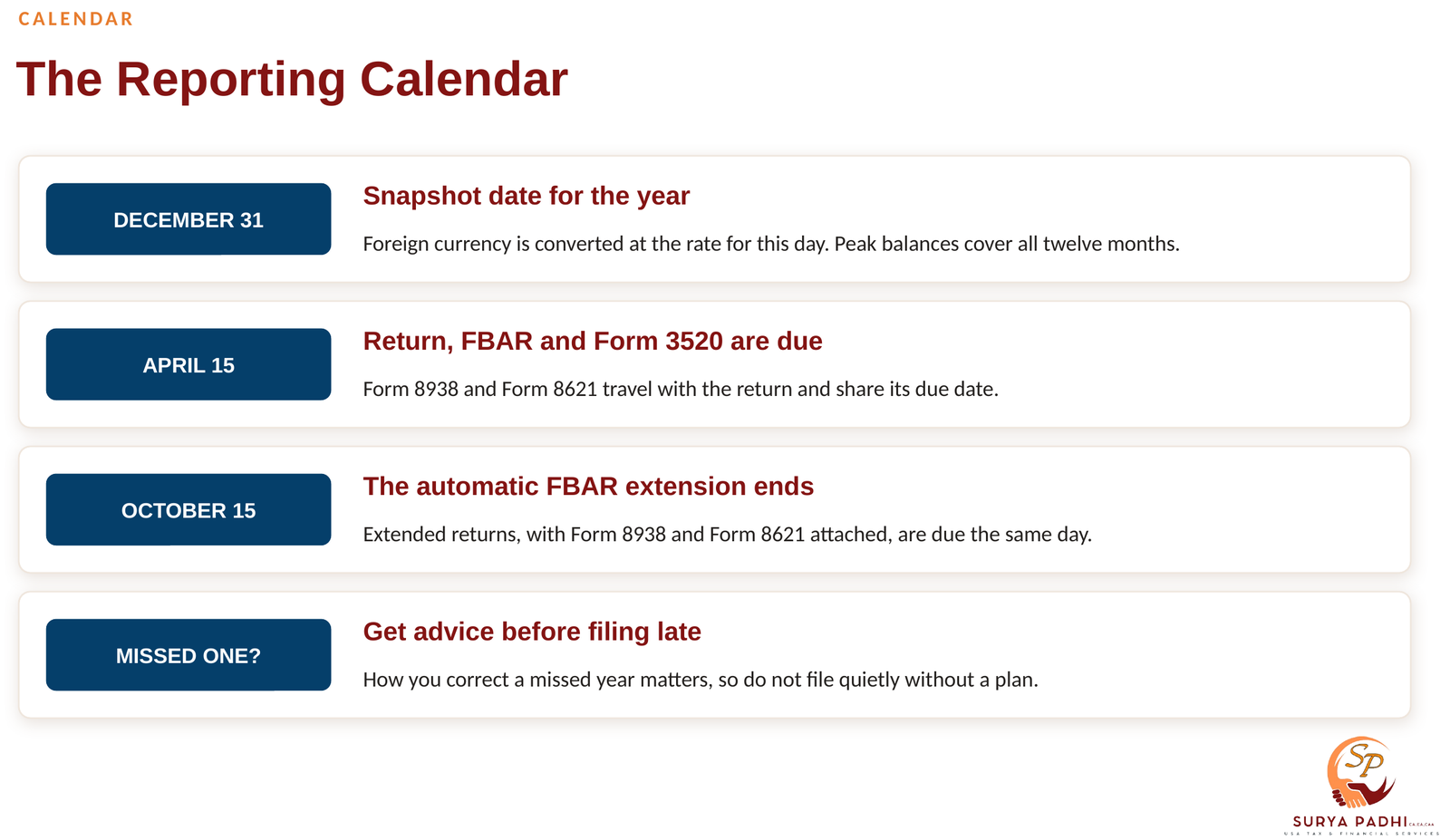
The reporting calendar
- December 31: the snapshot date. Foreign currency is converted at the rate for this day, and peak balances cover all twelve months.
- April 15: your return and your FBAR are due, along with Form 3520. Form 8938 and Form 8621 travel with the return and share its due date.
- October 15: the automatic FBAR extension ends, and an extended return with its attached forms is due the same day.
- If you missed a year: get advice before filing anything late. How you correct a missed year matters.
A four-step yearly routine
- List every foreign account: the institution, the country, the account number, and whether you own it or only sign on it.
- Record each account’s peak balance for the year and convert it to U.S. dollars.
- Run the three tests in order: Schedule B, Part III, then the FBAR, then Form 8938.
- File each form in its own place: the return and attachments to the IRS, the FBAR to FinCEN, and Form 3520 mailed separately.
Done once a year with your statements in hand, this is far easier than rebuilding several years at once. If your situation includes foreign funds, companies or gifts, add those forms to the same routine and review them together.
Frequently asked questions
Is the FBAR filed with my tax return?
No. The FBAR is filed electronically with FinCEN through the BSA E-Filing System, not with your federal tax return. Your Form 1040 is filed with the IRS, so filing one does not file the other.
Do I need to file both the FBAR and Form 8938?
Possibly. The two forms have different thresholds and different definitions, and filing Form 8938 does not replace the FBAR. Some accounts appear on both forms and some on only one, so you test each form separately.
What is the FBAR threshold and when is it due?
You must file when the combined value of your foreign financial accounts exceeds $10,000 at any time during the calendar year. The FBAR is due April 15, with an automatic extension to October 15 that you do not need to request.
Do I check Yes on Schedule B if I do not have to file an FBAR?
Yes, if you had a financial interest in or signature authority over a foreign financial account at any time during the year, even if you are not required to file FinCEN Form 114. The second question and the country list apply only if you must file.
Do I file an FBAR with my state?
No. The FBAR is filed only with FinCEN, and Form 8938 is filed only with the IRS. No state has an equivalent form, but the income your foreign accounts earn is reported on your federal return and usually carries into your state return.
Is foreign income taxed on my state tax return?
Generally yes, if your state has an income tax and you are a resident of it. Most states start from federal adjusted gross income, so foreign interest, dividends and gains flow through. Many states give little or no credit for tax paid to another country, so check your state’s rules.
Want your foreign accounts mapped before the next deadline?
We prepare your return and the related foreign reporting forms together, so the numbers agree from form to form.
This article is general tax education and does not constitute individualized tax, legal or financial advice. Figures are stated for the tax year shown and are subject to IRS adjustment. Consult a qualified professional about your own facts. Surya Padhi holds the Indian Chartered Accountant qualification but is not licensed to practise in India and does not provide Indian tax filing or advisory services.