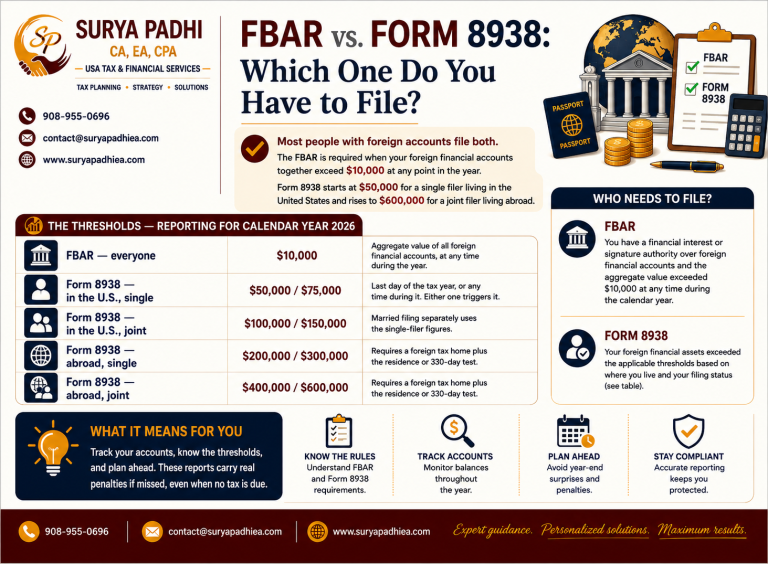

Yes, usually. A US citizen who inherits real property in India from a nonresident alien parent takes a basis equal to its value on the date of death, under Revenue Ruling 84-139 and section 1014. India still uses your mother’s original cost, and an inheritance over $100,000 must be reported on Form 3520.
6:55. The written version, the figures and the sources are all below.
| Your basis | Date-of-death value | Section 1014(a)(1): fair market value when your mother died, converted to dollars on that date. |
|---|---|---|
| Form 3520 trigger | $100,000 | Gifts or bequests above this from a nonresident alien individual or foreign estate must be reported. |
| Late-reporting penalty | 5% a month | Of the amount received, capped at 25% in total. |
| Standard due date | April 15 | Of the year after receipt. June 15 abroad; October 15 with an extended return. |
| Holding period | Long-term | Sell within one year of her death and section 1223(9) treats you as holding more than one year. |
The IRS resets your cost to the day she died. India keeps her original cost. And Form 3520 may be due even though nothing is taxed.
You inherit your mother’s flat in Pune. She lived in India, she was not a US citizen or green card holder, and you are a US taxpayer. Before anyone talks about selling, one question decides your tax bill: what is your cost? The step-up in basis on inherited property in India is the rule that answers it, and for most heirs it is good news.
The catch is that two countries look at the same flat and start from two different numbers. The United States resets your cost to what the flat was worth on the day she died. India generally keeps her original cost. This article walks through the US side: the rule, the paperwork that supports it, the sale, and the one form you may owe even though the inheritance itself is not taxed. The Indian filing stays with a Chartered Accountant in India.
Key takeaways
- A US citizen who inherits foreign real property from a nonresident alien gets a step-up in basis (Revenue Ruling 84-139).
- Your basis is the flat’s fair market value on the date she died, converted to dollars on that date.
- India generally uses your mother’s original cost, so the Indian gain and the US gain are different numbers.
- An inheritance over $100,000 from a nonresident alien must be reported on Form 3520. Missing it costs 5% a month.
The short answer: yes, if she wasn’t a US person and you are
Section 1014(a)(1) of the Internal Revenue Code sets the basis of inherited property at its fair market value on the date of death. Section 1014(b)(1) says property acquired by bequest, devise or inheritance counts. That is the whole step-up, and it means the gain that built up while your mother owned the flat drops out of your US calculation.
The usual worry is whether land in India counts, since it never enters the US estate. Revenue Ruling 84-139 answers it directly. It holds that foreign real property inherited by a US citizen from a nonresident alien receives a step-up under section 1014, even though the property is not included in the decedent’s US gross estate.
Read the ruling’s facts before you rely on it
The ruling speaks of a US citizen heir and a nonresident alien decedent. If you hold a green card, the same section 1014 language applies to your acquisition, but the ruling does not mention you, so we confirm the facts first. If your mother was a US citizen or green card holder, different estate rules come into play. Talk to us before you sell.
What the step-up is worth: a worked example
Here is the arithmetic with illustrative numbers. Your mother bought the flat decades ago for the dollar equivalent of $20,000. On the day she died it was worth $180,000. You later sell it for $190,000.
Illustrative: the same flat, two routes
| Your mother’s original cost (USD equivalent) | $20,000 |
| Value on the date she died | $180,000 |
| Sale price | $190,000 |
| US gain if the flat passed by inheritance | $10,000 |
| US gain if she gifted it to you in her lifetime | $170,000 |
| Federal tax at an assumed 15%: inherited vs gifted | $1,500 vs $25,500 |
Assumed rate, for illustration only. Excludes state tax, the net investment income tax and currency effects.
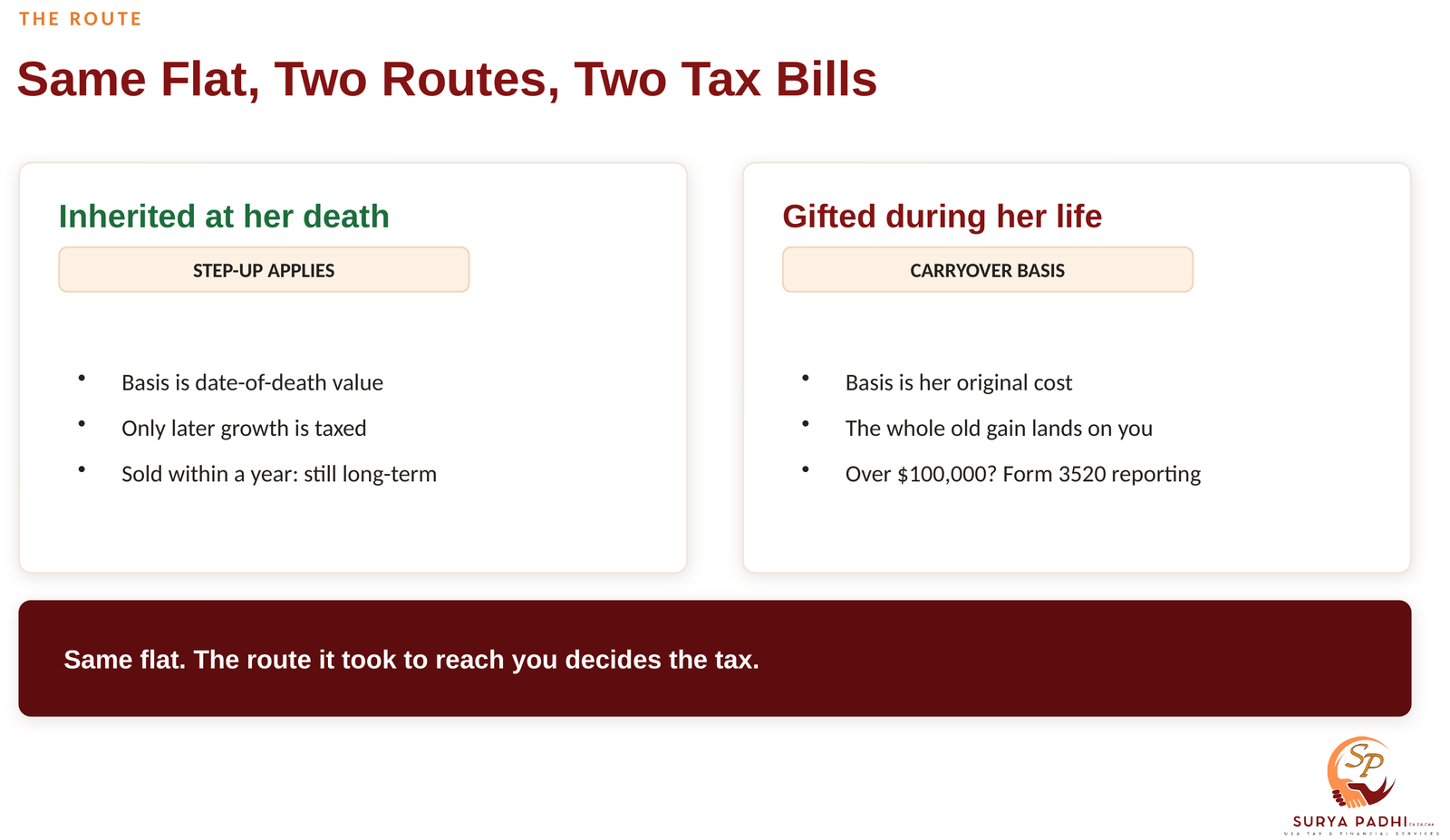
The gift route matters because gift deeds are common in Indian family transfers. Property she gave you while she was alive generally keeps her original cost in your hands. Ask what the deed says before you assume you inherited.
Step-up in basis for inherited property in India: building the value
The step-up only helps if you can prove the number, and an Indian flat rarely comes with a US-style appraisal. You build the file yourself.
- Collect the papers: the death certificate, the will or legal heir documents, and the registered deed. They fix the date and show how the flat reached you.
- Get a written valuation from an independent valuer, dated to the day she died.
- Support it with registered sale deeds of comparable flats nearby. Government guideline values are a data point, not a substitute.
- Convert the rupee value to dollars at the exchange rate on the date of death, and keep a record of where the rate came from.
- Keep the whole file until well after you sell.
The test is fair market value on the date she died. A listing price, a broker’s phone estimate or today’s value pushed back in time will not hold up, and neither will her original purchase price. That number is India’s starting point, not ours.
Which exchange rate, and when
In our work, basis is converted at the rate on the date of death and sale proceeds at the rate on the date of sale. Because the dates differ, a stronger or weaker rupee can create or shrink a dollar gain that does not exist in rupees. Pick a documented source for the rate, apply it consistently, and keep a printout.
Where the step-up stops: India still uses her cost
Section 49 of India’s Income-tax Act, 1961 treats a flat that comes to you by inheritance as having the cost your mother paid for it, plus improvements. That is the opposite of a step-up. Indian tax is computed on that gain in rupees. Your India CA will confirm the current section number and rules, and the Indian filing is theirs to prepare.
| United States | India | |
|---|---|---|
| Starting cost | Date-of-death value | Your mother’s cost plus improvements |
| Who sets it | Fair market value, in dollars | Previous owner’s cost, in rupees |
| Receiving the flat | Not income; may need Form 3520 | Ask your India CA |
| Gain on sale | Capital gain on your Form 1040 | Capital gain under Indian law |
| Tax already paid | Credit for Indian tax, Form 1116 | Handled on the Indian return |
| Where reported | Form 8949 and Schedule D | Indian return, by your India CA |
On your US return, Indian tax on the gain may qualify for a foreign tax credit on Form 1116, within that form’s limits. Because the Indian tax usually follows the larger gain, it can exceed the US tax on the smaller one, and part of the credit may go unused. This is the point to plan before you sign a sale agreement, not after.
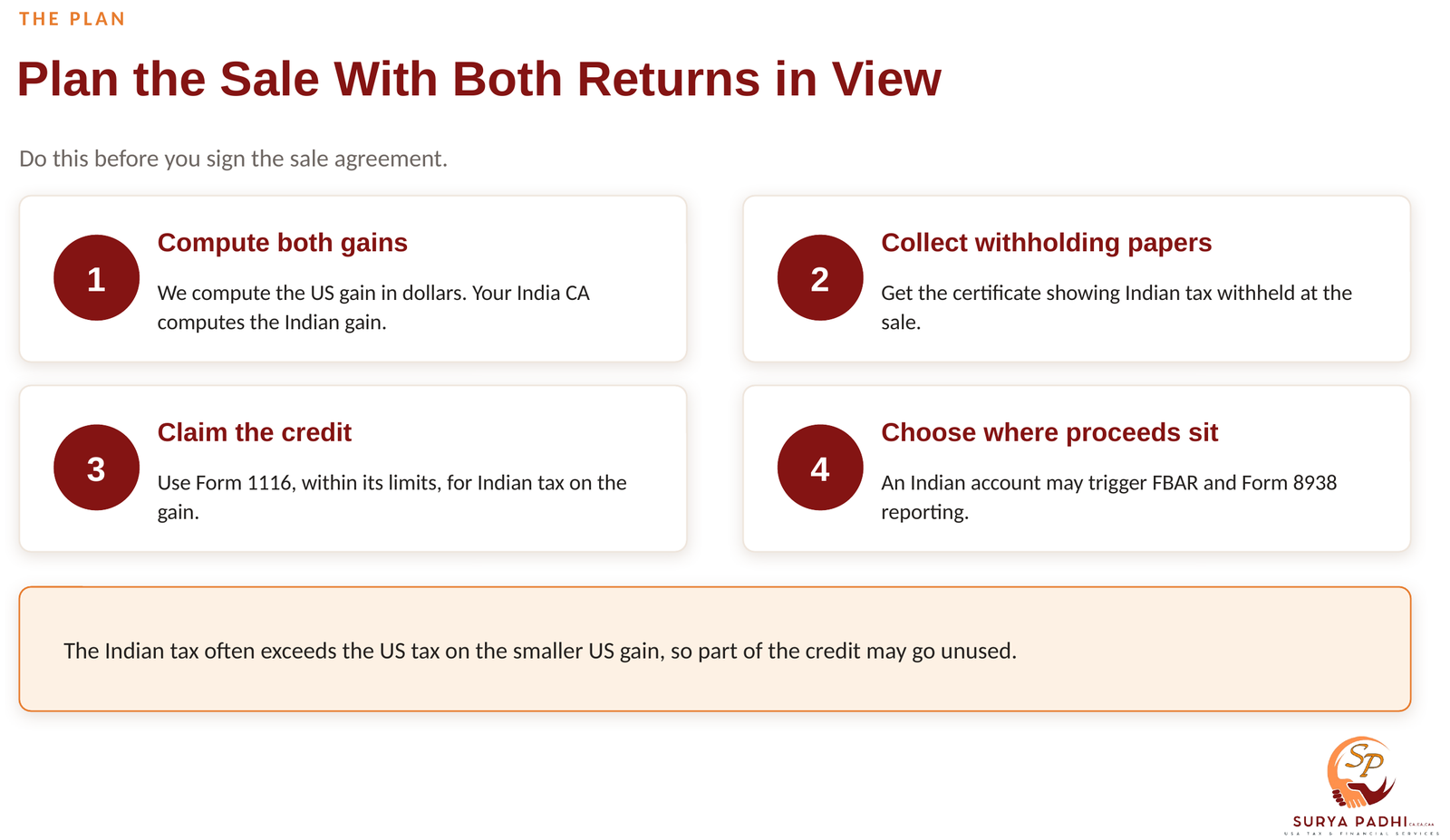
The mismatch to plan for
Two gains, two returns. The step-up lowers your US tax but does not change the Indian computation. Proceeds that land in an Indian bank account may also trigger FBAR and Form 8938 reporting.
Form 3520: nothing is taxed, but you may still have to report
An inheritance is not income to you under section 102(a), so the flat itself creates no US tax. It can still create a reporting duty. If you receive more than $100,000 from a nonresident alien individual or a foreign estate, Part IV of Form 3520 asks you to report it. Gifts from related foreign persons count toward the threshold.
| Rule | What the instructions say |
|---|---|
| Trigger | More than $100,000 from a nonresident alien individual or foreign estate, including related foreign persons |
| Due date | April 15 after the tax year; June 15 for certain US citizens and residents abroad; October 15 with an extended income tax return |
| Penalty | 5% of the amount for each month the failure continues, capped at 25% in total |
| Where it goes | Mailed to the Ogden, Utah service center listed in the form instructions |
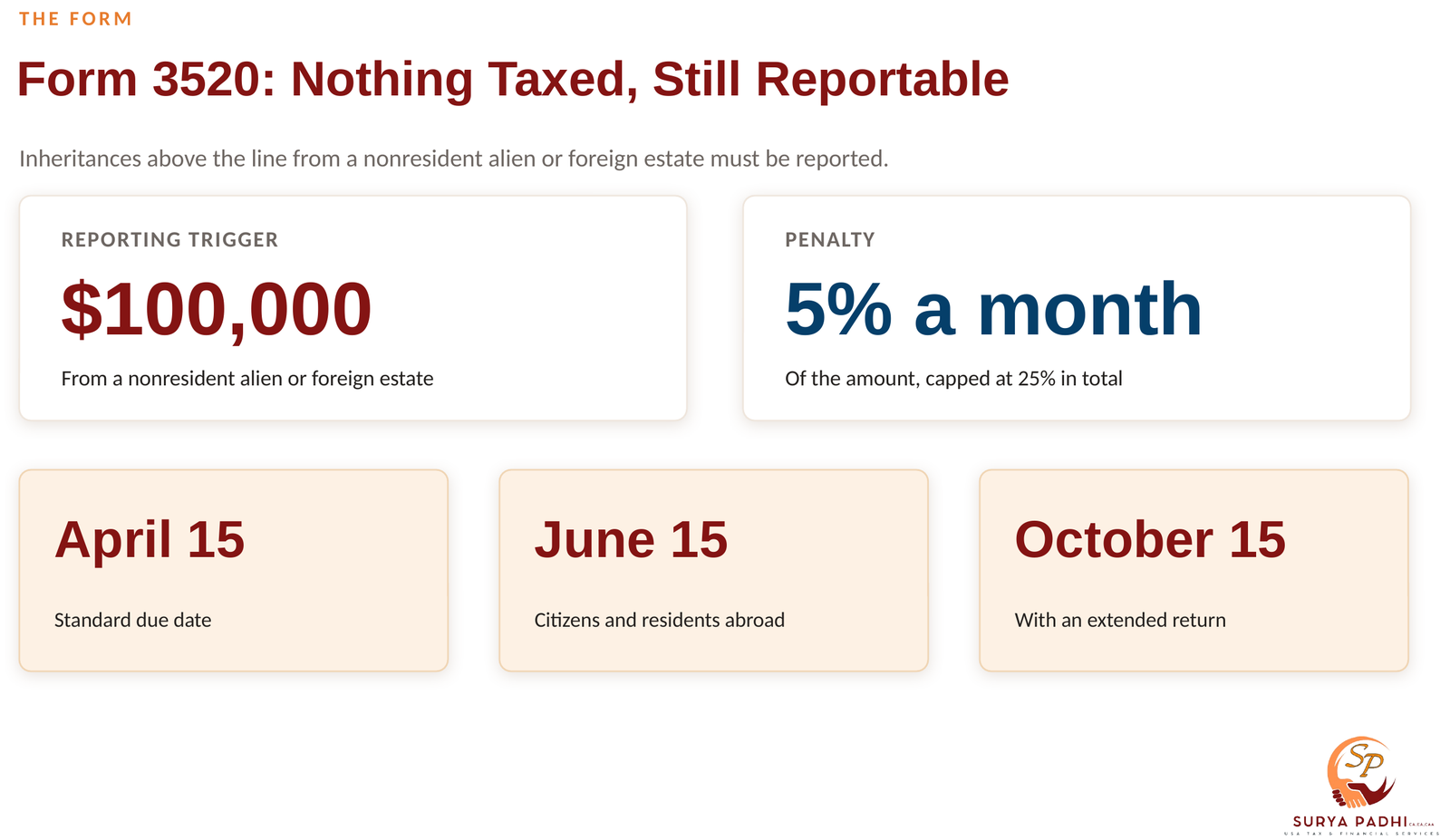
For an inheritance received in 2026, the standard due date is April 15, 2027.
Four ways the step-up gets lost or complicated
- A gift deed in her lifetime. Property she gave you while alive generally keeps her original cost in your hands.
- A share a sibling released. A share a co-heir releases to you reached you from your sibling, not from your mother. We treat it separately and need to see the deed.
- A different decedent. If your mother was a US citizen or green card holder at death, US estate rules can apply. The step-up generally still follows, but the paperwork changes.
- A different heir. Revenue Ruling 84-139 speaks of a US citizen heir. If you hold a green card, we confirm the facts before relying on it.
Frequently asked questions
Do I get a step-up in basis on a house I inherit in India?
Usually yes, if the person who died was a nonresident alien and you are a US citizen. Revenue Ruling 84-139 says foreign real property inherited that way receives a step-up under section 1014, so your basis is its fair market value on the date of death.
Do I have to file Form 3520 for property inherited from my mother in India?
You do if what you received from a nonresident alien individual or foreign estate, including related foreign persons, is more than $100,000. The penalty for failing to report is 5% of the amount for each month, up to 25%.
Is an inheritance from India taxable in the United States?
No, the inheritance itself is not income to you. What is taxable is income the property produces afterward, such as rent, and any gain when you sell. The sale is measured from the stepped-up basis, converted to US dollars.
Does the holding period start over when I inherit property?
If your basis comes from section 1014 and you sell within one year after the death, section 1223(9) treats you as having held the property for more than one year, so the gain is long-term.
Selling an inherited flat in India?
Bring the deed, the succession papers and any valuation. We will compute the US gain, work out the credit for Indian tax and check Form 3520 before you sign a sale agreement.
This article is general tax education and does not constitute individualized tax, legal or financial advice. Figures are stated for the tax year shown and are subject to IRS adjustment. Consult a qualified professional about your own facts. Surya Padhi holds the Indian Chartered Accountant qualification but is not licensed to practise in India and does not provide Indian tax filing or advisory services.