
Tax-loss harvesting means selling a losing investment to offset realized gains, then deducting up to $3,000 of any remaining net loss against ordinary income and carrying the rest forward. The wash sale rule disallows the loss if you or your IRA buy a substantially identical security within 30 days before or after the sale.
6:45. The written version, the figures and the sources are all below.
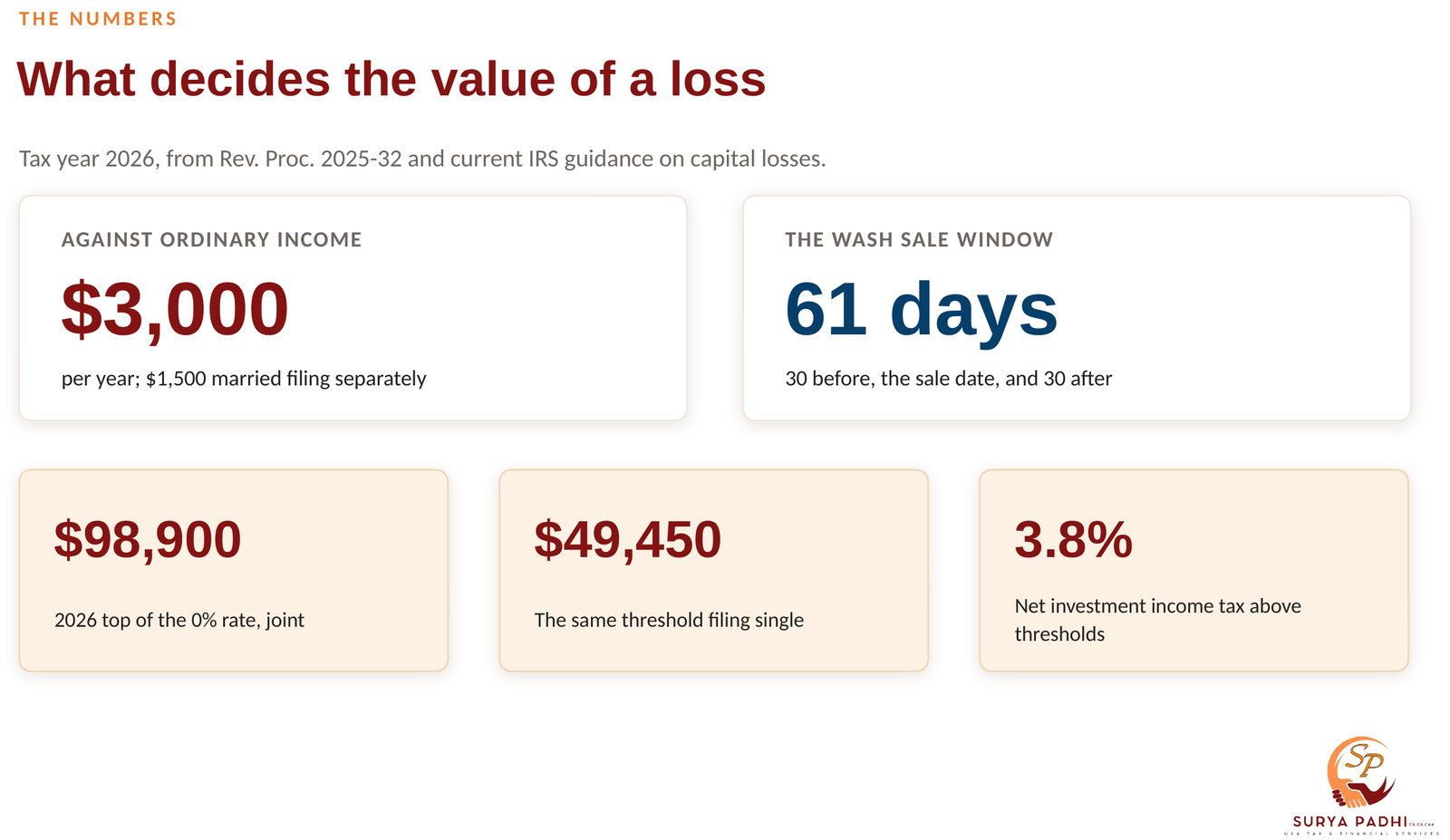
| Ordinary income offset | $3,000 | Per year. $1,500 if married filing separately. |
|---|---|---|
| Loss carryforward | Indefinite | The excess keeps its long-term or short-term character. |
| Wash sale window | 61 days | 30 days before the sale, the sale date, and 30 days after. |
| 0% long-term rate | $98,900 | Taxable income ceiling, married filing jointly. $49,450 single. |
| 20% long-term rate | Above $613,700 | Married filing jointly. Above $545,500 single. |
| Net investment income tax | 3.8% | On top, above $250,000 joint / $200,000 single MAGI. Not indexed. |
A real deduction sitting inside a position you already regret — provided you do not buy it back too soon, and provided your IRA stays out of it.
There is a real deduction sitting inside every position you are down on, and most people never take it. Tax-loss harvesting is the deliberate sale of a losing investment so the loss offsets gains you have already realized — and then, if a loss is still left over, up to $3,000 of it against your ordinary income, with the rest carried forward indefinitely.
The catch is the wash sale rule. Sell a stock at a loss and buy a substantially identical one within 30 days before or after that sale, and the loss is disallowed. Nearly everyone has heard of the thirty days. Two parts get missed constantly: the window runs in both directions, so it is 61 days rather than 30, and it follows you into accounts you may not think of as yours — your spouse’s, and your own IRA, where the consequence is permanent.
Key takeaways
- Losses net against gains by character first, then across, and only $3,000 of what is left touches ordinary income.
- The wash sale window is 61 days: 30 before, the sale date, 30 after.
- A replacement bought inside your IRA disallows the loss and adds nothing to the IRA’s basis — the deduction is gone for good.
- Harvesting is usually deferral, not a discount, because your replacement position carries a lower basis.
What harvesting actually does
A paper loss is worth nothing to you at tax time. Until you sell, the red number on your brokerage statement is invisible to the IRS. Harvesting simply means choosing to sell so the loss becomes real, deductible and usable this year rather than someday.
Be honest about what it is, though. In most cases you are not making the loss disappear — you are moving the tax. Buy something similar to replace the position and your new holding has a lower cost basis, so the gain you avoided today shows up later when you sell that one. That is still genuinely valuable: a dollar of tax deferred is a dollar you keep investing, and the rate you pay later may be lower than the rate you avoid now. It is not free money.
When the deferral becomes permanent
Two situations turn the deferral into a real saving. Sell the replacement in a year when your taxable income sits under the 0% long-term capital gains ceiling and the deferred gain is never taxed. And appreciated assets held until death generally receive a basis adjustment, so it disappears for the heirs.
How losses net, and the $3,000 limit
The netting order is fixed and you do not get to choose it. Long-term losses net against long-term gains, short-term losses against short-term gains, and only after each group is netted internally do the two groups meet each other.
If the result is a net capital loss, you may deduct the lesser of $3,000 — $1,500 if you are married filing separately — or your total net loss against ordinary income. Anything beyond that carries forward indefinitely, keeping its long-term or short-term character. There is no expiry date, but there is no way to accelerate it either: $3,000 a year until you have gains to absorb the rest.
That limit is why harvesting is worth far more when you actually have realized gains. Against gains a loss works dollar for dollar with no cap. Against wages, it trickles.
| Filing status | 0% long-term rate up to | 15% rate up to |
|---|---|---|
| Married filing jointly | $98,900 | $613,700 |
| Single | $49,450 | $545,500 |
| Head of household | $66,200 | $579,600 |
| Married filing separately | $49,450 | $306,850 |
| Estates and trusts | $3,300 | $16,250 |
The 3.8% you may be forgetting
The net investment income tax adds 3.8% on investment income once modified AGI passes $250,000 for joint filers, $200,000 single or head of household, and $125,000 married filing separately. Those thresholds are not indexed for inflation, so more people cross them every year. A harvested loss reduces net investment income too.
Tax-loss harvesting and the wash sale rule
A wash sale happens when you sell a security at a loss and, within 30 days before or after that sale, you buy a substantially identical security, acquire one in a fully taxable trade, or enter into a contract or option to buy one. The disallowed loss is not confiscated — it is added to the basis of the replacement, whose holding period includes the time you held the original. That is why an ordinary wash sale is a timing problem, not a permanent one.
Two things about that window are worth stating precisely. First, it runs in both directions: thirty days before, the sale date itself, and thirty days after adds up to 61 calendar days, not 30. A purchase made three weeks before you decided to harvest can disallow the loss, which routinely surprises people who reinvest dividends automatically. Second, calendar days, not trading days.
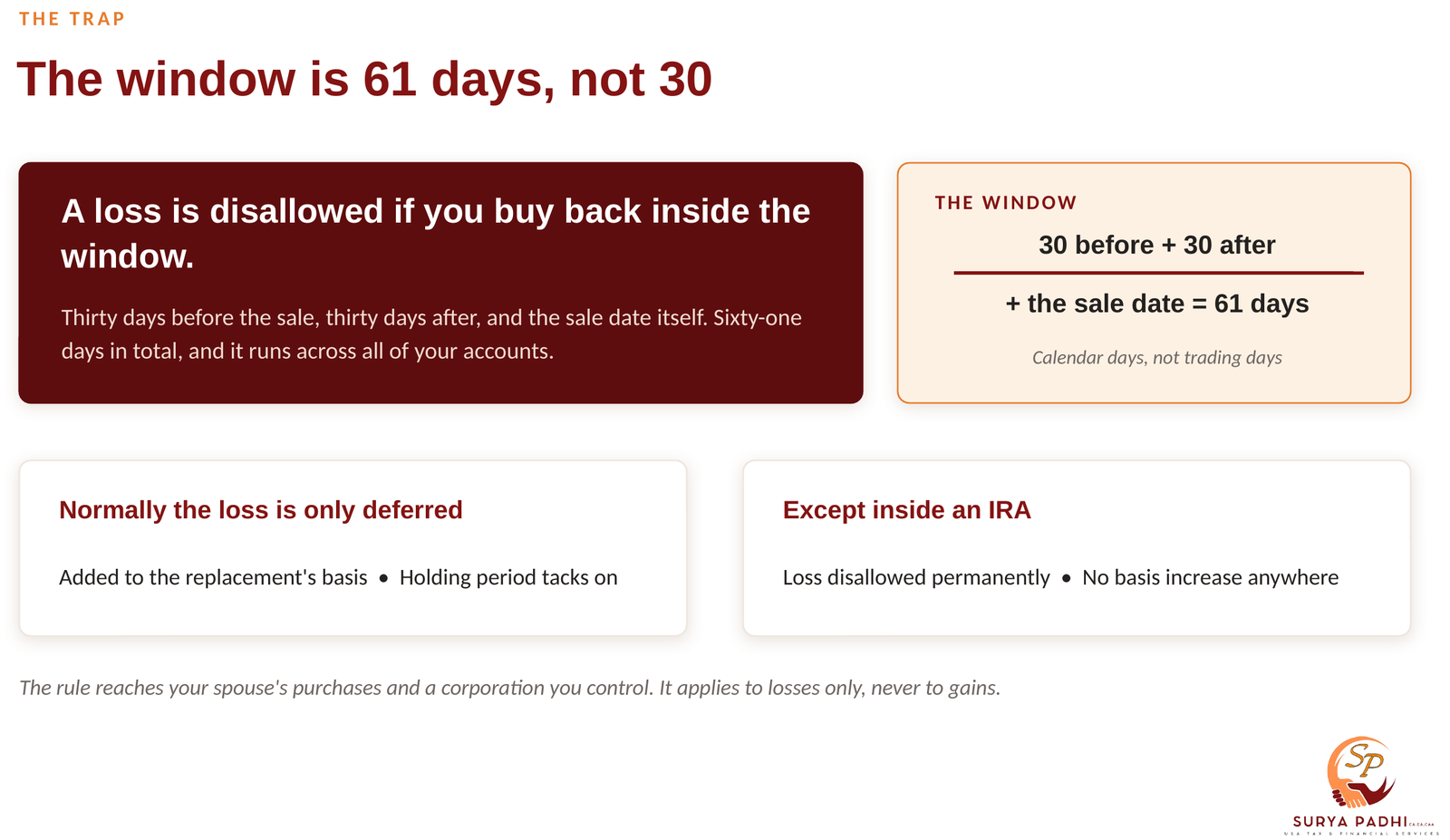
The rule also reaches beyond the account you traded in. A purchase by your spouse, or by a corporation you control, counts as yours. And your broker will not catch most of this: the Form 1099-B instructions require a broker to report a disallowed loss only when the sale and the purchase occur in the same account and involve covered securities with the same CUSIP number. Reporting anything broader is permitted, not required.
Your 1099-B is not the whole answer
The same fund bought at one firm and sold at another will usually produce two clean-looking 1099-Bs and one wash sale nobody flagged. The obligation to identify it is yours. Report a disallowed loss on Form 8949 with adjustment code W.
“Substantially identical” is a judgment call, not a formula
This is the part of the rule where confident answers should make you suspicious. The Code does not define the phrase, and the guidance that exists settles the easy end of the range, not the hard one.
What is reasonably clear: Publication 550 states that stocks or bonds of one corporation are generally not substantially identical to those of another corporation. Selling one bank’s shares and buying a different bank’s shares is not a wash sale, even though the two move together. And the rule applies to losses only — selling at a gain and buying straight back is not a wash sale.
What is not clear: whether two funds tracking the same index are substantially identical. Two S&P 500 index funds from different sponsors hold the same 500 companies in the same weights and are built to produce the same return. No regulation, revenue ruling or court decision squarely answers that. The widely held practitioner view is that different issuers make them different securities, and many people harvest that way every December. That view is not a rule, and anyone who tells you the swap is definitively safe is giving you an opinion.
The way around the uncertainty
If it is a position you want to stay invested in, switch to a fund tracking a genuinely different index — a total-market fund in place of an S&P 500 fund, or a large-cap fund built on another methodology. The exposure is close enough for a month, and the question never has to be argued.
The IRA mistake that destroys the loss for good
There is one version of the wash sale rule that is not a deferral at all, and it is the most expensive mistake in this topic.
Publication 550 lists acquiring substantially identical stock for your individual retirement account or Roth IRA as a trigger for a wash sale. Revenue Ruling 2008-5 addresses exactly this: an individual sells stock at a loss in a taxable account and, the next day, directs his IRA to buy the same stock. The IRS held that the loss is disallowed under section 1091, and that the individual’s basis in the IRA is not increased by virtue of section 1091(d).
Read that second half carefully. In an ordinary wash sale the disallowed loss attaches to the basis of the replacement shares, so you recover it eventually. Inside an IRA there is no basis to attach it to. The deduction is not deferred — it is gone permanently, and nothing in the IRA distribution rules gives it back.
Automatic investing is how this happens
Almost nobody does this on purpose. It happens because a monthly IRA contribution buys the same fund on a schedule, and one of those purchases lands inside the 61-day window around a taxable-account harvest. Check the IRA’s buy schedule before you sell, not after.
A worked example, start to finish
An investor filing single has already realized $12,000 of short-term gains and $8,000 of long-term gains in 2026. She also holds an ETF, owned three years, that is down $30,000. She sells it in December and buys a fund tracking a different index the same day. Assume a 24% bracket, 15% on long-term gains, and modified AGI below the net investment income tax threshold.
Netting the $30,000 loss
| Long-term gains realized | $8,000 |
| Less the harvested long-term loss | ($30,000) |
| Net long-term loss | ($22,000) |
| Net short-term gain | $12,000 |
| Net capital loss for 2026 | ($10,000) |
| Deducted against ordinary income | ($3,000) |
| Carried forward to 2027 | $7,000 |
Every dollar is accounted for: $8,000 against long-term gains, $12,000 against short-term gains, $3,000 against wages, $7,000 carried forward. That is the full $30,000.
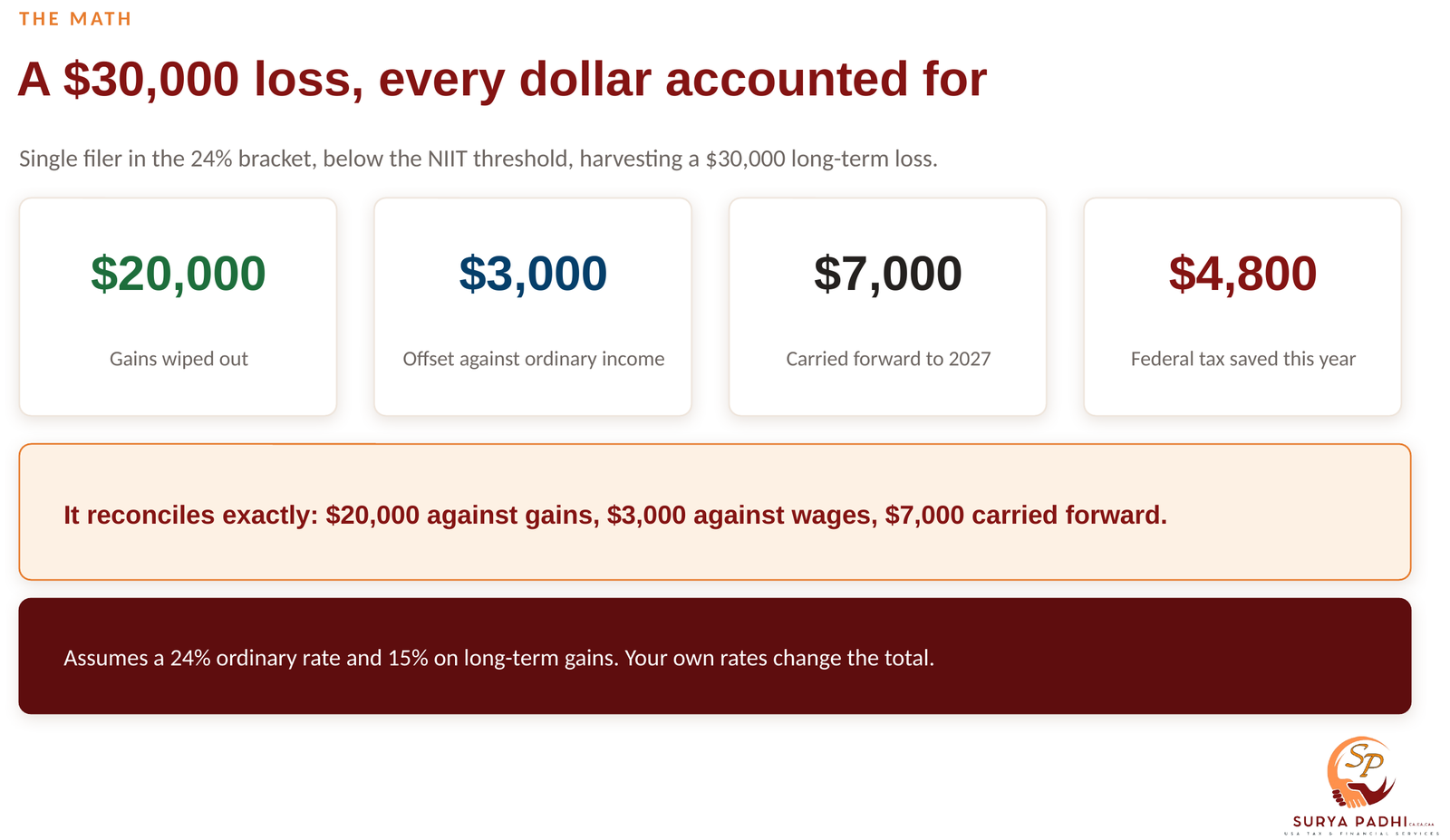
Now the tax. Without harvesting she would have paid 15% on the $8,000 of long-term gain, which is $1,200, and 24% on the $12,000 of short-term gain, which is $2,880 — $4,080 in total. With the harvest, both of those go to zero, and the $3,000 offset against ordinary income saves another $720 at 24%. Her 2026 federal tax falls by $4,800, and she still has $7,000 of long-term loss waiting for next year.
One honest caveat on that $4,800. Her replacement fund carries a basis $30,000 lower than the position she sold, so a chunk of this reappears whenever she sells it. She has bought time, plus the chance that the eventual rate is lower.
Doing it properly in December
Harvesting is a year-end job, but the review that makes it work belongs in November, while there is still room to move.
- Pull your realized gains for the year first. Their size determines what a loss is worth.
- Check every account you and your spouse control, including IRAs, for scheduled purchases inside the window.
- Turn off dividend reinvestment on the position you intend to sell, and look back 30 days.
- Sell by December 31 — the trade date governs for stocks, not settlement.
- Replace it with a fund tracking a different index, not a near-twin.
- Report each disallowed loss on Form 8949 with code W, whatever the 1099-B shows.
New Jersey does not follow this
New Jersey does not allow a net capital loss to offset other categories of income, and it permits no carryforward to another year. A harvest with a clean federal result can produce nothing on the NJ-1040. Check your own state before assuming the federal answer carries over.
Frequently asked questions
How long do I have to wait before buying the stock back?
Thirty-one days after the sale. The disallowance period runs 30 days before the sale, the sale date itself, and 30 days after — 61 calendar days in total. A purchase on day 30 after the sale is still inside the window; day 31 is outside it. Remember the window also runs backwards, so a purchase made in the 30 days before you sell can disallow the loss too.
Can I sell an S&P 500 fund at a loss and buy a different company’s S&P 500 fund?
Many people do, and the common practitioner view is that funds from different sponsors are different securities. But there is no regulation, revenue ruling or court decision that squarely answers whether two funds tracking the identical index are substantially identical, so nobody can tell you it is definitively safe. If you want the question not to arise, move to a fund tracking a different index instead.
Does the wash sale rule apply to my IRA?
Yes, and this is the worst version of it. Publication 550 treats a purchase of substantially identical stock for your IRA or Roth IRA as triggering a wash sale on a loss you realized in a taxable account. Revenue Ruling 2008-5 holds that the loss is disallowed and the IRA’s basis is not increased. Unlike an ordinary wash sale, the deduction is lost permanently rather than deferred.
Will my broker tell me if I have a wash sale?
Only sometimes. The Form 1099-B instructions require a broker to report a disallowed loss when the sale and the repurchase happen in the same account and involve securities with the same CUSIP number. Brokers may report more than that but are not required to. Purchases in a second account, at another firm, in your spouse’s account or inside an IRA are on you to identify.
Does a wash sale apply if I sell at a gain?
No. The rule disallows losses only. If you sell a position at a gain and buy it straight back the same day, the gain is fully taxable and the repurchase changes nothing. That asymmetry is also what makes gain harvesting a separate strategy: realizing gains deliberately in a year when your taxable income is under the 0% long-term threshold and buying back immediately is permitted.
Work out what a loss is actually worth to you
What a harvested loss saves depends entirely on the gains and the bracket it lands against. The income tax projection tool runs your 2026 numbers so you can size the harvest before December, not after.
This article is general educational information, not individualized tax or investment advice. Figures cited are subject to IRS adjustment. Consult a qualified professional about your own facts.