
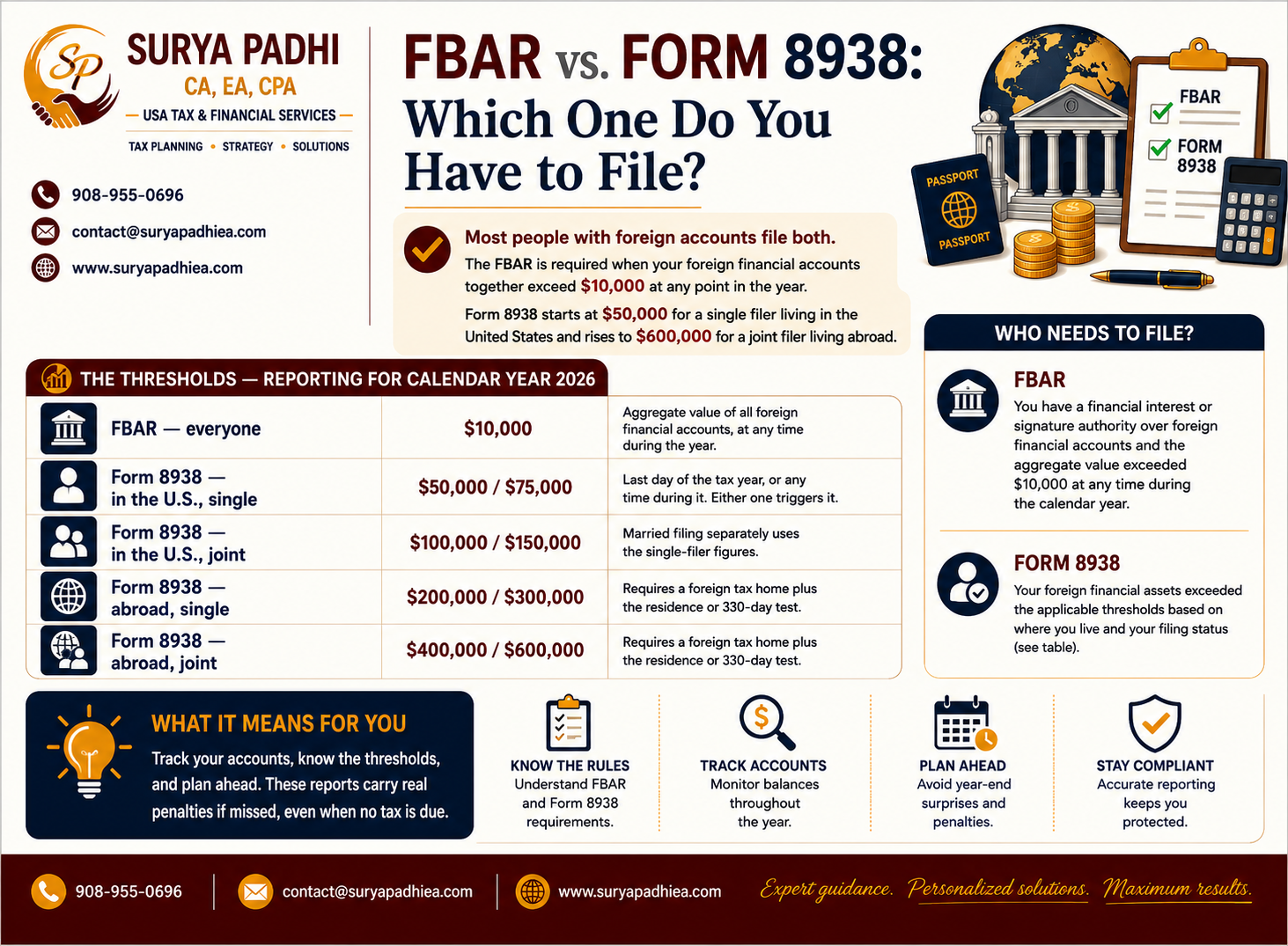
FBAR vs. Form 8938: Which One Do You Have to File?
Most people with foreign accounts file both. The FBAR is required when your foreign financial accounts together exceed $10,000 at any point in the year. Form 8938 starts at $50,000 for a single filer living in the United States and rises to $600,000 for a joint filer living abroad.
7:40. The written version, the figures and the sources are all below.
| FBAR — everyone | $10,000 | Aggregate value of all foreign financial accounts, at any time during the year. |
|---|---|---|
| Form 8938 — in the U.S., single | $50,000 / $75,000 | Last day of the tax year, or any time during it. Either one triggers it. |
| Form 8938 — in the U.S., joint | $100,000 / $150,000 | Married filing separately uses the single-filer figures. |
| Form 8938 — abroad, single | $200,000 / $300,000 | Requires a foreign tax home plus the residence or 330-day test. |
| Form 8938 — abroad, joint | $400,000 / $600,000 | Married filing separately abroad also uses the single-filer figures. |
| Form 8938 penalty | $10,000 | Plus $10,000 per 30 days after IRS notice, to a $50,000 additional maximum. |
They look like the same report. They come from different laws, go to different places, use different thresholds, and one never excuses the other.
The question of fbar vs form 8938 comes up every spring, and it is almost always framed as a choice. It is not one. They are two separate reports, created by two different statutes, filed in two different places, and filing either one has no effect on whether you owe the other. The IRS says so in plain language in the Form 8938 instructions.
The practical answer for most people with money abroad is that they file both. The FBAR threshold is low enough that a single ordinary savings account can clear it. Form 8938 starts much higher, and where it starts depends on two things: your filing status, and whether you live in the United States or abroad. That produces four pairs of numbers, and mixing them up is the classic error in this area.
Key takeaways
- The FBAR is a Treasury report filed with FinCEN. Form 8938 is a tax form attached to your Form 1040.
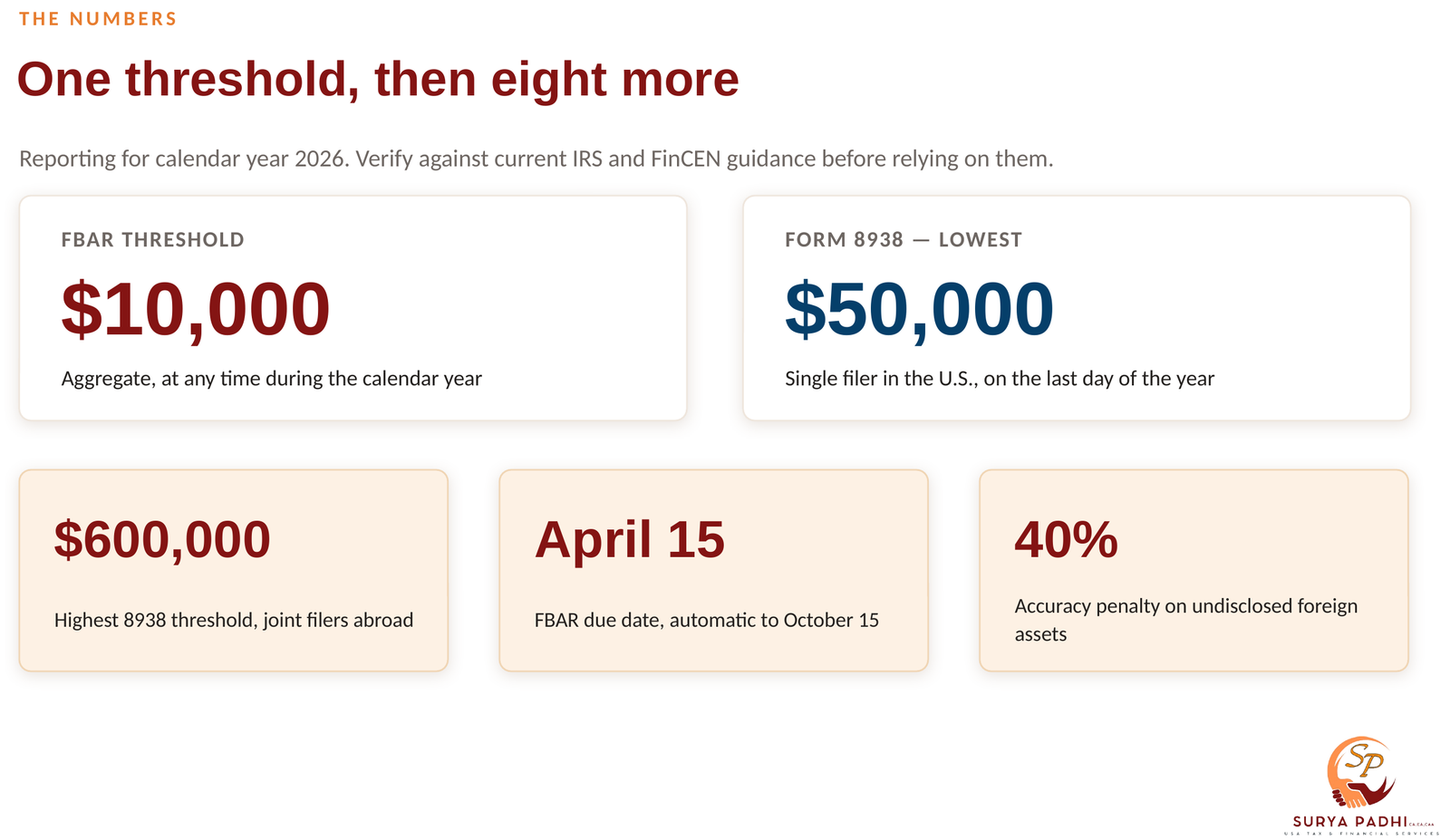
- One threshold governs the FBAR: $10,000 aggregate, at any point in the year, not on December 31.
- Form 8938 has four pairs of thresholds, from $50,000 up to $600,000, set by filing status and where you live.
- Directly held foreign real estate is on neither form. An interest in a foreign company that owns it is on Form 8938.
Two forms, two laws, two agencies
The FBAR comes from the Bank Secrecy Act, not the tax code. It is FinCEN Form 114, filed electronically through FinCEN’s BSA E-Filing System, and it never touches your income tax return. Its purpose is to tell Treasury where American money sits abroad, and whether the account produced any income is irrelevant to whether it must be reported.
Form 8938 comes from FATCA and lives in the Internal Revenue Code. It attaches to your Form 1040 and is due when that return is due, extensions included. If you are not required to file an income tax return at all, you are not required to file Form 8938 — a rule with no FBAR equivalent.
Neither one substitutes for the other
The Form 8938 instructions state it directly: filing Form 8938 does not relieve you of the requirement to file FinCEN Form 114 if you are otherwise required to file it. There is real duplication here, and it is deliberate.
The FBAR: one threshold, and it is low
A U.S. person must file an FBAR if the aggregate value of their foreign financial accounts <strong>exceeded $10,000 at any time during the calendar year</strong>. Read that carefully, because three words in it cause most of the mistakes. <em>Aggregate</em> means you add every account together, not test each one. <em>Any time</em> means the highest point the balances reached, not the December 31 figure. And <em>exceeded</em> means $10,000 exactly is not enough — you need to be over it.
The consequence people find surprising: money moved between two foreign accounts is counted in both. Send $9,000 from a savings account to a fixed deposit and, if both peaked at $9,000, your aggregate is $18,000 and the FBAR is required, even though you never had more than $9,000 abroad.
The FBAR also reaches accounts you do not own. Signature or other authority over a foreign account — an employer’s account, an elderly parent’s account you were added to — is an FBAR filing obligation on its own. There are exceptions, and there is a related-spouse rule: if all your foreign accounts are jointly owned with your spouse, one spouse may file for both using FinCEN Form 114a. Records supporting the report should be kept for five years from the due date.
FBAR vs Form 8938: the four pairs of thresholds
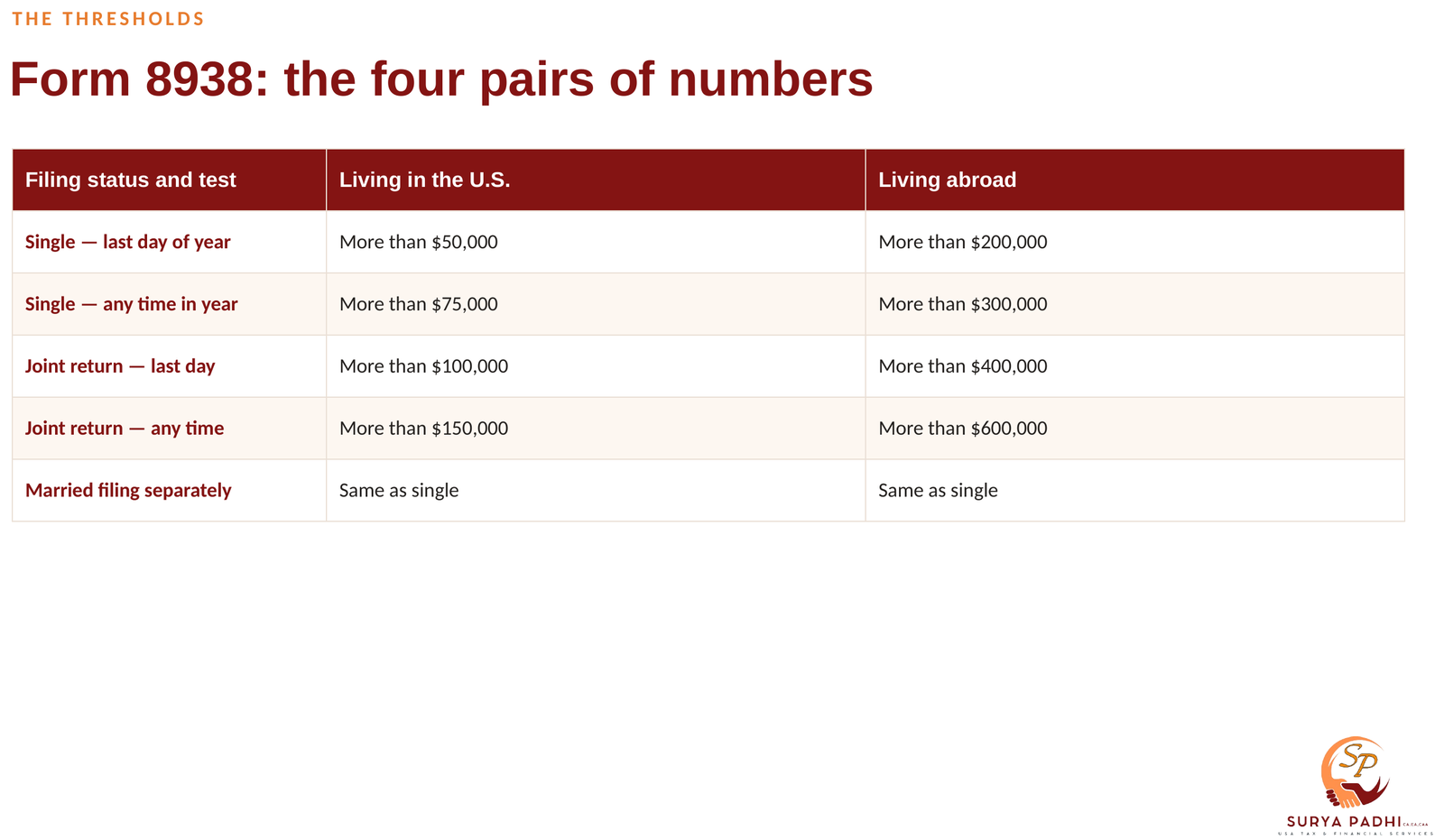
Form 8938 has two tests, and meeting <em>either</em> one triggers the filing: the total value of your specified foreign financial assets on the last day of the tax year, or the total at any point during it. Which pair of numbers applies depends on your filing status and on whether you count as living abroad.
| Who you are | Last day of the tax year | Any time during the year |
|---|---|---|
| Single or married filing separately, in the U.S. | More than $50,000 | More than $75,000 |
| Married filing jointly, in the U.S. | More than $100,000 | More than $150,000 |
| Single or married filing separately, abroad | More than $200,000 | More than $300,000 |
| Married filing jointly, abroad | More than $400,000 | More than $600,000 |
“Living abroad” is a defined term here, not a description of how your life feels. You qualify if your tax home is in a foreign country and either you were a bona fide resident of a foreign country for an uninterrupted period covering the entire tax year, or you were physically present in a foreign country for at least 330 days during a twelve-month period ending in the tax year. A long overseas assignment that keeps a U.S. tax home does not get you there.
The FBAR threshold does not move
Living abroad quadruples the Form 8938 threshold. It does nothing at all to the FBAR, which stays at $10,000 aggregate whether you live in Hillsborough or Hyderabad.
What goes on which form
The FBAR covers foreign financial <em>accounts</em>. Form 8938 covers those same accounts plus a second category: specified foreign financial assets held for investment outside of any account. That second category is where the two forms genuinely diverge.
| Asset | FBAR | Form 8938 |
|---|---|---|
| Foreign bank, brokerage or deposit account | Yes | Yes |
| Account you only have signature authority over | Yes | No, unless you hold an interest |
| Foreign stock held directly, not in an account | No | Yes |
| Interest in a foreign partnership or entity | No | Yes |
| Foreign hedge fund or private equity fund | No | Yes |
| Foreign life insurance or annuity with cash value | Yes | Yes |
| Foreign real estate held directly | No | No |
| Foreign currency or precious metals held directly | No | No |
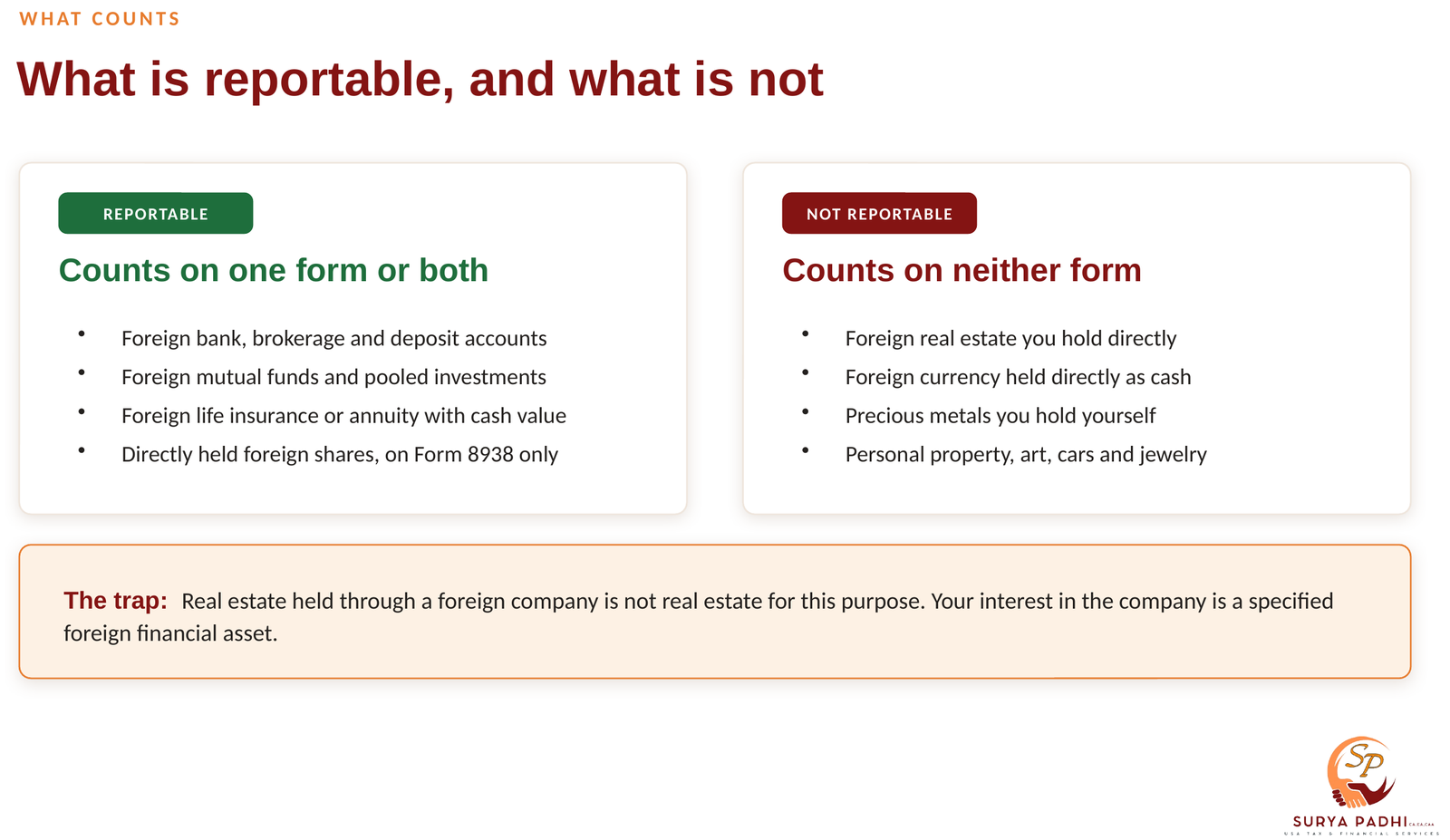
The real estate line is the one that costs people money in both directions. An apartment in Pune or a flat in London that you own outright is on neither form. But if you hold that same property through a foreign company, the property is still not reportable — your <strong>interest in the company</strong> is, and it goes on Form 8938.
Duplicates still count toward the threshold
If an asset is already reported on Form 3520, 3520-A, 5471, 8621 or 8865 for the same year, you do not list it again on Form 8938. You do still count its value when testing whether you cleared the threshold.
A worked example: one couple, both forms
A married couple in Hillsborough, both U.S. citizens, filing jointly and living in the United States. During 2026 they hold three accounts in India, some shares they bought directly in an Indian company, and an apartment in Pune worth about $180,000.
Running both tests on the same assets
| Savings account — highest balance in 2026 | $28,000 |
| Fixed deposit — highest balance in 2026 | $46,000 |
| Demat/brokerage account — highest balance | $19,000 |
| FBAR aggregate — accounts only | $93,000 |
| FBAR threshold | $10,000 |
| Directly held Indian shares — highest value | $22,000 |
| Specified foreign assets, any-time test ($93,000 + $22,000) | $115,000 |
| Any-time threshold, joint filers in the U.S. | $150,000 |
| Same four assets valued on December 31, 2026 | $106,000 |
| Last-day threshold, joint filers in the U.S. | $100,000 |
| Result | Both forms required |
The $106,000 is $24,000 of savings, the $46,000 fixed deposit, $17,000 of brokerage and $19,000 of shares. The apartment is on neither form and never enters the arithmetic.
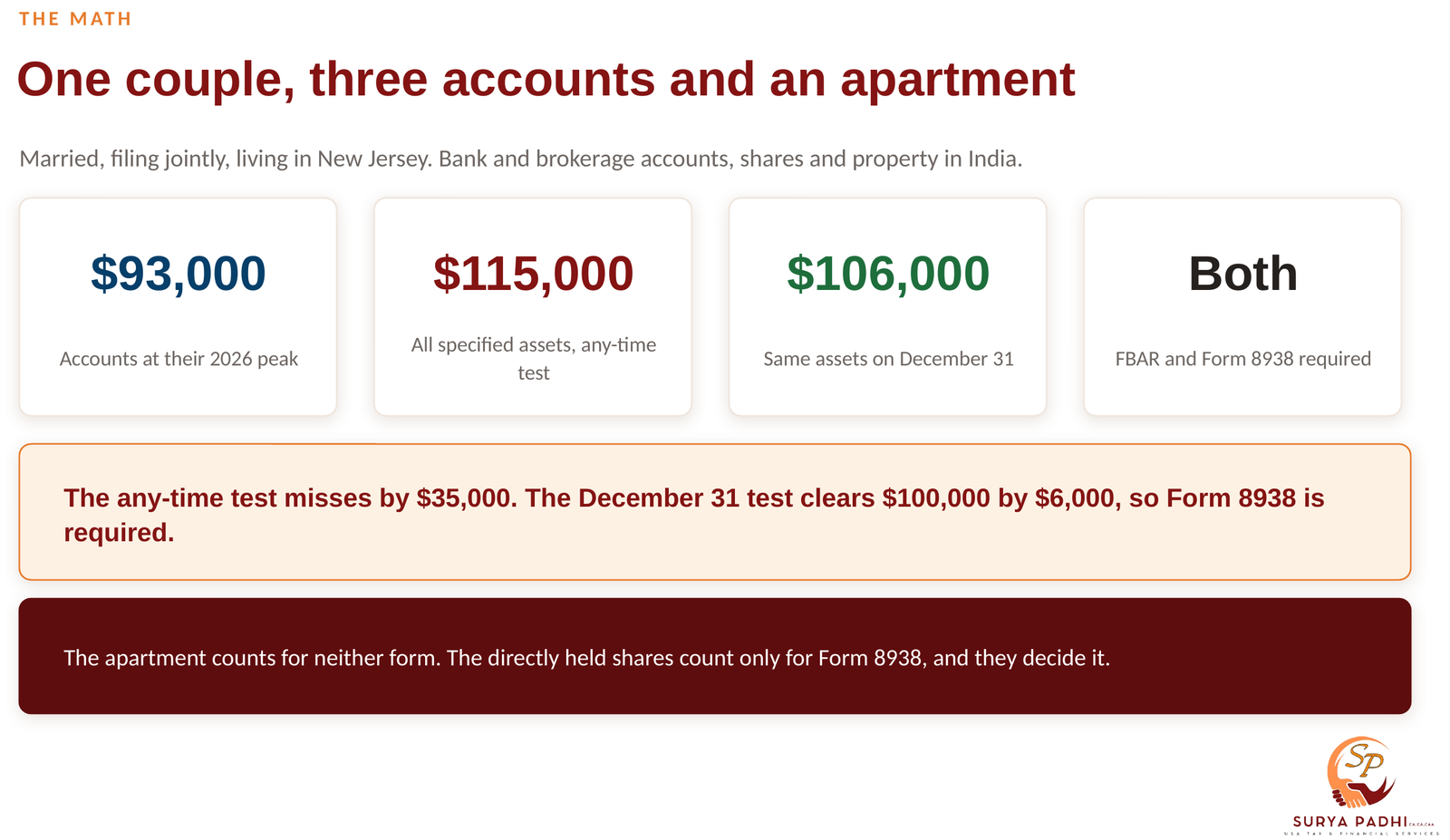
Three things are worth pulling out of that. The FBAR was never close — $93,000 against a $10,000 threshold, and it would have been required at a tenth of the balance. The any-time test for Form 8938 <em>failed</em>, by $35,000. And the last-day test passed by $6,000, which means Form 8938 is required even though the more generous-looking test was missed. A taxpayer who checked only one of the two tests would have reached the wrong answer.
The shares are what decide it
Without the $22,000 of directly held shares, the December 31 total is $87,000 and no Form 8938 is required. Those shares are invisible to the FBAR and decisive for Form 8938 — which is exactly why the two forms cannot be tested as though they were one.
What getting it wrong costs
Both regimes carry penalties per year, and both are informational — you can owe nothing in tax and still be exposed.
- <strong>Form 8938:</strong> $10,000 for failing to file, plus $10,000 for each 30-day period after the IRS mails a notice, to a maximum additional $50,000. Where an understatement of tax is attributable to an undisclosed specified foreign financial asset, the accuracy-related penalty is 40%.
- <strong>FBAR, non-willful:</strong> the statutory ceiling is $10,000, adjusted for inflation. The current adjusted maximum in the FinCEN penalty table is $16,536.
- <strong>FBAR, willful:</strong> the greater of the adjusted $100,000 figure — currently $165,353 — or 50% of the account balance at the time of the violation.
- <strong>Statute of limitations:</strong> failing to file Form 8938 can hold the assessment period open for all or part of the return until three years after you eventually file it. Separately, omitting more than $5,000 of income attributable to a specified foreign financial asset extends the assessment period to six years.
One piece of good news on the FBAR side. In <em>Bittner v. United States</em> (2023) the Supreme Court held that the non-willful penalty accrues per annual report rather than per account, which is a very large difference for anyone with several accounts and several missed years. The statute also provides that no non-willful penalty applies where the violation was due to reasonable cause and the balance was properly reported.
If you are already behind
Coming forward before the IRS contacts you is a materially different conversation from responding after it does. Two established paths exist, and which one fits depends on facts you should establish before filing anything.
- If you missed FBARs but reported all the income and paid the tax, the delinquent FBAR submission procedures let you e-file the late reports with a statement of why they were late.
- If income went unreported and the failure was genuinely non-willful, the Streamlined Filing Compliance Procedures cover it. Domestic filers submit three years of amended returns and six years of FBARs, and pay a 5% miscellaneous offshore penalty on the highest aggregate value of the assets involved.
- Non-resident filers using the streamlined procedures are not subject to that 5% penalty, but they have their own eligibility test.
- Every streamlined submission requires a certification of non-willfulness, signed under penalty of perjury. That is the sentence to get advice on, not the arithmetic.
Do not certify first and think later
The streamlined procedures are only available to taxpayers whose conduct was non-willful and who are not already under examination or criminal investigation. If there is any real question about which side of that line your facts fall on, that question gets answered before a form is filed, not after.
Full transcript
[PASTE THE CORRECTED TRANSCRIPT HERE — one paragraph per chapter. Download the auto-generated captions from YouTube Studio, fix the form numbers and dollar amounts, and paste the cleaned text. This is several hundred extra indexable words in your own voice, and it is what AI answer engines read.]
Frequently asked questions
Do I have to file both the FBAR and Form 8938?
Often, yes. They are independent requirements from different statutes, and the IRS states in the Form 8938 instructions that filing Form 8938 does not relieve you of the FBAR obligation. Because the FBAR threshold is $10,000 aggregate and the lowest Form 8938 threshold is $50,000, it is common to owe the FBAR alone, and less common to owe Form 8938 without also owing the FBAR.
Does the $10,000 FBAR threshold apply per account or in total?
In total. You add the highest value each foreign account reached during the calendar year and compare the sum to $10,000. Because it is the peak of each account rather than the year-end balance, money transferred between two foreign accounts gets counted in both, and people routinely clear the threshold without ever having held more than $10,000 abroad at one moment.
Is my apartment overseas reportable?
Not if you own it directly. Foreign real estate held in your own name is not a specified foreign financial asset for Form 8938 and is not a financial account for the FBAR. But if you hold the property through a foreign corporation, partnership or trust, your interest in that entity is a specified foreign financial asset and is reportable on Form 8938 once you clear the threshold.
What if I only have signature authority over someone else’s account?
That is enough to require an FBAR. Signature or other authority over a foreign financial account is a filing obligation even where you have no financial interest in it, which catches people who were added to a parent’s account abroad or who can sign on an employer’s foreign account. Form 8938 works differently — signature authority alone does not make an account reportable there.
When are these actually due?
For calendar year 2026, the FBAR is due April 15, 2027, with an automatic extension to October 15, 2027 that you do not have to request. Form 8938 is due with your Form 1040, including any extension, so an extended return carries the Form 8938 with it. Taxpayers abroad who use the automatic two-month extension to June 15 move Form 8938 to that date as well.
Not sure which forms your accounts trigger?
Foreign reporting turns on details — signature authority, joint accounts, entity interests, and where the December 31 balance landed. We work through it with you before anything is filed, and we are a Certifying Acceptance Agent for ITIN cases.
This article is general educational information, not individualized tax or investment advice. Figures cited are subject to IRS adjustment. Consult a qualified professional about your own facts.