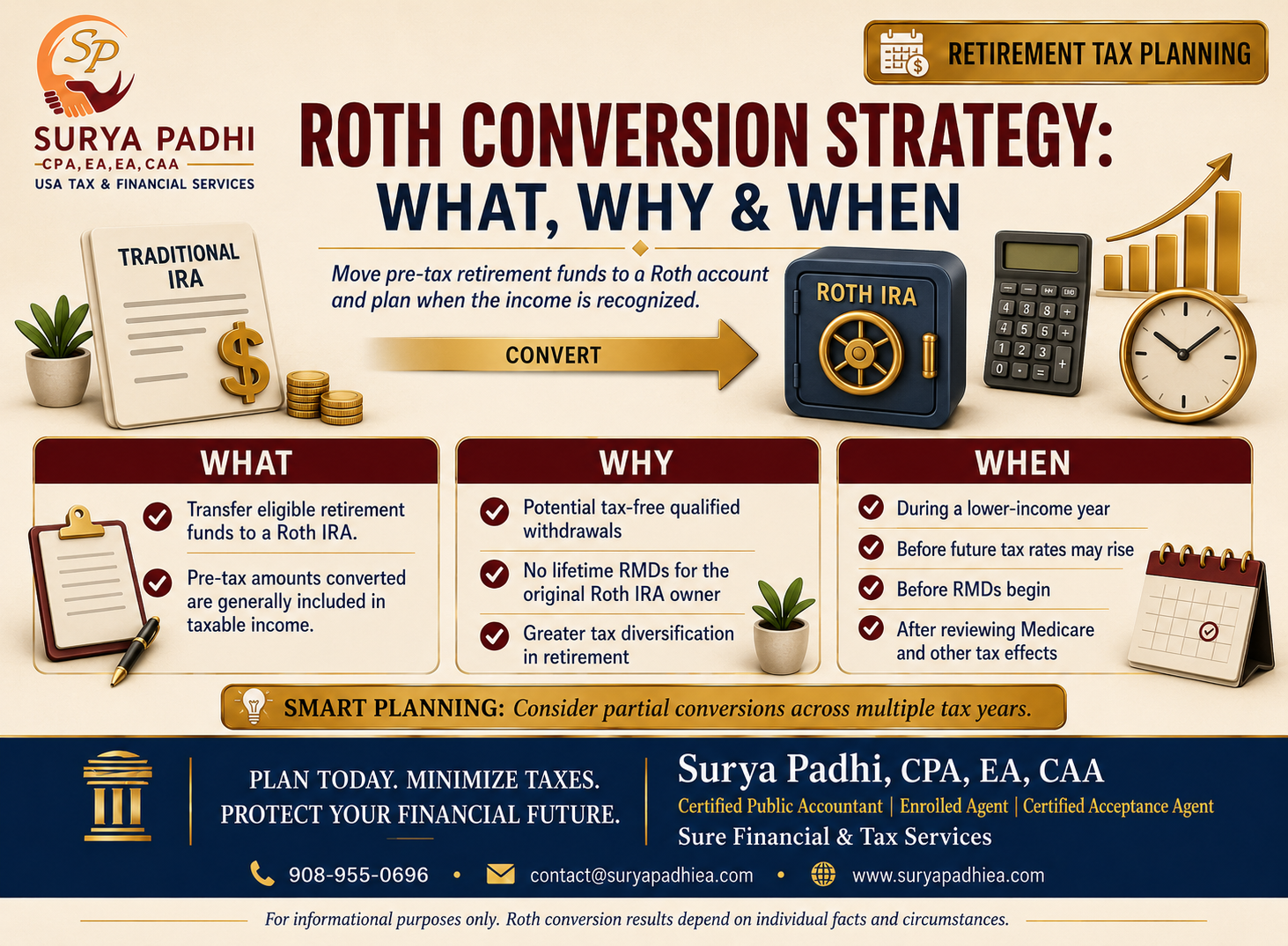
Usually in the years between retiring and the start of required minimum distributions, when your income is temporarily low and the lower brackets sit empty. Convert in December once the year is known, fill a bracket without overflowing it, and pay the tax from outside the account rather than withholding it.
6:26. The written version, the figures and the sources are all below.
| Top of the 22% bracket, MFJ | $206,700 | Taxable income after the standard deduction. Verify against the current IRS inflation-adjustment notice. |
|---|---|---|
| First IRMAA tier, MFJ | $212,000 | Modified AGI, measured two years in arrears, and it applies to both spouses. |
| Conversion deadline | December 31 | Calendar-year event. Unlike an IRA contribution there is no April extension. |
| Five-year clock | Per conversion | Governs penalty-free access to converted principal if you are under 59½. |
| Cap on conversion size | None | No income limit and no annual maximum, which is what separates a conversion from a contribution. |
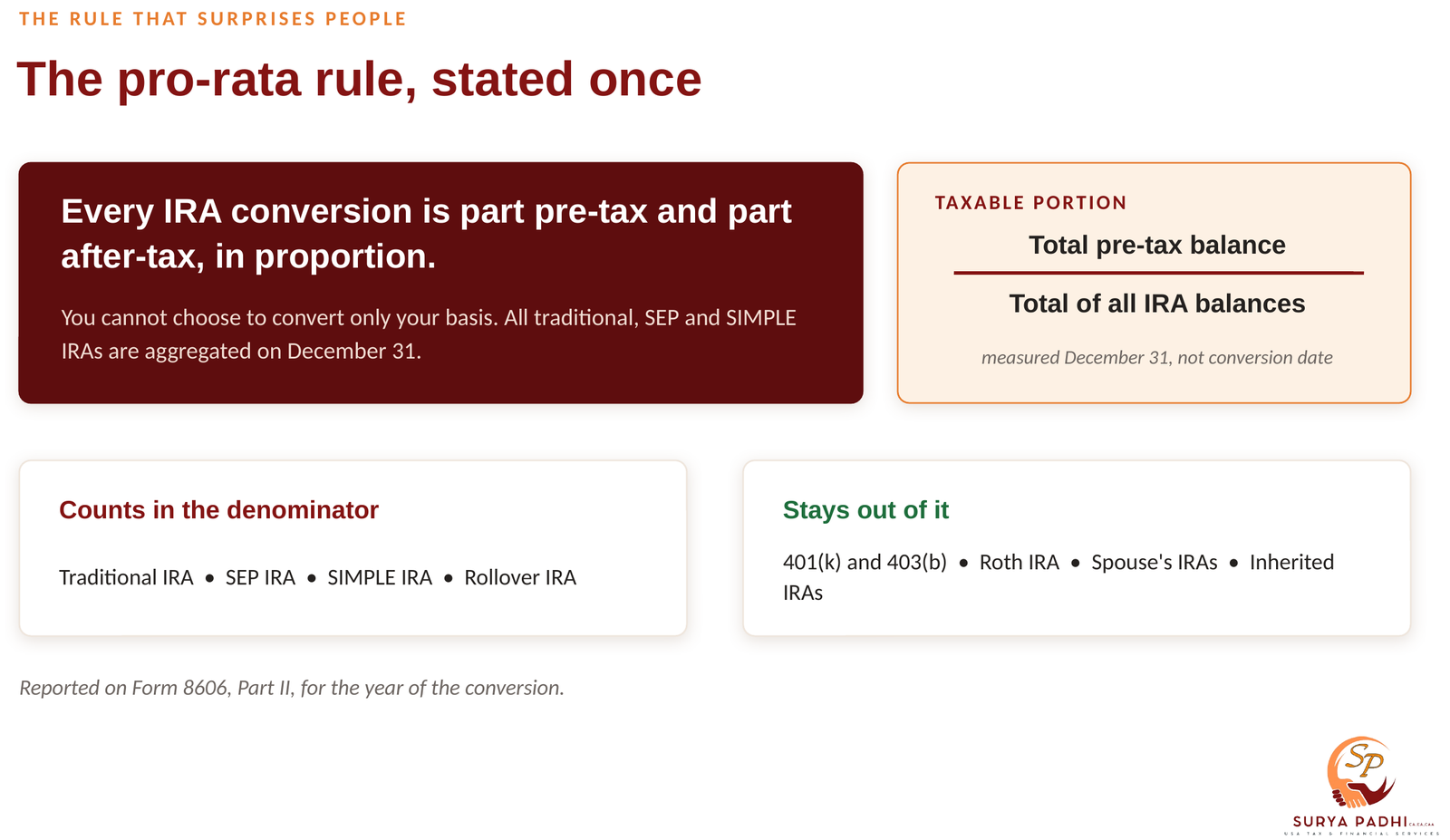
| Pro-rata measurement date | December 31 | All traditional, SEP and SIMPLE IRA balances are aggregated. Employer plan balances are not. |
A conversion is the rare tax bill where you choose the year, the amount, and largely the rate you pay. Here is how to decide whether this is your year, and how much to convert.
Almost nothing in the tax code lets you choose your own bill. A Roth conversion does. You pick the year, you pick the amount, and within limits you pick the marginal rate you pay on it. That is unusual enough to be worth using deliberately.
It is also why conversions get done badly. Without a method, people convert on instinct — after a market drop, or in January when they first think of it — and end up paying more than they needed to. This article covers the mechanics, the years worth converting in, the years worth waiting through, and how to size a conversion so it fills a bracket instead of overflowing one.
Key takeaways
- A conversion is taxed as ordinary income in the year you do it. There is no income limit and no annual cap.
- Pay the tax from a taxable account, never by withholding from the conversion itself.
- The pro-rata rule aggregates all traditional, SEP and SIMPLE IRAs on December 31 — but not 401(k) balances.
- The years between retiring and the start of required distributions are usually the best window you will get.
What a conversion actually does
You move money from a pre-tax account into a Roth and add the pre-tax portion to your income for the year. The investments do not have to change — the same holdings can move across in kind, valued at the conversion date. What you are buying is the removal of all future tax on that money and its growth.
Two features separate a conversion from a Roth contribution. There is no income limit, so high earners locked out of contributing may still convert. And there is no dollar cap, so the size is entirely your decision.
There is no undo
Recharacterisation of conversions was repealed for tax years after 2017. Once you convert in December, you cannot reverse it in April if the market moves against you or your income comes in higher than projected.
Converting a 401(k) is not the same as converting an IRA
These two routes look interchangeable and are not, and the difference has real money attached.
From a 401(k) or 403(b)
Many employer plans permit an in-plan Roth conversion, which moves the balance to a Roth account inside the same plan. Where the plan does not allow it, the usual path is to roll the balance into a traditional IRA and convert from there. That second step has a consequence people rarely anticipate.
From a traditional IRA
No plan permission is needed, but the pro-rata rule applies across every IRA you hold. Rolling a 401(k) into a traditional IRA adds that entire balance to the pro-rata denominator — which can turn a previously clean backdoor Roth into a largely taxable event. If you use the backdoor strategy, do the rollover after the conversion, or not at all.
The escape route
If your plan accepts incoming rollovers, moving pre-tax IRA money into the 401(k) before December 31 clears the pro-rata denominator entirely. Not every plan permits this, so confirm before you rely on it.
Where the tax money comes from
This single choice separates a good conversion from a poor one, and most custodians will offer to handle it the wrong way.
Pay the tax from a taxable account. Money withheld from the conversion never reaches the Roth, so you have shrunk the very account you just paid to build. If you are under 59½, the withheld amount is also treated as an early distribution and carries its own penalty on top of the tax.
A $50,000 conversion, tax withheld versus tax paid separately
| Amount converted | $50,000 |
| Tax withheld at 24% | $12,000 |
| Amount that actually reaches the Roth | $38,000 |
| Possible penalty if under 59½ | $1,200 |
| Amount reaching the Roth if paid from cash | $50,000 |
Illustrative at a 24% marginal rate. Your own rate, state tax and age determine the real figures.
Paying from outside also means the conversion functions as an additional contribution. You have moved $50,000 into a tax-free account and spent a further $12,000 of taxable money to do it — money that would otherwise have kept generating taxable returns.
The years worth converting in
The whole strategy rests on one comparison: is your marginal rate this year lower than the rate you expect to pay when the money eventually comes out? Everything else is detail.
The retirement window
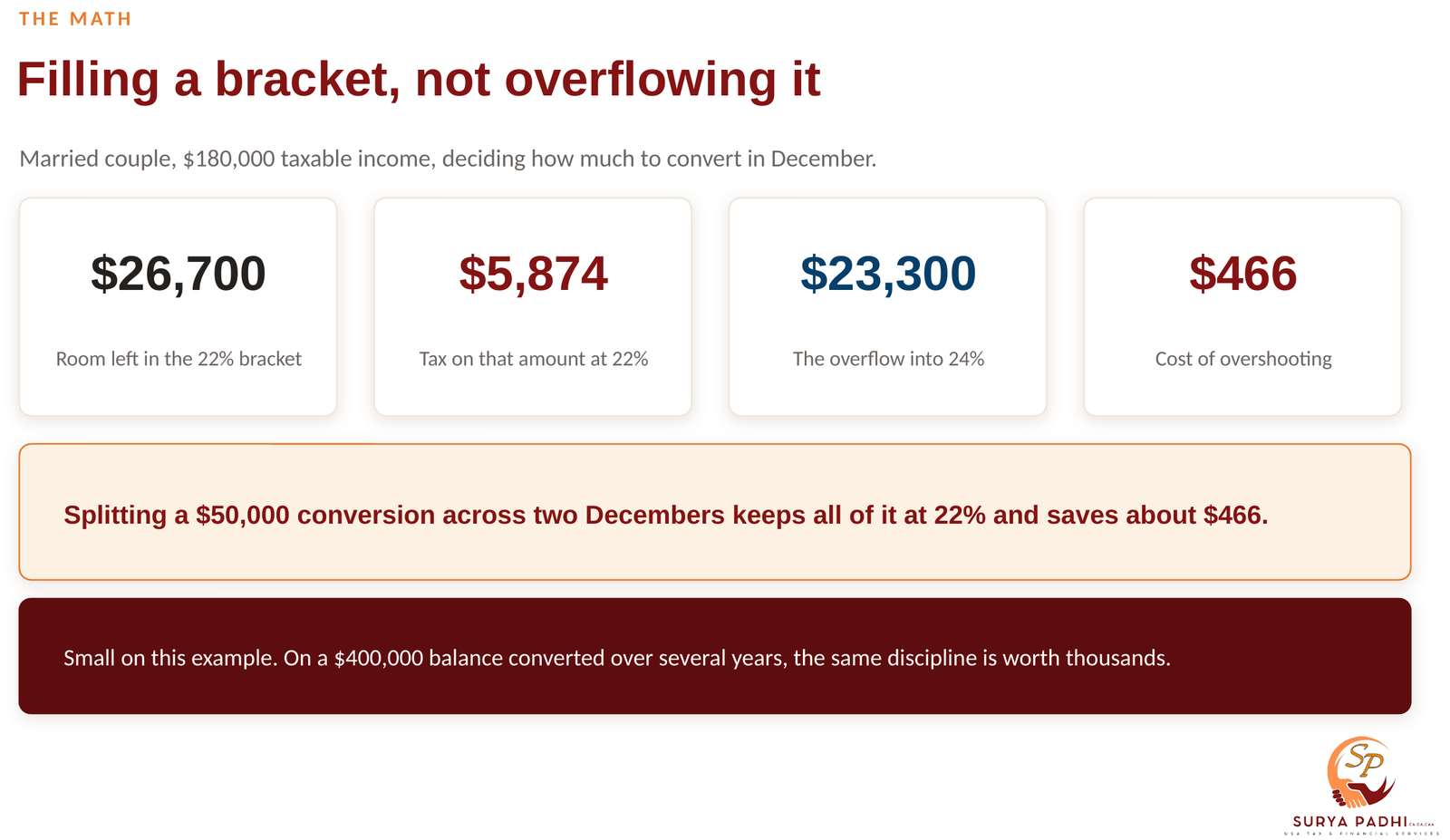
For most people this is the opening. Between the end of a career and the start of required minimum distributions, income is unusually low and the lower brackets sit empty. Deferring Social Security widens the window further. Once required distributions begin they fill those brackets first, and every conversion after that stacks on top at a higher rate. The window closes on its own, which is what makes it worth using deliberately.
Other good years
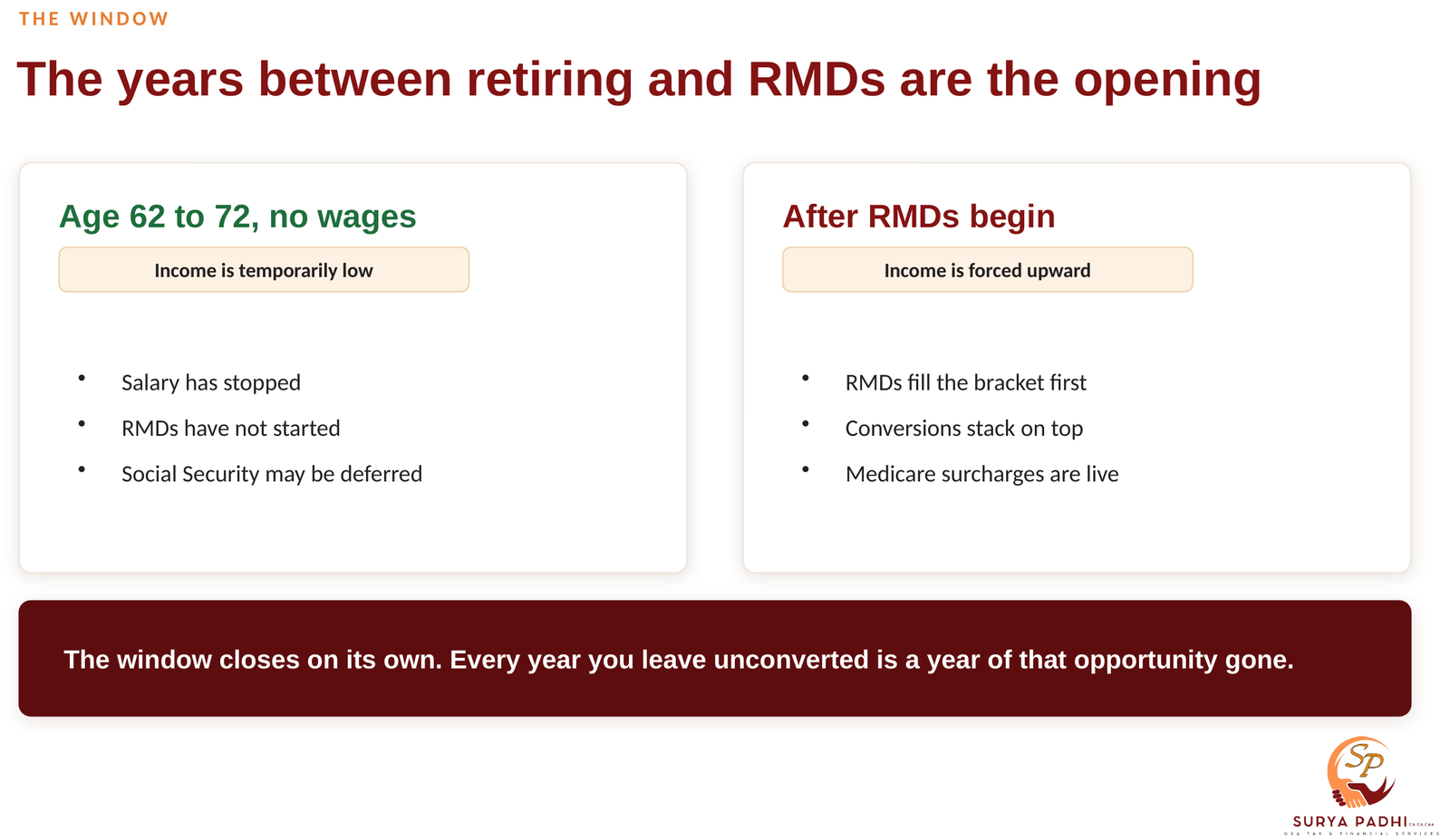
- A gap year between jobs, or a sabbatical — often the cheapest bracket you will ever fill
- A year with a large deduction, business loss or charitable gift that absorbs the income
- A sharp market decline, which lets the same shares move across at a lower value
- Any year your income comes in materially below normal for reasons you did not choose
A market drop is a discount, not a reason
Converting because the market fell is only sound if you already had a reason to convert. A decline lowers the cost of a good decision; it does not turn a bad one into a good one.
The years worth waiting through
- A peak earning year, when you are already paying your highest marginal rate
- The two years before a Medicare premium determination, since IRMAA looks back two years and applies to both spouses
- Any year you are receiving ACA premium tax credits, which phase out on the same income the conversion adds
- Any year the tax would have to come out of the account itself
The Medicare point deserves emphasis because it arrives long after the tax bill is forgotten. A conversion at 63 sets the premium surcharge at 65, for both spouses, and a surcharge that lands just over a tier boundary can cost more than the conversion saved.
How to size it: fill the bracket, do not overflow it
The method is three steps, and the order matters more than the amount.
- Project the full year’s income before you convert — not in January, when you are guessing at twelve months you have not lived yet.
- Choose the bracket ceiling you are willing to fill. That is a decision about your own future rates, and it should be made deliberately rather than by accident.
- Convert in December, once bonuses, capital gains and business income have already landed, and stop exactly at the line you chose.
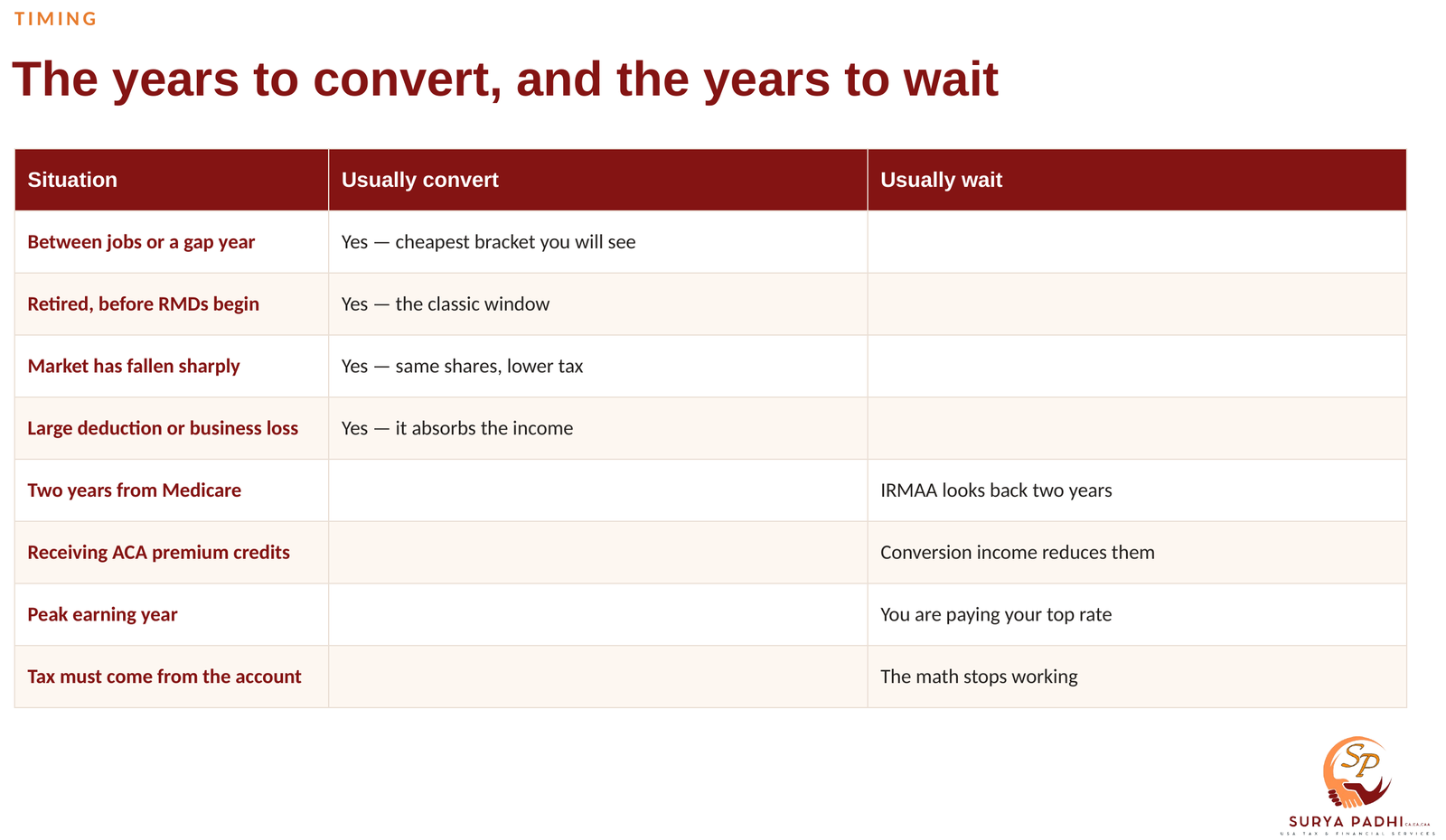
Married couple, $180,000 of taxable income, converting $50,000
| Room remaining in the 22% bracket | $26,700 |
| Tax on that portion at 22% | $5,874 |
| Overflow taxed at 24% | $23,300 |
| Extra cost of the overflow | about $466 |
| Cost if split across two Decembers | $0 |
Bracket figures are illustrative. Verify against the current IRS inflation-adjustment notice before relying on them.
On this example the saving is modest. On a $400,000 balance converted across several years, the same discipline is worth thousands — and it costs nothing but patience.
Five ways a conversion goes wrong
- Withholding the tax from the conversion, which shrinks the Roth and can trigger an early distribution penalty.
- Overlooking a rollover IRA sitting in the pro-rata denominator, which makes a supposedly tax-free conversion partly taxable.
- Converting in January against income that has not happened yet.
- Forgetting the state. Some states tax the conversion even where the federal case is strong, and a few treat it more favourably — either way it changes the answer.
- Skipping Form 8606, which is how basis quietly disappears and the same dollars end up taxed twice.
One deadline with no grace period
Unlike an IRA contribution, a conversion must be completed by December 31. There is no April extension. A conversion you meant to make in 2026 and executed in January is a 2027 conversion.
The tax is generally due with the fourth-quarter estimated payment in mid-January, or through increased withholding elsewhere, to avoid an underpayment penalty. Converting a large amount in December without adjusting for that is a common and avoidable cost.
Frequently asked questions
Is there an income limit on Roth conversions?
No. Income limits apply to Roth contributions, not conversions. That asymmetry is what makes the backdoor Roth strategy possible for high earners who cannot contribute directly.
Can I convert only part of my account?
Yes, and usually you should. Partial conversions let you fill a bracket precisely rather than overshooting it. There is no requirement to convert an entire account, and converting a fixed amount each December over several years is the standard approach.
What is the five-year rule on conversions?
Each conversion starts its own five-year clock for penalty-free access to the converted principal if you are under 59½. This is separate from the five-year rule that governs whether Roth earnings come out tax-free. If you are over 59½ and have held a Roth for five years, neither is usually a constraint.
Should I convert because the market has fallen?
Only if you already had a reason to convert. A decline means the same shares move across at a lower value, so the tax is lower for the same holdings. That is a genuine discount — but it improves a decision you were already going to make rather than creating a case on its own.
How does a conversion affect my Medicare premiums?
IRMAA surcharges are set using modified AGI from two years earlier, so a conversion at 63 affects premiums at 65, for both spouses. Crossing a tier boundary by a small amount triggers the full surcharge for that tier, which is why a conversion in the years before a determination should be modelled rather than estimated.
Do I have to convert everything eventually?
No. Many people convert only enough to level out their lifetime bracket, leaving some pre-tax money to fund charitable giving or to be drawn in genuinely low-income years. Full conversion is rarely the goal — a smoother rate across the years is.
Not sure which bracket you will actually land in?
We build the year-end projection first, then size the conversion to the bracket — including the state and Medicare effects a federal-only calculator misses.
This article is general tax education and does not constitute individualized tax, legal or financial advice. Figures are stated for the tax year shown and are subject to IRS adjustment. Consult a qualified professional about your own facts. Surya Padhi holds the Indian Chartered Accountant qualification but is not licensed to practise in India and does not provide Indian tax filing or advisory services.