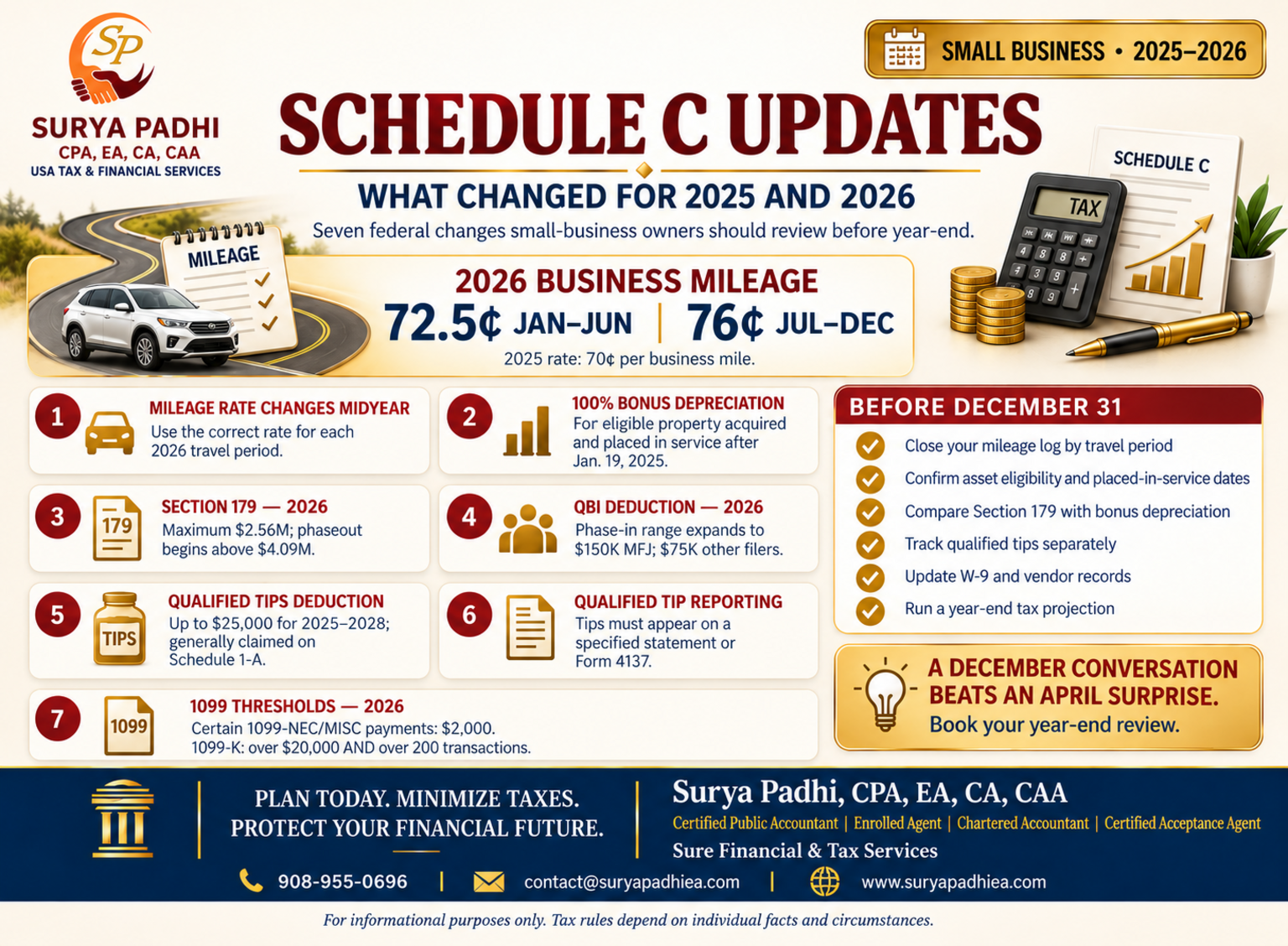
Five things changed on Schedule C for 2025 and 2026: the mileage rate rose to 72.5 cents, bonus depreciation became a permanent 100%, the Section 179 limit reached $2,560,000, the QBI phase-in ranges widened, and a new tip deduction arrived. The tip deduction goes on Schedule 1-A and never reduces self-employment tax.
7:00. The written version, the figures and the sources are all below.
| 2026 standard mileage rate | 72.5¢ / mile | Up from 70 cents in 2025. IRS Notice 2026-10. |
|---|---|---|
| 2026 Section 179 limit | $2,560,000 | Phase-out begins above $4,090,000. Rev. Proc. 2025-32. |
| Bonus depreciation | 100%, permanent | Property acquired after January 19, 2025. |
| 2026 QBI threshold (MFJ) | $403,500 | Fully phased out at $553,500 — a $150,000 range. |
| 2026 QBI threshold (other) | $201,750 | Fully phased out at $276,750 — a $75,000 range. |
| Tip deduction cap | $25,000 | Tax years 2025–2028. Phases out above $150,000 MAGI. |
| Overtime deduction cap | $12,500 / $25,000 | Single / joint. FLSA section 7 overtime only. |
| 1099-NEC and 1099-MISC | $2,000 | For payments in 2026, up from $600. Indexed from 2027. |
| 1099-K threshold | $20,000 / 200 | Reverted to the pre-2021 threshold. |
The mileage rate, Section 179, QBI and the tip deduction all moved. One of them is not a Schedule C deduction at all.
Five things changed on Schedule C for tax years 2025 and 2026. Two of them are simply new numbers — the standard mileage rate and the Section 179 limit — and you will pick those up from your software without thinking about it. The other three are rule changes, and they behave differently from how most business owners assume they behave.
The one that causes the most confusion is the tip deduction. It is real, it is worth up to $25,000, and it is not a Schedule C deduction. It does not reduce your net profit and it does not reduce your self-employment tax by a single dollar. Below is each change, what it is actually worth, and the decision it asks you to make before December 31.
Key takeaways
- The 2026 business standard mileage rate is 72.5 cents per mile, up from 70 cents in 2025.
- 100% bonus depreciation is now permanent; the 2026 Section 179 limit is $2,560,000.
- The tip deduction goes on Schedule 1-A, not Schedule C — it never reduces self-employment tax.
- From tax year 2026, tips must be separately stated on a 1099 or there is no deduction at all.
- A large first-year vehicle write-off is conditional: business use at 50% or less later triggers recapture.
The numbers that moved
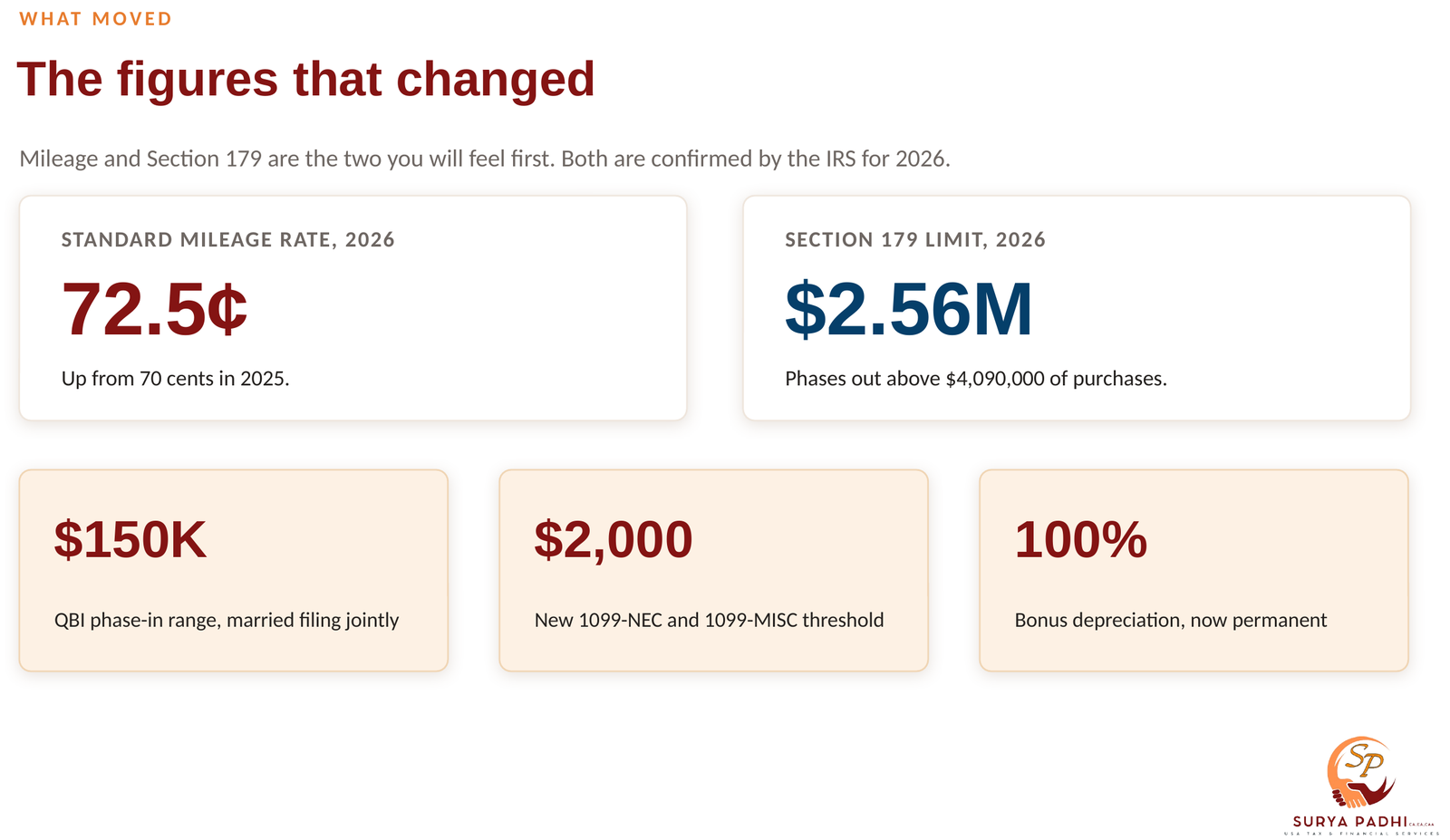
Two figures changed that affect almost every Schedule C. The business standard mileage rate is 72.5 cents per mile for 2026, up 2.5 cents from the 70 cents that applied in 2025. The Section 179 expensing limit is $2,560,000 for 2026, and it begins to phase out once you place more than $4,090,000 of property in service.
Alongside those, 100% bonus depreciation is now a permanent part of the law rather than a phasing-down provision, applying to qualifying property acquired after January 19, 2025. The qualified business income phase-in ranges also widened, which matters if your income sits near the threshold.
On the QBI ranges
For 2026 the threshold is $403,500 for married filing jointly with the deduction fully phased out at $553,500 — a $150,000 band instead of the previous $100,000. For every other filing status the threshold is $201,750, fully phased out at $276,750. A wider band means the deduction falls away more gradually, so year-end income timing moves it less abruptly than it used to.
Mileage or actual expenses: the first year decides the rest
You get one choice per vehicle, and the year you place the vehicle in service is the year the choice is made. Standard mileage is 72.5 cents a mile in 2026 with depreciation already built into the rate, so you never claim depreciation separately. You can still add parking and tolls; nothing else.
Actual expenses means gas, oil, insurance, repairs and depreciation, each multiplied by your business-use percentage. It usually produces a larger deduction on an expensive vehicle and a smaller one on a paid-off commuter car.
The lock-in most owners miss
If you claim actual expenses in year one, you must keep using actual expenses for that vehicle for as long as you own it. If you start with standard mileage, you may switch to actual expenses later — but depreciation from that point has to be figured straight-line rather than under standard MACRS. The flexible choice is the mileage rate, which is the opposite of what most people assume.
Section 179 and bonus depreciation are not the same election
These two get discussed as if they were interchangeable. They are not, and the difference decides which one belongs on a given purchase.
| Section 179 | Bonus depreciation | |
|---|---|---|
| How you get it | You elect it on Form 4562 | Automatic unless you elect out |
| 2026 ceiling | $2,560,000 | No dollar ceiling |
| Phase-out | Begins above $4,090,000 | None |
| Can it create a loss? | No — capped at business income | Yes |
| Chosen per asset? | Yes, asset by asset | No — by property class |
The income cap is the practical difference. Section 179 cannot push your business income below zero, so it is the instrument to use when you want a deduction this year but not an unlimited one. Bonus depreciation applies automatically to a whole class of property and can create a loss, which is useful when that is what you want and expensive when it is not.
The trade-off nobody mentions
Taking the largest possible deduction this year lowers your basis in the asset, which raises the tax when you eventually sell it. On a vehicle or a piece of equipment you expect to sell within a few years, a bigger write-off now is not automatically the better answer. Run it both ways before you buy, not after.
The heavy vehicle write-off is conditional, not final
This is the mistake I see most often. A vehicle weighing more than 6,000 pounds is not subject to the annual depreciation caps that apply to lighter cars, so it can be written off in full in year one. What gets forgotten is that the write-off is only safe while business use stays above 50%.
If business use falls to 50% or less in any later year, you must refigure all the prior depreciation on a straight-line basis and report the difference as income. It applies equally to bonus depreciation, Section 179 and ordinary MACRS depreciation, and the income lands on Schedule C — where it carries self-employment tax — rather than on Form 4797.
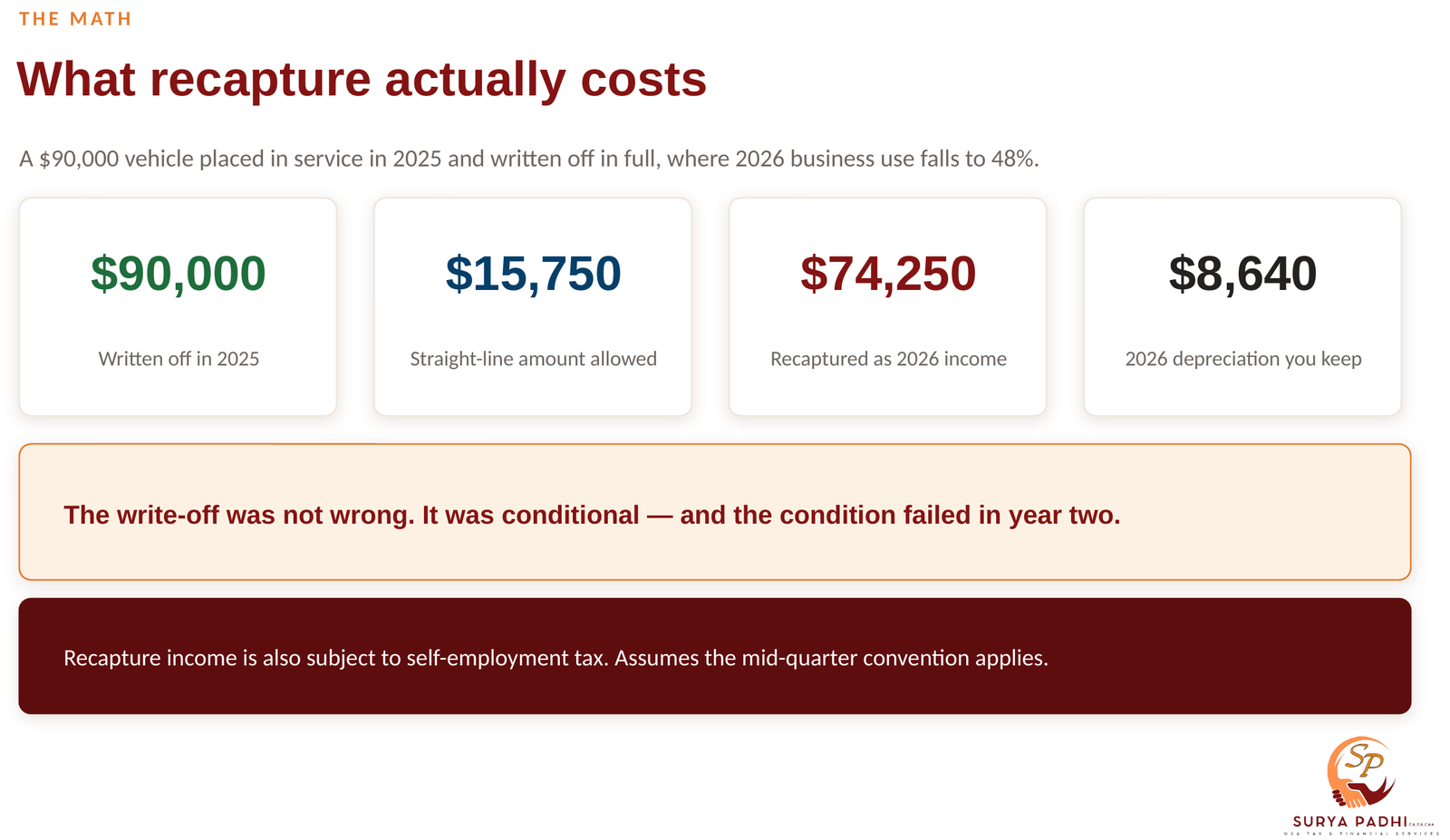
A $90,000 vehicle, written off in full, then business use drops to 48%
| Deduction claimed in 2025 | $90,000 |
| Straight-line amount actually allowed | $15,750 |
| Recaptured as income on the 2026 Schedule C | $74,250 |
| Straight-line depreciation kept for 2026 | $8,640 |
Assumes the mid-quarter convention applies. The recapture is ordinary income and is subject to self-employment tax.
The write-off was not wrong. It was conditional, and the condition failed in year two. If you have a heavy vehicle on your depreciation schedule, the number worth checking in December is this year’s business-use percentage — not next October.
“No tax on tips” is not a Schedule C deduction
The tip deduction created by the One Big Beautiful Bill is worth up to $25,000 a year for tax years 2025 through 2028. It phases out above $150,000 of modified adjusted gross income, or $300,000 on a joint return, and you need a valid Social Security number to claim it. It is available whether you itemize or take the standard deduction.
A qualified tip has to clear three tests. It must be paid voluntarily by the customer, paid in cash or charged to a card, and earned in an industry where tipping is customary. The 18% gratuity a restaurant adds automatically to a large party is not voluntary, so it does not qualify no matter what the bill calls it.
It does not touch your self-employment tax
The deduction is claimed on the new Schedule 1-A, as a deduction from adjusted gross income. It is not a business deduction, so your Schedule C net profit is unchanged — and self-employment tax is calculated on that net profit. If you are self-employed, the deduction is also capped at your net income from the trade or business where the tips were earned.
From 2026, the tips have to be on a 1099
For tax year 2025 there is transition relief: employers and payers do not have to separately report qualified tips, and you can substantiate the amount from pay statements, point-of-sale reports or a daily tip log. That relief ends. Forms W-2, 1099-NEC, 1099-MISC and 1099-K are being updated for tax year 2026 to state qualified tips separately, and from that point the deduction depends on the amount appearing that way.
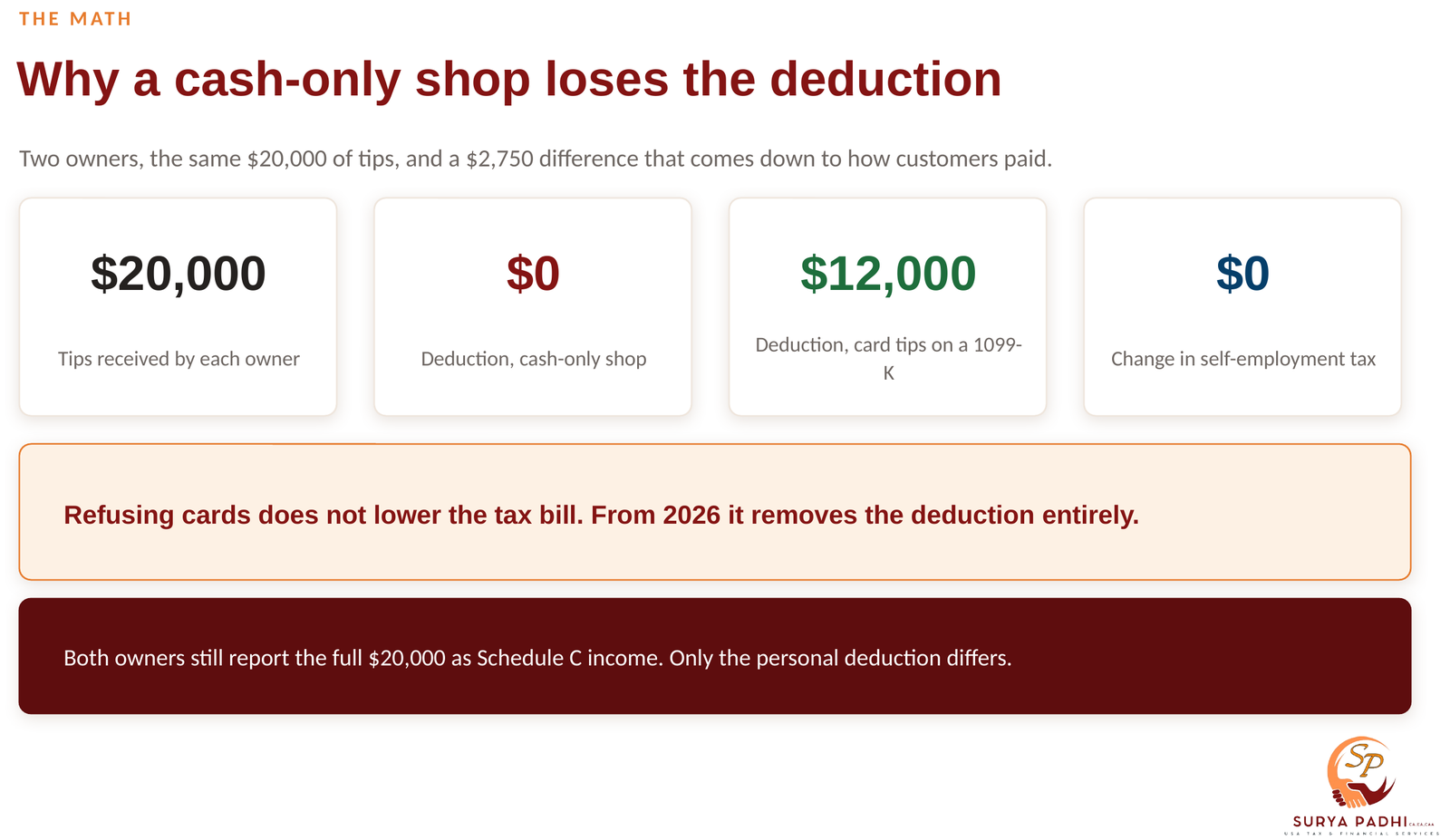
Two coffee shops, $20,000 of tips each, tax year 2026
| Owner A — cash only, no reporting form | $0 deduction |
| Owner B — $12,000 of tips swiped to a card | $12,000 deduction |
| Schedule C income reported by each | $20,000 |
| Change in self-employment tax for either | $0 |
Refusing cards does not lower the tax bill. From 2026 it removes the personal deduction entirely.
If you work in a tipped trade and take a meaningful share of tips in cash, the conversation to have before January is with your payment processor, not your preparer.
Overtime, and the 1099 thresholds
The overtime deduction — $12,500 for single filers, $25,000 for joint filers, for 2025 through 2028 — covers only overtime required by section 7 of the Fair Labor Standards Act. That is an employee provision. A contractor paid an overtime premium under a contract is not receiving FLSA section 7 overtime, so a Schedule C filer will almost never qualify for it.
The information return rules moved in both directions. The threshold for issuing a Form 1099-NEC or 1099-MISC rises from $600 to $2,000 for payments made in 2026, indexed for inflation from 2027. The Form 1099-K threshold went back to more than $20,000 and more than 200 transactions, reversing the lower figure introduced in 2021.
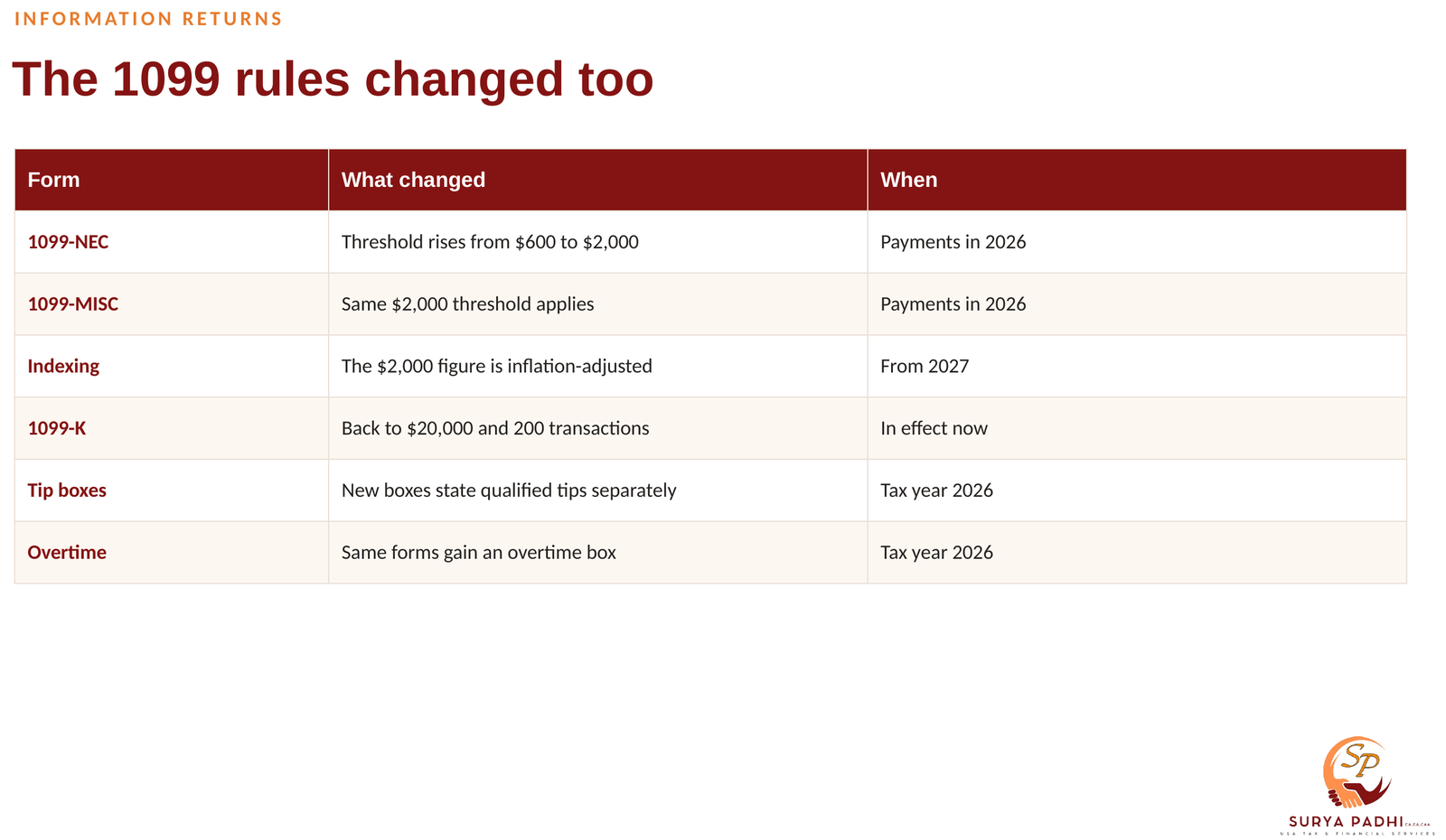
A higher threshold is not a lower obligation
The $2,000 threshold decides when you must issue a 1099. It does not change what a recipient owes, and it does not change what you must report as income. Payments below the threshold are still deductible to you and still taxable to them — the form simply is not required.
What to do before December 31
- Close out your mileage log and reconcile it to the odometer while the trips are still recallable. Reconstructed mileage is not substantiated mileage.
- Check the business-use percentage on every vehicle on your depreciation schedule. If any is drifting toward 50%, you want to know in December.
- If you take tips, talk to your payment processor about how they will be reported for 2026. No separate statement on a 1099 means no deduction.
- Before buying equipment, model Section 179 against bonus depreciation. The business income cap is usually the deciding factor.
- Review which vendors will now fall below the $2,000 1099 threshold — and keep paying attention to the ones that do not.
Most of what goes wrong on a Schedule C is decided before the year closes, not when the return is prepared.
Frequently asked questions
What is the standard mileage rate for 2026?
The business standard mileage rate for 2026 is 72.5 cents per mile, an increase of 2.5 cents from the 70 cents per mile that applied in 2025. The rate is set in IRS Notice 2026-10 and takes effect January 1, 2026. Depreciation is built into the rate, so it cannot be claimed separately, though parking and tolls can still be deducted.
Does the no tax on tips deduction reduce self-employment tax?
No. The tip deduction is claimed on Schedule 1-A as a deduction from adjusted gross income, not as a business expense on Schedule C. Your Schedule C net profit is unchanged, and self-employment tax is calculated on that net profit, so the deduction reduces income tax only. For a self-employed person the deduction is also limited to net income from the trade or business where the tips were earned.
What is the Section 179 limit for 2026?
The Section 179 expensing limit for 2026 is $2,560,000, with the phase-out beginning once more than $4,090,000 of qualifying property is placed in service during the year. The figures come from Revenue Procedure 2025-32. Section 179 is an election, is chosen asset by asset, and cannot reduce your business income below zero.
Do I still have to issue a 1099 for payments under $2,000 in 2026?
No. For payments made in 2026, the reporting threshold for Form 1099-NEC and Form 1099-MISC rises from $600 to $2,000, and the threshold is indexed for inflation beginning in 2027. The higher threshold changes only whether the form is required. Payments below it remain deductible to the payer and taxable to the recipient.
Bring your Schedule C in before year-end
A planning conversation in December is worth more than a good preparer in April. I work with sole proprietors and small business owners across New Jersey on tax planning, preparation and filing, business formation, bookkeeping, payroll and corporate compliance.
This article is general tax education and does not constitute individualized tax, legal or financial advice. Figures are stated for the tax year shown and are subject to IRS adjustment. Consult a qualified professional about your own facts. Surya Padhi holds the Indian Chartered Accountant qualification but is not licensed to practise in India and does not provide Indian tax filing or advisory services.