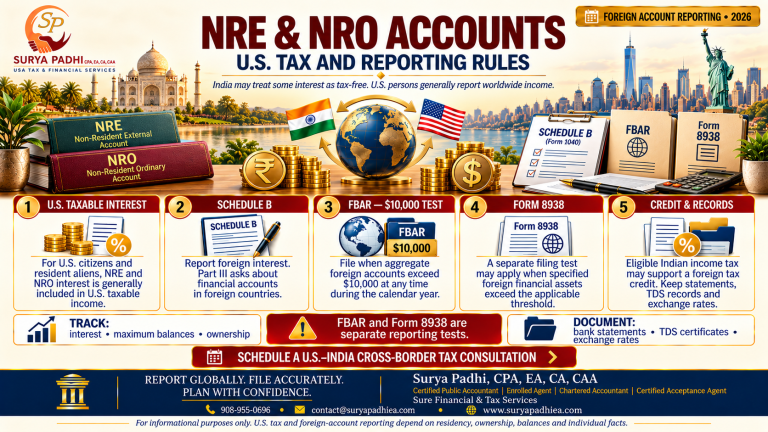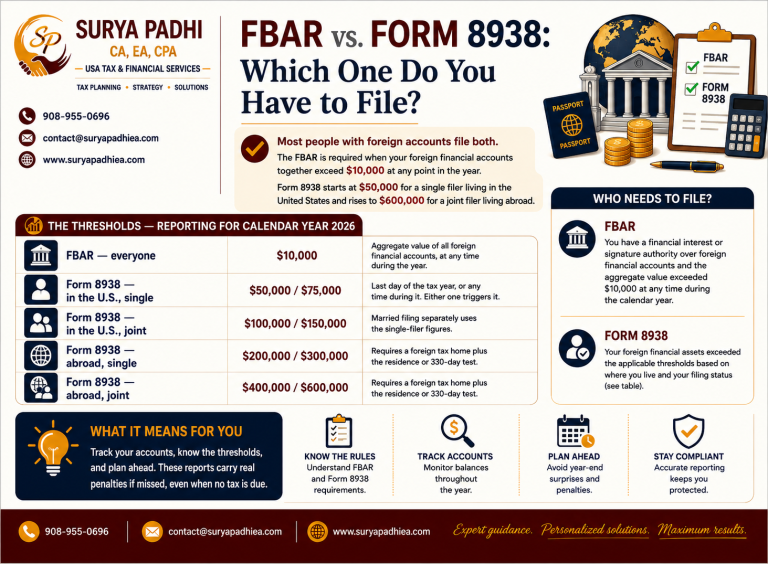

Most Indian bank accounts, fixed deposits, demat accounts and mutual funds go on both the FBAR and Form 8938. The FBAR applies once all your foreign accounts exceed $10,000 at any time. Form 8938 starts at $50,000 for a single filer in the US. Shares held outside an account go on Form 8938 only.
6:45. The written version, the figures and the sources are all below.
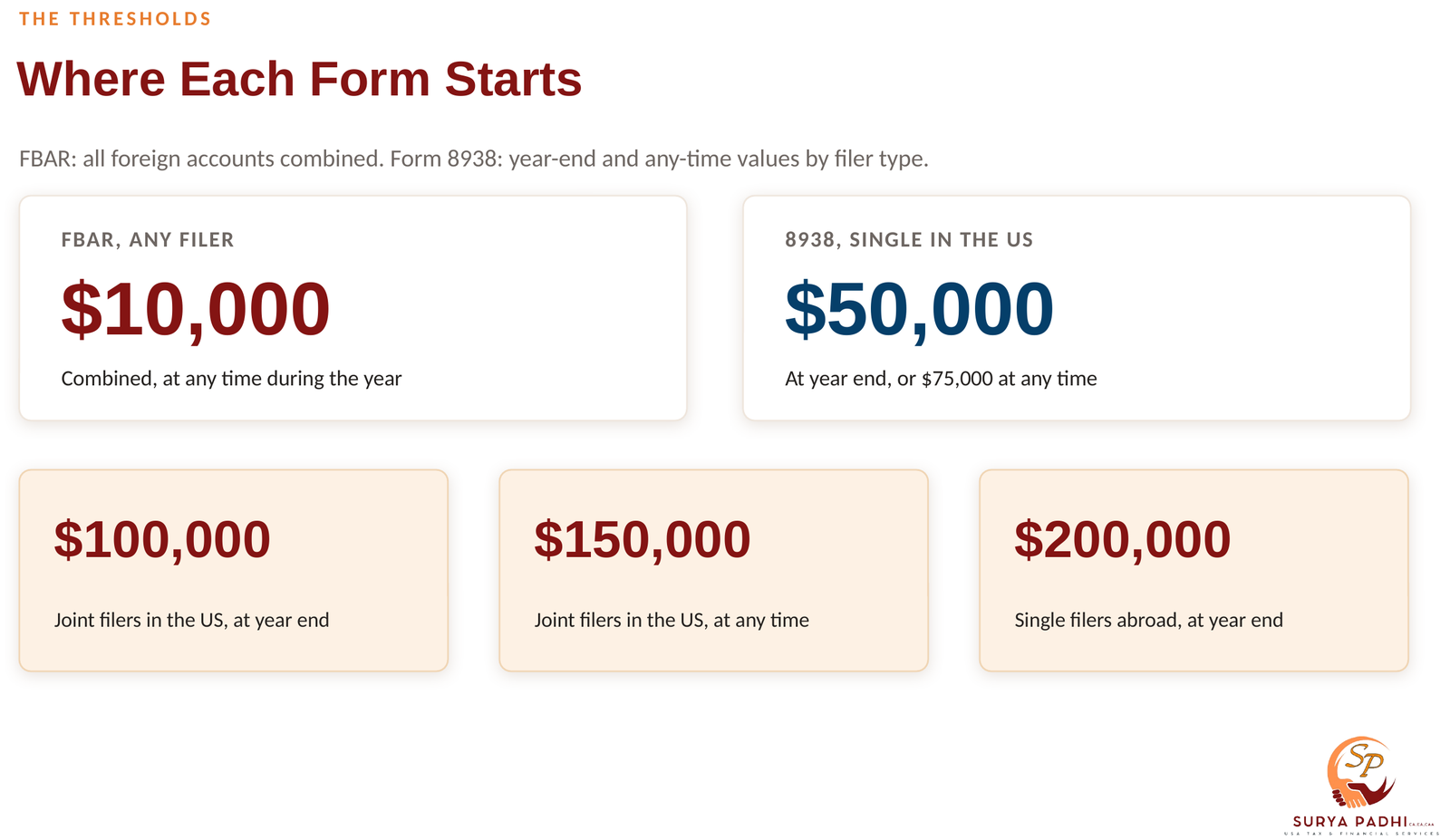
| FBAR threshold | $10,000 | All foreign accounts combined, at any time during the calendar year. Same for every filer. |
|---|---|---|
| Form 8938, single, living in the US | $50,000 / $75,000 | Year-end value / value at any time during the year. |
| Form 8938, married filing jointly, in the US | $100,000 / $150,000 | Year-end value / value at any time during the year. |
| Form 8938, living abroad | $200,000 / $300,000 single; $400,000 / $600,000 joint | Year-end value / value at any time during the year. |
| Form 8938 failure-to-file penalty | $10,000 | Up to $50,000 more for continued failure after IRS notice. |
| FBAR non-willful maximum | $16,536 | Inflation-adjusted amount effective January 17, 2025. |
Most Indian bank, deposit, demat and mutual fund accounts go on both forms. A few assets go on only one, and Indian retirement accounts need a documented position.
If you moved to the United States from India, you may still hold money there: a savings or NRO account, fixed deposits, a demat account, a few mutual funds, maybe an insurance policy. Which of those Indian assets go on the FBAR and Form 8938 is one of the most common questions I get, and the answer is not the same for every asset.
The short version is that most accounts go on both forms, a handful of investments go on Form 8938 only, and a few things go on neither. The rest of this article sorts them, shows the thresholds, and flags the one corner, Indian retirement accounts, where you need to make and document a judgment call.
Key takeaways
- Bank accounts, deposits, demat accounts, mutual funds and cash-value insurance in India generally go on both the FBAR and Form 8938.
- Shares held outside an account and interests in Indian partnerships or private companies go on Form 8938 only.
- Land, gold and jewelry you own directly, and cash you hold yourself, go on neither form.
- Form 8938 is clear about foreign pensions. For the FBAR, PPF, EPF and NPS are judgment calls: decide, document, and stay consistent.
The FBAR and Form 8938 are separate filings
The FBAR, formally FinCEN Form 114, is filed electronically with the Financial Crimes Enforcement Network. It is not attached to your tax return and is not filed with the IRS. Form 8938 is attached to your federal income tax return and is due when that return is due, including extensions.
The two forms overlap, but they do not ask for the same list of assets, and filing one never satisfies the other. That is why most people with Indian accounts end up filing both.
The thresholds also differ. The FBAR applies when the combined value of all your foreign financial accounts exceeds $10,000 at any time during the year. Form 8938 starts higher, and the amount depends on your filing status and whether you live in the United States.
Indian assets, form by form
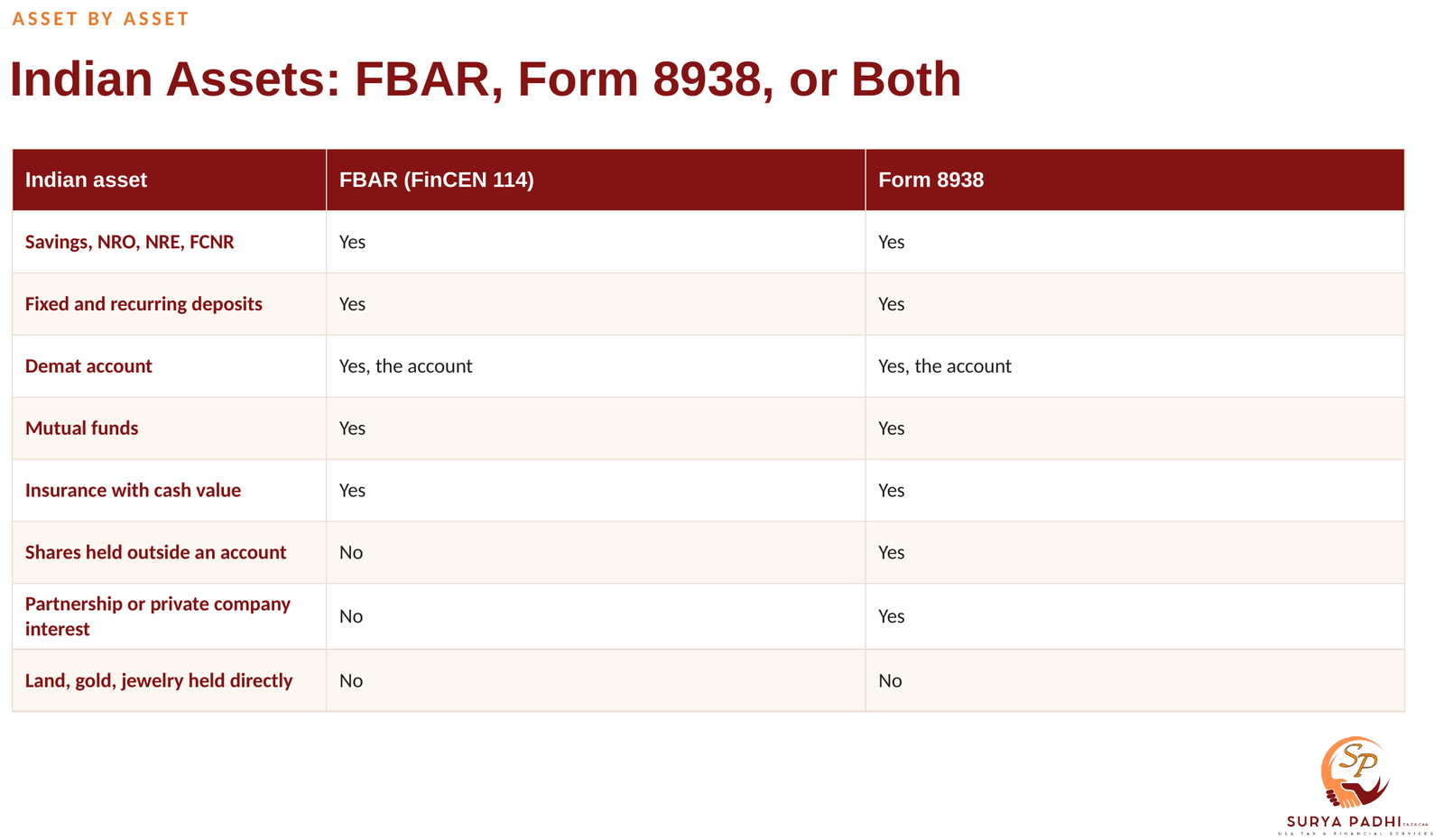
For the FBAR, a foreign financial account is an account at a financial institution located in a foreign country. The IRS lists bank, brokerage and mutual fund accounts, and says you must have a financial interest in the account or signature or other authority over it. Here is how the usual Indian assets sort.
| Indian asset | FBAR | Form 8938 |
|---|---|---|
| Savings, NRO, NRE and FCNR accounts | Yes | Yes |
| Fixed and recurring deposits | Yes | Yes |
| Demat or brokerage account | Yes, the account | Yes, the account |
| Mutual funds | Yes | Yes |
| Insurance or annuity with a cash value | Yes | Yes |
| Shares held outside an account | No | Yes |
| Interest in an Indian partnership or private company | No | Yes |
| Land, gold and jewelry you own directly | No | No |
For a demat account, the account is what you report. The shares inside it are not listed separately on either form. The IRS treats foreign mutual funds as reportable on both forms, and treats foreign-issued life insurance or annuity contracts with a cash value the same way.
What goes on Form 8938 only, and what goes on neither
Form 8938 reaches further than the FBAR. Foreign stock held outside a financial account, interests in foreign partnerships, and foreign hedge funds and private equity funds are reportable on Form 8938 and are not FBAR accounts. If you hold shares in an Indian private company, or a partnership interest, that is a Form 8938 item.
Some assets are on neither form. Foreign real estate you own directly, including a home or rental property, is not reportable. Neither are foreign currency you hold directly, and tangible assets such as gold, jewelry and cars that you hold yourself.
Check how you own it, not just what it is
Real estate held directly is not reportable. Hold the same property through an Indian company or partnership, and the interest in that entity is reportable on Form 8938, with its value including the property.
Indian retirement accounts: the unsettled corner
Form 8938 is explicit. The IRS says an interest in a foreign pension or deferred compensation plan is reportable once you meet the threshold. Value it at the fair market value of your beneficial interest on the last day of the year. If that value is not known or readily available, use the value of what was distributed to you during the year, and if nothing was distributed the value is zero.
The FBAR is less clear for Indian schemes. A PPF account is opened at a bank or post office, which points toward treating it as a foreign financial account. EPF and NPS are less clear-cut. I would not assume they are exempt, and I would not report them without thinking it through. Decide your position for each account, write down the reasoning, and apply it the same way every year.
Foreign social security is different
Rights under a foreign government’s social security or similar program are not reportable on Form 8938. Whether a particular Indian scheme falls on that side of the line is exactly the kind of question to settle before you file, not after.
A worked example
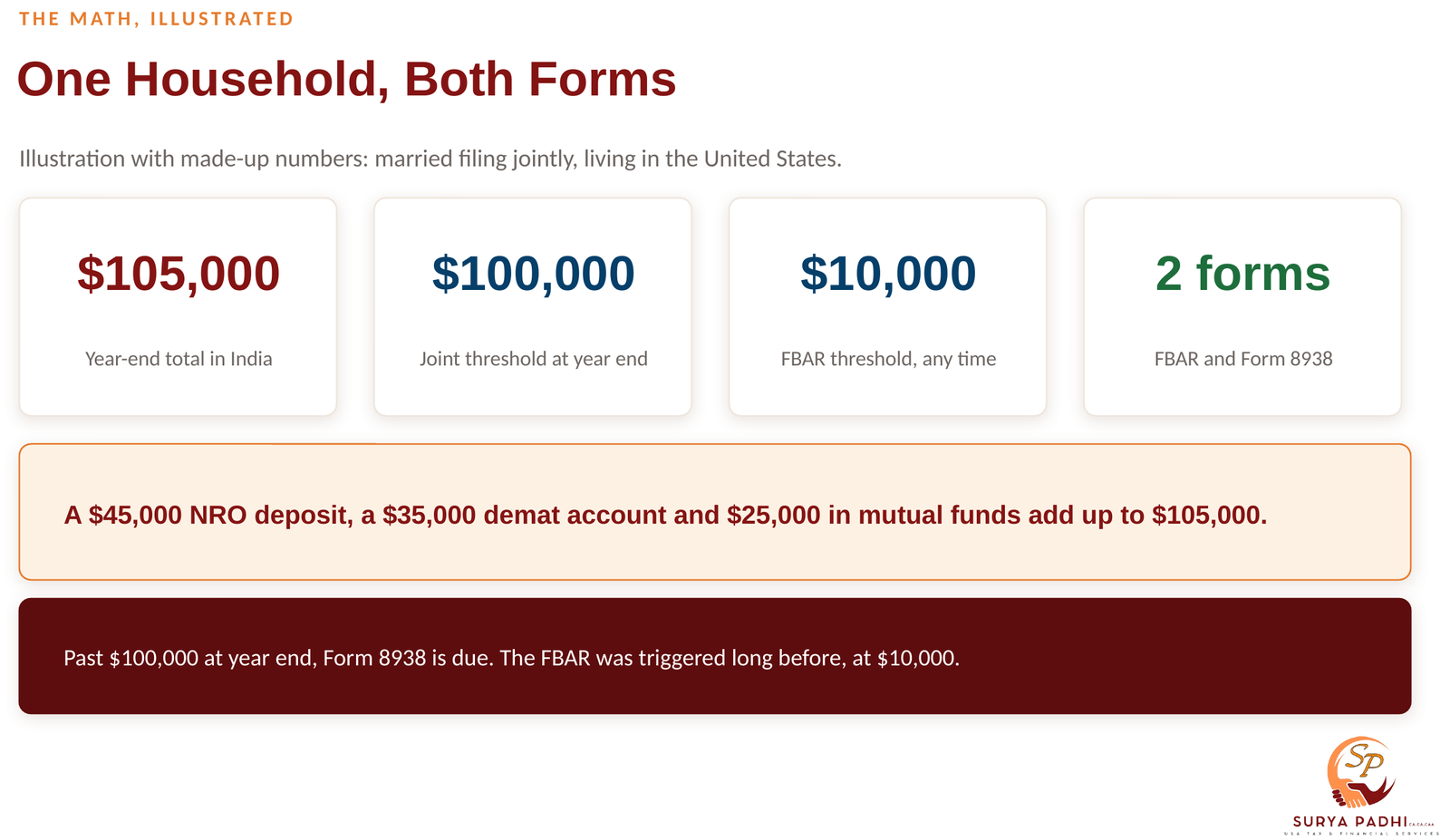
Here is an illustration with made-up numbers, not a client case. A married couple files jointly and lives in the United States. They have an NRO fixed deposit, a demat account and some mutual funds in India.
Illustration: married filing jointly, living in the US
| NRO fixed deposit | $45,000 |
| Demat account | $35,000 |
| Mutual funds | $25,000 |
| Year-end total in India | $105,000 |
| Form 8938 joint threshold at year end | $100,000 |
Illustrative figures. The FBAR applies once combined accounts exceed $10,000 at any time. Form 8938 also applies because the year-end total is over $100,000.
The FBAR was triggered long before the year ended, at $10,000. The year-end total of $105,000 is more than $100,000, so Form 8938 is due with their return as well.
How to value and convert
Both forms report the maximum value during the year, and both convert to US dollars using the exchange rate at the end of the year. Your periodic statements are the source for the maximum.
- List every account and asset in India, including anything held through a company.
- Find the highest balance of each account during the year, in rupees, from your statements.
- Convert to US dollars using the exchange rate at the end of the year.
- Add the accounts up to test the $10,000 FBAR line and your Form 8938 threshold.
- File the FBAR electronically with FinCEN and attach Form 8938 to your return.
Five mistakes to avoid
- Checking only December 31. The FBAR threshold applies at any time in the year, and both forms report the maximum value.
- Skipping the small account. Once you cross the threshold, every account is reported, including one with a tiny balance.
- Assuming one form covers the other. The FBAR goes to FinCEN and Form 8938 goes with your return. Neither replaces the other.
- Ignoring signature authority. You may owe an FBAR for an account you only sign on, such as a parent’s, subject to exceptions.
- Leaving Form 8938 off the return. If you filed without it, the IRS says to file Form 1040-X with Form 8938 attached.
Deadlines and penalties for tax year 2026
| Date | What happens |
|---|---|
| December 31, 2026 | Record every Indian balance and each account’s highest balance for the year. |
| April 15, 2027 | FBAR due, filed electronically with FinCEN. |
| October 15, 2027 | Automatic FBAR extension if you miss April 15. No request is needed. |
| With your return | Form 8938 is due with your tax return, including any extension of that return. |
The Form 8938 penalty for failing to file is $10,000, with up to $50,000 more for continued failure after IRS notice, and a 40 percent penalty on an understatement of tax attributable to undisclosed assets. No penalty applies if the failure was due to reasonable cause and not willful neglect.
FBAR civil penalties are adjusted for inflation. The non-willful maximum was set at $16,536 effective January 17, 2025. Willful violations carry a much higher cap, the greater of $165,353 or half the account balance, and criminal penalties can apply.
Start in December
The work is mostly gathering statements. Do it while every account is easy to log into and every statement is easy to download, not in April.
Frequently asked questions
Does my NRO or NRE account go on the FBAR?
Yes. An NRO or NRE savings account at an Indian bank is a foreign financial account, so it counts toward the $10,000 FBAR threshold and is reported on the FBAR. It is also reported on Form 8938 if you meet that form’s higher threshold.
Do Indian mutual funds go on the FBAR and Form 8938?
Yes. The IRS treats foreign mutual funds as reportable on both forms. Mutual funds are also a separate issue for your return because they are generally passive foreign investment companies, which may require Form 8621.
Do I report my PPF, EPF or NPS on the FBAR?
Form 8938 clearly covers foreign pension interests once you meet the threshold. For the FBAR it is a judgment call: a PPF account at a bank or post office points toward reporting, while EPF and NPS are less clear. Decide, document your reasoning, and apply it consistently.
Is real estate I own in India reported on the FBAR or Form 8938?
No, not when you own it directly. Foreign real estate held directly, including a home or rental property, is not reportable on either form. If you hold it through an Indian company or partnership, the interest in that entity is reportable on Form 8938.
Not sure what to report from India?
We read your Indian statements and build the FBAR and Form 8938 list with you. Your Indian filings stay with a practising Chartered Accountant in India, and we make sure the US side is done right.
This article is general tax education and does not constitute individualized tax, legal or financial advice. Figures are stated for the tax year shown and are subject to IRS adjustment. Consult a qualified professional about your own facts. Surya Padhi holds the Indian Chartered Accountant qualification but is not licensed to practise in India and does not provide Indian tax filing or advisory services.