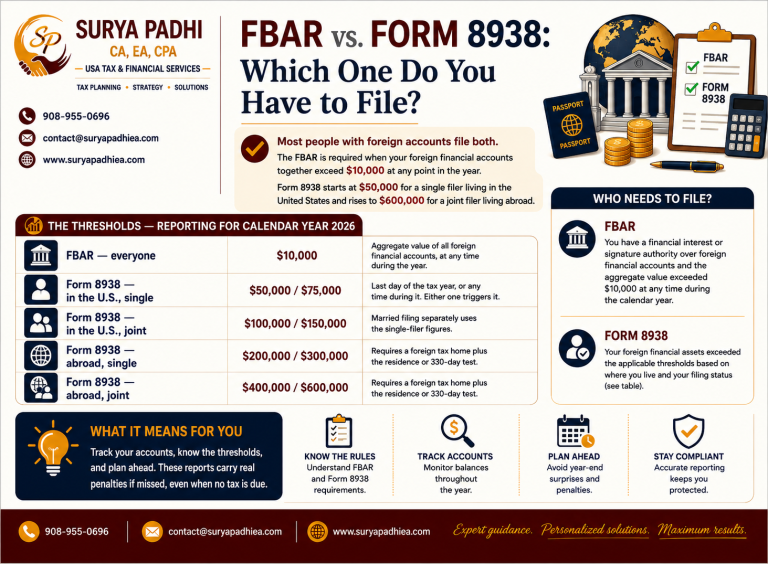
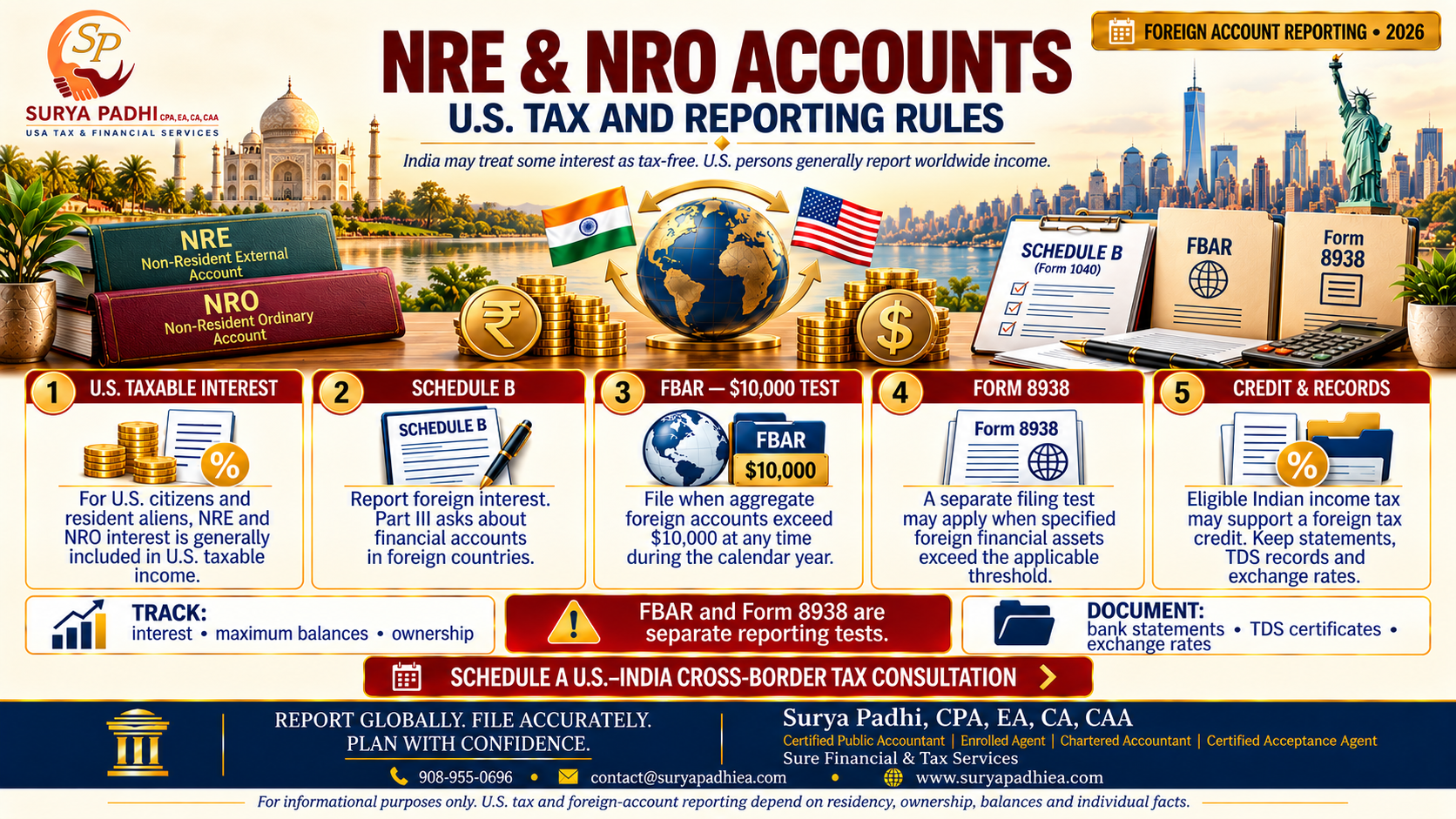
If you are a US citizen, green card holder or US tax resident, your NRE and NRO accounts are foreign accounts for US purposes. Report the interest on your Form 1040, file an FBAR when their combined peak balances exceed $10,000, and file Form 8938 if you cross its higher thresholds. India’s tax treatment does not change that.
6:59. The written version, the figures and the sources are all below.
| FBAR trigger | $10,000 | Combined highest balances of all foreign accounts at any time in the year. An aggregate test on FinCEN Form 114. |
|---|---|---|
| Form 8938, single, living in the US | $50,000 | Year-end value, or $75,000 at any time during the year. |
| Form 8938, joint, living in the US | $100,000 | Year-end value, or $150,000 at any time during the year. |
| Form 8938, single, living abroad | $200,000 | Year-end value, or $300,000 at any time. Joint filers abroad: $400,000 and $600,000. |
| FBAR due date | April 15 | Automatic extension to October 15. No request is needed. |
Your Indian bank may call the interest tax-free. The IRS does not, and the accounts may need an FBAR and a Form 8938 as well.
If you moved to the United States from India and kept your bank accounts back home, you probably hold an NRE account, an NRO account, or both. Your Indian bank describes them in Indian terms: what India taxes, what you can repatriate, what rate the deposit earns. None of that tells you what the IRS expects, and the gap between the two is where most of the mistakes happen.
This guide covers the US side only: who has to report, which forms apply, how the interest is taxed on your Form 1040, and what to do about years you may have missed. Indian filings and Indian tax advice belong with a practising Chartered Accountant in India. The goal here is to read your Indian documents correctly for your US return.
Key takeaways
- Your US status decides your reporting, not the NRE or NRO label.
- The FBAR adds up the highest balance of every foreign account, so no single account has to exceed $10,000.
- The FBAR and Form 8938 are separate filings, and one account can trigger both.
- NRE interest may be exempt in India, but it is taxable income on your US return.
What NRE and NRO accounts are, and why the labels do not matter to the IRS
An NRE account (non-resident external) holds money you transfer in from abroad, typically your earnings in the United States. An NRO account (non-resident ordinary) holds income that arises in India, such as rent, dividends or a pension. Indian rules treat the two differently, so your bank sorts your deposits into one or the other.
For US purposes there is no such distinction. Both are accounts at a financial institution outside the United States, both can earn interest, and both can be reportable. The Indian label is useful for reading your statements. It does not decide your US filings.
Are you a US person? That decides everything
US reporting follows your US tax status, not your status in India. If you are a US citizen, a green card holder, or a resident alien under the substantial presence test, you report your worldwide income and your foreign accounts. Being a non-resident Indian under Indian law has no bearing on that.
- US citizens report worldwide income and foreign accounts every year, wherever they live.
- Green card holders are treated the same way once they hold the card.
- Other visa holders can become resident aliens by counting days in the United States over three years, and many cross that line without noticing.
If your status is unclear, settle it first. Everything below depends on it.
The FBAR: add up the peak balances
The Report of Foreign Bank and Financial Accounts, filed on FinCEN Form 114, is required when the combined highest balances of all your foreign accounts exceed $10,000 at any time during the year. It is an aggregate test. No single account has to be over the line.
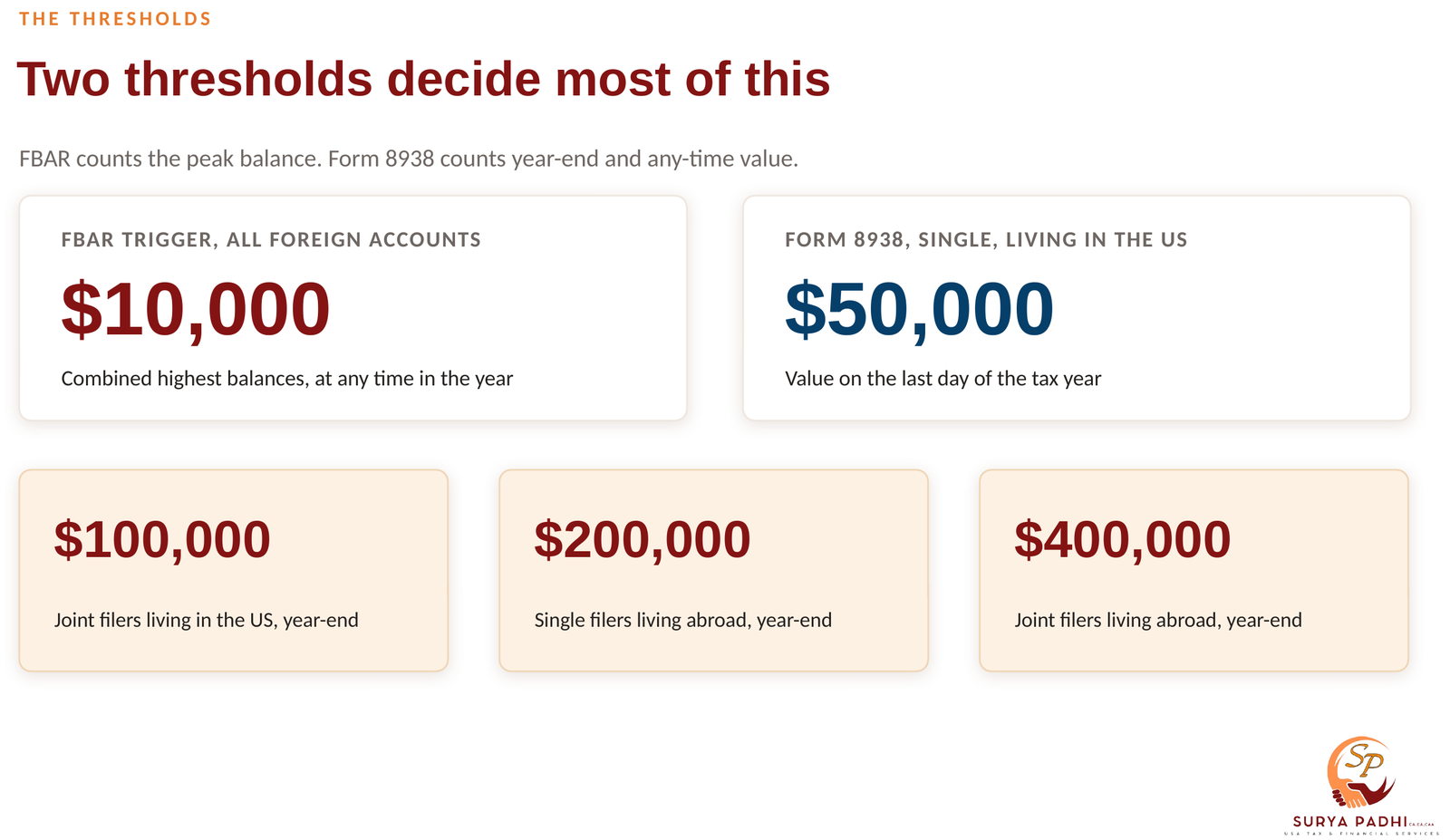
Count the highest balance each account reached during the year, not the balance on December 31. Convert each peak to dollars, add them up, and include savings accounts, fixed deposits, joint accounts, and accounts you closed during the year.
Illustrative example: no account over $10,000
| NRE savings account, highest balance | $6,500 |
| NRO savings account, highest balance | $3,200 |
| Fixed deposit, highest balance | $1,800 |
| Combined total | $11,500 |
| Any single account over $10,000? | No |
| FBAR required? | Yes |
Made-up balances in US dollars, to show how the aggregate test works.
Peak, not year-end
An account you emptied in March still counts if it was open and funded earlier in the year. A zero balance today does not mean a zero balance for the FBAR.
The FBAR is filed electronically with FinCEN through the BSA E-Filing system. It is not attached to your tax return. It is due April 15, with an automatic extension to October 15 that needs no request.
Form 8938: the second filing
Form 8938 is the other half of the picture. It is attached to your Form 1040 and reports specified foreign financial assets, a broader category than bank accounts, once their value passes thresholds that depend on your filing status and where you live. For a single filer living in the United States, the starting point is $50,000 on the last day of the year.
| FBAR | Form 8938 | |
|---|---|---|
| Filed with | FinCEN, electronically | The IRS, with your Form 1040 |
| Trigger | Combined peak balances over $10,000 | Higher thresholds by filing status and residence |
| What it covers | Foreign financial accounts | Accounts and other foreign financial assets |
| Due date | April 15, with an automatic extension to October 15 | With your return, including extensions |
Many Indian accounts appear on both forms. Filing one never replaces the other. If both apply, file both.
The income side: how NRE and NRO interest is taxed on your 1040
Separate from the forms, the interest itself is income. Report the interest from every NRE and NRO account and every fixed deposit on your Form 1040, converted to dollars with a consistent, documented exchange rate. The Schedule B question about foreign accounts has to be answered honestly as well.
Tax-free in India is not tax-free here
NRE interest may be exempt from Indian tax. The United States still taxes it as ordinary interest income, because a US person is taxed on worldwide income.
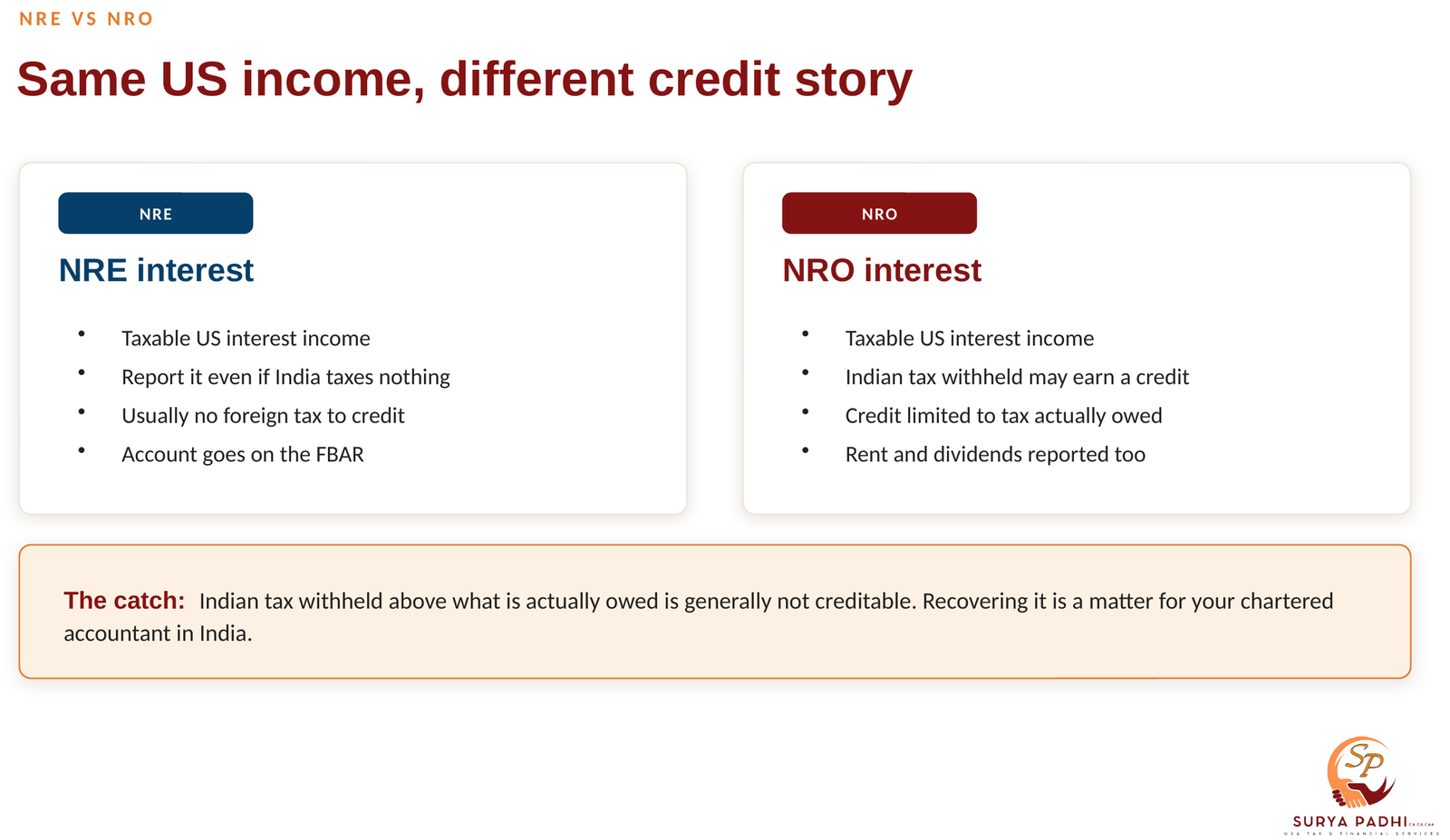
NRO interest usually has Indian tax withheld at the source. That tax may qualify for a foreign tax credit, but the credit is limited to the tax you actually owe. Withholding above that amount is generally not creditable and may need to be recovered in India, which is a question for your Indian Chartered Accountant.
Cumulative fixed deposits that pay interest only at maturity can also raise a timing question about which year the interest belongs to, so check them before you assume.
Joint accounts, parents’ accounts and nominees
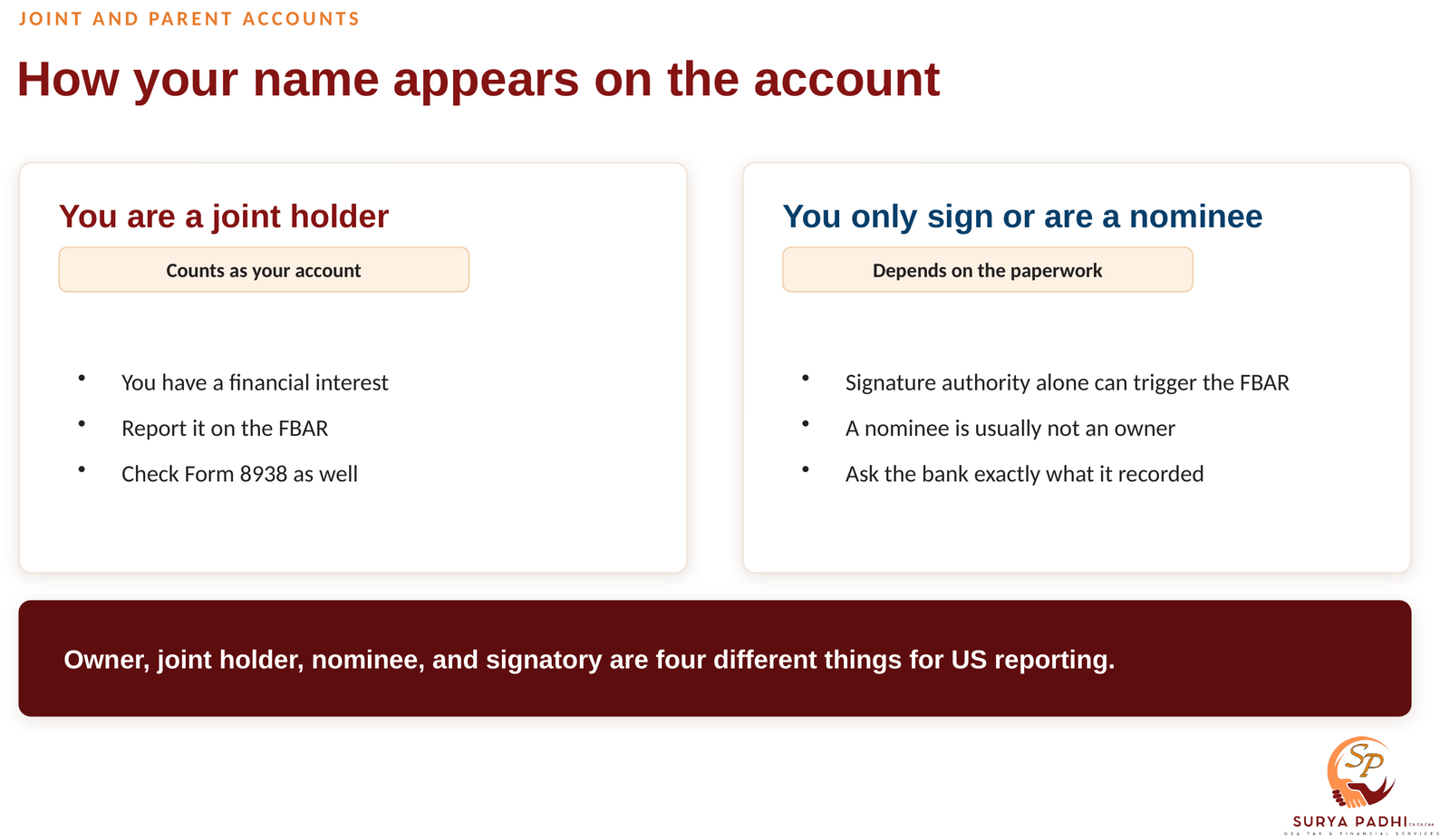
Many people have an Indian account that is really their parents’, with their own name added for convenience. How your name appears is what decides the US treatment.
- Owner or joint holder: you have a financial interest, and the account is reportable.
- Signature authority only: you can control the account without owning it, and that alone can trigger the FBAR.
- Nominee: in India a nominee generally receives the money after the holder’s death and is usually not an owner, but check the paperwork rather than assuming.
Ask for the paperwork
Request the account opening form and your current mandate from the bank. The exact wording is more reliable than anyone’s memory of how the account was set up.
If you missed earlier years
Missing an FBAR or a Form 8938 is more common than most people expect, and it is usually fixable. The right approach depends mainly on whether the failure was willful, which is a question of facts, so settle the route before you file anything late.
- Gather statements for every year, including accounts you closed.
- Total the peak balances year by year and check which forms applied.
- Choose the procedure that fits your facts, such as streamlined filing or a delinquent FBAR submission.
- Report all income and credits correctly in each year.
- File before the IRS contacts you, which generally keeps more options open.
Penalties depend on facts
Penalties differ for willful and non-willful failures, and they can be severe. Talk to a professional before you submit late forms.
Frequently asked questions
Is NRE account interest taxable in the US?
Yes. NRE interest is taxable as ordinary interest income on the Form 1040 of a US citizen, green card holder or resident alien, even when India does not tax it.
Do I report an NRO account on the FBAR?
Yes, if you are a US person and the combined peak balances of all your foreign accounts exceed $10,000 at any time in the year. NRO accounts count toward that total just like NRE accounts and fixed deposits.
Do I file both an FBAR and Form 8938?
Possibly, because they are separate filings with different thresholds. The FBAR goes to FinCEN and Form 8938 is attached to your tax return, and filing one does not replace the other.
I only have signature authority over my parent’s account in India. Do I have to report it?
Signature authority alone can trigger an FBAR even when the money is not yours, so the account needs to be counted. Whether Form 8938 applies depends on whether you have an ownership interest in the account.
Not sure what your Indian accounts trigger?
We read the statements, add up the peak balances, and tell you which US forms apply. If you also have earlier years to fix, we will help you choose the right route.
This article is general tax education and does not constitute individualized tax, legal or financial advice. Figures are stated for the tax year shown and are subject to IRS adjustment. Consult a qualified professional about your own facts. Surya Padhi holds the Indian Chartered Accountant qualification but is not licensed to practise in India and does not provide Indian tax filing or advisory services.