PFIC Rules: Why a Foreign Mutual Fund Is a Tax Problem
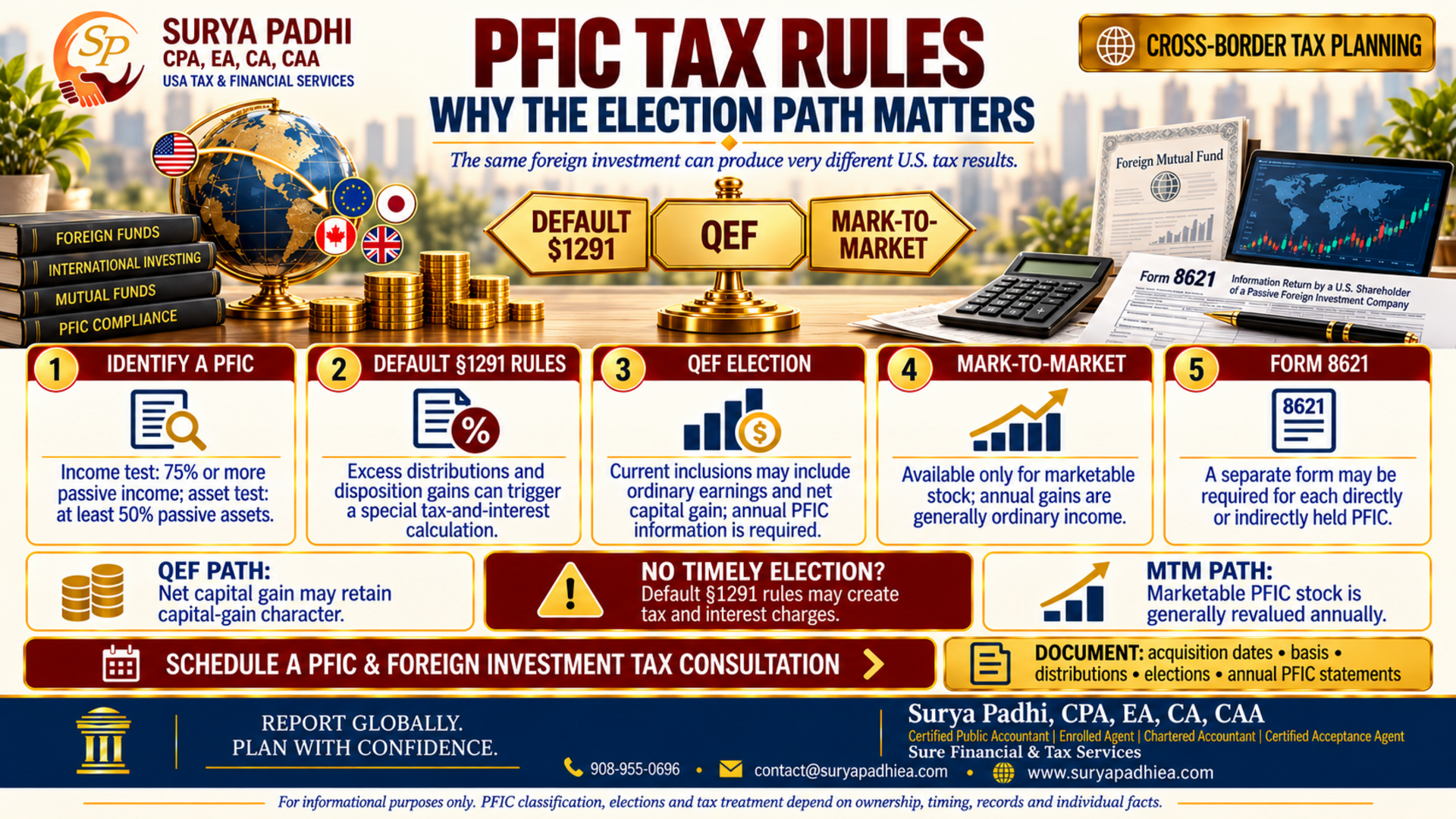
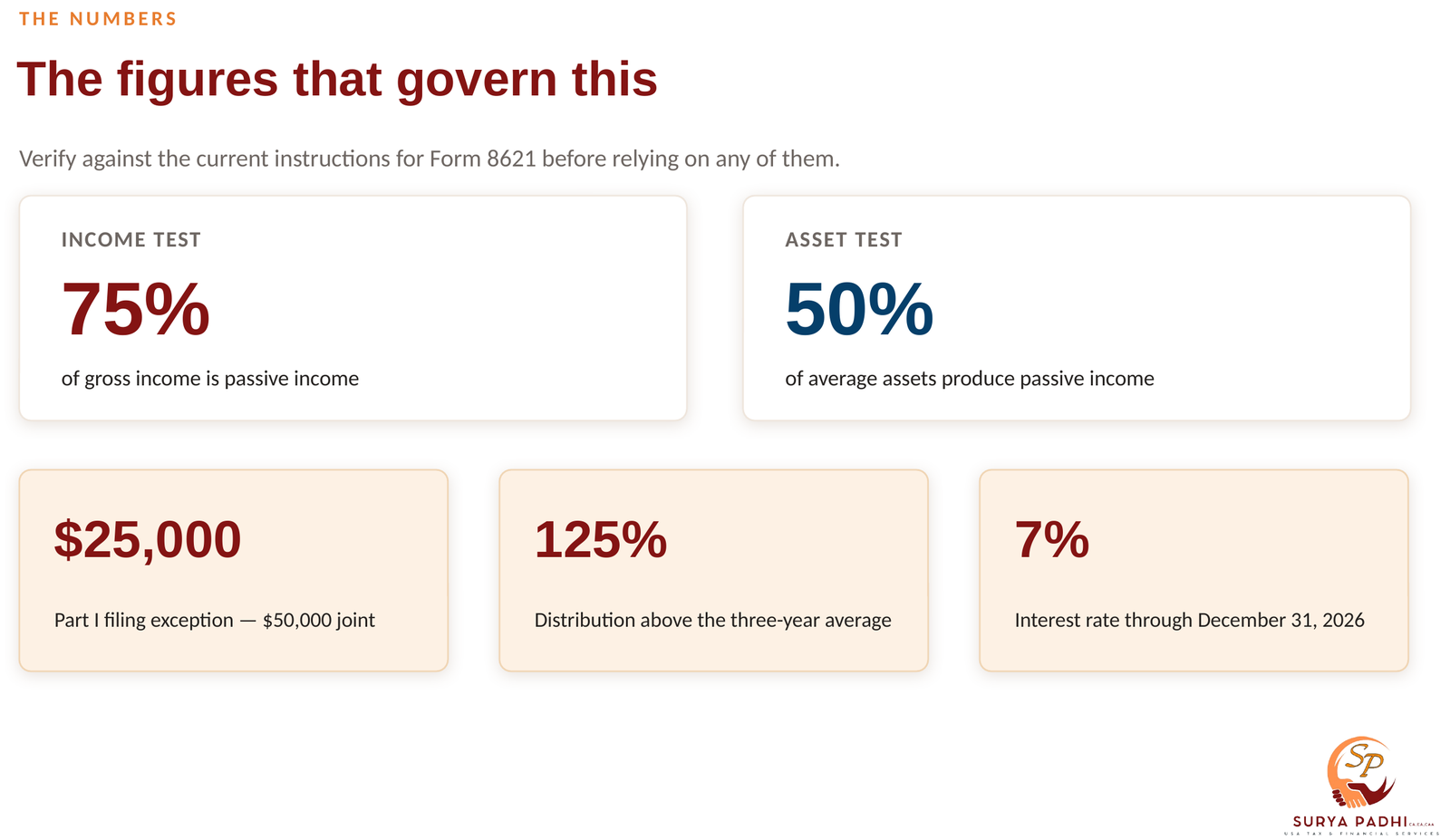
A foreign mutual fund is almost always a PFIC — 75% or more of its gross income is passive, or 50% or more of its assets are. Without a QEF or mark-to-market election, gain is taxed as ordinary income at the top rate for each prior year, plus an interest charge.
7:05. The written version, the figures and the sources are all below.
| Income test | 75% | Gross income that is passive income makes the fund a PFIC. |
|---|---|---|
| Asset test | 50% | Average assets producing, or held to produce, passive income. |
| Form 8621 Part I exception | $25,000 | Aggregate PFIC value on the last day of the year. $50,000 on a joint return. |
| Excess distribution trigger | 125% | Of the average distributions over the three preceding tax years. |
| Rate on prior-year slices | 37% | The highest individual rate in effect for each of those years. |
| Interest rate | 7% | The §6621 underpayment rate, confirmed through December 31, 2026. |
A fund that is perfectly ordinary in London or Mumbai becomes one of the most expensive things a US taxpayer can own — and the cost is built into the default rules, not into any mistake you made.
The PFIC rules are the reason a perfectly ordinary savings product from another country turns into one of the most expensive things a US taxpayer can own. A foreign mutual fund, a UCITS fund, a SICAV, an Indian equity fund, a Canadian ETF — nearly all of them meet the definition of a passive foreign investment company, and the moment they do, the tax treatment you would expect from a US fund disappears.
Nobody makes a mistake to get here. There is no de minimis holding, no threshold you can stay under, and no exception for a fund you inherited or bought before you ever became a US taxpayer. One share is enough. What follows is the definition, the three ways the income can be taxed, the arithmetic on a real gain, and what to do if you already own one.
Key takeaways
- Two tests define a PFIC. Meeting either one, in any single year, is enough.
- The default regime taxes gain as ordinary income at prior-year top rates and adds an interest charge.
- A QEF or mark-to-market election fixes the treatment going forward — but only if you can actually make it.
- Form 8621 is filed per fund, not per taxpayer, and the $25,000 exception disappears the year you sell.
What makes a fund a PFIC
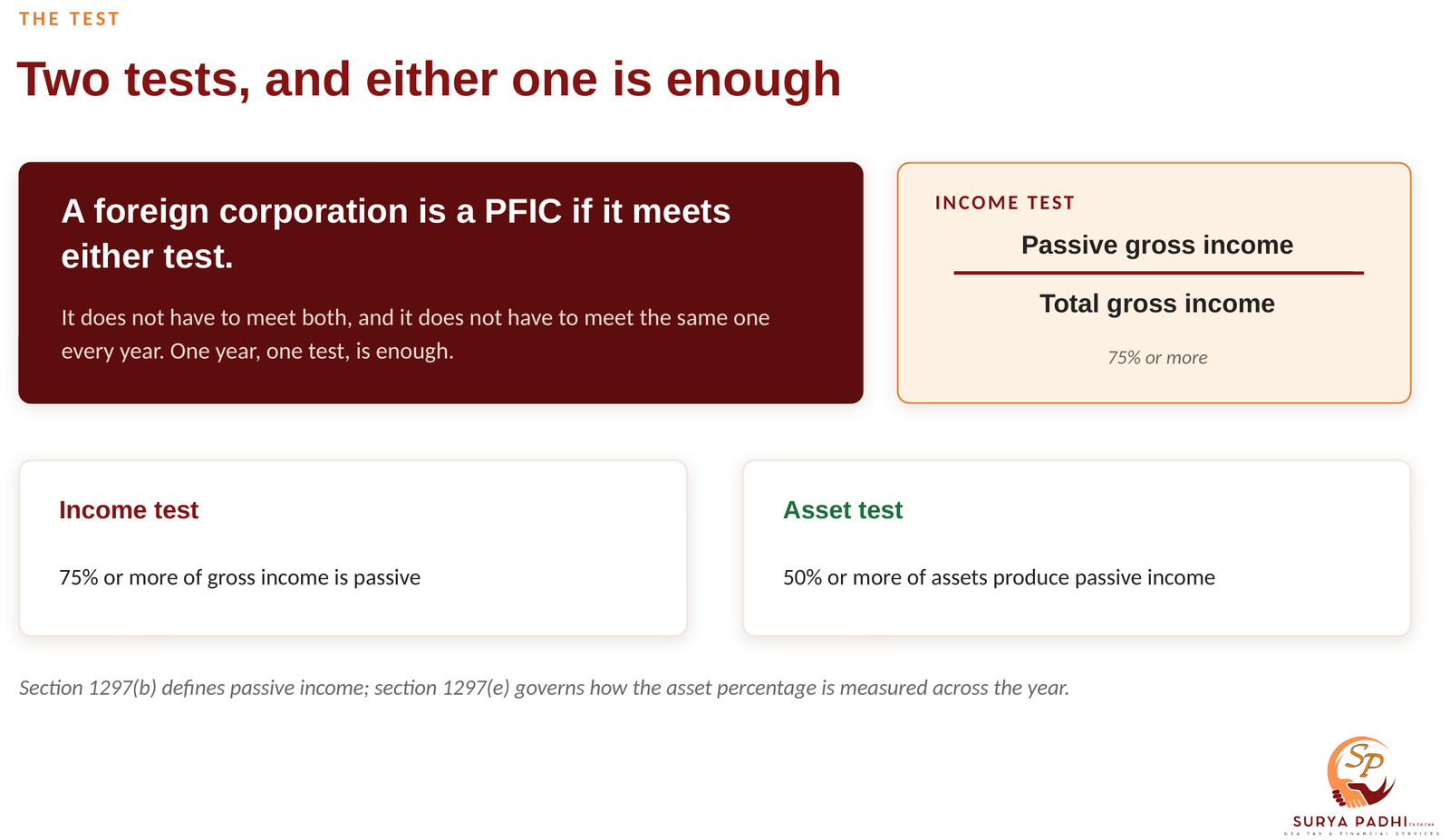
A foreign corporation is a passive foreign investment company if it meets either of two tests in a tax year. The first is the income test: 75% or more of the corporation’s gross income for the year is passive income. The second is the asset test: at least 50% of the average percentage of assets it held during the year are assets that produce passive income, or that are held for the production of passive income.
Read those two sentences again with a mutual fund in mind. A fund exists to hold securities and collect dividends and interest. It meets both tests by design — that is what a fund is. So the question is almost never <em>whether</em> a foreign fund is a PFIC. It is whether you know that it is.
| The test | The threshold | What it means for a fund |
|---|---|---|
| Income test | 75% or more of gross income is passive | A fund’s income is dividends, interest and gains. It clears this on day one. |
| Asset test | 50% or more of average assets produce passive income | A fund’s assets are securities. It clears this on day one too. |
| Either, not both | One test in one year | A corporation can become a PFIC in a year it holds a large cash balance. |
There is no small-holding exception
The definition does not depend on how much you own. One share of a foreign fund makes you a shareholder of a PFIC. The $25,000 figure discussed later is a reporting exception only — it does not change how the income is taxed.
Why the PFIC rules make a foreign fund expensive
If you make no election, the fund is what the instructions call a section 1291 fund, and it is taxed under the excess distribution regime. Two things trigger it: an excess distribution, which is the part of a distribution greater than 125% of the average distributions you received on that stock over the three preceding tax years, and a disposition — because the entire gain on the sale of a section 1291 fund is treated as an excess distribution.
Once triggered, the amount is spread ratably across the days in your holding period, and then each slice is taxed differently depending on which year it lands in.
- The slice allocated to the current tax year, and to any years before the corporation was a PFIC, is taxed as ordinary income on this year’s return.
- Each slice allocated to a prior PFIC year is taxed separately, at the highest individual rate in effect for that year — 37% for every recent year — regardless of your own bracket.
- Interest is added to each of those prior-year amounts at the section 6621 underpayment rate, running from the due date of that year’s return to the due date of the return for the year of the excess distribution.
Long-term capital gain treatment is gone
This is the part people get wrong. Under the excess distribution regime there is no long-term capital gain rate, no matter how long you held the fund. Every dollar is ordinary. Holding for ten years does not help you — it makes the interest charge larger.
What it actually costs: a worked example
A client bought a UCITS equity fund for $50,000 in January 2022 and sold it in 2026 for $80,000. Five years, no distributions along the way, a $30,000 gain. She is in the 32% bracket for 2026. The fund was a PFIC for the whole period and she made no election.
One sale, five slices
| Sale proceeds | $80,000 |
| Cost basis | ($50,000) |
| Gain — all of it an excess distribution | $30,000 |
| Allocated ratably over 5 years | $6,000 per year |
| 2026 slice — ordinary income at 32% | $1,920 |
| 2022–2025 slices — $24,000 at 37% | $8,880 |
| Interest on the four prior-year amounts | $1,731 |
| Total federal cost | $12,531 |
| The same gain in a US fund at 15% | $4,500 |
Interest is estimated at 7% compounded daily on each year’s deferred tax from that year’s return due date to April 15, 2027. The rate is set quarterly and has been higher in some past quarters, so treat that line as an approximation, not a quote.
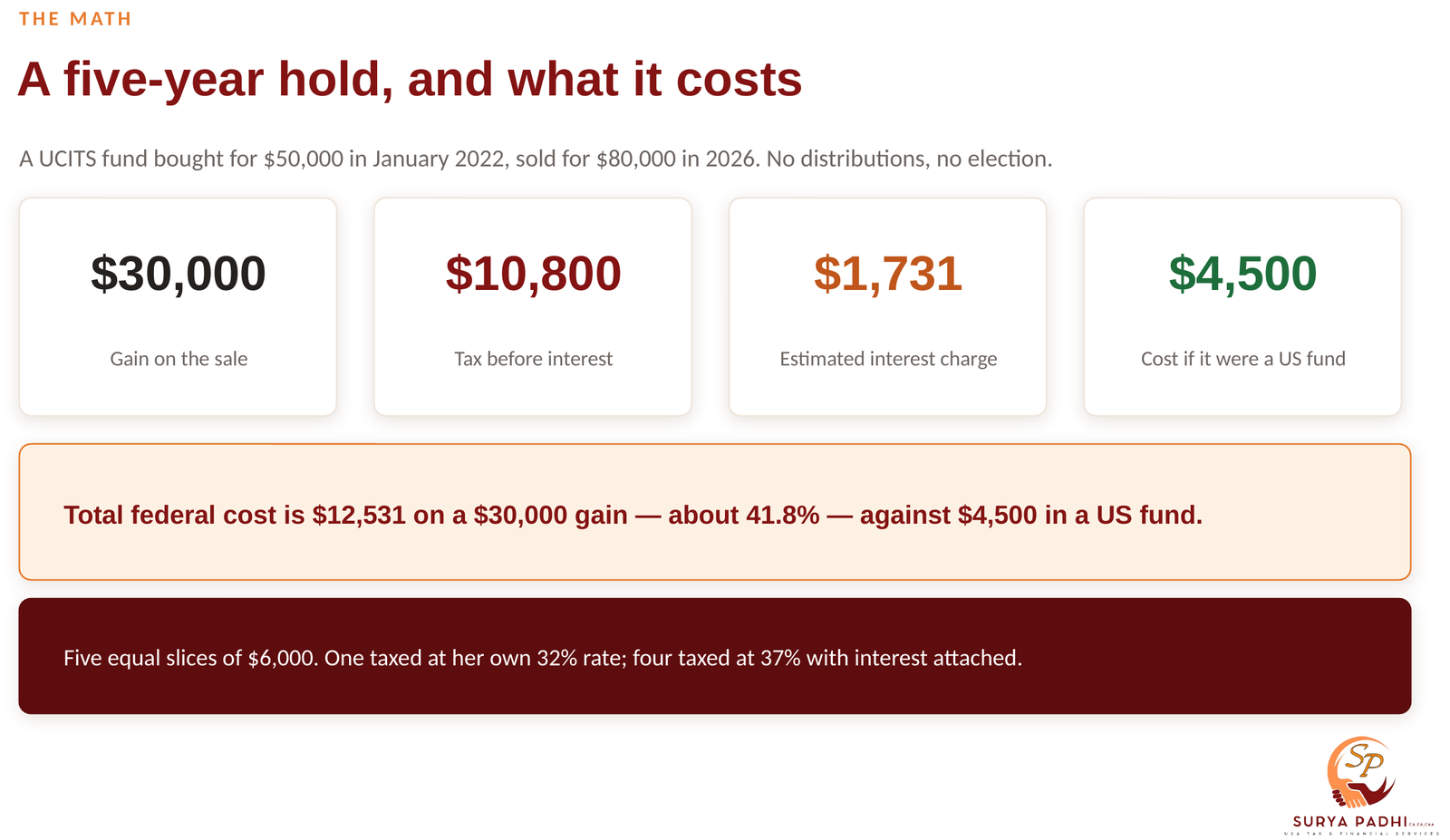
The tax alone is $10,800 on a $30,000 gain — 36%. Add the interest and the total is $12,531, an effective rate of about 41.8% on a gain that would have been long-term capital gain in any US fund. The gap is $8,031, and none of it comes from a mistake. It is simply what the default rules produce.
Why the holding period cuts the wrong way
A longer hold means more prior-year slices, each taxed at 37% and each carrying interest for longer. The single worst version of this is a fund held quietly for twenty years and sold in retirement.
The two elections: QEF and mark-to-market
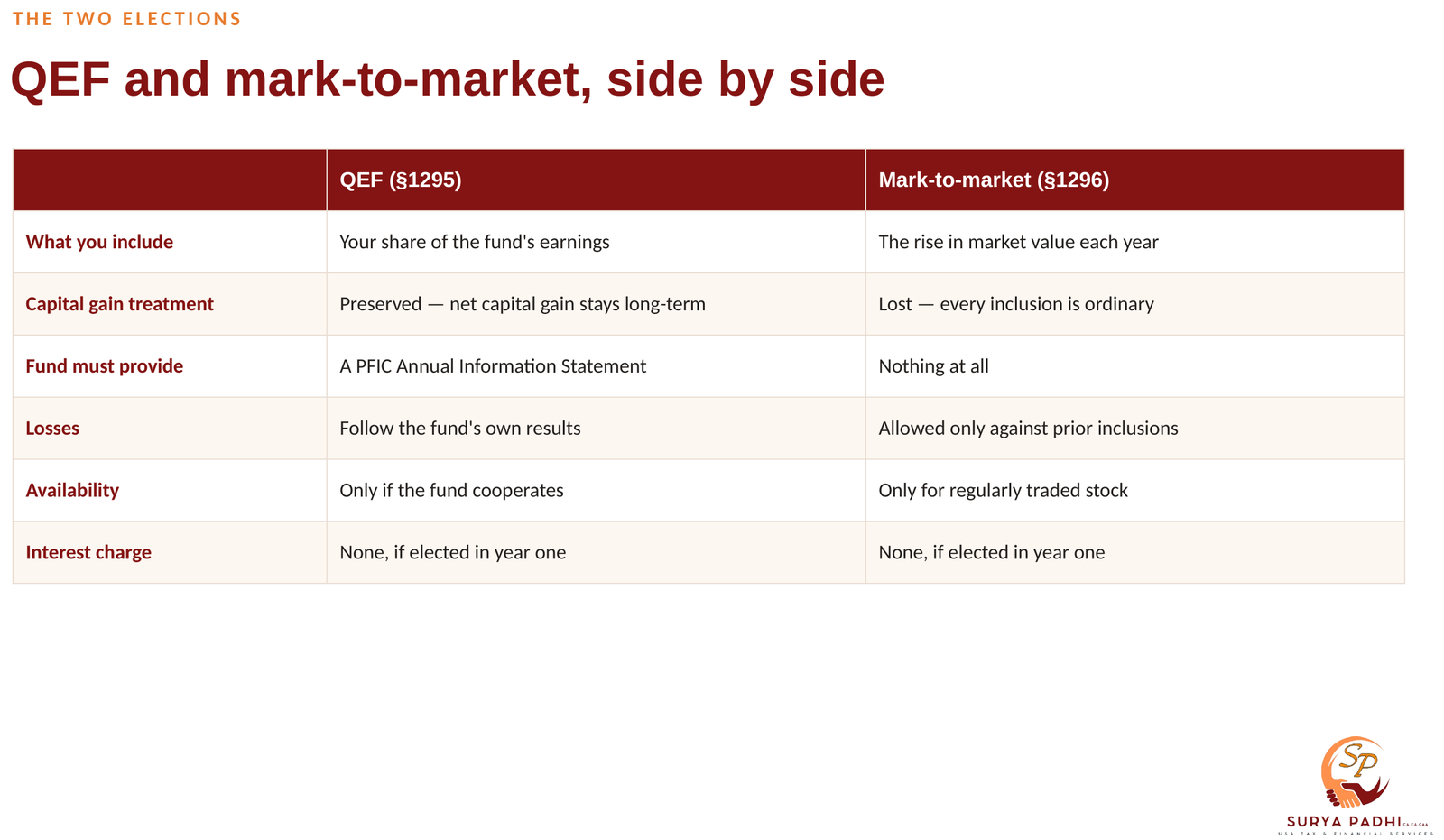
There are two ways out, and both replace the excess distribution regime with annual reporting. A qualified electing fund election under section 1295 means you include your pro rata share of the fund’s ordinary earnings as ordinary income each year, and your pro rata share of its net capital gain as long-term capital gain. It is the only regime that preserves capital gain treatment.
| QEF election (§1295) | Mark-to-market (§1296) | |
|---|---|---|
| What you include each year | Your share of the fund’s earnings, whether or not distributed | The increase in market value over your basis |
| Capital gain treatment | Preserved — net capital gain stays long-term | Lost — every inclusion is ordinary income |
| What the fund must give you | A PFIC Annual Information Statement | Nothing |
| Losses | Follow the fund’s own results | Deductible only against prior unreversed inclusions |
| Availability | Only if the fund produces the statement | Only for marketable stock regularly traded on a qualifying exchange |
| Interest charge | None, if elected for the first year you hold it | None, if elected for the first year you hold it |
The practical problem with QEF
The election depends on the fund handing you a PFIC Annual Information Statement. A foreign fund with no US investor base has no reason to prepare one, and many simply do not. Ask before you buy — after the fact you have no leverage at all.
The mark-to-market election is available only for marketable stock: PFIC stock regularly traded on a national securities exchange registered with the SEC, on the national market system, or on a foreign securities exchange regulated or supervised by a governmental authority of that country. A listed foreign ETF often qualifies. An unlisted mutual fund almost never does.
Form 8621: who files, and the $25,000 exception
Form 8621 is filed per fund, not per taxpayer. Ten foreign funds means ten forms, each attached to your return and filed by the return’s due date including extensions. The instructions require a shareholder to file when any of five things happen in the year.
- You receive a direct or indirect distribution from a PFIC.
- You recognize gain on a direct or indirect disposition of PFIC stock.
- You are reporting information for a QEF or a mark-to-market election.
- You are making an election reportable in Part II of the form.
- You are required to file an annual report under section 1298(f).
That last one is the annual report in Part I, and it is the piece the exception addresses. You are not required to complete Part I for a section 1291 fund if, on the last day of your tax year, the aggregate value of the PFIC stock you own directly or indirectly is $25,000 or less — $50,000 on a joint return — and you did not receive an excess distribution from, or recognize gain on, that fund. A separate $5,000 threshold covers stock held indirectly.
The exception evaporates in the year you sell
It is conditional on there being no excess distribution and no gain. The year you dispose of the fund is precisely the year both conditions fail — so the exception protects you in the quiet years and disappears in the expensive one. It also never applies to a fund you have elected on.
What to do if you already own one
Most people find out about this after the fact, often when a new preparer asks what the foreign line items on a brokerage statement are. The position is fixable, but the order of operations matters, and doing nothing is the one choice that reliably gets worse.
- Inventory every foreign fund, ETF and pooled account, with its purchase date and cost. The holding period drives the whole calculation.
- Ask each fund whether it issues a PFIC Annual Information Statement, and check whether the stock is regularly traded on a qualifying exchange.
- Model the cost of selling now against continuing to hold. A longer hold means more slices and more interest, so waiting is rarely free.
- For a fund you keep, make the election on a timely filed return. An election made in a later year does not undo the earlier section 1291 exposure without a purging election.
The cheapest version of this problem
It is the one you avoid. If you are a US taxpayer living abroad, or a US resident with an account left behind in another country, hold cash, individual securities or US-registered funds. The PFIC regime does not reach any of those.
One caution about the timing. Making a QEF or mark-to-market election in a year after the first year you owned the fund does not clean up the past by itself. The pre-election period stays in the section 1291 regime unless you also make a purging election, which generally means recognizing the built-in gain. That is a decision to make with a preparer and a spreadsheet, not on a hunch.
Frequently asked questions
Is every foreign mutual fund a PFIC?
Not by statute, but as a practical matter nearly all of them are. A fund fails the income test because its income is dividends, interest and gains, and it fails the asset test because its assets are securities. Foreign-domiciled ETFs, UCITS funds, SICAVs and pooled pension-style investment accounts generally fall inside the definition. A US-registered fund that happens to invest overseas is not a PFIC — the test looks at where the fund is organized, not where it invests.
Do I have to file Form 8621 if the fund paid me nothing?
Possibly not. The annual report in Part I is not required for a section 1291 fund if the aggregate value of your PFIC stock is $25,000 or less on the last day of your tax year — $50,000 on a joint return — and you received no excess distribution and recognized no gain on it. If you have made a QEF or mark-to-market election, or if you sold during the year, the form is required regardless.
Can I just sell the fund and be done with it?
Selling ends the future exposure but triggers the full section 1291 calculation on the accumulated gain, because the entire gain on a disposition is treated as an excess distribution. That is often still the right answer, particularly if the built-in gain is small or the fund is one you would not choose today. It is worth modelling both paths before you place the trade rather than after.
What is the difference between the QEF and mark-to-market elections?
A QEF election taxes you on the fund’s actual earnings each year and preserves long-term capital gain treatment on its net capital gain, but it works only if the fund gives you a PFIC Annual Information Statement. A mark-to-market election taxes the annual increase in market value as ordinary income and needs no cooperation from the fund, but it is available only for stock that is regularly traded on a qualifying exchange.
Does a foreign pension or retirement account fall under these rules?
It depends on the structure and, in some cases, on a treaty. Some foreign retirement arrangements hold the underlying investments in a way that raises PFIC questions and some do not, and a few treaties address the account itself rather than what it holds. This is one of the places where the answer genuinely turns on the specific plan documents, so it is worth having the account reviewed rather than assuming either way.
Not sure what you are holding?
If you have a foreign fund, an overseas brokerage account or a retirement arrangement in another country, a foreign reporting consult will tell you what is inside the PFIC rules, what has to be filed, and what the elections would cost.
This article is general educational information, not individualized tax or investment advice. Figures cited are subject to IRS adjustment. Consult a qualified professional about your own facts.