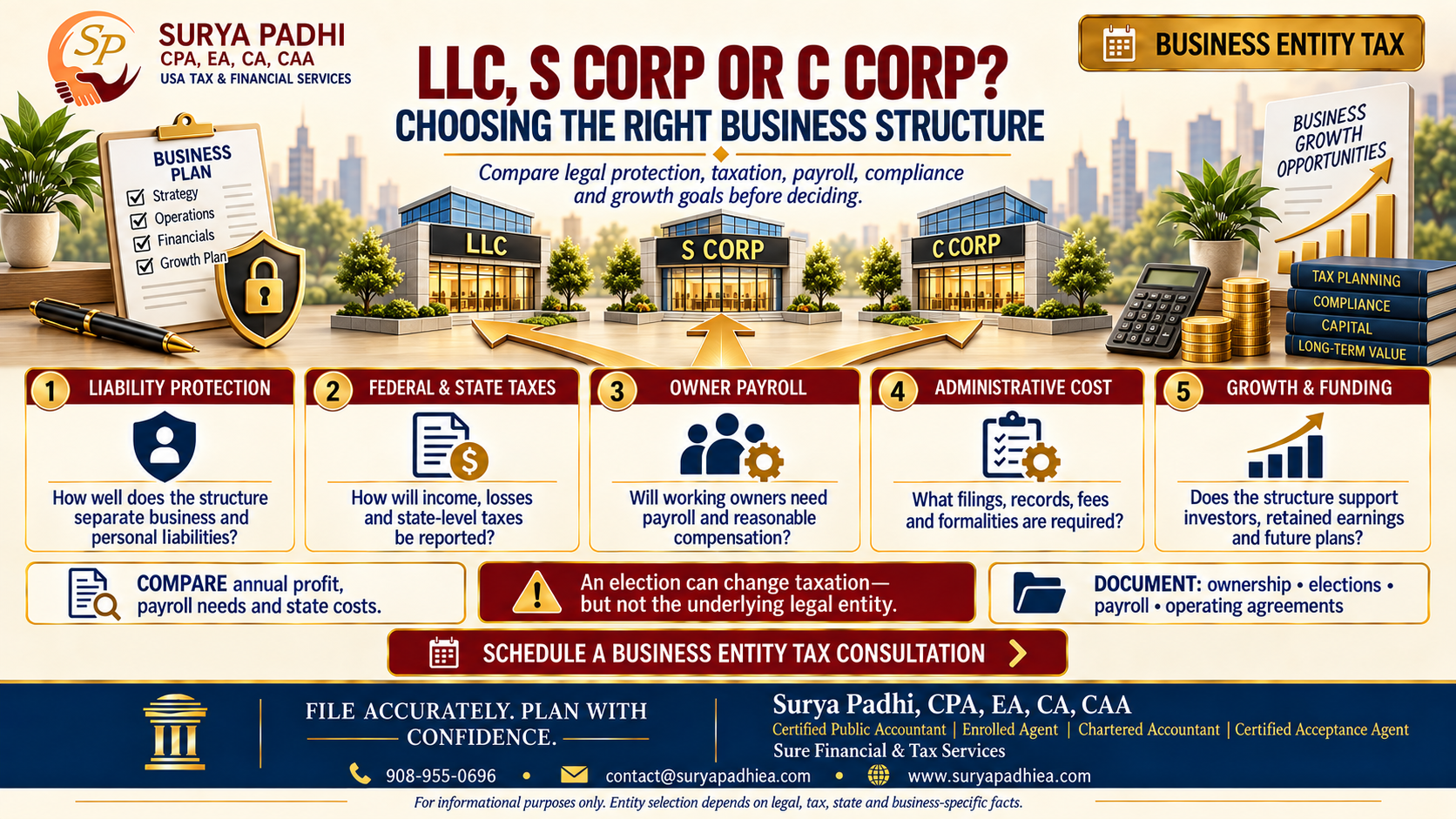
Choosing a business entity comes down to two questions. State law decides liability protection, and the IRS classification decides tax. Sole proprietors and partners pay self-employment tax on all profit, S corporation owners pay payroll tax only on a reasonable salary, and C corporations pay a flat 21%, with dividends taxed again.
8:20. The written version, the figures and the sources are all below.
| C corporation tax rate | 21% | Flat federal rate on corporate taxable income, IRC section 11. |
|---|---|---|
| Self-employment tax | 15.3% | 12.4% Social Security plus 2.9% Medicare, on 92.35% of net earnings. |
| 2026 Social Security wage base | $184,500 | Social Security tax stops above this amount; Medicare does not. Announced by SSA, October 2025. |
| QBI deduction | Up to 20% | For pass-through owners; made permanent by the One Big Beautiful Bill Act. Not available to C corporations. |
| S corporation shareholders | 100 maximum | One class of stock; eligible shareholders only. |
| Form 2553 deadline for 2027 | March 15, 2027 | Two months and fifteen days after the start of a calendar tax year. |
The LLC answers the legal question. The tax classification answers the money question. Here is how each of the five options is taxed, and who each one fits.
Choosing a business entity is usually done in a hurry, on a formation website, before anyone has looked at the numbers. That is a problem, because the structure you pick decides how your profit is taxed, whether you owe self-employment tax on all of it, and what it will cost to change your mind later.
There are five structures most owners choose from: sole proprietorship, partnership, limited liability company (LLC), S corporation and C corporation. This guide explains how each one is taxed for 2026, what each protects, where each costs you, and which owners each one tends to fit.
Key takeaways
- An LLC is a state-law legal form. The IRS taxes it as a disregarded entity, a partnership, an S corporation or a C corporation.
- Sole proprietors and active partners pay 15.3% self-employment tax on their share of profit; S corporation owners pay payroll tax only on a reasonable salary.
- A C corporation pays a flat 21% federal tax, and profit paid out as dividends is taxed again on your personal return.
- The 20% qualified business income deduction is now permanent for pass-through owners, but C corporations cannot use it.
Start here: legal form and tax classification are two different decisions
Most confusion about choosing a business entity comes from mixing two separate questions. The first is legal: what do you file with the state, and does it protect your personal assets from business debts? The second is tax: how does the IRS classify the business, and who pays the tax on its profit?
An LLC answers only the first question. It is created under state law, and federal tax law does not recognise it as a tax category at all. Under the entity classification regulations, an LLC with one member is disregarded by default and reported on its owner’s return, and an LLC with two or more members is taxed as a partnership by default. Either one can elect to be taxed as a corporation instead.
The one-line version
State law decides your liability shield. The IRS classification decides your tax. An LLC gives you the shield and lets you choose the classification.
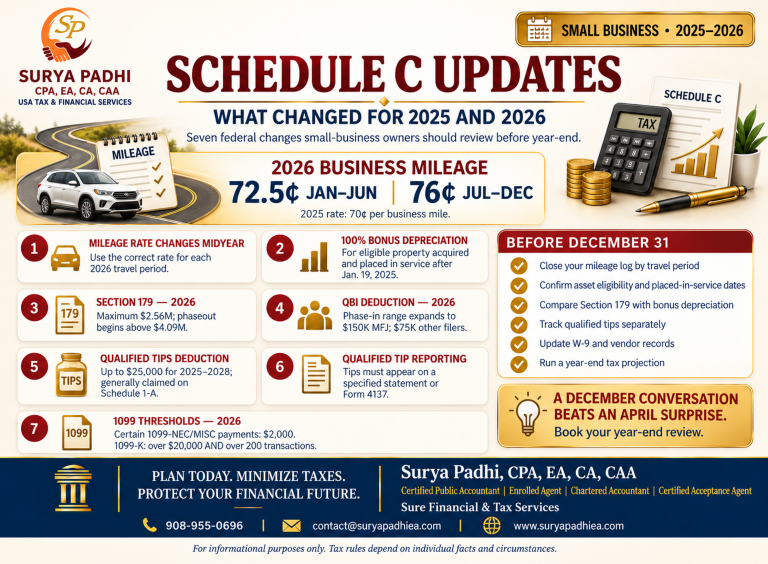
Option 1: Sole proprietorship and single-member LLC
A sole proprietorship exists as soon as one person carries on a business without choosing any other structure. There is nothing to form and no separate return: the profit goes on Schedule C of the owner’s Form 1040 (Schedule F for farming, Schedule E for rental real estate). A single-member LLC gets exactly the same federal tax treatment by default. The difference is legal, because the LLC puts a wall between business debts and your personal assets.
- Strengths: cheapest to start and run, no payroll, complete control, no double tax, and eligible for the qualified business income (QBI) deduction.
- Weaknesses: self-employment tax on all net earnings, no liability protection without the LLC, and harder to bring in investors or sell anything but the assets.
Self-employment tax is the cost that drives most owners to look further. It runs at 15.3% on 92.35% of net earnings, with the 12.4% Social Security part stopping at the 2026 wage base of $184,500 and the 2.9% Medicare part continuing above it.
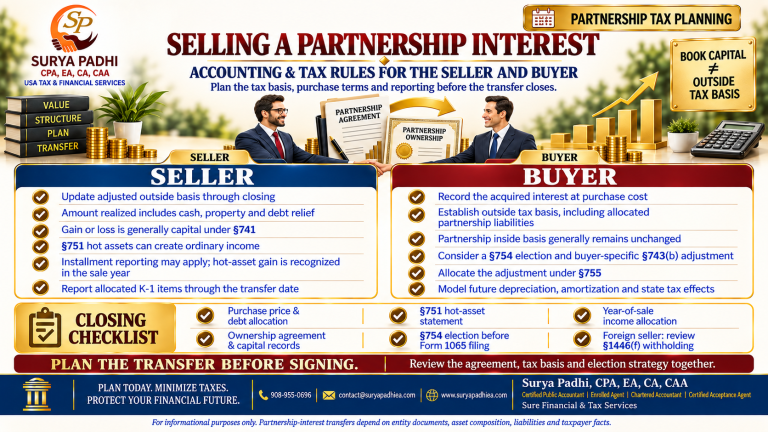
Option 2: Partnership and multi-member LLC
With two or more owners, the default is a partnership, and a multi-member LLC is taxed the same way. The partnership files Form 1065 but pays no income tax. Each partner receives a Schedule K-1 and reports their share of the income, deductions and credits on their own return.
The partnership’s main advantage is flexibility. The agreement can split profits and losses differently from ownership percentages, as long as the allocations have substantial economic effect, and a partner’s share of partnership debt can add to their basis, which helps them deduct losses. Distributions are generally tax-free up to basis.
The costs: general partners (and LLC members active in the business) owe self-employment tax on their share of ordinary income, guaranteed payments for services carry self-employment tax for every partner, and partners generally cannot receive tax-free fringe benefits. Basis tracking is among the hardest record-keeping in the tax code.
Married couples who own a business together
Spouses who are the only owners of an unincorporated business, both materially participate and file jointly can elect qualified joint venture status and file two Schedule Cs instead of a Form 1065. An LLC generally does not qualify, with a narrow exception for spouses in community property states.
Option 3: The S corporation
An S corporation is a corporation, or an LLC, that has elected pass-through treatment on Form 2553. It files Form 1120-S and generally pays no federal income tax; profit flows to shareholders on Schedule K-1 and remains eligible for the QBI deduction. What makes it different from a partnership is payroll. An owner who works in the business must be paid a reasonable salary through payroll, which carries FICA, and the remaining profit can be distributed without self-employment tax.
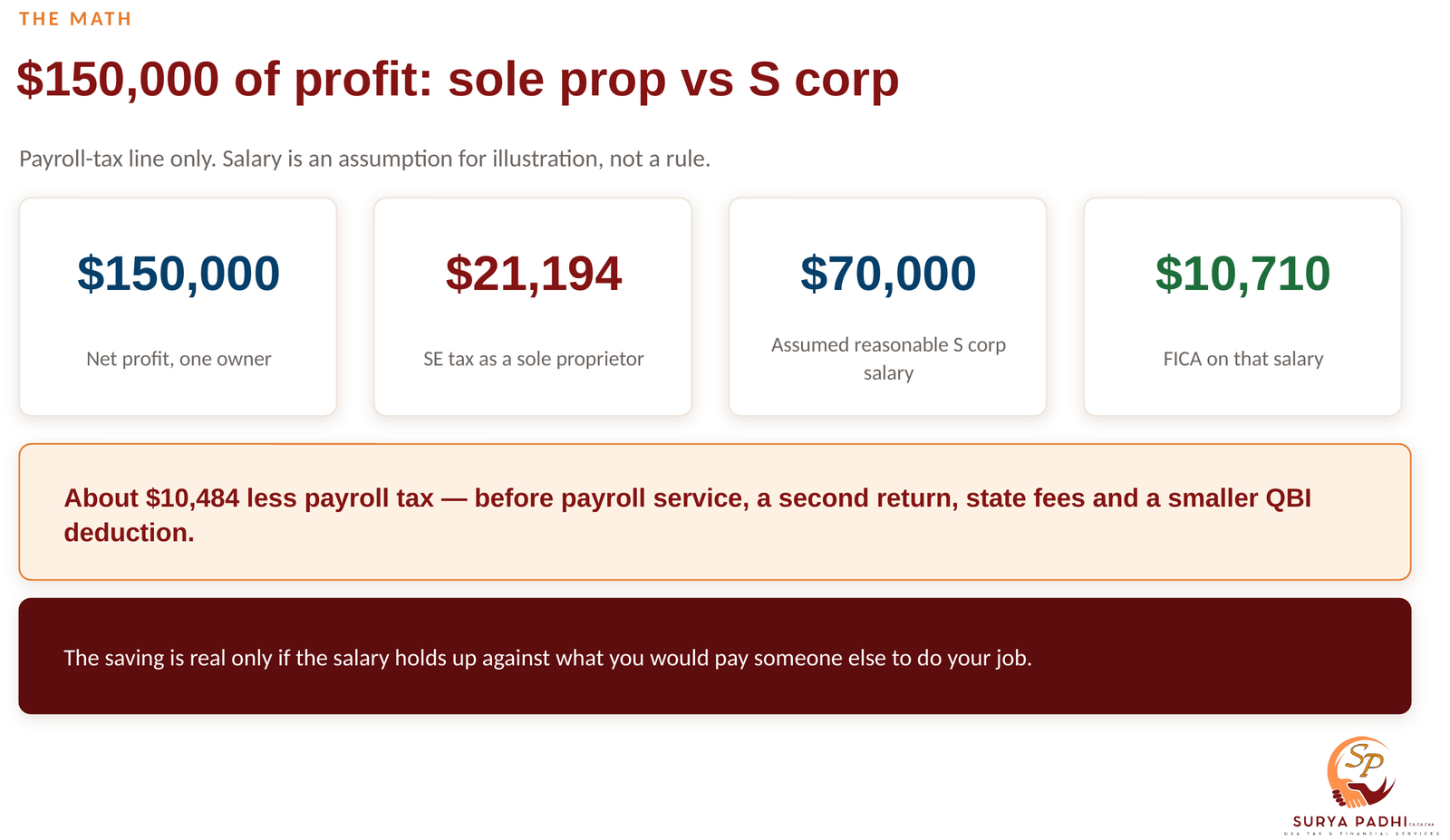
Worked example: $150,000 of profit, one owner
| Net profit | $150,000 |
| Sole proprietor: SE tax (15.3% x 92.35%) | $21,194 |
| S corp: assumed reasonable salary | $70,000 |
| S corp: combined FICA on salary (15.3%) | $10,710 |
| Difference in payroll tax | $10,484 |
Before payroll service fees, the extra return, state fees, unemployment taxes and the smaller QBI deduction that comes with paying wages. The saving holds only if the salary is reasonable for the work.
Who can elect S status
- A domestic corporation or LLC with no more than 100 shareholders.
- One class of stock only, although voting and non-voting common shares are allowed.
- Shareholders must be US citizens or residents, estates or certain trusts. Nonresident aliens, partnerships and corporations cannot own shares.
- Profit is split strictly by ownership percentage, so special allocations are not possible.
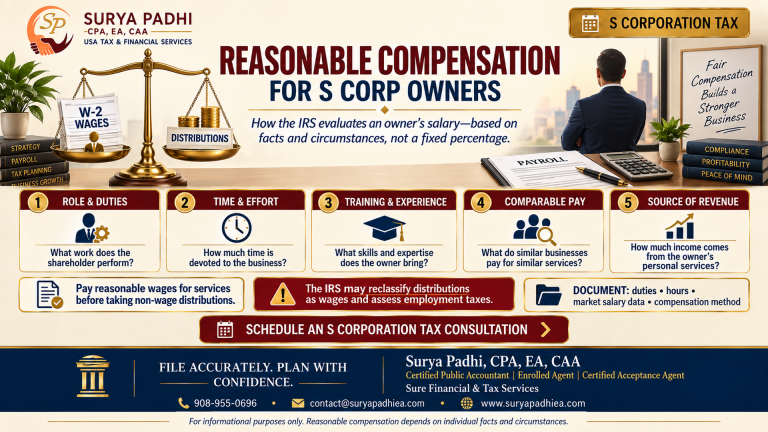
The salary is not optional
A token salary with large distributions is the pattern the IRS looks for. Where compensation is unreasonably low, distributions can be recharacterised as wages, with back payroll tax, penalties and interest. There is no approved rule of thumb such as a 60/40 split; the test is what the business would pay someone else to do the owner’s job.
The other trade-offs: shareholders who own more than 2% are taxed on fringe benefits such as employer-paid health insurance, debt basis includes only loans the shareholder makes directly to the corporation, and a corporation that converts from C status can owe built-in gains tax. For New Jersey owners, the state has treated a federal S corporation as a New Jersey S corporation automatically since December 22, 2022, so no separate state election is needed; opting out requires the consent of every shareholder.
Option 4: The C corporation
A C corporation is the only structure that is a taxpayer in its own right. It files Form 1120 and pays a flat 21% federal tax on its taxable income. Shareholders pay nothing until profit is distributed to them as dividends, when it is taxed again on their personal returns. That second layer is what people mean by double taxation.
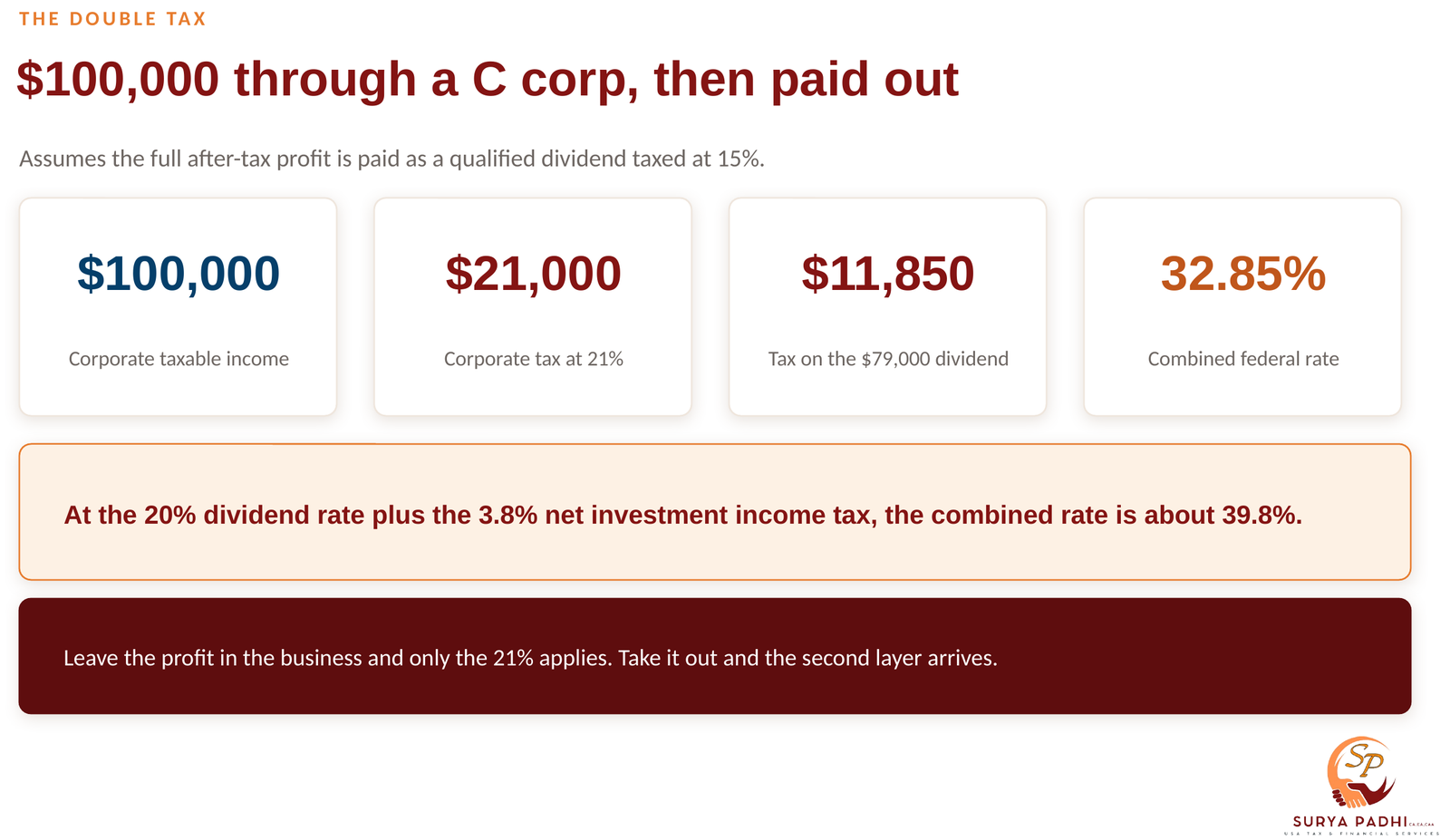
In the example above, $100,000 of corporate profit pays $21,000 of tax. If the remaining $79,000 is paid out as a qualified dividend taxed at 15%, the shareholder pays another $11,850, for a combined federal rate of 32.85%. For a shareholder in the 20% dividend bracket who also owes the 3.8% net investment income tax, the combined rate is about 39.8%.
The C corporation still has real strengths. It can have any number and type of owners, multiple classes of stock including preferred, a fiscal year, and continuous life. Owner-employees can receive tax-free fringe benefits such as health coverage. And profit kept in the business to fund growth is taxed only once, at 21%. The costs: losses stay inside the corporation rather than offsetting your other income, capital gains get no preferential rate at the corporate level, the QBI deduction is not available, and the IRS scrutinises owner salaries that look too high, because salary is deductible and dividends are not.
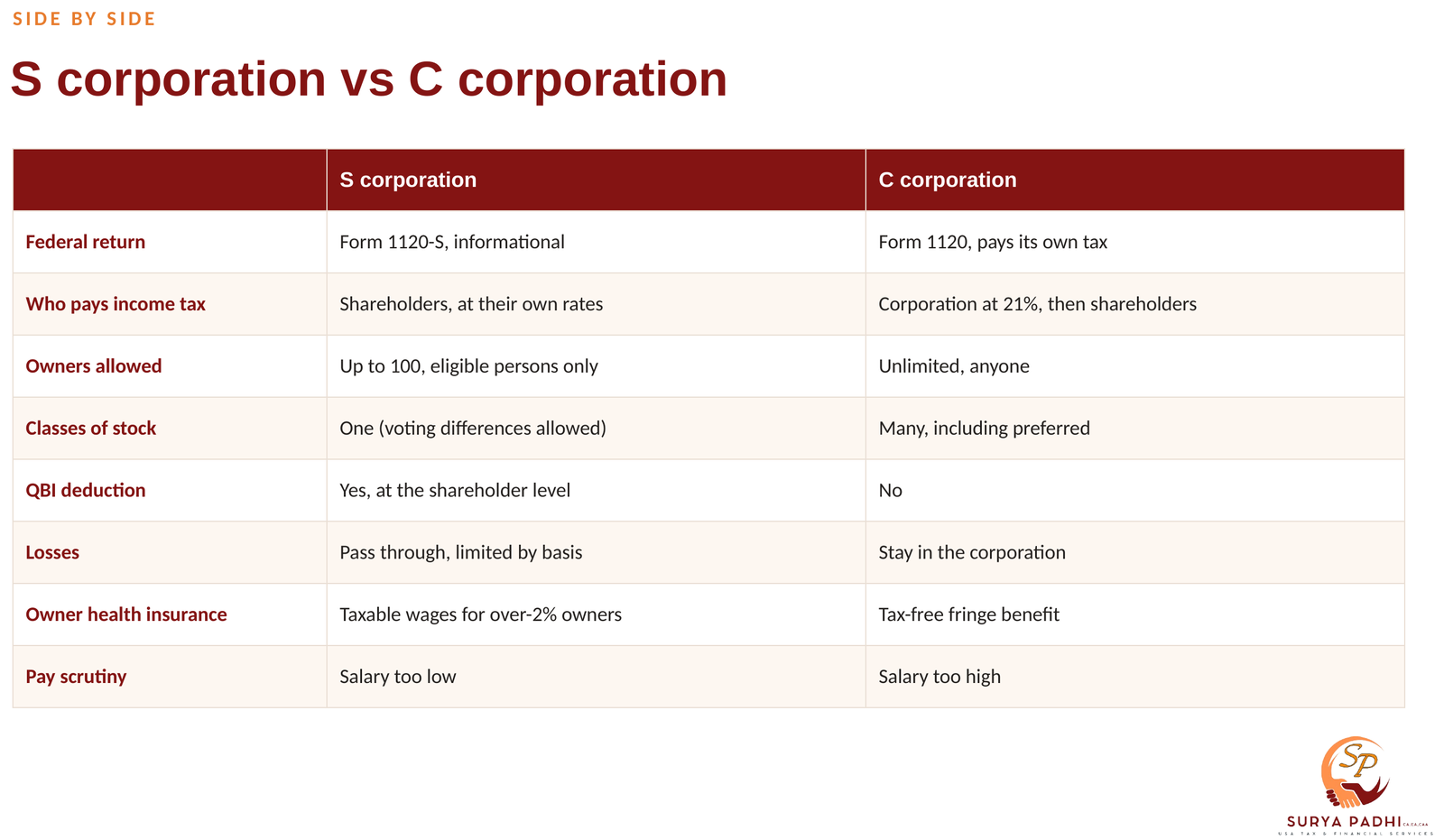
Business entity comparison: the five options side by side
| Sole prop / SMLLC | Partnership / MMLLC | S corporation | C corporation | |
|---|---|---|---|---|
| Federal return | Schedule C on Form 1040 | Form 1065 | Form 1120-S | Form 1120 |
| Owners | One | Two or more | 1 to 100, eligible only | Unlimited |
| Who pays income tax | Owner | Partners | Shareholders | Corporation, then shareholders on dividends |
| Self-employment tax on profit | Yes | Yes, for active partners | No; FICA on salary | No; FICA on salary |
| QBI deduction | Yes | Yes | Yes | No |
| Reasonable salary required | No | No | Yes | Yes |
| Liability shield | Only with the LLC | LLC or limited partners | Yes | Yes |
| Losses | Flow to owner | Flow to partners | Flow to shareholders | Stay in the corporation |
Changing your entity’s tax classification later
An LLC’s tax treatment is not fixed. To be taxed as an S corporation, file Form 2553 no more than two months and fifteen days after the start of the tax year the election is to take effect, so March 15, 2027 for a calendar-year 2027 election. To be taxed as a C corporation, file Form 8832; the effective date can be up to 75 days before, or 12 months after, the filing date. The IRS has procedures for late-election relief, but relying on them adds cost and uncertainty.
Check the balance sheet before you elect
An election to be taxed as a corporation is treated as if the owners transferred the business’s assets and liabilities to a new corporation for stock. Where liabilities exceed the tax basis of the assets, that deemed incorporation can create taxable gain.
The election changes only the tax classification. For legal purposes the LLC, its state registration and its EIN stay the same.
Which entity fits which owner
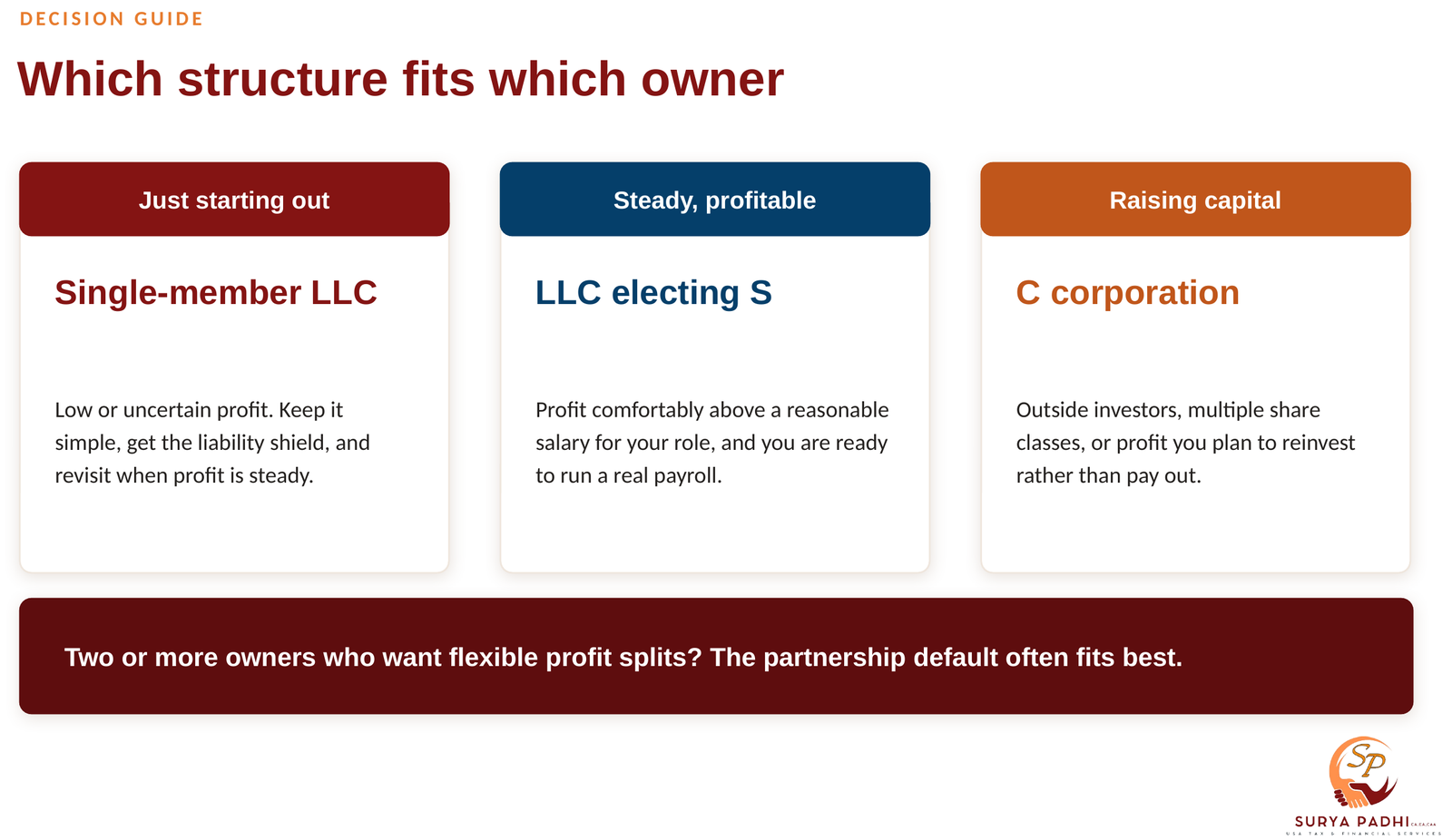
- Just starting, or profit is small and unpredictable: a single-member LLC gives you the liability shield without payroll or a second return. Revisit once profit is steady.
- Steady profit comfortably above a reasonable salary for your role: an LLC electing S status is usually worth modelling, provided you are ready to run a real payroll.
- Two or more owners who want flexible profit splits, or who hold appreciating property: the partnership default often fits best.
- Raising outside capital, issuing different classes of stock, or reinvesting most of the profit: look hard at a C corporation.
The questions that decide it are practical ones. How much profit do you expect, and how steady is it? Will you take the money out or leave it in? Who will own the business now and later, and is anyone abroad? Are investors or a sale on the horizon? Will the business hold real estate? Those answers, run through actual numbers, settle the choice better than any rule of thumb.
Common mistakes when choosing a business entity
- Electing S status before the profit supports a real salary, so payroll and compliance costs outrun the tax saved.
- Paying a token salary and taking the rest as distributions.
- Filing Form 2553 late and losing a year of S status.
- Admitting a shareholder who cannot own S corporation stock, which can terminate the election.
- Treating the LLC itself as the tax answer and never choosing the classification deliberately.
Frequently asked questions
Is an LLC better than an S corp?
They are not alternatives. An LLC is a legal form created under state law, and an S corporation is a federal tax classification. An LLC can elect to be taxed as an S corporation, which keeps the LLC’s legal structure while changing how its profit is taxed.
When does an S corporation election save money?
An S corporation election saves money when the self-employment tax avoided on distributions is larger than the added costs of payroll, a separate Form 1120-S, state fees and a reduced qualified business income deduction. That usually requires steady profit well above a reasonable salary for the owner’s role.
What is the tax rate for a C corporation in 2026?
A C corporation pays a flat 21% federal income tax on its taxable income in 2026. Profit paid to shareholders as dividends is taxed again on their personal returns, which is why the combined rate on distributed profit is higher.
Can a single-member LLC be taxed as an S corporation?
Yes. A single-member LLC owned by an eligible individual can file Form 2553 to be taxed as an S corporation. It cannot be taxed as a partnership, because a partnership requires at least two owners.
Choose your entity with the numbers in front of you
We model your own profit through a sole proprietorship, an S corporation and a C corporation side by side, then handle the formation, the elections and the payroll if you decide to go ahead.
This article is general tax education and does not constitute individualized tax, legal or financial advice. Figures are stated for the tax year shown and are subject to IRS adjustment. Consult a qualified professional about your own facts. Surya Padhi holds the Indian Chartered Accountant qualification but is not licensed to practise in India and does not provide Indian tax filing or advisory services.