Trader tax status is a facts-and-circumstances test: you must seek daily trading profits, substantially and with continuity. It moves your trading expenses to Schedule C. It does not lift the $3,000 capital loss cap or the wash sale rule — only a timely section 475(f) mark-to-market election does that, filed a full year early.
7:14. The written version, the figures and the sources are all below.
| Capital loss against other income | $3,000 | Per year under IRC §1211(b), whatever your trade count. The rest carries forward indefinitely. |
|---|---|---|
| An investor’s deduction for fees, data and subscriptions | $0 | Miscellaneous itemized deductions were suspended by the TCJA and made permanent by the One Big Beautiful Bill Act. |
| Trades the Tax Court accepted | 720 a year | About 60 a month. Poppe v. Commissioner, T.C. Memo 2015-3. |
| Trades the Tax Court rejected | 535 a year | Over 121 of 250 trading days. Nelson v. Commissioner, T.C. Memo 2013-259 — days count, not just trades. |
| §475(f) election statement for tax year 2027 | April 15, 2027 | The unextended due date of the 2026 return, not the 2027 one. IRS Topic No. 429. |
| 2026 excess business loss cap | $256,000 / $512,000 | Single / joint, under IRC §461(l). Rev. Proc. 2025-32. Losses above it become an NOL carryforward. |
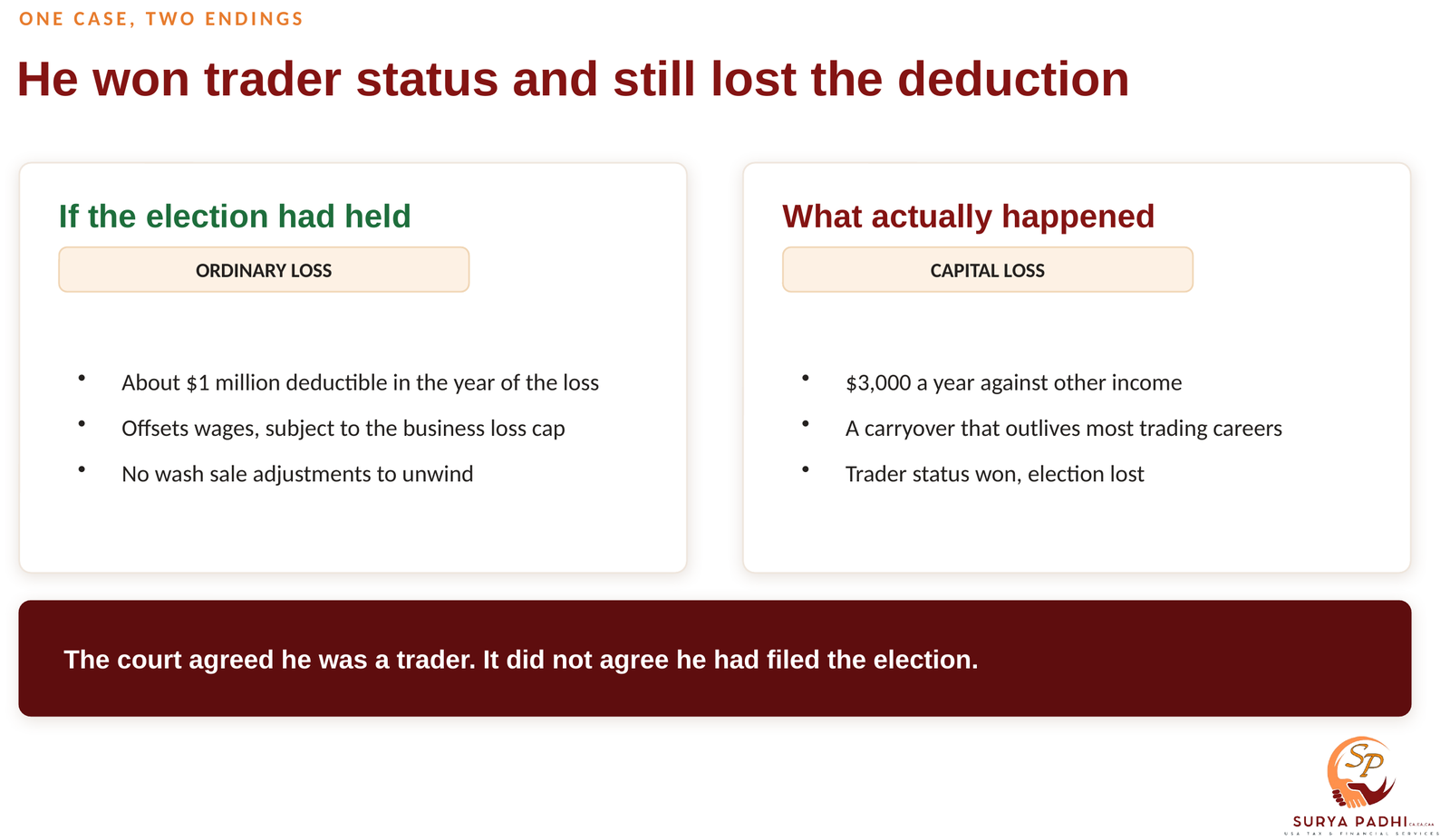
| The deduction Poppe lost | about $1 million | Trader status was allowed. The election was not proved filed, so a $1 million loss became $3,000 a year. |
Trader tax status decides whether your trading costs are deductible at all — and a separate election, filed a year early, decides what a losing year is worth.
Two people can place exactly the same trades, at the same broker, in the same year, and file completely different tax returns. One of them deducts nothing for the platform, the data feed and the subscriptions, and carries a losing year forward $3,000 at a time. The other deducts the whole loss against wages and writes off the home office. The difference between them is trader tax status — and a one-page election that almost nobody files on time.
This is the question that gets asked every January and answered badly. It sounds like a semantic distinction. It is not: it decides which schedule your costs land on, whether the wash sale rule applies to you, and whether a bad year produces a $3,000 deduction or a full one. Here is how the IRS actually decides it, how much trading has been enough in court, and what the section 475(f) election is worth in dollars.
Key takeaways
- Trader status is a facts-and-circumstances test decided every year. There is no form that grants it and no minimum trade count in the law.
- Trader status alone moves your expenses to Schedule C. It does not lift the $3,000 capital loss cap or switch off the wash sale rule.
- Only a timely section 475(f) election does that — and the statement is due with the prior year’s return, unextended.
- The election is two filings: the statement, then Form 3115. In Poppe, a trader who missed the paperwork lost about $1 million of deductions.
- Elect 475 because you expect losses and volatility. In a winning year it converts long-term gains into ordinary income.
What the IRS actually asks about trader tax status
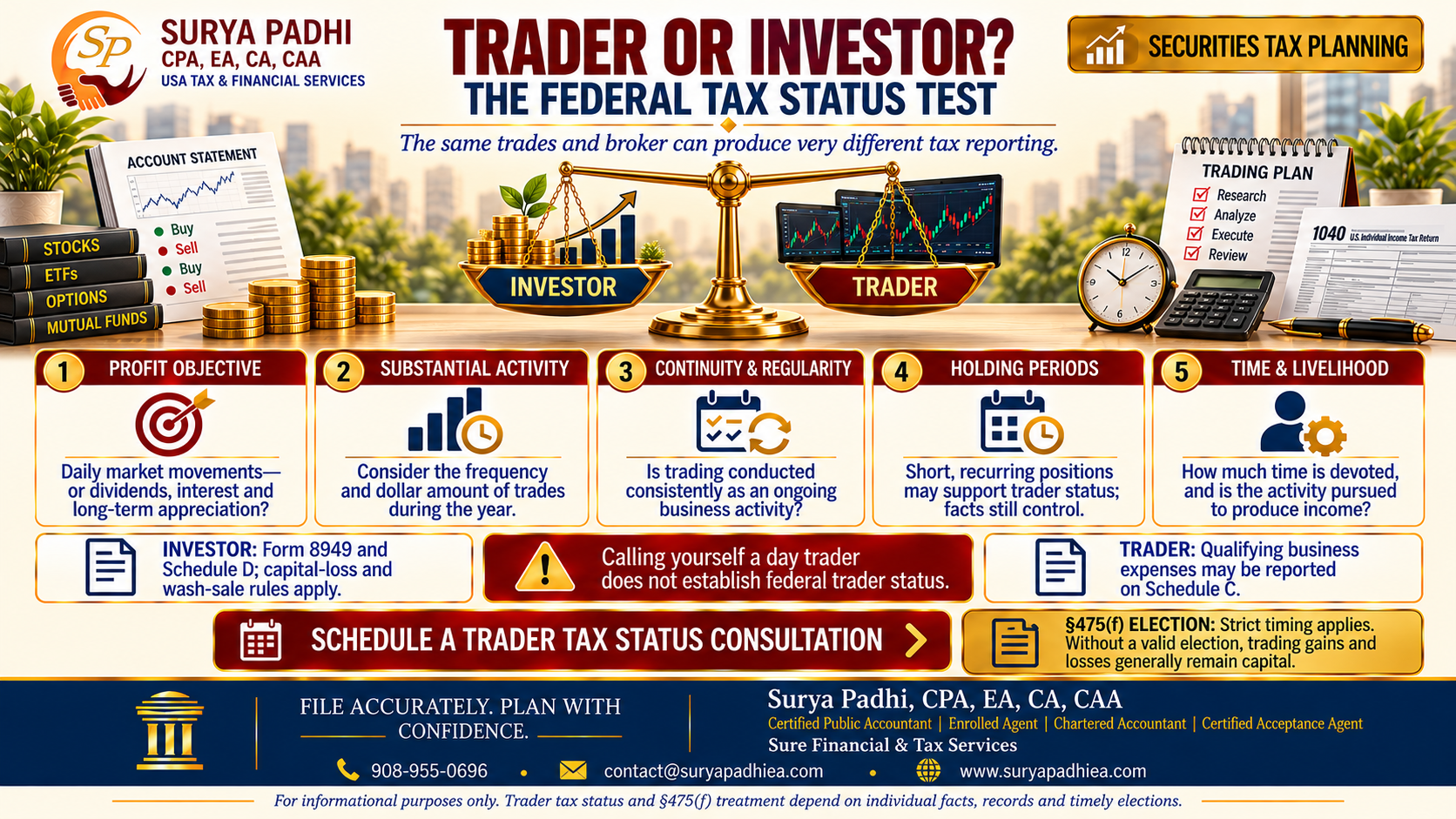
The IRS sets out three conditions in Topic No. 429, and you have to meet all of them. You must seek to profit from daily market movements in the prices of securities, and not from dividends, interest or capital appreciation. Your activity must be substantial. And you must carry on the activity with continuity and regularity.
Notice that none of those is a number. That is deliberate, and it is why this question gets litigated rather than looked up. Beyond the three conditions, the IRS says it considers your typical holding periods, the frequency and dollar amount of your trades, the extent to which you pursue the activity for a livelihood, and the amount of time you devote to it.
There is no box to tick
You do not elect trader status. You either meet the facts or you do not, and an examiner can test that years after the return is filed. What you can control is the record: the days you actually traded, your average holding period, and the hours you spent in the market. Build it as you go, because reconstructing it three years later is how people lose.
One more point that catches people: the test runs year by year. A year of heavy trading does not carry over into a thin one, and a trader who takes a full-time job in September has a harder case for that year than for the one before it.
How much trading has actually been enough?
There is no statutory threshold, so the only honest guide is what the courts have accepted and rejected. The pattern in the cases is clearer than most summaries admit: the courts count trading days at least as carefully as they count trades.
| Case | Activity | Held |
|---|---|---|
| Poppe, T.C. Memo 2015-3 | About 720 trades a year — roughly 60 a month | Trader |
| Nelson, T.C. Memo 2013-259 | 535 trades over 121 of 250 trading days | Investor |
| Endicott, T.C. Memo 2013-199 | 204, then 303, then 1,543 trades | Investor |
| Kay, T.C. Memo 2011-234 | 313 trades over 73 days | Investor |
| Holsinger, T.C. Memo 2008-191 | 289, then 372 trades, on 40–45% of trading days | Investor |
Read Endicott and Nelson together and the lesson is uncomfortable for anyone hoping for a bright line. Endicott had more than 1,500 trades in one year and still lost, largely because the trades were option writing held for longer periods rather than an attempt to capture daily movement. Nelson had 535 trades and lost because he was only in the market on about half the available days. Volume without regularity does not get there.
What the record should show
In practice a defensible file has four things: the number of days you placed trades, your average holding period, evidence that trading was a material source of your livelihood, and the hours. A broker export gives you the first two in an afternoon.
What changes on the return
This is where the money is, and where most articles blur two separate things. Trader status changes where your expenses go. The section 475(f) election changes what your gains and losses are. You can have the first without the second, and most people who think they have both actually have only the first.
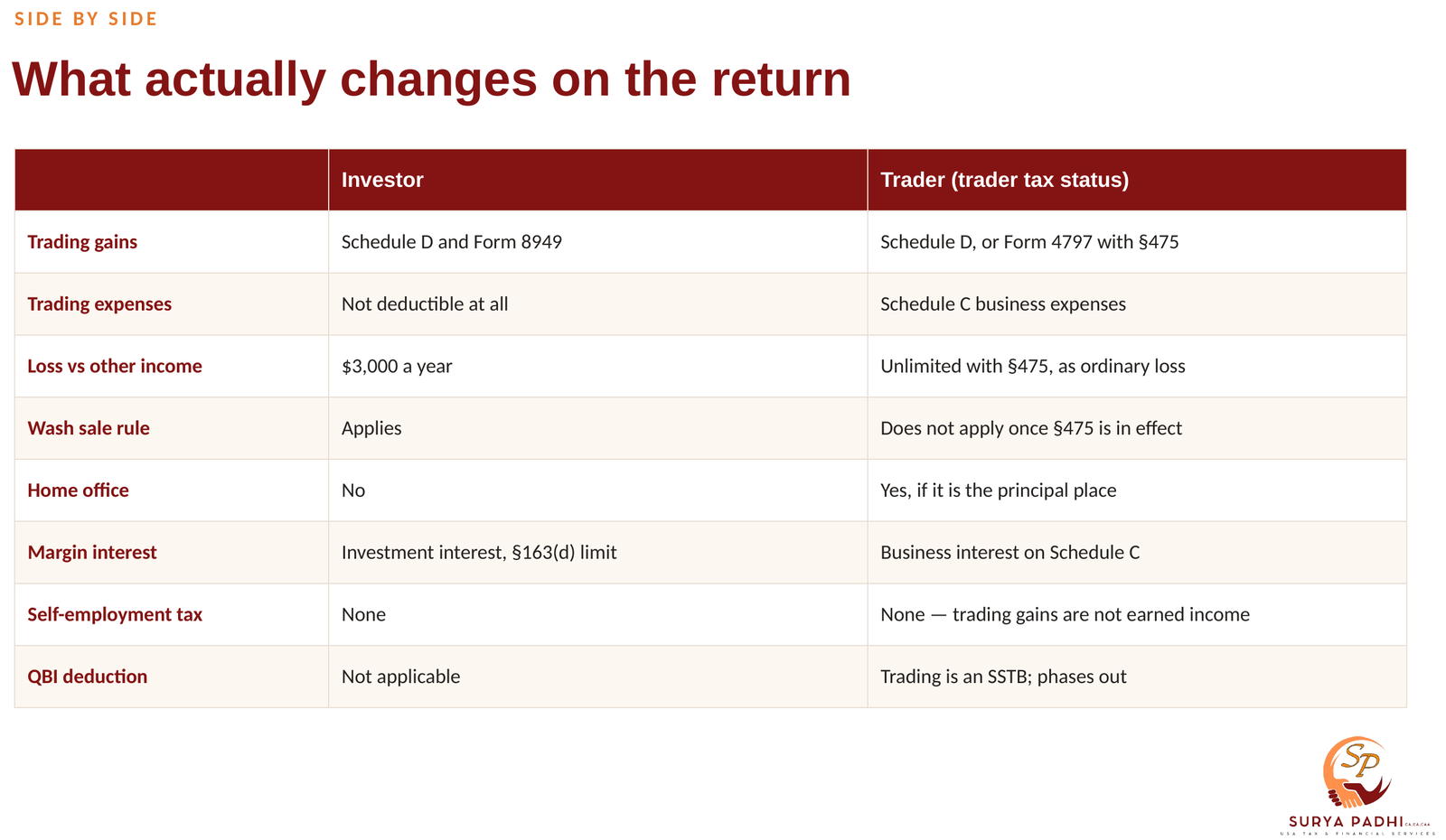
An investor’s trading costs are not deductible at all. Platform fees, data feeds, research subscriptions, advisory fees — those were miscellaneous itemized deductions subject to the 2% floor, the Tax Cuts and Jobs Act suspended them, and the One Big Beautiful Bill Act made the repeal permanent. There is no version of the return where an investor writes them off.
A trader puts them on Schedule C as ordinary business expenses, along with the home office if the trading space qualifies as the principal place of business. What does not go on Schedule C is the trading income itself. Gains and losses stay on Schedule D and Form 8949, or move to Form 4797 once a 475 election is in effect. Putting trading gains on Schedule C invites a self-employment tax argument you should never have to have — trading gains are not earned income and are not subject to SE tax either way.
Two things trader status does not do
It does not remove the $3,000 capital loss limitation and it does not switch off the wash sale rule. Only a timely section 475(f) election does either. Every year I see a Schedule C for a trading business sitting next to a Schedule D with $3,000 of allowed loss and a six-figure carryover — which means the election was never made.
One more asymmetry worth knowing: trading is a specified service trade or business under Treas. Reg. §1.199A-5(b)(2)(xii), and the regulation says so whether you trade for your own account or for others. Above the §199A taxable income thresholds there is no qualified business income deduction on trading profits. The Schedule C helps with expenses; it does not buy you the 20%.
The §475(f) election: two filings, two deadlines
The mark-to-market election under section 475(f) is the part that actually changes the arithmetic. Make it, and your securities are treated as sold at fair market value on the last business day of the year. Gains and losses become ordinary. The $3,000 capital loss cap stops applying. The wash sale rule stops applying, because there are no capital transactions left to wash.
It is also the part people get wrong, and they get it wrong in the same two ways every time.
- File the election statement. A short statement saying you are electing under section 475(f), naming the first tax year it is effective for, and naming the trade or business it covers.
- File it on time — which means a year early. The statement is due by the due date, not including extensions, of the return for the year before the year the election takes effect. It is attached to that prior-year return or to its extension request.
- File Form 3115. Because your prior method of accounting was something other than mark-to-market, you are changing your method of accounting, under Rev. Proc. 2025-23, Section 24.01. The Form 3115 goes with the election-year return.
The date that catches people
To use §475 for tax year 2027, the election statement is due April 15, 2027 — the unextended due date of the 2026 return, not the 2027 one. Nothing you file in 2027 can reach back and fix 2026: that window closed in April 2026. This is why the decision belongs in December, when you can still see the year in front of you.
Poppe is the case to know here, because it shows both failures in one taxpayer. The Tax Court accepted that he was a trader — about 720 trades a year cleared the frequency bar. Then it looked at the election and found he could not establish that the statement had been filed on time, and that he had never filed a Form 3115 at all. A trading loss of roughly $1 million became a $3,000-a-year deduction and a carryover that would outlive most trading careers. He won the argument everybody worries about and lost on paperwork.
Getting back out is not symmetrical either. Revoking a 475 election is its own accounting method change with its own notification and its own Form 3115, and the procedures have been tightened in recent years. Treat the election as a multi-year commitment rather than something you switch on for one bad quarter.
What the election is worth, in dollars
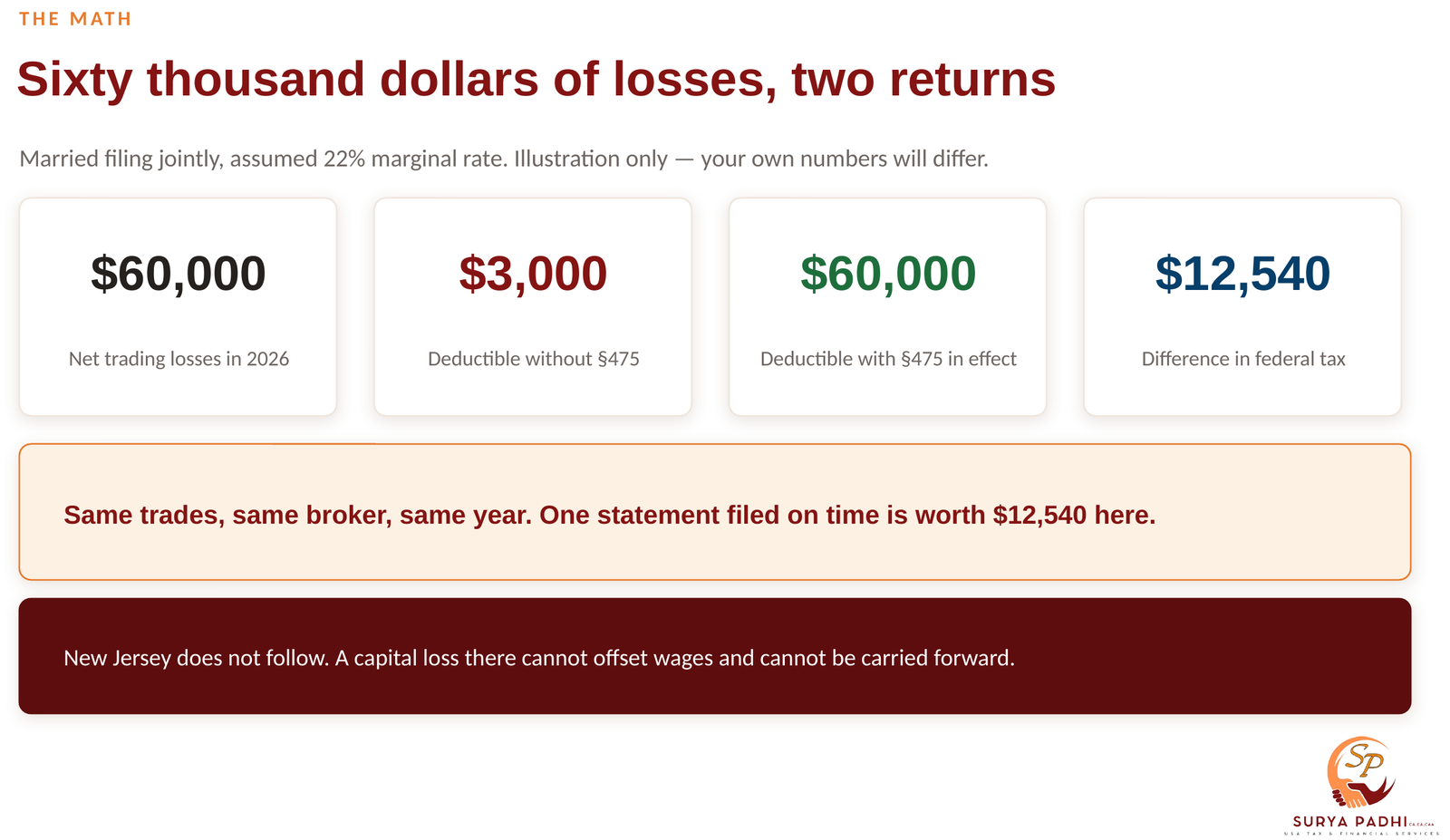
Take a couple filing jointly. One spouse trades full-time and ends 2026 with $60,000 of net trading losses; the other has W-2 wages. Assume a 22% marginal rate to keep the arithmetic visible.
$60,000 of trading losses, two returns
| Net trading losses, 2026 | $60,000 |
| Deductible without a §475 election | $3,000 |
| Carried forward instead | $57,000 |
| Federal tax saved, no election | $660 |
| Deductible with §475 in effect | $60,000 |
| Federal tax saved, with election | $13,200 |
| Difference, one statement filed on time | $12,540 |
Illustration at an assumed 22% marginal rate; your own brackets, state and other income will change the figures.
Two limits sit on top of that. An ordinary trading loss is a business loss, so the excess business loss limitation under §461(l) applies: for 2026 the threshold is $256,000 for single filers and $512,000 for joint filers under Rev. Proc. 2025-32. A loss above the threshold is not lost, but it becomes a net operating loss carryforward rather than a deduction this year.
New Jersey does not follow any of this
New Jersey taxes 16 separate categories of income. A net loss in the disposition-of-property category cannot offset wages, and New Jersey does not allow losses to be carried forward or back between years. A §475 ordinary loss lands instead in the business categories, where the Alternative Business Calculation Adjustment allows limited netting and a carryforward — but it still will not reach your salary. Federal and New Jersey answers to this question are genuinely different.
What the election costs you
Everybody reads the loss paragraph and nobody reads this one. Section 475 is not a free option, and in the wrong year it is expensive.
- Long-term capital gain rates are gone on securities inside the election. Ordinary income at your top marginal rate is the trade you are making.
- You are taxed on positions you still hold. Mark-to-market means unrealised gains at December 31 are income, whether or not you sold.
- Section 1256 contracts — most regulated futures and broad-based index options — already mark to market and already get 60/40 treatment. Electing 475 for commodities can be a straight downgrade. Look at §1256 before you touch this.
- Nothing is retroactive. There is no late-election relief for a year that has already begun.
Elect section 475 because you expect volatility and losses — not because you have just had a good year.
Five mistakes that cost real money
- Putting the trading gains on Schedule C. Only the expenses go there. Gains stay on Schedule D, or on Form 4797 once §475 applies.
- Assuming the election covers the year you file it in. It never does. The statement runs a full year ahead.
- Filing the statement and skipping Form 3115. Both steps or neither — that is exactly how Poppe lost.
- Electing §475 in a winning year, converting long-term gains into ordinary income at the top rate.
- Counting trades and ignoring trading days. Nelson placed 535 trades and lost, because he traded on 121 days out of 250.
None of these is a judgment call. They are all documentation, and all five are cheaper to get right in December than to argue about in an examination.
The dates that decide it
Four dates, and the one that matters most falls a year earlier than people expect. Put all four in the calendar now, because none of them can be fixed after the fact.
| Date | What has to happen |
|---|---|
| December 31, 2026 | Last day to realise 2026 gains or losses, and to settle whether you will qualify as a trader for 2027. |
| April 15, 2027 | §475(f) election statement for tax year 2027, attached to the 2026 return or its extension request. Unextended due date. |
| April 15, 2027 | The 2026 return itself. The 2026 election window closed in April 2026 — nothing filed now reaches back. |
| October 15, 2027 | Form 3115 with a timely filed 2027 return, extensions included. The election is not complete without it. |
Frequently asked questions
How many trades do you need for trader tax status?
There is no number in the law. The Tax Court accepted about 720 trades a year in Poppe and rejected 535 trades in Nelson, because Nelson only traded on 121 of 250 available days. Frequency, short holding periods and the number of days you were actually in the market matter more than the raw trade count.
Do I have to file anything to claim trader tax status?
No. Trader status is a facts-and-circumstances conclusion you take on the return by reporting business expenses on Schedule C; there is no election or application. The separate section 475(f) mark-to-market election does require filings, and it is the only thing that lifts the $3,000 capital loss limitation.
What is the deadline for the section 475(f) election?
The election statement is due by the due date of the prior year’s return, not including extensions. For tax year 2027 that is April 15, 2027, filed with the 2026 return or its extension request. Form 3115 then goes with the timely filed 2027 return, including extensions.
Do day traders pay self-employment tax on trading profits?
No. The IRS states in Topic No. 429 that gains and losses from selling securities as a trader are not subject to self-employment tax. That also means trading profits are not earned income, so they cannot support a self-employed retirement plan contribution or the self-employed health insurance deduction.
Does a section 475 election apply to futures and options?
Section 1256 contracts already mark to market and receive 60/40 long-term and short-term treatment, which is usually better than ordinary income. A commodities election under section 475(e) or (f) can turn that favourable split into ordinary income, so check what you actually trade before electing.
Not sure which side of the line you are on?
Bring a year of trade confirmations or a broker export and we will tell you what the record actually supports, what it does not, and whether the section 475 election is worth making for next year — while there is still time to file it.
This article is general tax education and does not constitute individualized tax, legal or financial advice. Figures are stated for tax year 2026 and are subject to IRS adjustment. Consult a qualified professional about your own facts.