
A partner who sells an interest has a gain equal to cash received plus debt relieved, less outside basis. Most of it is capital gain under section 741, but the share tied to receivables, inventory and recapture is ordinary under section 751. The buyer’s higher basis reaches partnership assets only through a section 754 election.
6:59. The written version, the figures and the sources are all below.
| Top rate on the §751 ordinary slice | 37% | Top federal ordinary income rate for 2026. |
|---|---|---|
| Top rate on long-term capital gain | 20% | Plus the 3.8% net investment income tax where it applies. |
| Substantial built-in loss | $250,000 | Above this, the §743(b) adjustment is mandatory with or without a §754 election (§743(d)). |
| Withholding on a foreign seller | 10% | Of the amount realized, withheld by the buyer under §1446(f). |
| Seller’s notice to the partnership | 30 days | Or January 15 of the next year if earlier (Treas. Reg. §1.6050K-1(d)). |
| Form 8308 to seller and buyer | January 31 | Or 30 days after the partnership has notice, if later. |
When a partner sells out, three parties have work to do. Here is how the seller’s gain is taxed, how the buyer gets the right basis, and what the partnership records in the year of the sale.
A partner in your business wants out, and someone else — a new investor or one of the existing partners — is buying the interest. The price is agreed, the lawyers are drafting, and the question lands on the accountant: what is the tax treatment of the sale of a partnership interest, and what has to happen on the partnership’s books?
The answer involves three parties, not two. The seller has to work out the gain and split it between ordinary income and capital gain. The buyer has to make sure their higher basis actually reaches the partnership’s assets. And the partnership has to move the capital account, split the year’s income, and file the right forms on time. This article covers all three, in that order, for a sale to a new or existing partner. The same rules apply to an LLC taxed as a partnership.
Key takeaways
- The seller’s amount realized includes their share of partnership debt the buyer takes over, not just the cash.
- Gain is capital under §741, except the slice from receivables, inventory and depreciation recapture, which §751 makes ordinary.
- The buyer’s higher basis reaches the partnership’s assets only through a §743(b) adjustment, which needs a §754 election (or is mandatory with a built-in loss over $250,000).
- The partnership moves the capital account, splits the year’s income, issues a final K-1 and a part-year K-1, and files Form 8308 when hot assets exist.
Two bases: outside and inside
Everything in a partnership sale turns on two numbers. Outside basis is a partner’s basis in the interest itself. It starts with what they paid or contributed, goes up with their share of income and of partnership debt, and goes down with losses and distributions. Inside basis is the partnership’s own basis in its assets — the building, the equipment, the receivables.
When an interest is sold, the buyer gets a fresh outside basis equal to what they paid. Inside basis does not move on its own. That gap is the reason a buyer can end up worse off than they expected, and it is what the §754 election, covered below, is designed to close.
The tax treatment of the sale of a partnership interest: the seller
The seller’s gain is the amount realized less outside basis. The amount realized is the cash received plus the seller’s share of partnership liabilities that shifts to the buyer. That second piece is the one people miss: debt relief counts as money received, so a seller who takes little cash can still have a real gain.
Outside basis has to be brought up to date first — the seller’s share of income and distributions for the current year, through the sale date, goes into it. Only then is the gain worked out.
Section 751: part of the gain is ordinary
Section 741 treats a partnership interest as a capital asset, so the general answer is capital gain. Section 751 carves out the seller’s share of the partnership’s so-called hot assets: unrealized receivables (which include depreciation that would be recaptured on a sale) and inventory. That slice is ordinary income, taxed like wages. The seller shows the split on a statement attached to their own return.
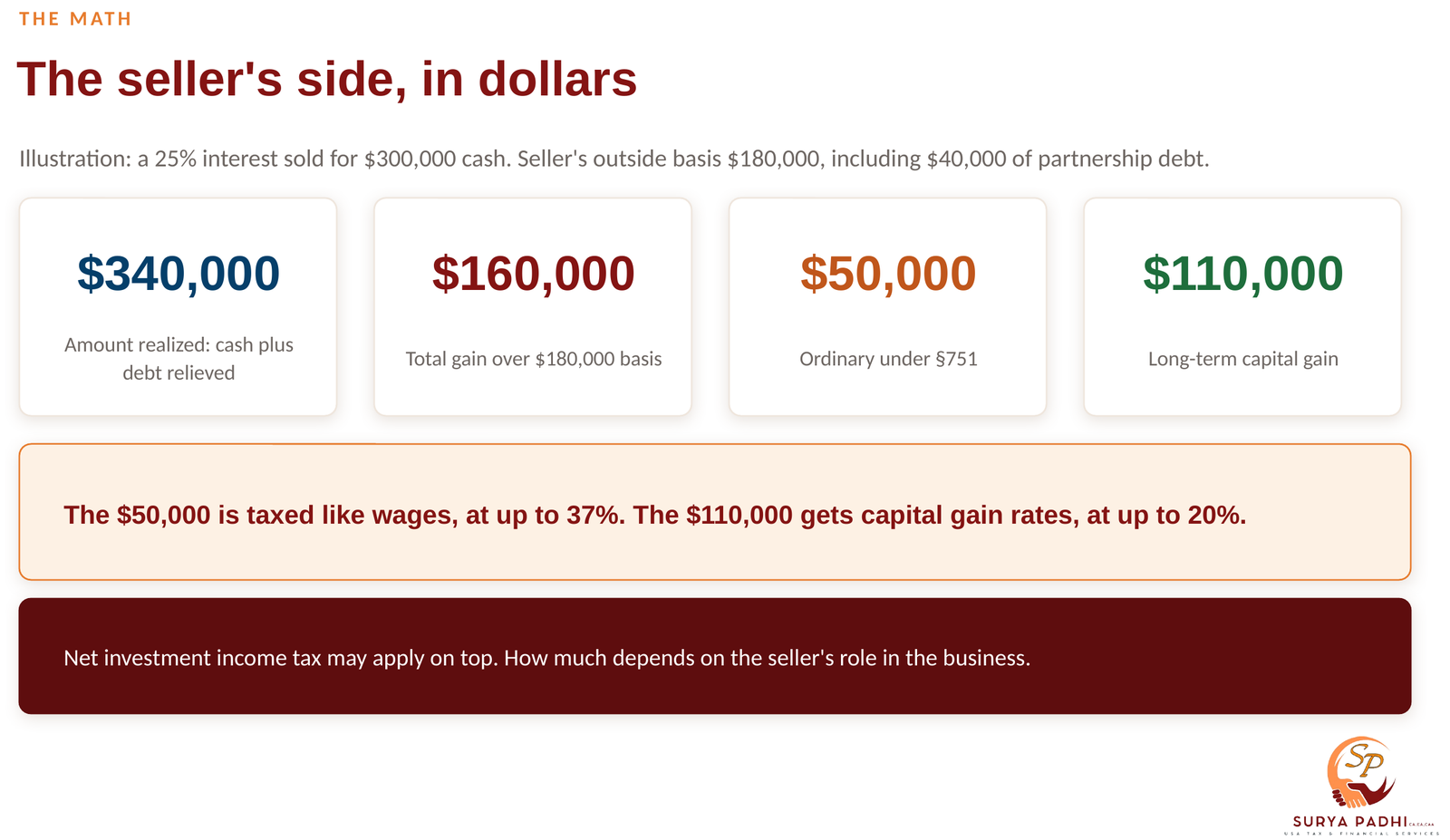
The seller’s side (illustration)
| Cash received for a 25% interest | $300,000 |
| Plus share of partnership debt relieved | $40,000 |
| Amount realized | $340,000 |
| Less outside basis (including the $40,000 of debt) | ($180,000) |
| Total gain | $160,000 |
| Ordinary under §751 — recapture and receivables | $50,000 |
| Long-term capital gain under §741 | $110,000 |
Illustrative figures. The ordinary slice is taxed at ordinary rates (top federal rate 37%); the capital slice at long-term capital gain rates (top rate 20%), plus the 3.8% net investment income tax where it applies.
Get the §751 numbers before you sign
Only the partnership can tell the seller their share of receivables, inventory and recapture. Ask for it before closing; a seller who prices the deal assuming all capital gain can be surprised by the ordinary slice.
The buyer: why the §754 election matters
In the example, the buyer paid $300,000 and took on $40,000 of the partnership’s debt, so their outside basis is $340,000. But their share of the partnership’s inside basis is only $180,000 — the seller’s old number. Without an adjustment, the buyer depreciates the lower basis and, if the partnership later sells the assets, is allocated gain the seller already paid tax on.
Section 743(b) fixes that, but only if the partnership has a §754 election in effect. The partnership makes the election by attaching a statement to a timely filed Form 1065 (including extensions) for the year of the transfer. The buyer’s $160,000 step-up is then allocated among the partnership’s assets under §755 and belongs to the buyer alone; it is tracked separately from the partnership’s common basis.
When the adjustment is mandatory
If the partnership has a substantial built-in loss immediately after the transfer — inside basis exceeds value by more than $250,000, or the buyer would be allocated a loss of more than $250,000 on a sale of the assets — the §743(b) adjustment is required, election or not (§743(d)).
The election applies to later transfers and distributions too, and once made it stays in place unless the IRS approves revoking it. That is the trade-off: more record-keeping for the partnership every year after. For a buyer paying a premium over the seller’s basis, it is usually worth making the election a term of the deal.
The partnership’s books in the year of sale
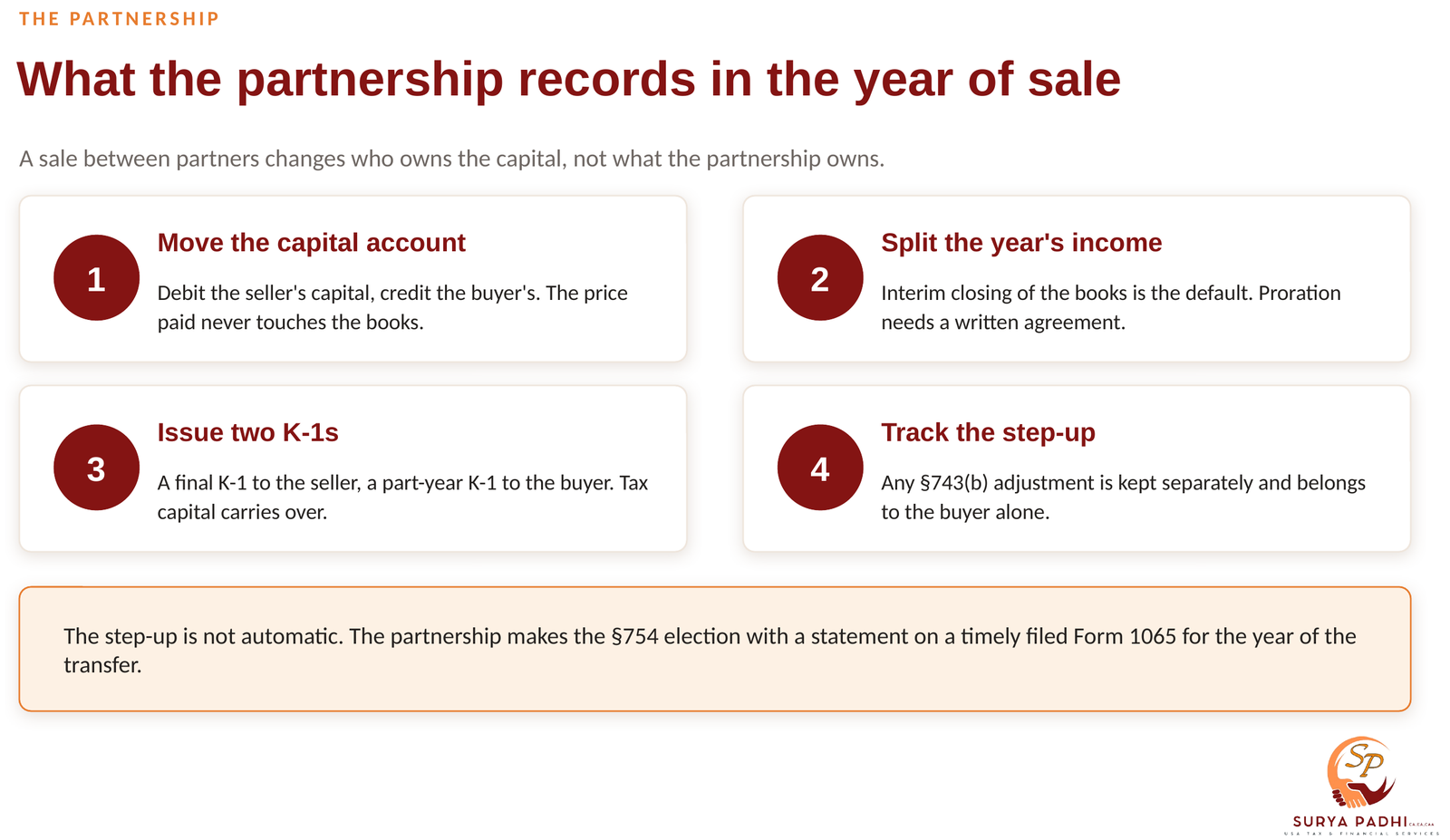
A sale between partners changes who owns the capital, not what the partnership owns. The buyer pays the seller directly, so no cash moves through the partnership and its assets are unchanged. The journal entry is simply a debit to the seller’s capital account and a credit to the buyer’s for the same amount. The price paid never touches the partnership’s books.
- Move the capital account: debit the seller’s capital, credit the buyer’s. The buyer’s beginning tax capital carries over from the seller.
- Split the year’s income between them. Under the regulations, an interim closing of the books is the default; proration is allowed only with a dated, written agreement of the partners.
- Issue two K-1s: a final K-1 to the seller and a part-year K-1 to the buyer.
- Track any §743(b) adjustment separately, as a basis adjustment for the buyer only.
A sale is not a buyout
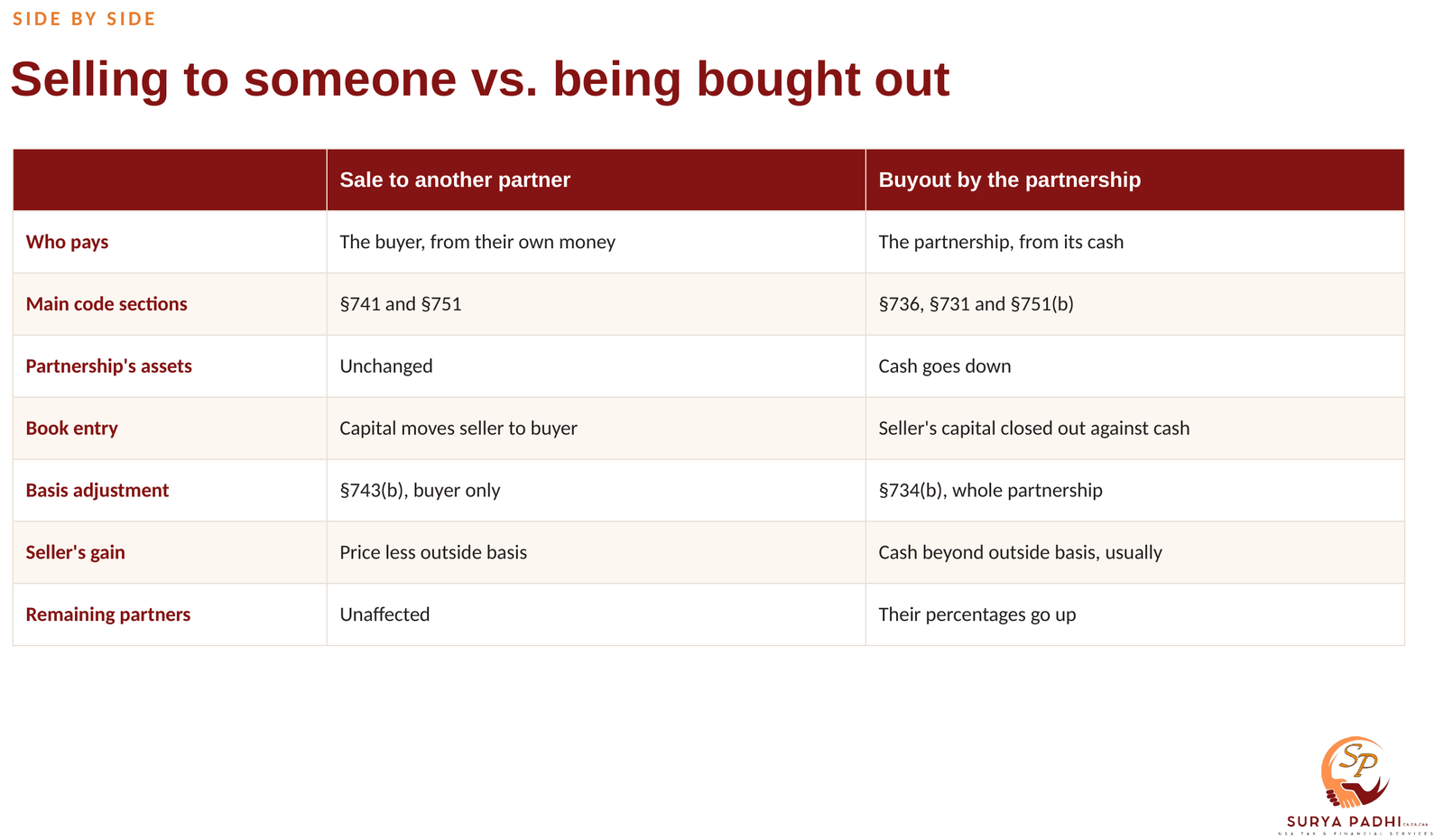
If the partnership itself pays the departing partner, the transaction is a liquidating distribution rather than a sale, and different rules apply (§736, §731 and §751(b)). Cash leaves the partnership, the seller’s capital account is closed out against it, the other partners’ percentages go up, and any basis adjustment falls under §734(b) for the whole partnership. The purchase documents should say plainly which one you are doing.
Forms and deadlines for a 2026 sale
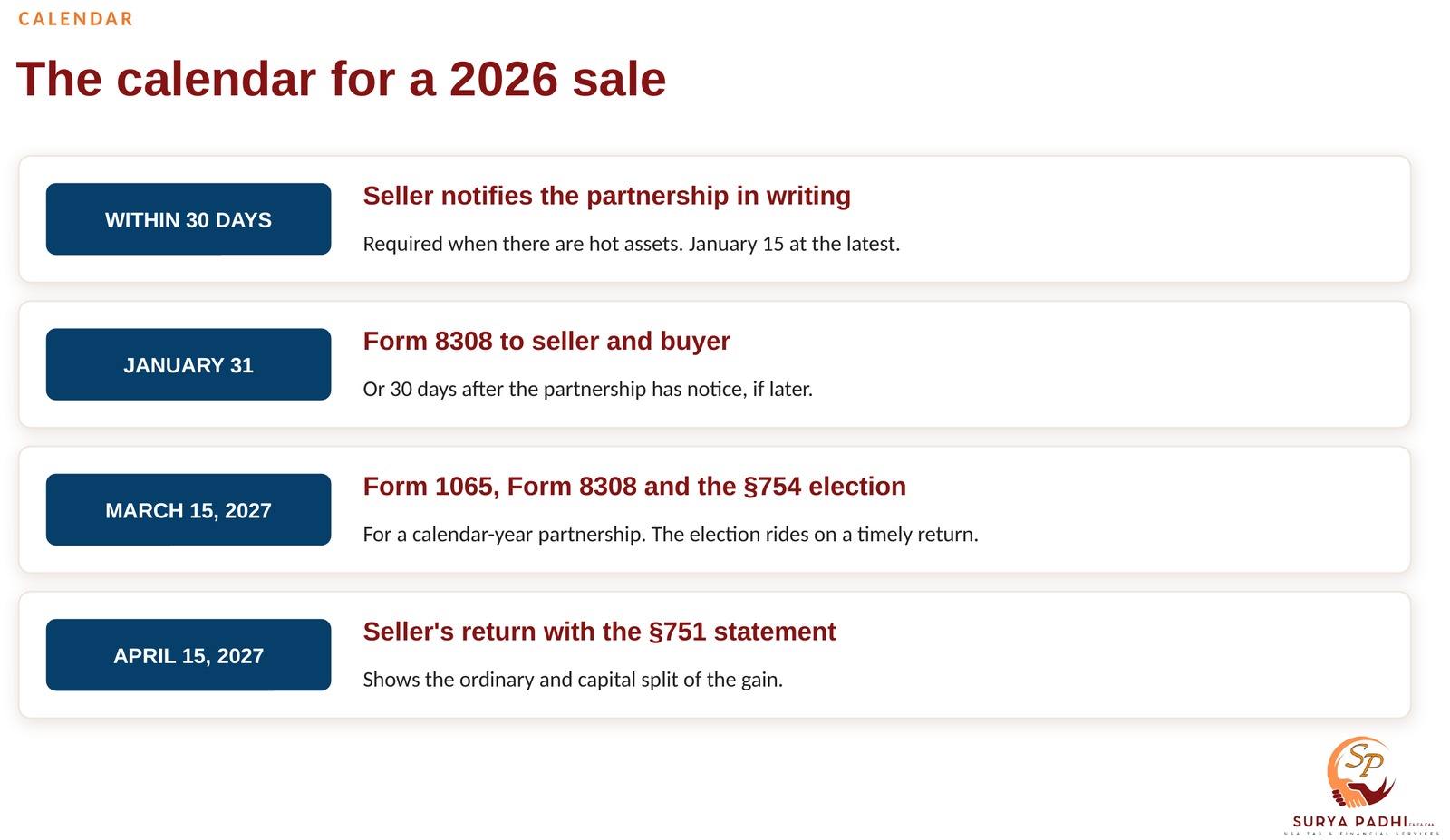
| When | What | Who |
|---|---|---|
| Within 30 days of the sale (January 15, 2027 at the latest) | Written notice to the partnership of a §751(a) exchange: names, addresses, TINs and the date | Seller |
| January 31, 2027 (or 30 days after notice, if later) | Form 8308 furnished to the seller and the buyer | Partnership |
| March 15, 2027 (calendar-year partnership) | Form 1065 with Form 8308 attached, and the §754 election statement if made | Partnership |
| April 15, 2027 | Seller’s return, with the §751 statement | Seller |
Buying from a foreign partner
If the seller is a foreign person, the buyer must generally withhold 10% of the amount realized under §1446(f) and report it on Forms 8288 and 8288-A. If the buyer does not, the partnership may have to withhold from the buyer’s distributions. Get the seller’s certification of non-foreign status before closing.
Five mistakes that cost real money
- Leaving the seller’s share of partnership debt out of the amount realized.
- Reporting the whole gain as capital when hot assets make part of it ordinary.
- Skipping the §754 election, so the buyer loses the step-up.
- Missing the seller’s written notice and the partnership’s Form 8308.
- Buying from a foreign partner without withholding or a certification.
Gifts and transfers at death follow related but different rules — a gift of an interest carrying debt can itself trigger gain, and at death a §754 election lets the heir’s new basis reach the partnership’s assets. Both deserve their own look before the transfer happens.
Frequently asked questions
Is the sale of a partnership interest a capital gain?
Mostly. Section 741 treats a partnership interest as a capital asset, but section 751 makes the part of the gain from the partnership’s unrealized receivables, inventory and depreciation recapture ordinary income.
Do partnership liabilities count in the sale price of a partnership interest?
Yes. The seller’s share of partnership liabilities that shifts to the buyer is treated as money received, so it is part of the amount realized and part of the gain.
What does a section 754 election do when a partnership interest is sold?
It lets the partnership adjust the basis of its assets for the buyer under section 743(b), so the buyer’s higher purchase price turns into extra depreciation and less gain for that buyer only. It is made with a statement on a timely filed Form 1065.
How is the partnership’s income split in the year a partner sells?
By default the partnership closes its books on the sale date and each partner is allocated the income for their period. The partners can instead agree in writing to prorate the year’s items by days.
Buying or selling a partnership interest?
We work out the seller’s gain and the §751 split, set up the §754 election for the buyer, and prepare the partnership return and the K-1s. The best time to call is before the deal closes.
This article is general tax education and does not constitute individualized tax, legal or financial advice. Figures are stated for the tax year shown and are subject to IRS adjustment. Consult a qualified professional about your own facts.