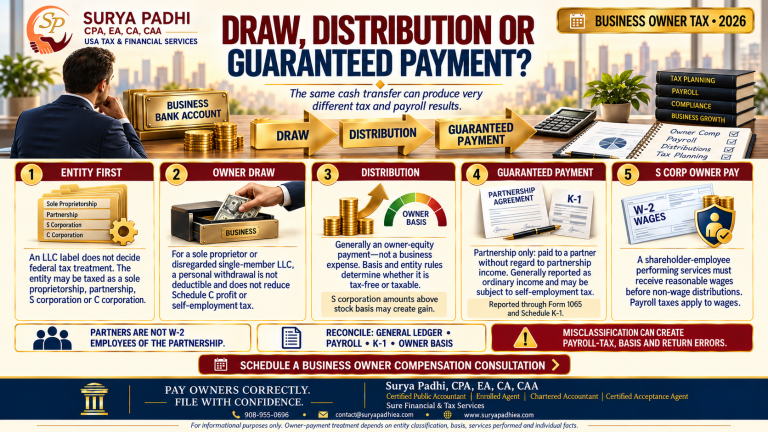
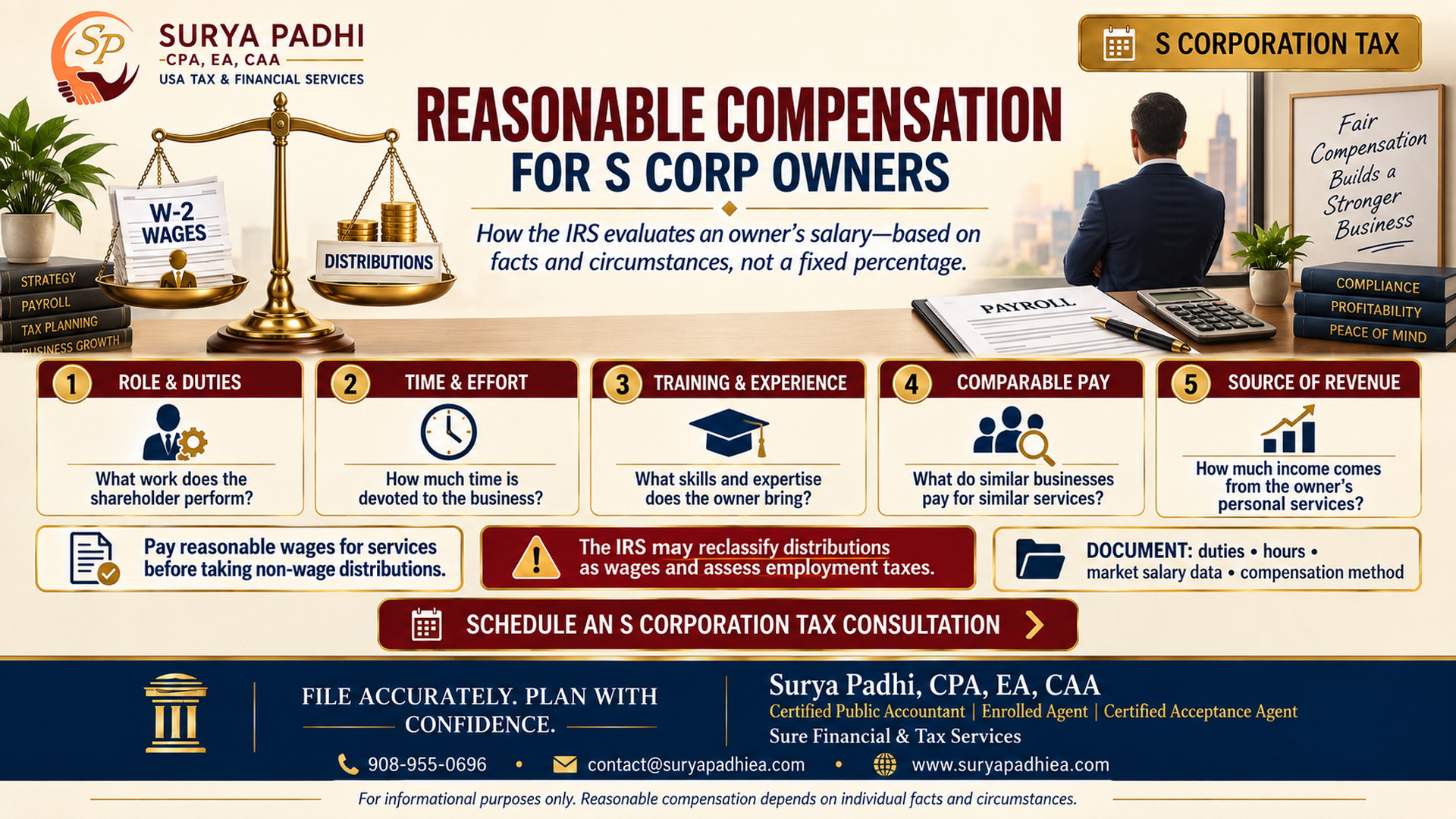
There is no percentage rule and no safe harbor. An S corp owner who works in the business is an employee, and the IRS can recharacterize distributions as wages to the extent they are reasonable pay for services performed. Nine factors decide it: training, duties, hours, dividend history, and what comparable businesses pay.
7:12. The written version, the figures and the sources are all below.
| Safe harbor percentage | None | No statute, regulation or revenue ruling sets a salary-to-distribution ratio. |
|---|---|---|
| Social Security wage base | $184,500 | 2026. Wages above this add no further Social Security tax. |
| Social Security tax | 12.4% | 6.2% employee plus 6.2% employer, up to the wage base. |
| Medicare tax | 2.9% | 1.45% each side, on every dollar of wages. No cap. |
| Additional Medicare Tax | 0.9% | Withheld on wages over $200,000. Employee side only. |
| QBI threshold | $201,750 | 2026, single filers. $403,500 married filing jointly. |
| Defined contribution limit | $72,000 | 2026 section 415(c) ceiling on total annual additions. |
There is no 60/40 rule and no safe harbor percentage. What actually decides your salary is a list of factors about the work you do — and whether you kept any evidence of it.
Ask ten S corp owners how they set their salary and most will quote you a ratio. Sixty-forty. A third and two thirds. Half and half. The problem with all of them is the same: there is no safe harbor percentage for S corp reasonable compensation anywhere in the Internal Revenue Code, the regulations, or a revenue ruling. Nobody at the IRS is bound by a ratio, and nobody in an examination has ever won with one.
What does govern it is narrower and more useful. A corporate officer who performs more than minor services is an employee, and payments to that officer are wages to the extent they represent reasonable compensation for services rendered. Whether your number is reasonable is answered by a published list of factors — and by whether you kept anything on file that speaks to them.
Key takeaways
- There is no statutory percentage. A ratio is a rule of thumb, not a defence.
- The IRS lists nine factors, and every one of them is about the work you personally perform.
- Moving a dollar from wages to distributions saves 15.3% while both sit under the 2026 wage base of $184,500 — that gap is exactly why the rule is enforced.
- The salary should be priced before the year starts, from comparable wage data, and written down.
Why an S corp owner has to take a salary at all
An S corporation does not pay federal income tax. Its profit flows through to the shareholders and is taxed on their personal returns, and — this is the part that creates the whole issue — that flow-through profit carries no Social Security or Medicare tax. Wages do. So two dollars leaving the same company, in the same year, to the same person, can carry a 15.3% difference depending only on what you call them.
The Treasury Regulations treat a corporate officer as an employee, with a narrow exception for an officer who performs no services or only minor services and neither receives nor is entitled to receive any remuneration. The instructions to Form 1120-S put the consequence plainly: distributions and other payments by an S corporation to a corporate officer must be treated as wages to the extent the amounts are reasonable compensation for services rendered to the corporation.
The courts have backed this repeatedly
The IRS names <em>Joly v. Commissioner</em>, T.C. Memo. 1998-361; <em>Veterinary Surgical Consultants, P.C. v. Commissioner</em>, 117 T.C. 141 (2001); <em>Joseph M. Grey Public Accountant, P.C. v. Commissioner</em>, 119 T.C. 121 (2002); and <em>David E. Watson, P.C. v. United States</em>, 668 F.3d 1008 (8th Cir. 2012) as authority for recharacterizing distributions as wages. This is settled ground, not a grey area.
There is no 60/40 rule, and there never has been
This is worth being blunt about, because the rules of thumb circulate faster than the law does. No section of the Code, no Treasury Regulation and no revenue ruling establishes a percentage split between salary and distributions. There is no 60/40 rule. There is no one-third rule. There is no figure your payroll software can calculate for you.
A ratio is not a safe harbor. It is a number somebody picked, and in an examination it carries exactly as much weight as that description suggests.
The rules of thumb persist because they feel like protection, and because for a large share of small S corps they happen to land somewhere defensible. That is not the same as being a rule. The test is whether the salary reflects what the services are worth, and a percentage of profit is not evidence about services — it is evidence about profit.
The nine factors the IRS actually names
The IRS publishes the list. It appears in Fact Sheet FS-2008-25, <em>Wage Compensation for S Corporation Officers</em>, and again on the agency’s S corporation compensation page. These are the considerations courts have applied, and they are all about the work rather than the profit.
| Factor | The question it asks | Evidence that answers it |
|---|---|---|
| Training and experience | What does this skill set command in the market? | Credentials, licences, years in the field |
| Duties and responsibilities | What do you actually do in this business? | A written role description |
| Time and effort devoted | Full time, or a few hours a week? | Calendars, timesheets, billing records |
| What comparable businesses pay | What would someone else charge for this role? | Salary surveys, wage data, job postings |
| Dividend history | How much has been distributed instead of paid? | The distribution record across several years |
| Payments to non-shareholder employees | What do your own staff earn for their work? | Payroll registers for the rest of the team |
| Timing and manner of bonuses | Do bonuses track services, or year-end profit? | Board minutes and the payment dates |
| Compensation agreements and formulas | Was the number set in advance, and how? | A signed, dated compensation agreement |
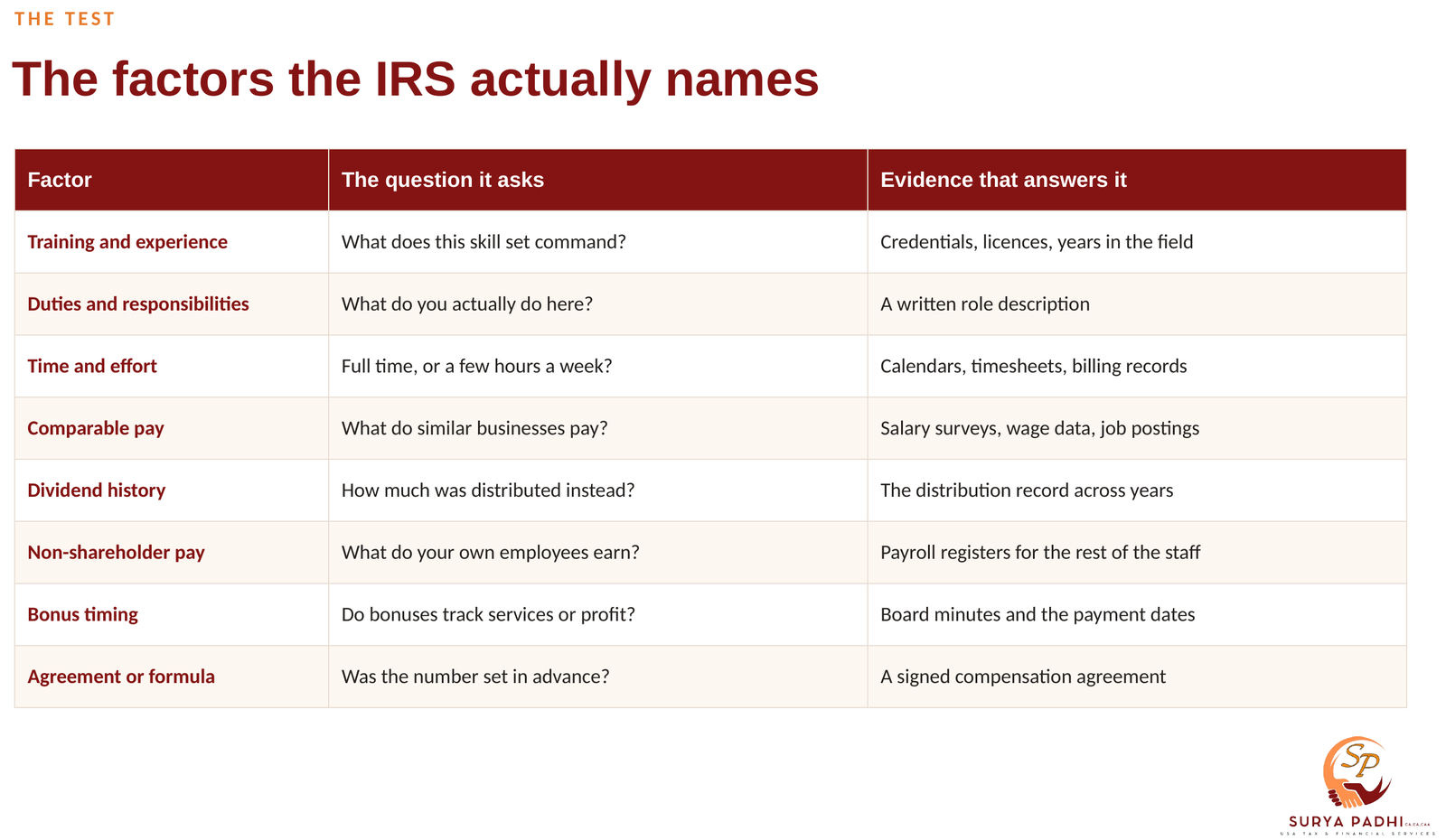
Read down that list and a pattern shows up. Every factor is a question about evidence. Not one of them asks what percentage of the profit you took. A file that answers seven or eight of them is in a completely different position from one that answers none, even if the two files support the same salary figure.
What the split is actually worth: a worked example
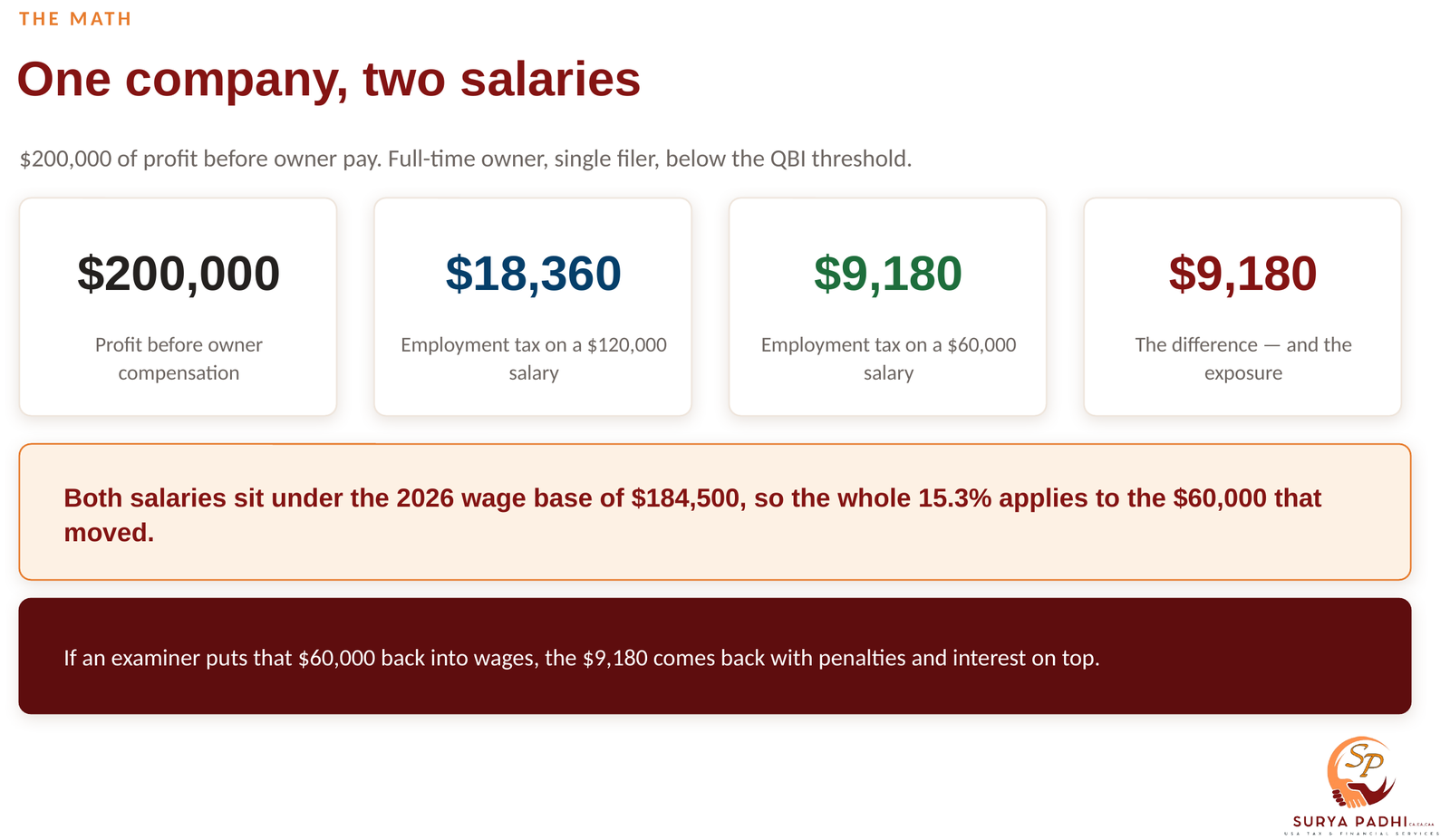
Take a single-owner consulting S corporation with $200,000 of profit before any owner compensation, in tax year 2026. The owner works full time. Compare a $120,000 salary with a $60,000 salary, and follow the employment tax.
One company, two salaries — tax year 2026
| Profit before owner compensation | $200,000 |
| Salary A | $120,000 |
| Social Security, both halves (12.4%) | $14,880 |
| Medicare, both halves (2.9%) | $3,480 |
| Employment tax on Salary A | $18,360 |
| Salary B | $60,000 |
| Employment tax on Salary B (15.3%) | $9,180 |
| Difference | $9,180 |
Both salaries sit under the 2026 Social Security wage base of $184,500, so the whole 15.3% applies to the $60,000 that moved. The employer half is deductible by the corporation, so the K-1 income is $135,410 under Salary B and $70,820 under Salary A.
Check the flow-through figures, because they matter for the next section. Under Salary B the corporation deducts $60,000 of wages and $4,590 of employer payroll tax, leaving $135,410 of ordinary income on the K-1. Under Salary A it deducts $120,000 and $9,180, leaving $70,820. The owner’s total taxable income is $195,410 in the first case and $190,820 in the second — the $4,590 gap is simply the extra employer payroll tax deduction.
So the payroll tax saving from the lower salary is $9,180, but it is not the whole story. The qualified business income deduction is 20% of the flow-through profit, and that profit is $64,590 larger under the lower salary. At the 20% rate that is $12,918 of additional deduction. The trade-off is real in both directions, which is why the answer has to come from the services rather than from the arithmetic.
What the $9,180 really represents
It is the saving if $60,000 is defensible. It is also the exposure if it is not. If an examiner concludes the reasonable figure was $120,000, that $60,000 of distributions is recharacterized as wages, the $9,180 of employment tax is assessed, and penalties and interest follow. The number is the same either way — only the direction changes.
Three ceilings that change the answer
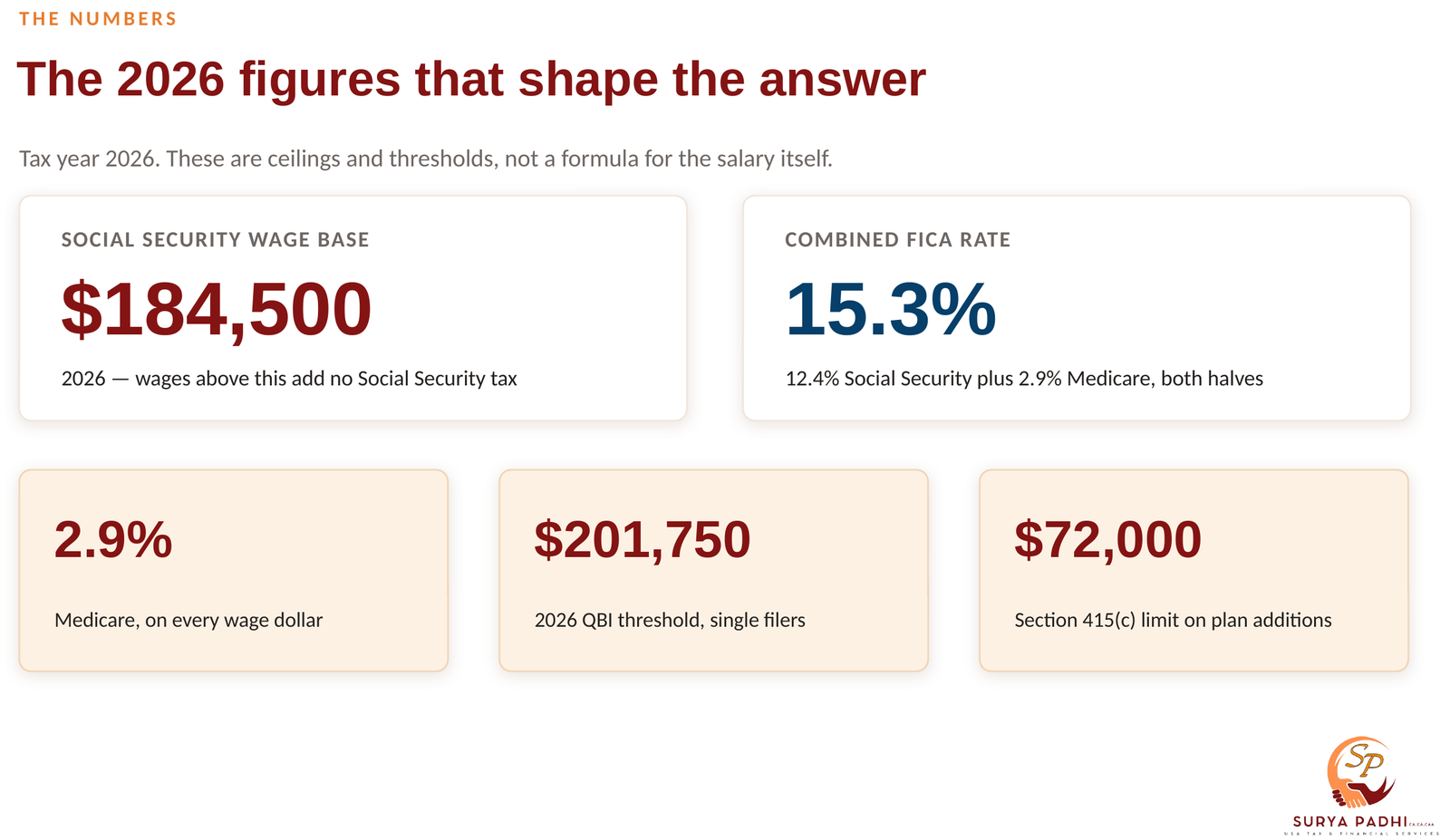
The factors decide what is reasonable. Three separate 2026 figures decide what a given salary costs, and any of them can make a higher number the better answer rather than the safer one.
| Ceiling | 2026 figure | What it changes |
|---|---|---|
| Social Security wage base | $184,500 | Wages above this add only the 2.9% Medicare tax, not the 12.4% Social Security tax. The marginal cost of extra salary drops sharply. |
| Section 199A threshold | $201,750 single, $403,500 joint | Below the threshold, salary simply shrinks the QBI deduction. Above the phase-in range — $276,750 and $553,500 — the deduction is limited by W-2 wages, so salary can increase it. |
| Retirement plan limits | $72,000 additions, $360,000 compensation | Employer plan contributions are calculated on W-2 wages. A low salary caps what the plan can absorb, and that room is often worth more than the payroll tax saved. |
The second row is where people get caught out. Below the threshold, extra salary costs payroll tax and reduces the 20% deduction, so the pressure runs downward. Once income is above the phase-in range, the deduction for each business is capped by reference to W-2 wages — the greater of 50% of wages, or 25% of wages plus 2.5% of the unadjusted basis of qualified property. At that point a salary that is too low can cost more in lost deduction than it ever saved in payroll tax.
How to document the number
A defensible salary is not a bigger salary. It is a salary with a file behind it. Three steps, done once a year before the first payroll run.
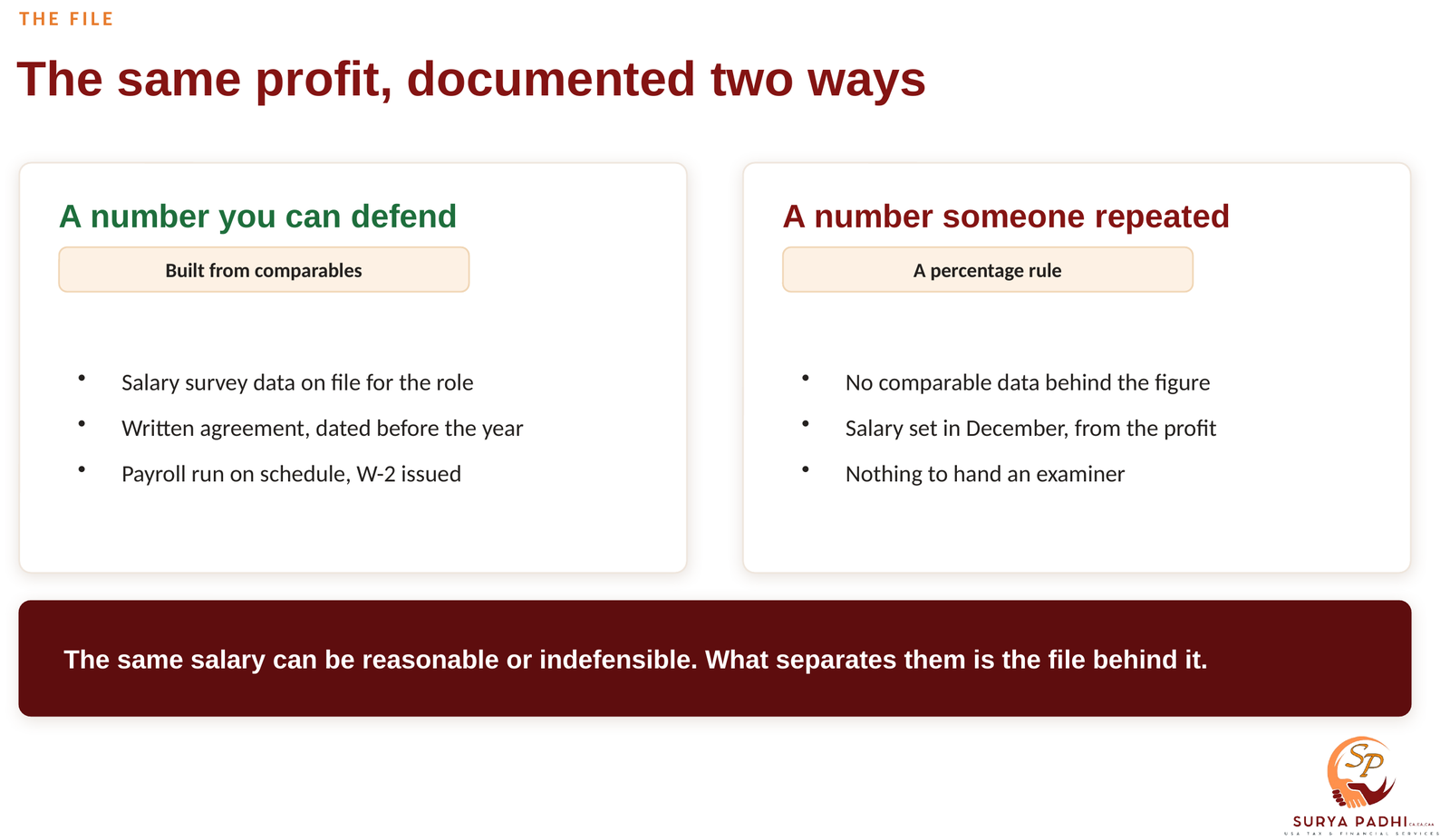
- Price the role. Find what the market pays for the work you personally do — your field, your region, your level. Save the source, dated.
- Split your time. A professional who also does the invoicing and the scheduling is not paid a professional rate for all of those hours. Price each part honestly.
- Write it down. A compensation agreement, dated before the year it applies to, naming the figure and the sources it came from.
Then run the payroll on a schedule and issue the W-2. A salary that appears as a single December entry, sized to whatever the profit turned out to be, tells an examiner exactly how it was set — regardless of whether the number itself was reasonable.
Review it annually, not once
The number moves. Hiring your first employee changes what share of the profit is yours to claim as compensation for services. So does stepping back from delivery into management, or a change in market rates. A file from four years ago supporting a salary you have not revisited is a stale file.
If the IRS disagrees with your number
A reasonable compensation examination is an employment tax matter. If the agent concludes the salary was too low, distributions are recharacterized as wages, the corporation owes the employer share and the withholding it should have made, and the employee share follows. Employment tax penalties and interest attach on top.
- The adjustment is not limited to one year. An examiner who finds a pattern can look at the open years.
- The corporation does get a deduction for the additional wages and the employer payroll tax, which softens the income tax side but not the employment tax itself.
- Amended payroll returns are needed for every quarter affected, which is administrative work you pay for either way.
- Your own documentation is what the examination turns on. Comparables, a written agreement and a consistent payroll history are what get a number accepted.
- New Jersey and most states follow the federal wage characterization for their own payroll taxes, so a federal adjustment does not stop at the federal line.
None of this is a reason to overpay yourself defensively. Salary that exceeds what the services are worth is its own inefficiency — it carries payroll tax you did not need to pay. The goal is a number you can explain in one sentence, backed by a file that a stranger could follow.
Full transcript
[PASTE THE CORRECTED TRANSCRIPT HERE — one paragraph per chapter. Download the auto-generated captions from YouTube Studio, fix the form numbers and dollar amounts, and paste the cleaned text. This is several hundred extra indexable words in your own voice, and it is what AI answer engines read.]
Frequently asked questions
Is there a 60/40 rule for S corp salary?
No. There is no percentage rule for S corp reasonable compensation in the Internal Revenue Code, the Treasury Regulations or any revenue ruling. The 60/40 split, the one-third rule and every similar formula are practitioner rules of thumb with no legal authority behind them. The test is whether the salary represents reasonable compensation for the services actually performed, which is answered by the factors the IRS publishes — training, duties, time, comparable pay and the rest.
What happens if I take no salary at all?
If you perform more than minor services for the corporation, you are an employee and payments to you are wages to the extent they are reasonable compensation. A working owner with distributions and zero W-2 wages is the clearest case an examiner can find, and the courts have consistently upheld recharacterization. The narrow exception in the regulations covers an officer who performs no services and receives no remuneration — genuinely passive, not merely uninvolved in payroll.
Does a higher salary ever make me better off?
Sometimes, yes. Once wages pass the 2026 Social Security wage base of $184,500, additional salary carries only the 2.9% Medicare tax rather than 15.3%. Employer retirement plan contributions are calculated on W-2 wages, so a low salary caps what the plan can absorb against the 2026 section 415(c) limit of $72,000. And above the section 199A phase-in range, the qualified business income deduction is limited by reference to W-2 wages, so too little salary can cost more deduction than it saves in tax.
How do I find comparable wage data?
Published salary surveys for your profession, federal wage data by occupation and metropolitan area, job postings for the same role in your region, and what you pay your own non-shareholder employees for comparable work. Save what you used and date it. Commercial reasonable compensation reports exist and are useful in a contested case, but for most small S corps a documented market rate plus an honest split of your working hours is what the factors are asking for.
When should I set the number?
Before the year starts, or as early in it as possible, and in writing. A salary set in December from the profit figure looks like what it is, and the timing and manner of paying compensation is itself one of the published factors. Review it annually before the first payroll run — hiring staff, changing your role, or a shift in market rates all move the answer.
Work out your own number
The S Corp Owner Compensation Optimizer sizes a salary against the payroll tax, the QBI deduction and the retirement plan room, so you can see the whole trade-off in one place before you set the payroll.
This article is general educational information, not individualized tax or investment advice. Figures cited are subject to IRS adjustment. Consult a qualified professional about your own facts.