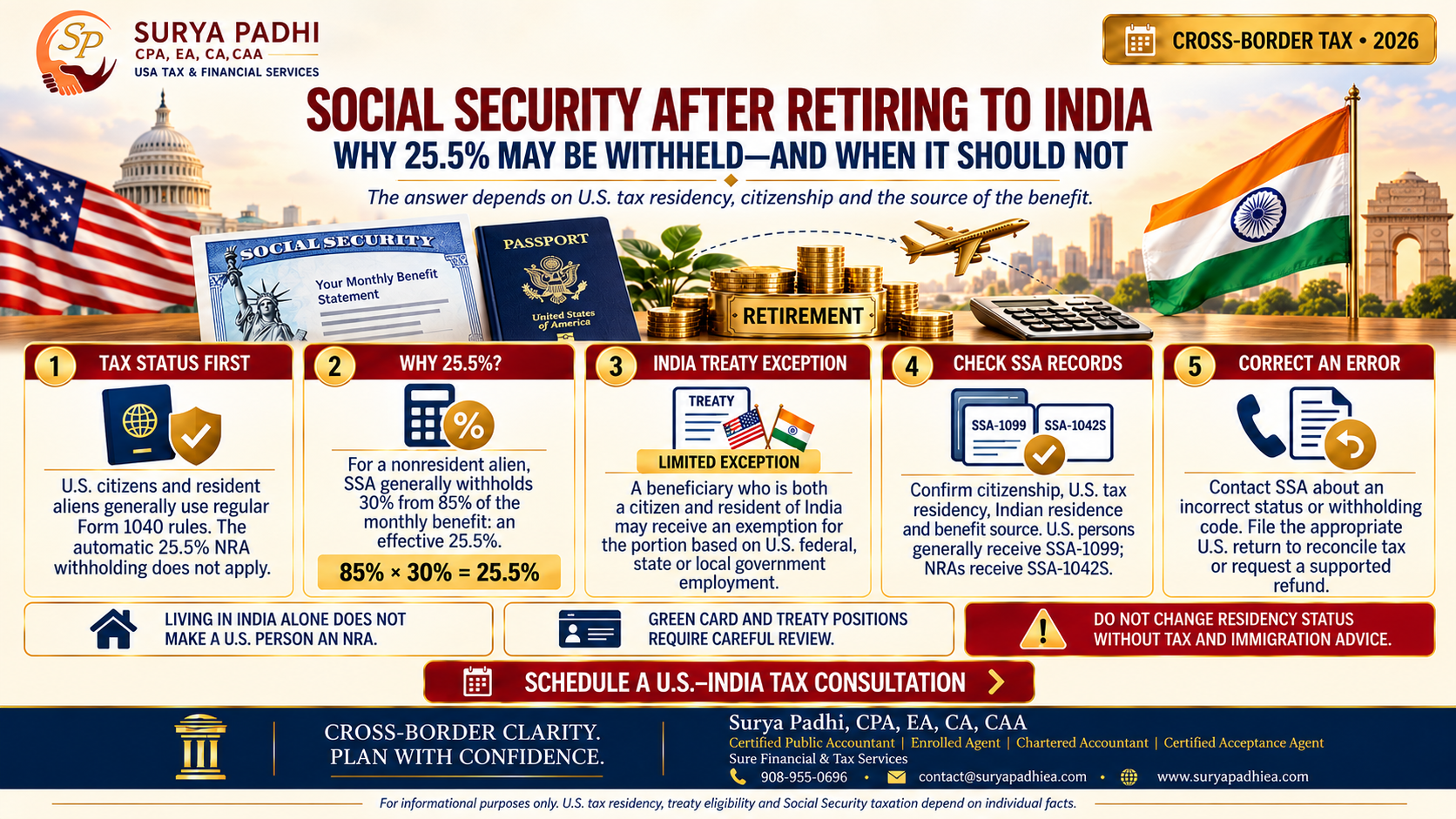
Yes, if you are a nonresident alien. The Social Security Administration withholds 25.5 percent of each payment, which is a flat 30 percent tax on the 85 percent treated as taxable. India is not an exempt treaty country. Citizens and green card holders are not subject to that rule, and a green card holder can recover tax withheld in error.
7:15. The written version, the figures and the sources are all below.
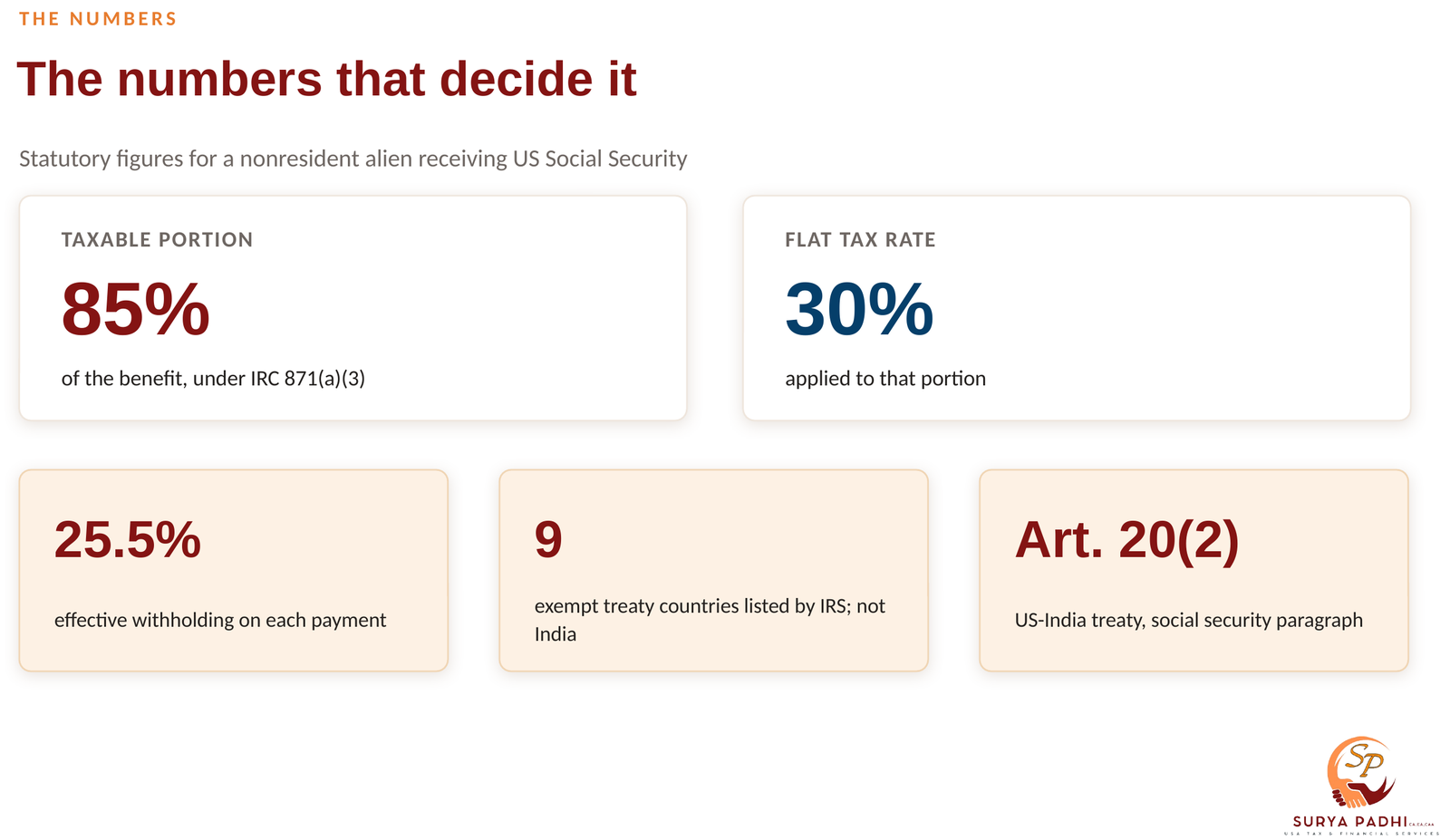
| Share of the benefit treated as taxable (nonresident alien) | 85% | Internal Revenue Code section 871(a)(3). |
|---|---|---|
| Flat tax rate on that share | 30% | Sections 871(a)(3) and 1441; SSA is the withholding agent. |
| Effective withholding on each payment | 25.5% | 85% times 30%, the rate SSA states. |
| Treaty countries exempt in IRS Publication 915 | 9 | India is not on the list. |
| US-India treaty paragraph on Social Security | Article 20(2) | Taxable only in the paying country, per the IRS technical explanation. |
A nonresident alien has 25.5 percent withheld. A citizen or green card holder does not. Which one are you?
If you retired to India and your US Social Security payment came in smaller than you expected, you are probably looking at withholding. Whether US Social Security is taxed while you are living in India as a nonresident depends on one thing: how the IRS classifies you. For a nonresident alien the answer is yes, and the tax comes off before the money is paid. For a citizen or a green card holder it is a different rule altogether.
This article separates the three common situations, shows the arithmetic, explains what the US-India treaty does and does not do, and lays out the steps when withholding was taken in error. It covers the US side only. How India treats the payment is a question for a practising Chartered Accountant there.
Key takeaways
- Your status decides everything: US citizen, green card holder, or nonresident alien.
- A nonresident alien has 25.5 percent withheld, which is 30 percent of the 85 percent of the benefit treated as taxable.
- India is not on the IRS list of treaty countries that exempt these benefits, and Article 20(2) of the treaty leaves the taxing right with the United States.
- A green card holder can recover tax withheld in error, and the cleanest route depends on acting within the same calendar year.
Start with your status
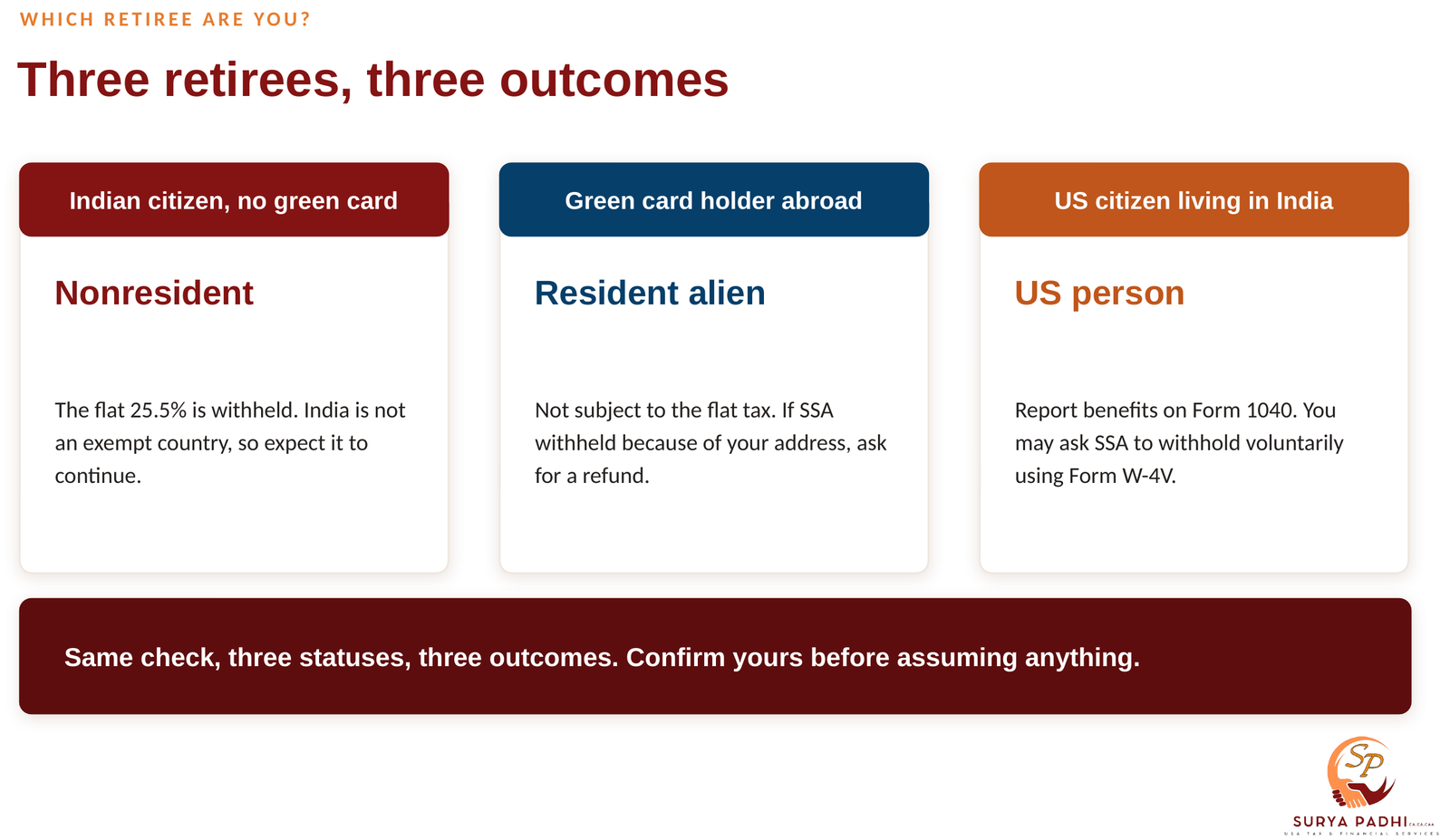
The Social Security Administration (SSA) does not ask where you live when it decides whether to withhold. It asks how the IRS classifies you, and it works from the citizenship and residency information in its own records. That produces three common situations for retirees in India.
| Your status | What SSA does | What you do |
|---|---|---|
| US citizen living in India | No flat nonresident withholding. Benefits are taxed on your own return. | Report on Form 1040. Form W-4V is available if you want voluntary withholding. |
| Green card holder living in India | Not subject to the 30 percent tax, though tax is sometimes withheld by mistake because of a foreign address. | Ask SSA for a refund, or file Form 1040. See below. |
| Nonresident alien: no citizenship, no green card, not a US resident | Withholds 25.5 percent of each payment. | Usually nothing more on the US side. Keep Form SSA-1042S. |
A green card keeps you a resident alien for tax purposes until it is revoked or formally found to be abandoned. Moving abroad does not end it by itself. Someone who never held a green card is generally a nonresident unless the substantial presence test makes them a resident.
Why US Social Security is taxed when you live in India as a nonresident
For a nonresident alien the rule is written into the Internal Revenue Code. Under section 871(a)(3), 85 percent of a Social Security benefit is included in income and taxed at a flat 30 percent, and section 1441 makes the payer withhold it. SSA is the payer, so the tax comes off before the money is deposited. Multiply the two percentages and the effective rate is 25.5 percent of every payment.
It is not a penalty
The 25.5 percent is not a charge for living abroad, and it does not depend on India. It is the standard way the Code taxes a foreign person who receives a US Social Security benefit.
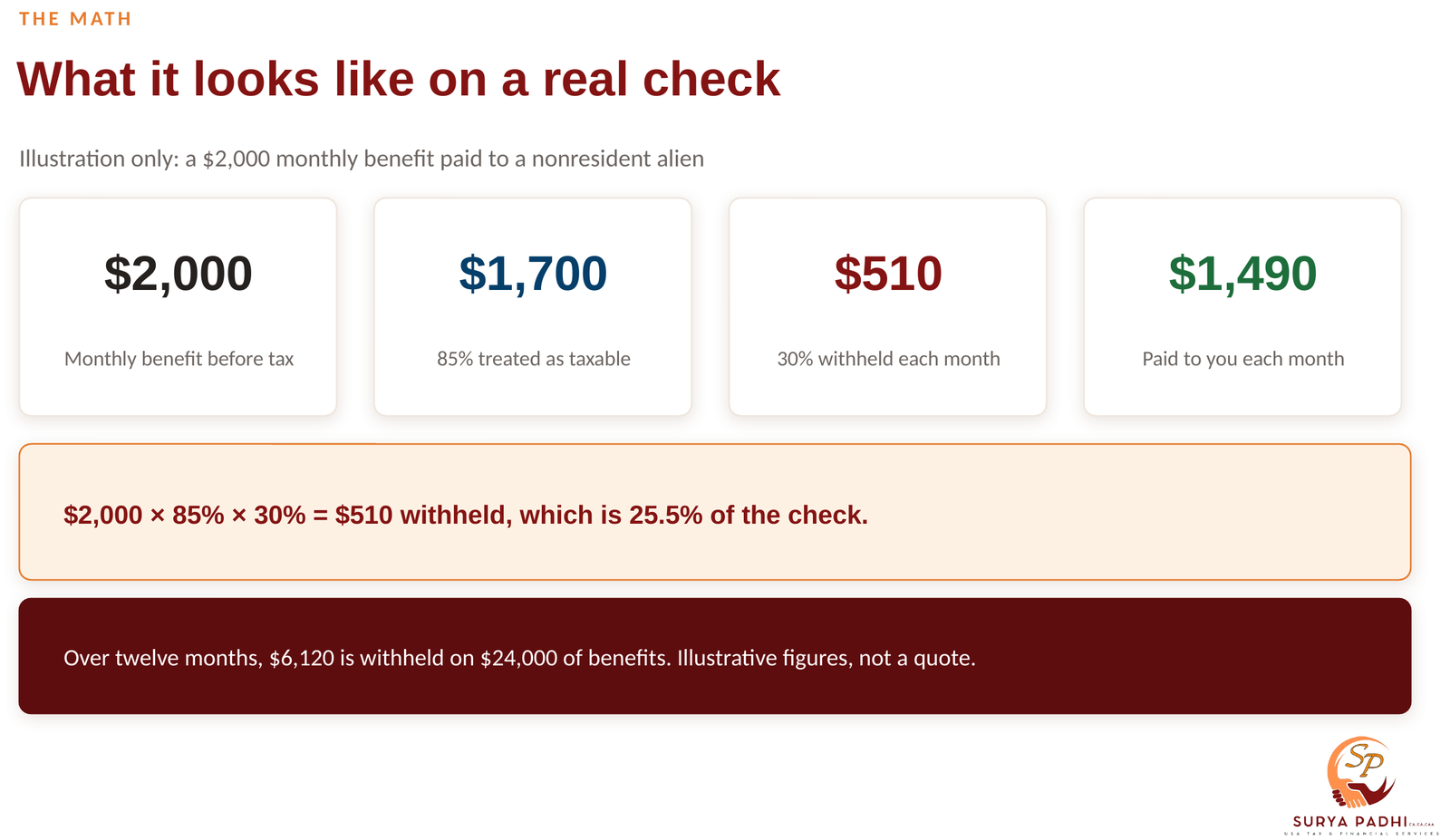
Illustration: a $2,000 monthly benefit
| Monthly benefit | $2,000 |
| Treated as taxable (85%) | $1,700 |
| Withheld (30% of $1,700) | $510 |
| Paid to you each month | $1,490 |
| Withheld over twelve months | $6,120 |
Illustrative figures only, not your benefit.
Because the rate is flat and applies to the gross benefit, the amount withheld is, for most nonresident retirees, the end of the US tax on that income. A US return is often unnecessary when the benefit is your only US income. Confirm that against your own facts before you decide not to file.
India is not on the exempt list
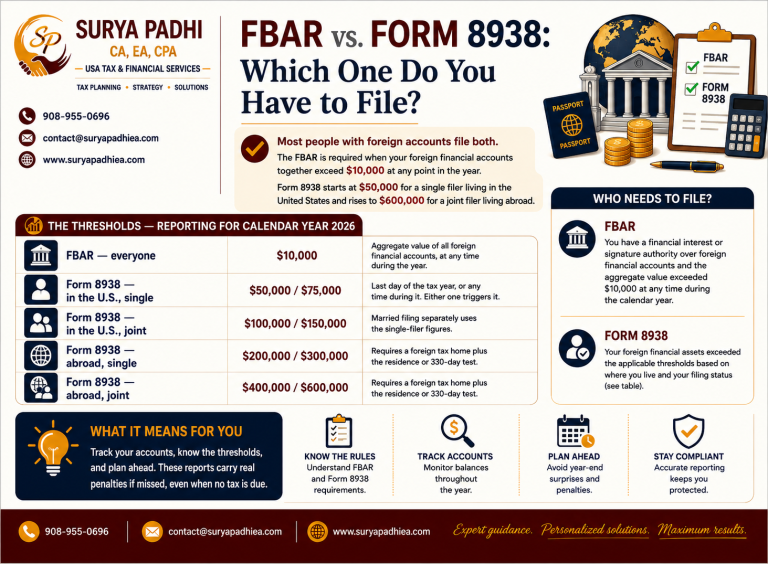
Some tax treaties remove the withholding altogether. IRS Publication 915 lists nine countries whose residents are exempt from US tax on these benefits: Canada, Egypt, Germany, Ireland, Israel, Italy, Japan, Romania and the United Kingdom. India is not among them.
The publication does carry one India-specific note, and it is a narrow one about benefits earned through US government service. That is not the situation most retirees are in, so for an ordinary retirement benefit assume the withholding applies.
What the US-India treaty actually says
The treaty does address Social Security, in Article 20, paragraph 2. In substance it says that Social Security paid by one country to a resident of the other is taxable only in the paying country. For a US benefit paid to a resident of India, the paying country is the United States. The IRS technical explanation describes the paragraph the same way: taxation of social security benefits only in the State making the payment.
Two points follow. First, the treaty confirms the US tax instead of removing it, which is why the withholding continues. Second, the same paragraph points away from a second layer of tax in India.
The Indian side
How an Indian resident reports this payment, and whether the treaty position has to be claimed on the Indian return, is a question of Indian law. Surya Padhi holds the Indian Chartered Accountant qualification but does not practise in India and does not prepare Indian filings. Take the treaty article and your SSA statement to a practising Chartered Accountant there.
When the withholding is a mistake
A green card holder is a resident alien, so the flat tax should not apply. Withholding sometimes happens anyway because the address SSA holds is outside the United States. IRS Publication 915 describes the remedy.
- Confirm that your green card has not been revoked or formally found abandoned.
- Ask SSA to refund the tax. SSA can do this when the refund can be processed in the same calendar year the tax was withheld.
- If SSA cannot, file Form 1040 or 1040-SR following the instructions in Publication 915. Attach your Form SSA-1042S, a copy of your green card, and a signed declaration that the withholding was not proper and that you are filing as a resident alien on your worldwide income.
- Keep copies of the statement, the card and any correspondence with SSA.
Mind the calendar
A refund through SSA depends on the same calendar year. If you spot the error in the autumn, act then instead of waiting for the January statement.
Dates to put on your calendar
| When | What happens |
|---|---|
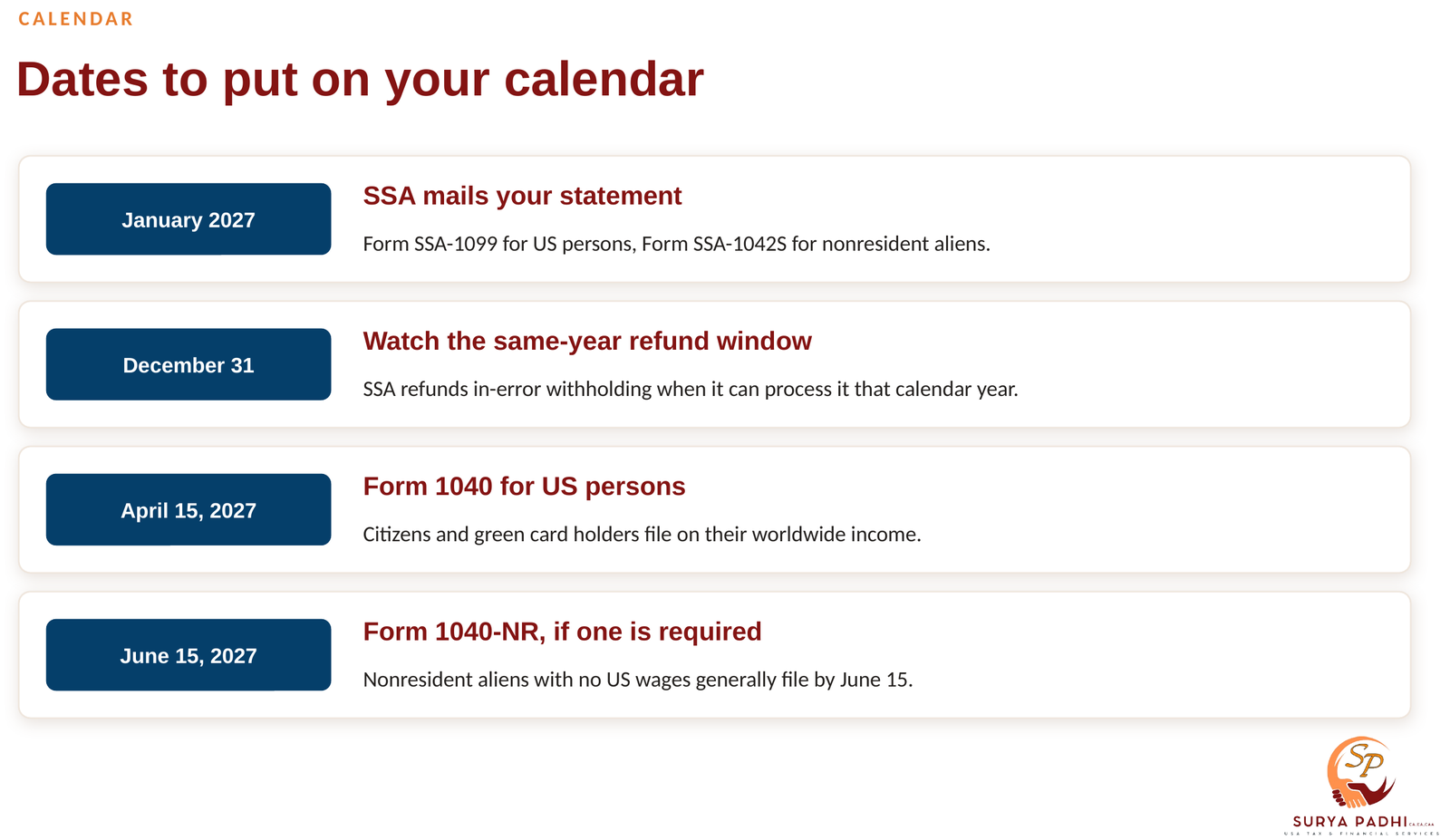
| January | SSA mails Form SSA-1099 to US persons and Form SSA-1042S to nonresident aliens. |
| December 31 | The same-calendar-year window for an SSA refund of tax withheld in error. |
| April 15 | Usual due date for Form 1040. |
| June 15 | Usual due date for Form 1040-NR when no wages were subject to US withholding. |
These are the usual dates. A weekend, a holiday or an extension can move them.
Frequently asked questions
Is US Social Security taxable if I live in India?
Yes, by the United States. Under Article 20(2) of the US-India treaty, US Social Security paid to a resident of India is taxable only in the United States. How a resident reports it on an Indian return is a question for a practising Chartered Accountant in India.
How much tax is withheld from a nonresident alien’s Social Security?
SSA withholds 25.5 percent of each payment. That is a flat 30 percent tax on the 85 percent of the benefit treated as taxable.
Does moving to India make a green card holder a nonresident?
Not by itself. A green card holder is treated as a resident alien until the status is revoked or formally found to be abandoned.
Can I get the Social Security withholding back?
A green card holder can. SSA can refund tax withheld in error when it can process the refund in the same calendar year, and otherwise the holder files Form 1040 with the SSA-1042S, a copy of the green card and a signed declaration. A nonresident alien generally has little to claim back, because the withholding usually equals the tax owed.
Not sure which status SSA has for you?
Send us your statement and we will confirm how the IRS classifies you and what, if anything, needs correcting. Indian filings stay with a practising Chartered Accountant in India.
This article is general tax education and does not constitute individualized tax, legal or financial advice. Figures are stated for the tax year shown and are subject to IRS adjustment. Consult a qualified professional about your own facts. Surya Padhi holds the Indian Chartered Accountant qualification but is not licensed to practise in India and does not provide Indian tax filing or advisory services. That background is used to read Indian documents and positions correctly for the US return; Indian filings should be handled by a practising Chartered Accountant in India.