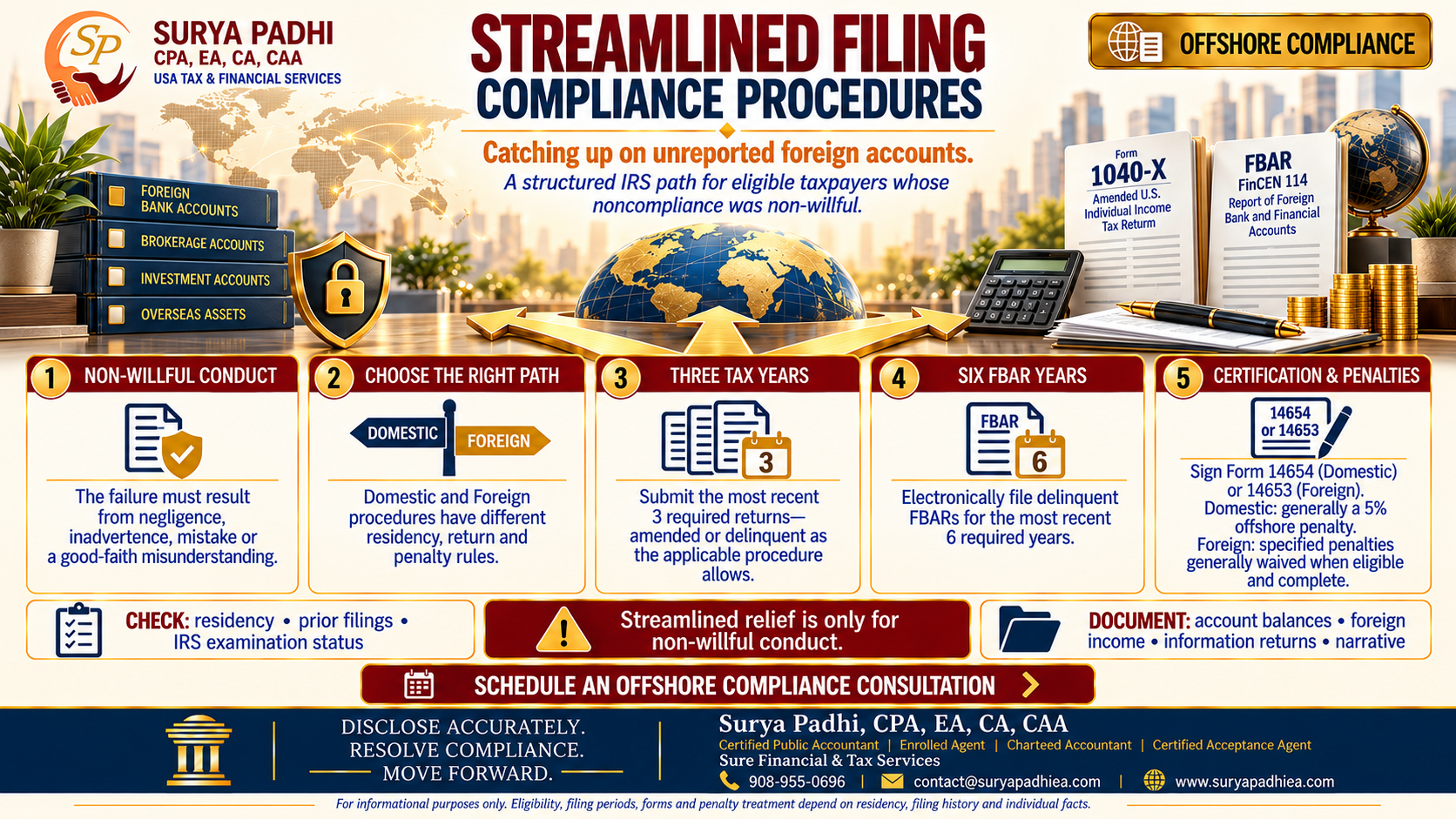
The streamlined filing compliance procedures let a taxpayer whose failure to report foreign accounts was non-willful file three years of returns and six years of FBARs. If you meet the non-residency test the miscellaneous offshore penalty is nothing; if you do not, it is 5% of the highest year-end aggregate value. You certify non-willfulness under penalties of perjury.
7:00. The written version, the figures and the sources are all below.
| Returns | 3 years | The most recent 3 for which the return due date has passed. |
|---|---|---|
| FBARs | 6 years | FinCEN Form 114, filed electronically for the most recent 6 years. |
| Foreign version penalty | None | Streamlined Foreign Offshore — requires meeting the non-residency test. |
| Domestic version penalty | 5% | Of the highest aggregate year-end balance across the covered periods. |
| Non-residency test | 330 days | No U.S. abode, and 330 full days abroad, in one of the 3 years. |
| The certification | Form 14653 or 14654 | Non-willfulness, in your own words, signed under penalties of perjury. |
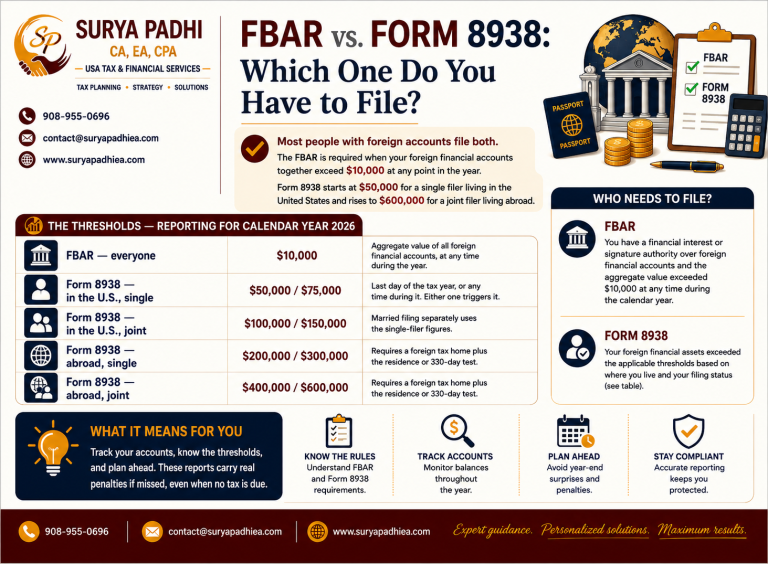
| FBAR threshold | $10,000 | Aggregate value of all foreign accounts at any time in the year. |
| Already under examination | Not eligible | A civil exam or a criminal investigation ends eligibility outright. |
Three years of returns, six years of FBARs, and a certification you sign under penalties of perjury. Whether it costs you a 5% penalty or nothing turns on one test — and it is not a test you get to choose.
The streamlined filing compliance procedures exist for one specific person: someone with foreign accounts who did not report them, and whose failure to report them was genuinely not willful. There are a great many such people. Immigrants who kept a bank account at home, Americans who moved abroad and never learned that the United States taxes citizens on worldwide income, heirs who inherited an account in another country and had no idea a form was involved.
The procedures are a real route back, and they are not an amnesty. You file three years of returns and six years of FBARs, you pay the tax and the interest, and you sign a certification of non-willfulness under penalties of perjury. Depending on one test, you either pay a 5% penalty or you pay none. Nothing here is guaranteed, and if there is any chance your conduct was willful this is the wrong document to be reading.
Key takeaways
- Two versions: Streamlined Foreign Offshore has no miscellaneous offshore penalty; Streamlined Domestic Offshore carries 5%.
- The non-residency requirement is what separates them — no U.S. abode and 330 full days abroad in one of the last three years.
- Every submission needs three years of returns, six years of FBARs, and Form 14653 or 14654 signed under penalties of perjury.
- If the IRS has already opened a civil examination or a criminal investigation, the procedures are not available at all.
What the streamlined filing compliance procedures are, and are not
The streamlined filing compliance procedures are available to U.S. individual taxpayers living outside the United States and to those living inside it. In both cases the entry condition is the same: you certify that the failure to report all income, pay all tax and submit all required information returns, including FBARs, was due to non-willful conduct. The IRS describes non-willful conduct as conduct due to negligence, inadvertence or mistake, or conduct resulting from a good-faith misunderstanding of the requirements of the law.
It is worth being blunt about the limits. A streamlined submission does not end in a closing agreement. The returns you file may be selected for audit under the ordinary audit selection processes that apply to any U.S. tax return. If the examination that follows turns up more, additional civil penalties and even criminal liability remain possible. And the Internal Revenue Manual states plainly that the streamlined procedures were approved by the Commissioner and can be changed or terminated at any time.
| Streamlined Foreign Offshore | Streamlined Domestic Offshore | |
|---|---|---|
| Who it is for | Meets the non-residency requirement | Everyone who does not |
| Prior returns | Delinquent or amended both allowed | Must already have filed all three years |
| Returns to file | 3 years | 3 years, as amended returns on Form 1040-X |
| FBARs to file | 6 years | 6 years |
| Certification | Form 14653 | Form 14654 |
| Miscellaneous offshore penalty | None | 5% of the highest aggregate year-end value |
| Paid with the submission | Tax and statutory interest | Tax, interest and the 5% penalty |
Two disqualifiers, and neither is negotiable
If the IRS has initiated a civil examination of your returns for any taxable year, you cannot use the streamlined procedures — regardless of whether the examination relates to the foreign accounts. The same is true if you are under criminal investigation by IRS Criminal Investigation. Every return submitted must also carry a valid Taxpayer Identification Number.
The one test that decides the penalty
There is no election between the foreign and domestic versions. The non-residency requirement is a factual test, and the answer places you in one or the other.
For a U.S. citizen or lawful permanent resident, the test is met if, in any one or more of the most recent three years for which the return due date has passed, you did not have a U.S. abode <em>and</em> you were physically outside the United States for at least 330 full days. For someone who is neither a citizen nor a green card holder, the test is met instead if, in any one or more of those years, you did not meet the substantial presence test of section 7701(b)(3).

- Both halves of the citizen test have to be satisfied in the same year. A year with 340 days abroad but a house kept and used in New Jersey does not qualify.
- You only need one qualifying year out of the three, not all three.
- “Abode” is not the same as domicile or tax home. It is about where you actually maintain a home, and it is a facts-and-circumstances question worth documenting carefully.
- The streamlined domestic version has an additional entry condition the foreign version does not: you must have previously filed a U.S. tax return, if one was required, for each of the most recent three years. If returns were never filed at all and you do not meet the non-residency test, neither version fits and you need advice.
What you actually file, and what it costs
A complete submission has three components and full payment. Three years of returns — delinquent or amended under the foreign version, amended on Form 1040-X under the domestic version. Six years of FBARs, FinCEN Form 114, filed electronically through the BSA E-Filing System. And one certification: Form 14653 abroad, Form 14654 at home.
Now the arithmetic, because the 5% penalty is the part people misunderstand most often. It is not 5% of the unreported income. It is 5% of the highest aggregate balance or value of the foreign financial assets subject to the penalty — computed by aggregating the year-end account balances and year-end asset values for each year in the covered tax return period and the covered FBAR period, then taking the highest of those aggregates.

A domestic submission, priced out
| Highest year-end aggregate across the covered years | $255,000 |
| Miscellaneous offshore penalty — 5% | $12,750 |
| Unreported interest across the three returns | $28,000 |
| Additional federal tax at a 24% marginal rate | $6,720 |
| Statutory interest on the three late payments | $502 |
| <strong>Total due with the submission</strong> | <strong>$19,972</strong> |
The interest line assumes 7% simple on each late payment for roughly two years, one year and three months. Actual interest compounds daily at a rate the IRS resets quarterly, and the rate for quarters beginning in 2027 is [[TK:2027-interest-rate]], so treat the figure as an estimate.
Look at the shape of that. The penalty is $12,750 against $6,720 of tax — nearly double. Had the same couple met the non-residency requirement, the identical returns and FBARs would have cost $7,222, because the foreign version carries no miscellaneous offshore penalty at all. That is the entire practical difference between the two, and it is decided by where someone lived, not by what they would prefer.
What the penalty protection covers
For a complete and accurate submission, the IRS states it will not impose failure-to-file and failure-to-pay penalties, accuracy-related penalties, information return penalties, or FBAR penalties. That protection is the reason the procedures are worth using: outside them, Forms 3520, 5471 and 8938 each carry substantial separate penalties, and a civil FBAR penalty for a non-willful violation is capped at [[TK:fbar-civil-penalty-max]], a figure adjusted annually for inflation.
The certification is the whole thing
Form 14653 and Form 14654 look like short forms. They are not. Each one carries a declaration that, under penalties of perjury, you have examined the certification and all accompanying schedules and statements and that to the best of your knowledge and belief they are true, correct and complete. Then it asks you to explain, in your own words, the specific reasons for the failure — and to name any professional adviser you relied on, with their address and phone number and a summary of the advice.
A three-sentence narrative is the most common defect in a streamlined package. The IRS is being asked to accept a factual claim about your state of mind over a period of years. That claim needs dates, a sequence of events, and an honest account of what you knew and when you knew it.

Say it out loud before you sign it
If any part of the narrative is a story you would not want tested — if it leaves out the year you were asked about foreign accounts on an organiser and answered no, or the conversation where somebody mentioned the form — the certification should not be signed. A false certification is a far worse position than the one you started in.
When streamlined is the wrong door
Willfulness in this area is not about whether you meant to be a criminal. The IRS describes it as the intentional, purposeful, deliberate act to hide income or assets, and courts have read it broadly enough that reckless disregard can qualify. Knowing the account existed, knowing there was a form, and choosing not to deal with it is a very different fact pattern from never having heard of an FBAR.
Taxpayers who are concerned that their failure was due to willful conduct, and who therefore seek assurance that they will not be subject to criminal liability and/or substantial monetary penalties, should consider participating in the IRS Criminal Investigation Voluntary Disclosure Practice and should consult with their professional or legal advisers.
That is the IRS’s own language, and it is the right advice. The Voluntary Disclosure Practice runs on Form 14457 and is a different animal: it requires full cooperation and payment of tax, interest and penalties, it must be made before the IRS has begun a civil examination or criminal investigation or received information about the noncompliance from a third party, and it does not automatically guarantee immunity from prosecution — it may result in prosecution not being recommended.
This is a conversation with an attorney
If there is any real prospect that the conduct was willful, the first call is to a tax attorney, not to a preparer, and the reason is attorney-client privilege. A CPA’s or an enrolled agent’s federally authorized practitioner privilege does not extend to criminal matters. Have the honest conversation in the place where it is protected.
Before you start
- Establish the timeline first. Which accounts, opened when, by whom, and what you knew at each point. Everything downstream depends on that narrative being accurate.
- Confirm nothing is already open. A civil examination for any year, or a criminal investigation, removes the option entirely.
- Gather six years of year-end balances for every foreign account, converted to U.S. dollars, plus the income each one generated.
- Work out the non-residency answer honestly, year by year, with travel records rather than recollection.
- Check the other forms. A foreign pension, a foreign mutual fund, an inheritance over the reporting threshold or a foreign company can all pull in Forms 3520, 8621 or 5471, and each has its own rules.
One more reason not to wait
The procedures are not a permanent fixture. The IRS’s own manual says they were approved by the Commissioner and can be changed or terminated at any time, and the predecessor offshore programs were in fact closed. Eligibility also disappears the moment the IRS opens an examination, and that is not something you control.

Frequently asked questions
What is the difference between the streamlined foreign and domestic procedures?
The non-residency requirement. If in any one of the most recent three years you had no U.S. abode and were physically outside the United States for at least 330 full days, you use the foreign version and there is no miscellaneous offshore penalty. If you cannot meet that test in any of those years, you use the domestic version and pay 5% of the highest aggregate year-end value of the foreign financial assets.
How many years do I have to file?
Three years of tax returns — the most recent three for which the return due date, or properly extended due date, has passed — and six years of FBARs on FinCEN Form 114. The returns are delinquent or amended under the foreign version and amended on Form 1040-X under the domestic version, which also requires that you had already filed a return for each of those three years.
Is the 5% penalty charged on the income I failed to report?
No. It is 5% of the highest aggregate balance or value of the foreign financial assets subject to the penalty. You aggregate the year-end account balances and asset values for each year in the covered return period and the covered FBAR period, and the highest of those aggregates is the base. It is frequently larger than the tax.
Will the IRS accept my streamlined submission?
Nobody can tell you that in advance. A streamlined submission does not produce a closing agreement or an acceptance letter, and the returns may be selected for audit under the same processes that apply to any return. What the IRS states is that for a complete and accurate submission meeting the requirements, it will not impose the failure-to-file, failure-to-pay, accuracy-related, information return or FBAR penalties.
What if I think my conduct might have been willful?
Then the streamlined procedures are not the right route, and the certification — which is signed under penalties of perjury — should not be signed. The IRS directs taxpayers in that position to consider the IRS Criminal Investigation Voluntary Disclosure Practice and to consult their professional or legal advisers. Speak with a tax attorney first, because that conversation is privileged in a way a conversation with a preparer is not.
Work out which door applies to you
The first hour of this work is establishing the facts: which accounts, since when, what you knew, and where you actually lived in each of the last three years. That determines everything else, and it is worth doing before any form is prepared.
This article is general educational information, not individualized tax or investment advice. Figures cited are subject to IRS adjustment. Consult a qualified professional about your own facts.