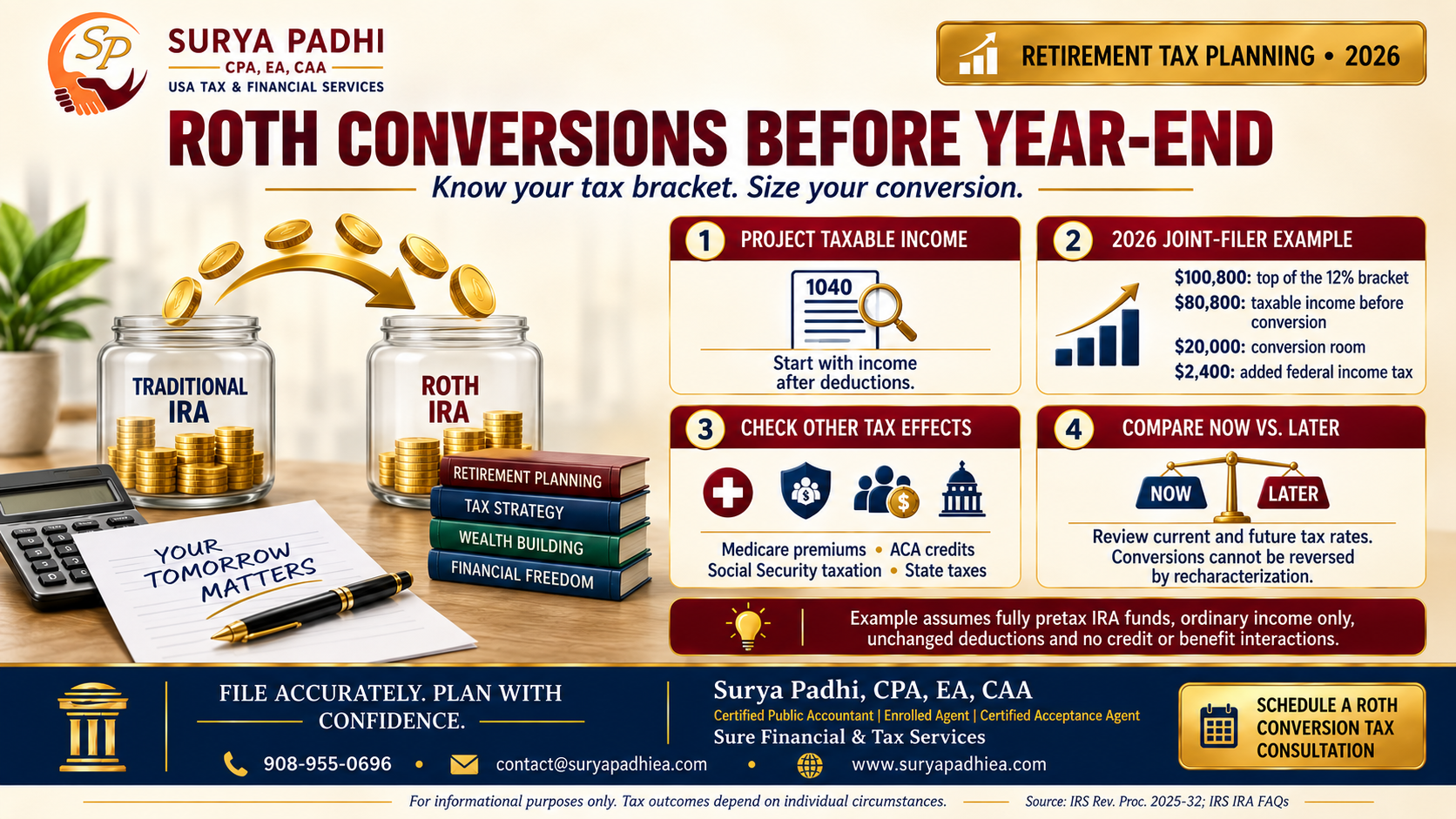
A Roth conversion is taxed at your marginal rate, so the planning move is to convert only up to the top of the bracket you are already in. For 2026 the 12% band ends at $100,800 of taxable income on a joint return. The next dollar costs 22%, and conversions can no longer be undone.
7:10. The written version, the figures and the sources are all below.
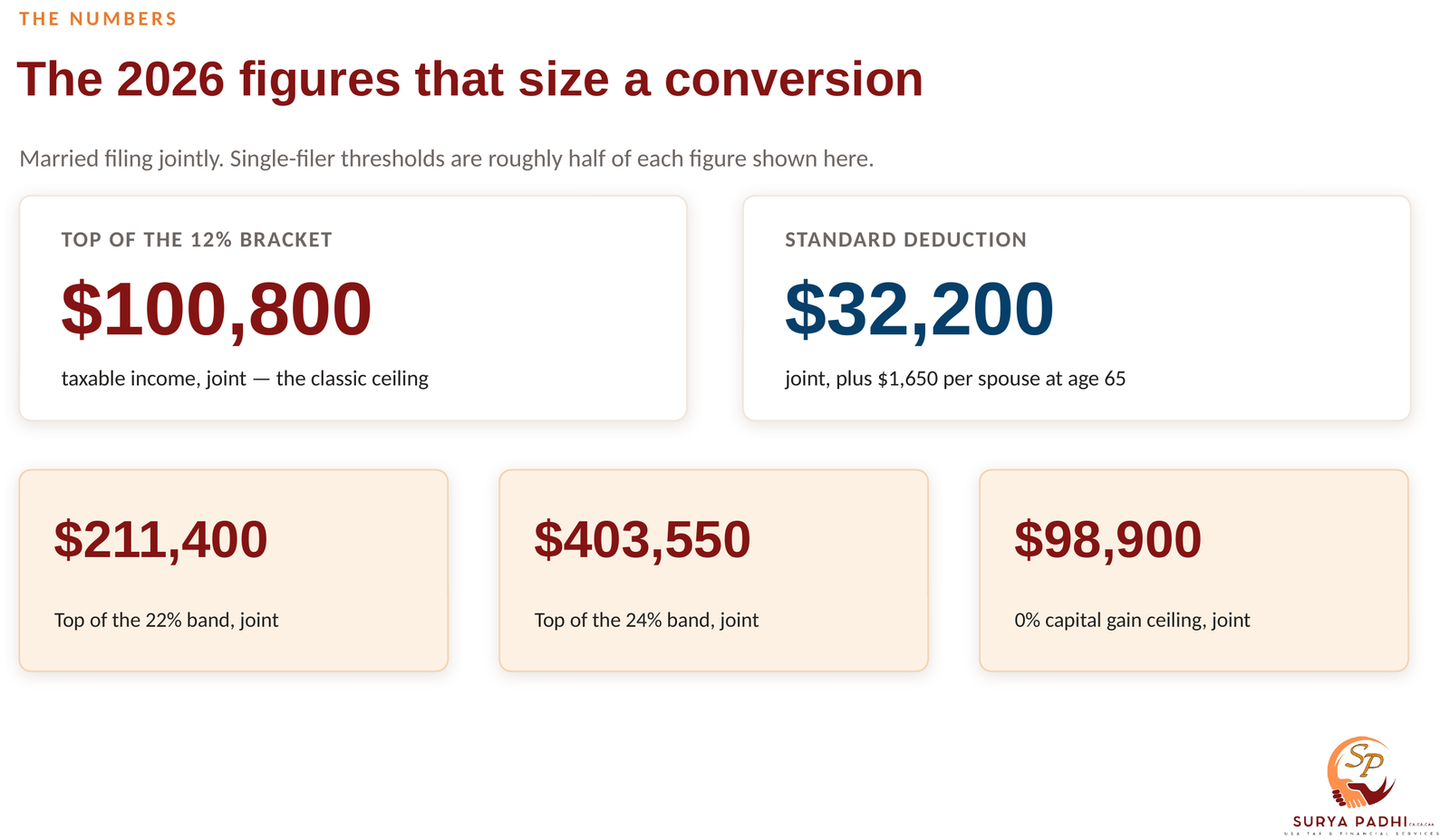
| Standard deduction, joint | $32,200 | $16,100 single. Add $1,650 per spouse at age 65. |
|---|---|---|
| Top of the 12% bracket, joint | $100,800 | Taxable income. $50,400 for a single filer. |
| Top of the 22% bracket, joint | $211,400 | $105,700 for a single filer. |
| 0% capital gain ceiling, joint | $98,900 | Conversion income stacks underneath and can displace this. |
| First IRMAA tier, joint | $218,000 | 2026 modified AGI, set from the 2024 return. Two-year lookback. |
| Net investment income tax | $250,000 | Joint MAGI. A conversion is not investment income but raises MAGI. |
| Recharacterization | Unavailable | Repealed for conversions after 2017. A 2026 conversion is permanent. |
A conversion is taxed at your marginal rate, so the size of the conversion is the whole decision. Here is how to find the number — and what it costs to overshoot it.
A Roth conversion moves money from a traditional IRA into a Roth IRA and puts the whole converted amount on this year’s tax return as ordinary income. There is no income limit on doing it and no cap on the amount. The only real question is how much to convert, and the answer is set by where your income already sits inside the 2026 rate brackets.
That is what bracket filling means: convert enough to reach the top of the band you are already in, and stop. Do it well and you move a lifetime of growth into an account that is never taxed again, at a rate you chose. Overshoot and you pay a higher rate than you needed to, on money that could have waited a year.
Key takeaways
- Taxable income, not gross income, is what the brackets read — subtract the standard deduction first.
- For 2026 the 12% band ends at $100,800 of taxable income on a joint return, $50,400 on a single return.
- A conversion made in 2026 cannot be recharacterized. That rule went away after 2017 and has not come back.
- Pay the tax from outside the IRA. Withholding from the conversion itself shrinks the amount that lands in the Roth.
What a conversion actually buys
A traditional IRA is money you have not been taxed on yet. Every dollar that comes out — whether you want it out or the required minimum distribution rules force it out — is ordinary income in the year it comes out. A Roth IRA is the opposite: the tax was paid on the way in, and qualified withdrawals, including all the growth, come out with no tax at all.
A conversion is the switch between the two. You move a chosen amount from one to the other, and you pay ordinary income tax on that amount this year. Nothing about your net worth changes on the day you do it. What changes is that you have volunteered to pay tax at a rate you know, now, instead of at a rate you do not know, later.
There is no income limit on a conversion
Roth <em>contributions</em> phase out at higher incomes. Roth <em>conversions</em> do not — that limit was removed in 2010. Anyone with a traditional IRA can convert any amount in any year, regardless of income.
The 2026 brackets and the standard deduction
The brackets do not read your gross income. They read your taxable income, which is what remains after the standard deduction or your itemized deductions. For 2026 the standard deduction is $32,200 on a joint return and $16,100 for a single filer, with an extra $1,650 per person once you turn 65 — $2,050 if you are unmarried.
That means the first tranche of a conversion can be genuinely cheap. A retired couple with very little other income has $32,200 of deduction and then a 10% band before the 12% band even starts. The rates only bite once the earlier bands are used up.
| Rate | Taxable income — joint | Taxable income — single |
|---|---|---|
| 10% | Up to $24,800 | Up to $12,400 |
| 12% | $24,800 to $100,800 | $12,400 to $50,400 |
| 22% | $100,800 to $211,400 | $50,400 to $105,700 |
| 24% | $211,400 to $403,550 | $105,700 to $201,775 |
| 32% | $403,550 to $512,450 | $201,775 to $256,225 |
| 35% | $512,450 to $768,700 | $256,225 to $640,600 |
For most people running this exercise, one of two ceilings is the target. The top of the 12% band is the classic one, because the jump from 12% to 22% is the largest single step in the whole table. The top of the 24% band matters to higher earners, because above it the rate goes to 32% and stays there.
Working out your 2026 Roth conversion tax bracket room
The calculation is short, and you can do it on the back of an envelope in October when there is still time to act on it. What you need is a realistic estimate of the income you will report for the full year without any conversion.
- Add up everything you expect to report for 2026 — pensions, interest, dividends, capital gains, wages, the taxable part of Social Security, any distribution you are already required to take.
- Subtract your standard deduction, or your itemized total if it is larger. What is left is your taxable income before any conversion.
- Pick the ceiling you are willing to reach — usually the top of the 12% band at $100,800 joint, or the top of the 24% band at $403,550 joint.
- Subtract your taxable income from that ceiling. The difference is the largest conversion that stays inside the bracket.
Leave yourself a cushion
A December mutual fund capital gain distribution or a corrected 1099 can add a few thousand dollars of income after you have already converted. Converting to a few thousand below the ceiling rather than exactly at it costs almost nothing and removes the risk of a small overshoot.
A worked example: a retired couple at 63
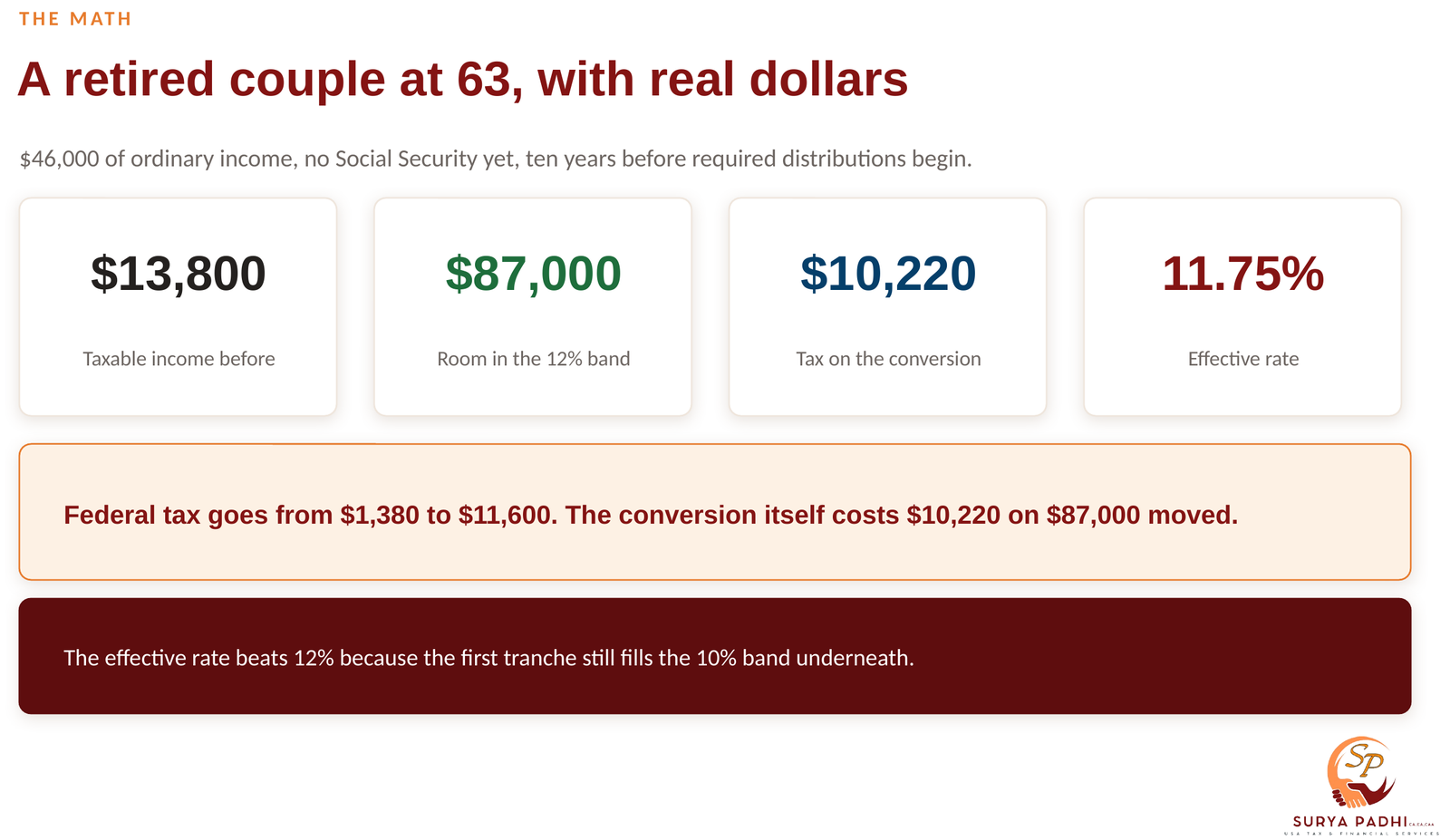
A married couple, both 63, retired last year. They have not started Social Security and they are ten years away from required minimum distributions. For 2026 they expect $46,000 of ordinary income — a small pension and interest — and they are living mostly off a taxable brokerage account. Between them they hold about $900,000 in traditional IRAs.
Sizing the conversion
| Expected 2026 ordinary income | $46,000 |
| Less standard deduction, joint | ($32,200) |
| Taxable income before converting | $13,800 |
| Top of the 12% bracket, joint | $100,800 |
| Room available ($100,800 − $13,800) | $87,000 |
| Federal tax before the conversion | $1,380 |
| Federal tax after converting $87,000 | $11,600 |
| Tax caused by the conversion | $10,220 |
$10,220 on $87,000 is an effective rate of 11.75% — because the first $11,000 of the conversion still fills the 10% band before the 12% rate takes over.
Now look at what happens if they convert $107,000 instead. The extra $20,000 sits entirely in the 22% band and costs $4,400 — an extra $4,400 of tax for $20,000 of movement, against $10,220 for the first $87,000. That is the whole argument for stopping at the line.
What the alternative looks like
If they leave the $87,000 alone, it keeps growing and comes out later as required minimum distributions, likely stacked on top of two Social Security checks. At 22% the same $87,000 would cost $19,140 in tax; at 24%, $20,880. That is the comparison — not conversion against zero, but conversion now against distribution later.
What else moves when income moves
The bracket is the headline, but it is not the only threshold in the code. A conversion raises adjusted gross income, and several other rules read AGI or modified AGI rather than taxable income. None of these are reasons not to convert. They are reasons to know where the edges are before you pick the number.
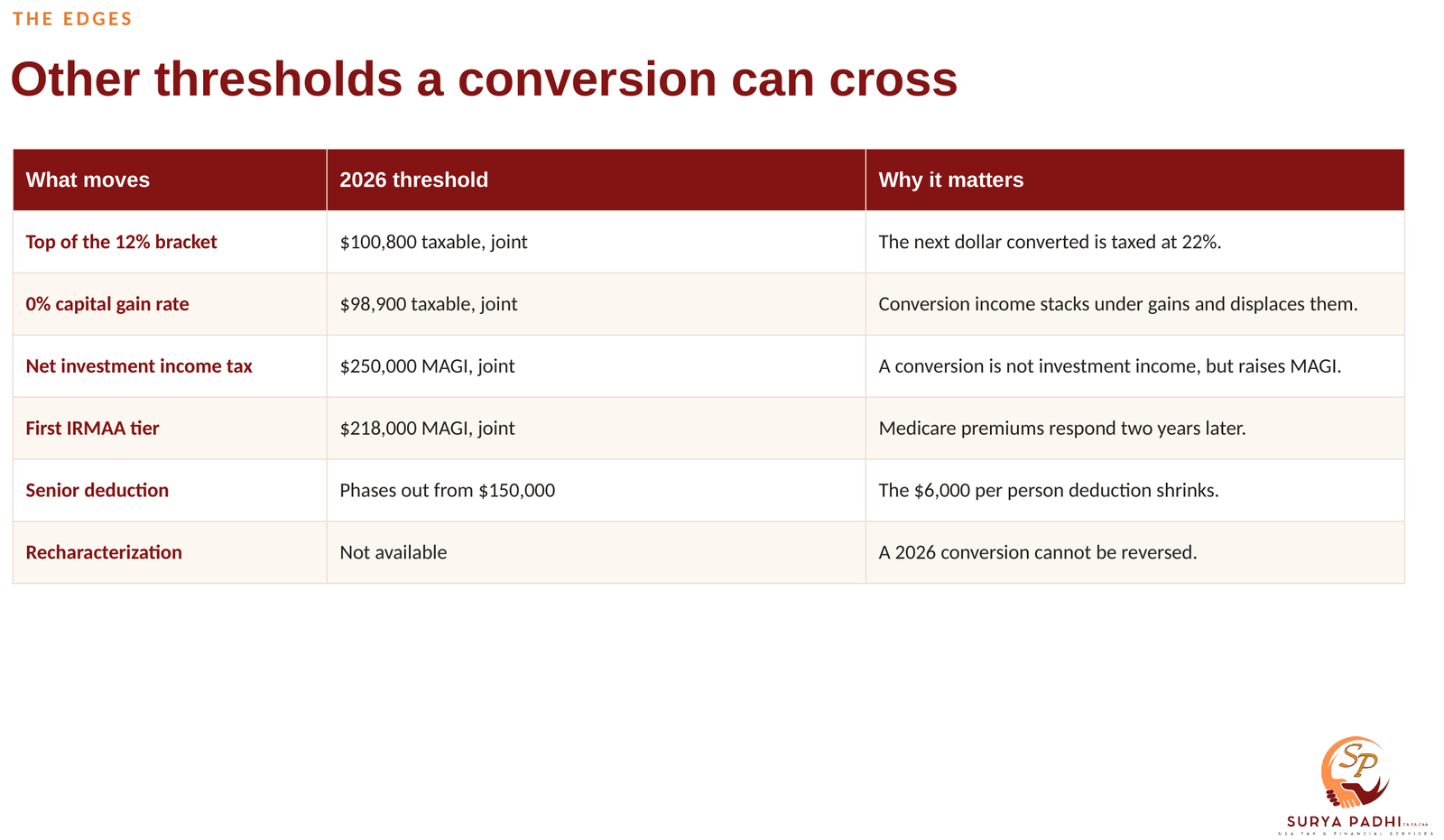
| What moves | 2026 threshold | Why it matters |
|---|---|---|
| Top of the 12% bracket | $100,800 taxable, joint | The next dollar converted is taxed at 22%. |
| 0% capital gain rate | $98,900 taxable, joint | Conversion income stacks underneath and displaces gains upward. |
| Net investment income tax | $250,000 MAGI, joint | A conversion is not investment income, but it raises MAGI. |
| First IRMAA tier | $218,000 MAGI, joint | Medicare premiums respond two years after the conversion year. |
| Senior deduction phase-out | $150,000 to [[TK:senior-deduction-phaseout-end]] | The $6,000 per person deduction shrinks as income rises. |
| Recharacterization | Not available | A conversion made in 2026 cannot be reversed. |
IRMAA runs on a two-year lookback
Social Security sets your Medicare Part B and Part D surcharge from the tax return filed two years earlier — the 2026 surcharge is based on 2024 income. So a conversion done in 2026 shows up in your 2028 premiums, not next year’s. If the increase came from a one-time event such as retirement, Form SSA-44 lets you ask for a new determination; a Roth conversion by itself is not on the list of qualifying life-changing events.
The part that has no undo button
Until 2018 you could convert in January, watch the market, and recharacterize the conversion back to a traditional IRA as late as October of the following year if it had not worked out. The Tax Cuts and Jobs Act removed that. In the IRS’s own words, a conversion from a traditional, SEP or SIMPLE IRA to a Roth IRA made after December 31, 2017 cannot be recharacterized.
A regular annual contribution can still be recharacterized — if you put money into a Roth IRA and later discover you should have used a traditional IRA, that is fixable by the return due date including extensions. A conversion is not. Once the assets move and the year closes, the income is on the return.
- Two five-year clocks exist. One decides whether earnings come out tax-free and starts with your first Roth IRA of any kind; the other applies to each conversion separately.
- The conversion clock only matters under 59½ — take converted money out inside five years and the 10% early-distribution tax can apply even though the income tax was already paid.
- If you have nondeductible basis in any traditional IRA, Form 8606 pro-rates it across every traditional, SEP and SIMPLE IRA you own. You cannot convert only the basis.
- Once you are subject to required minimum distributions, the RMD has to come out first and cannot itself be converted.
- New Jersey never allowed a deduction for most IRA contributions, so it tracks its own basis. The New Jersey taxable amount of a conversion is often smaller than the federal amount — keep that worksheet.
Executing before December 31
A conversion is a calendar-year event. It has to be completed by December 31 to count for 2026, and unlike an IRA contribution there is no extension into April. Custodians get busy in late December, and a conversion request submitted on the 30th does not always settle on the 30th.
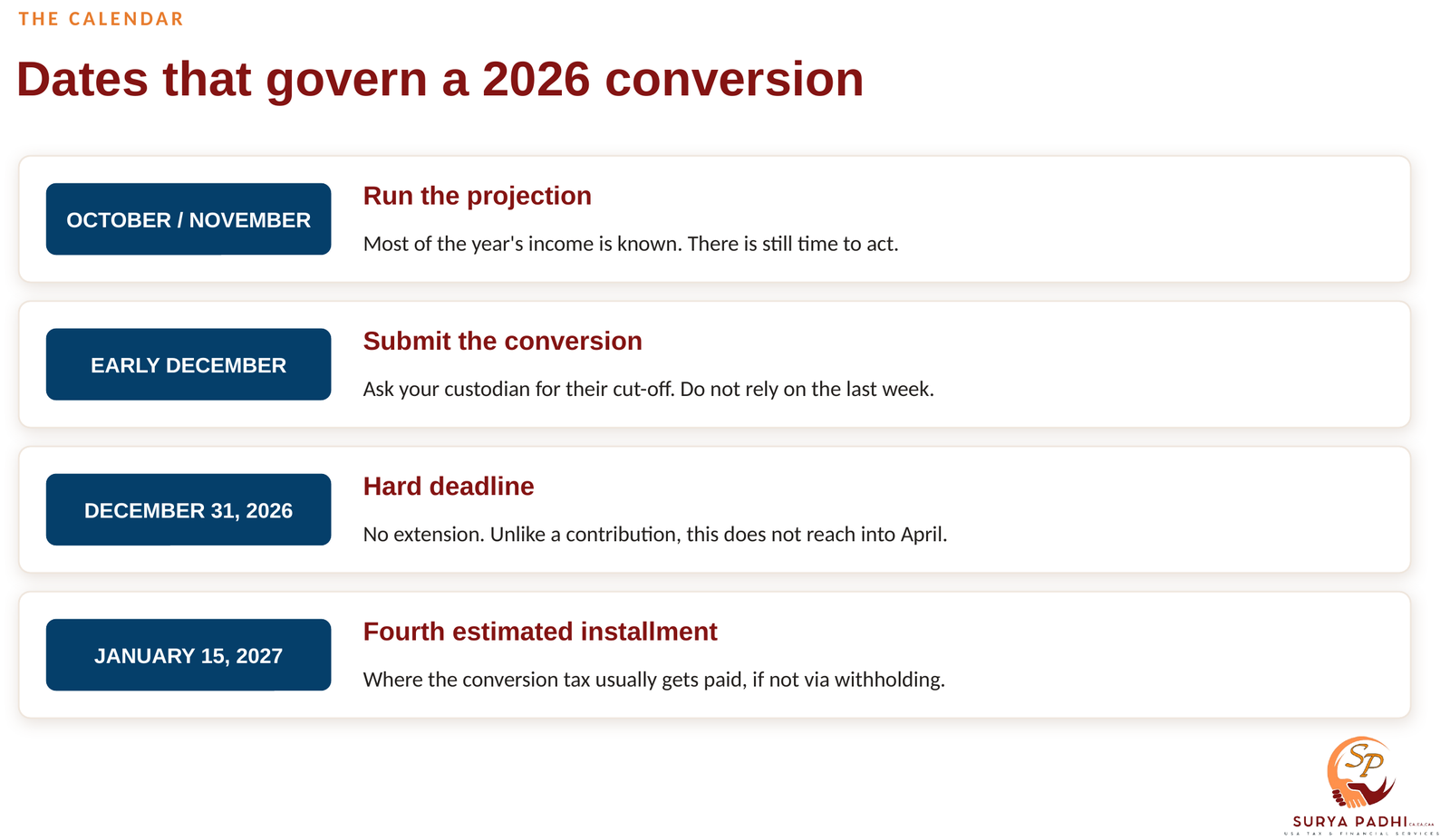
- Run a full-year projection in October or early November, once most of the year’s income is known.
- Decide the ceiling and subtract, leaving a few thousand dollars of cushion for late income.
- Submit the conversion by early December, not the last week. Ask the custodian for their cut-off date.
- Decline withholding on the conversion and cover the tax from a taxable account instead — and if that leaves you short for the year, raise withholding elsewhere or make the January 15, 2027 estimated payment.
Why paying the tax from outside matters
If you convert $87,000 and have 20% withheld, only $69,600 reaches the Roth and the $17,400 withheld is itself a distribution. Under 59½, that withheld amount also attracts the 10% early-distribution tax. Paying the tax from a taxable account keeps the full $87,000 growing tax-free.
Full transcript
[PASTE THE CORRECTED TRANSCRIPT HERE — one paragraph per chapter. Download the auto-generated captions from YouTube Studio, fix the form numbers and dollar amounts, and paste the cleaned text. This is several hundred extra indexable words in your own voice, and it is what AI answer engines read.]
Frequently asked questions
Is there an income limit on a Roth conversion?
No. The income limit on conversions was removed in 2010 and has not returned. Roth contributions still phase out at higher incomes, but a conversion can be made in any amount, in any year, at any income level. What varies is the rate you pay on it, which is simply your marginal rate for that year.
Can I undo a Roth conversion if the market drops afterwards?
No. Recharacterization of a conversion was repealed by the Tax Cuts and Jobs Act for conversions made after December 31, 2017. If you convert in November and the account falls 15% in December, you still report the November value as income. That is one reason to convert in tranches rather than all at once.
Should I have tax withheld from the conversion?
Usually not. Anything withheld leaves the retirement system and never reaches the Roth IRA, so you convert less than you intended. If you are under 59½, the withheld portion is also treated as a distribution and can carry the 10% early-distribution tax. Paying the tax from a taxable account is almost always the better arrangement.
How does a conversion affect my Medicare premiums?
Social Security sets the income-related monthly adjustment amount from the tax return filed two years earlier, so a conversion done in 2026 affects your 2028 Part B and Part D premiums rather than your 2027 ones. The surcharge is a cliff, not a phase-in — crossing a tier by one dollar moves you into the whole tier for the year.
Do I have to pay estimated tax on the conversion?
You have to pay it in somehow. A conversion does not come with automatic withholding unless you request it, so the tax is usually covered by increasing withholding on other income or by making the fourth estimated installment, due January 15, 2027. Check the safe harbor first — hitting it means the penalty cannot apply even if the balance is large.
Find your own number before December
The income tax projection tool works out your 2026 taxable income and shows how much room is left in your current bracket, so you can size a conversion instead of guessing at one. Free, no signup, and nothing you enter is stored.
This article is general educational information, not individualized tax or investment advice. Figures cited are subject to IRS adjustment. Consult a qualified professional about your own facts.