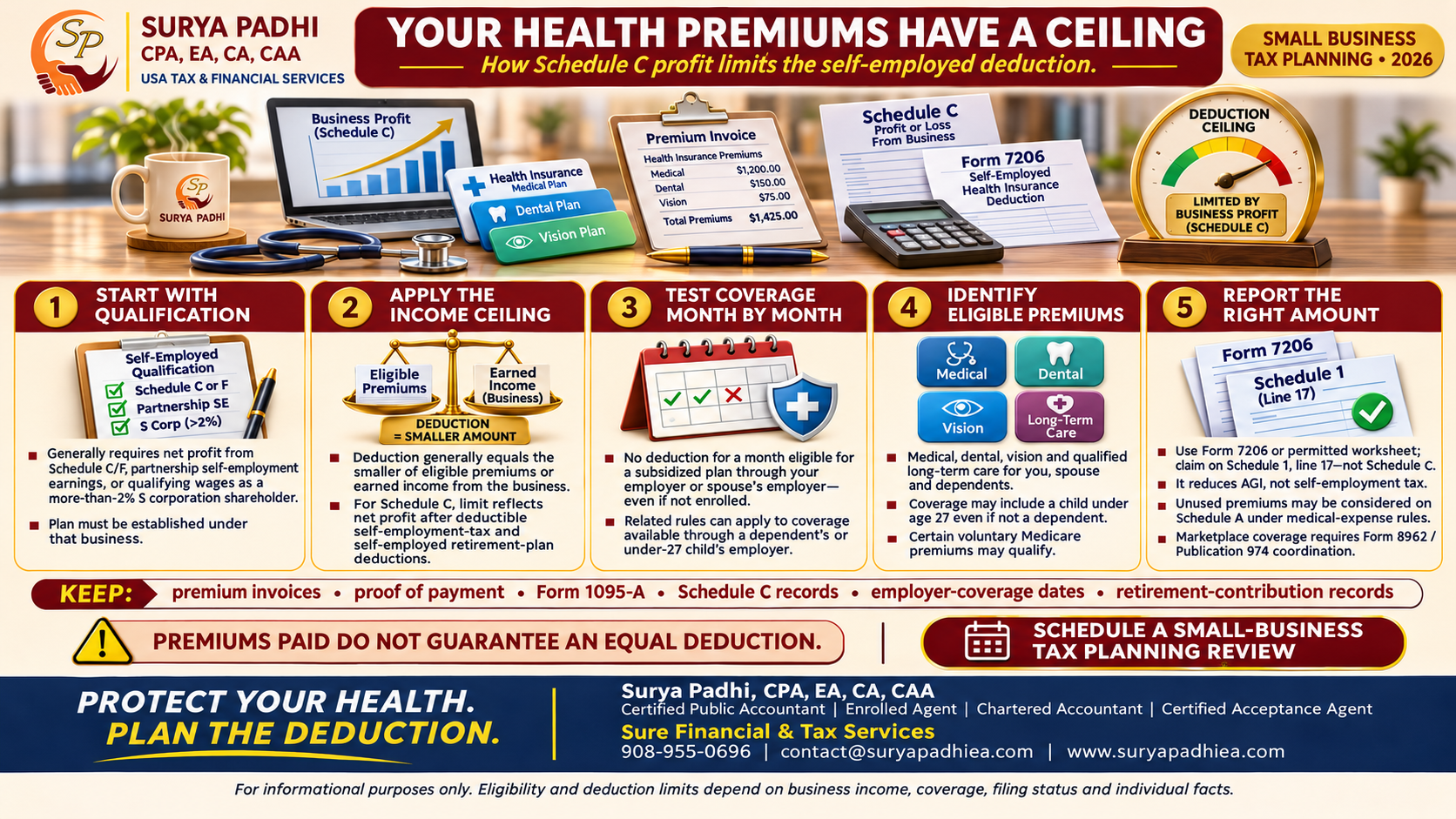
Your self-employed health insurance deduction cannot exceed the net profit of the business that carries the plan, less half of self-employment tax and retirement contributions. It also disappears for any month you or your spouse could join a subsidized employer plan. Premiums above the cap do not carry forward, and a premium tax credit lowers the premium you can deduct.
7:02. The written version, the figures and the sources are all below.
| Profit ceiling | Net profit | Less half of self-employment tax and self-employed retirement plan contributions. Loss year, ceiling of zero. |
|---|---|---|
| Self-employment tax | 15.3% | Applied to 92.35% of net profit. This deduction does not reduce it. |
| Employer-plan test | Monthly | Eligibility for a subsidized employer plan removes that month, whether or not you enroll. |
| Premium tax credit line | 400% of FPL | Back in force for 2026 after the enhanced credits expired at the end of 2025. |
| Where it is reported | Schedule 1 | Calculated on Form 7206. Marketplace coverage also needs Form 8962. |
The deduction follows your profit, not your premiums, and it switches off in months an employer plan was open to you or your spouse.
The self-employed health insurance deduction limit catches more Schedule C filers off guard than almost any other line on Schedule 1. Most people assume that if they pay the premium themselves, they can deduct the premium. In practice the deduction is capped by your profit, switched off for any month an employer plan was open to you or your spouse, and tied in a loop to the premium tax credit.
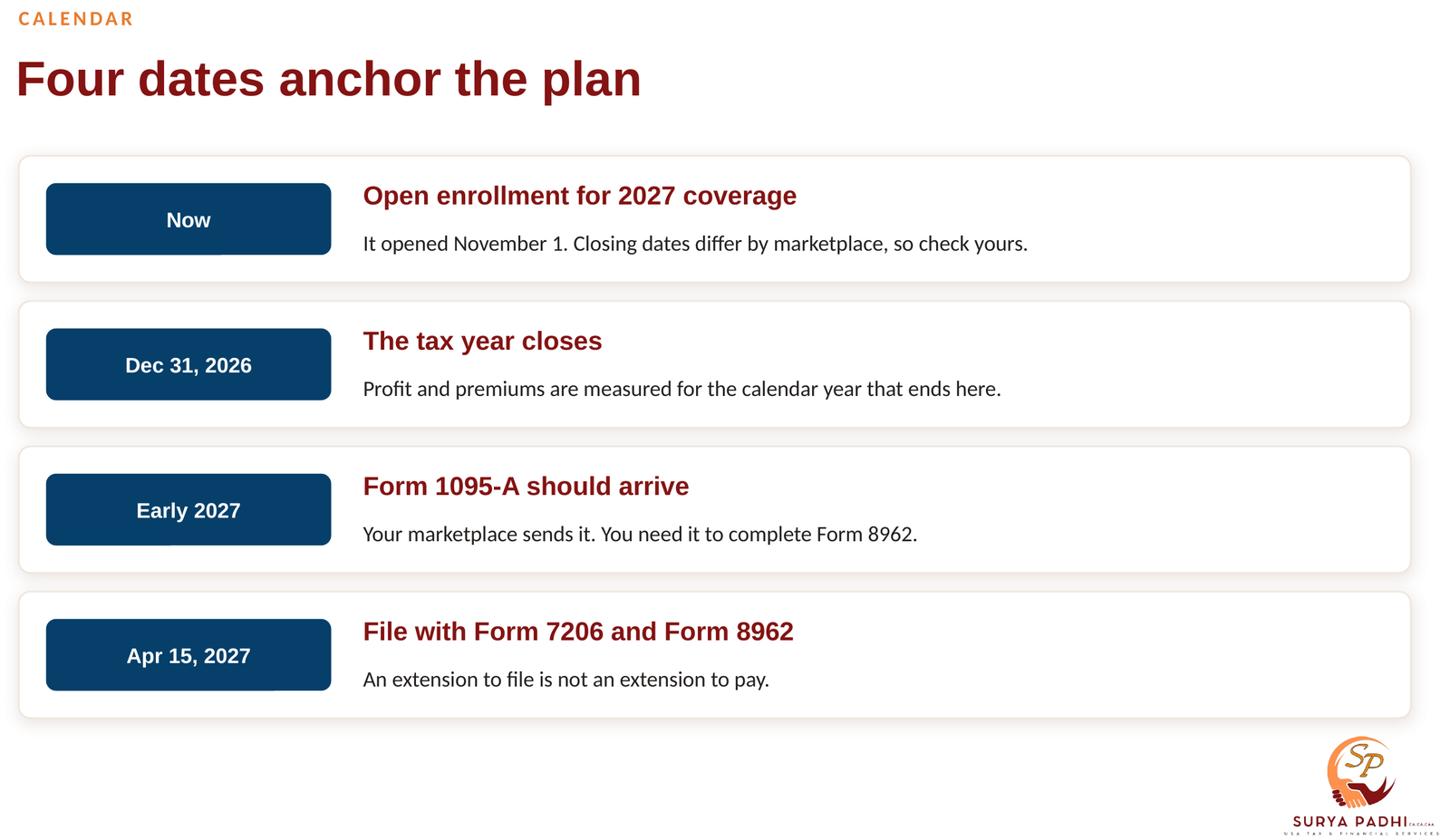
Open enrollment for 2027 coverage opened on November 1, so this is the moment to see how a plan choice will interact with your business income. This guide walks through each test in the order I check them, uses illustrative numbers, and ends with the year-end checks worth doing before December 31.
Key takeaways
- The deduction cannot exceed net profit from the business that sets up the plan, less half of self-employment tax and any retirement plan contributions.
- Any month you or your spouse could join a subsidized employer plan is excluded, even if you never enrolled.
- With a premium tax credit, you deduct the premium you actually paid, and the deduction and the credit are solved together.
- Premiums above the ceiling do not carry forward, and the deduction never reduces self-employment tax.
What the deduction is, and what it is not
Section 162(l) of the Internal Revenue Code lets a self-employed person deduct premiums for medical, dental, vision and qualified long-term care insurance covering themselves, a spouse and their children. Medicare premiums can be included as well. You figure the amount on Form 7206 and report it on Schedule 1 of Form 1040.
Two features make it valuable. It is an above-the-line deduction, so you get it whether or not you itemize. And it applies to premiums you pay yourself, which for most Schedule C owners means a marketplace plan, a plan bought directly from an insurer, or Medicare.
It lowers income tax only
The Form 7206 instructions say you cannot subtract this deduction when figuring net earnings for self-employment tax. Schedule SE is computed on your full net profit, so the self-employment tax bill does not change.
The self-employed health insurance deduction limit: your profit
The first and most common limit is profit. The deduction cannot be more than the net earnings from the business under which the plan is established. On Form 7206 that works out to your Schedule C net profit, minus the deductible half of self-employment tax, minus any contributions you made to a self-employed retirement plan such as a SEP-IRA or solo 401(k).
Take a Schedule C that shows $12,000 of net profit. Self-employment tax is computed on 92.35 percent of that profit at 15.3 percent, which comes to $1,696, and half of it, $848, is deductible. If the household pays $1,200 a month for coverage, or $14,400 for the year, the ceiling is $11,152. That is the deduction. The other $3,248 of premium is not deductible on Schedule 1 and does not carry forward to another year. These figures are illustrative.
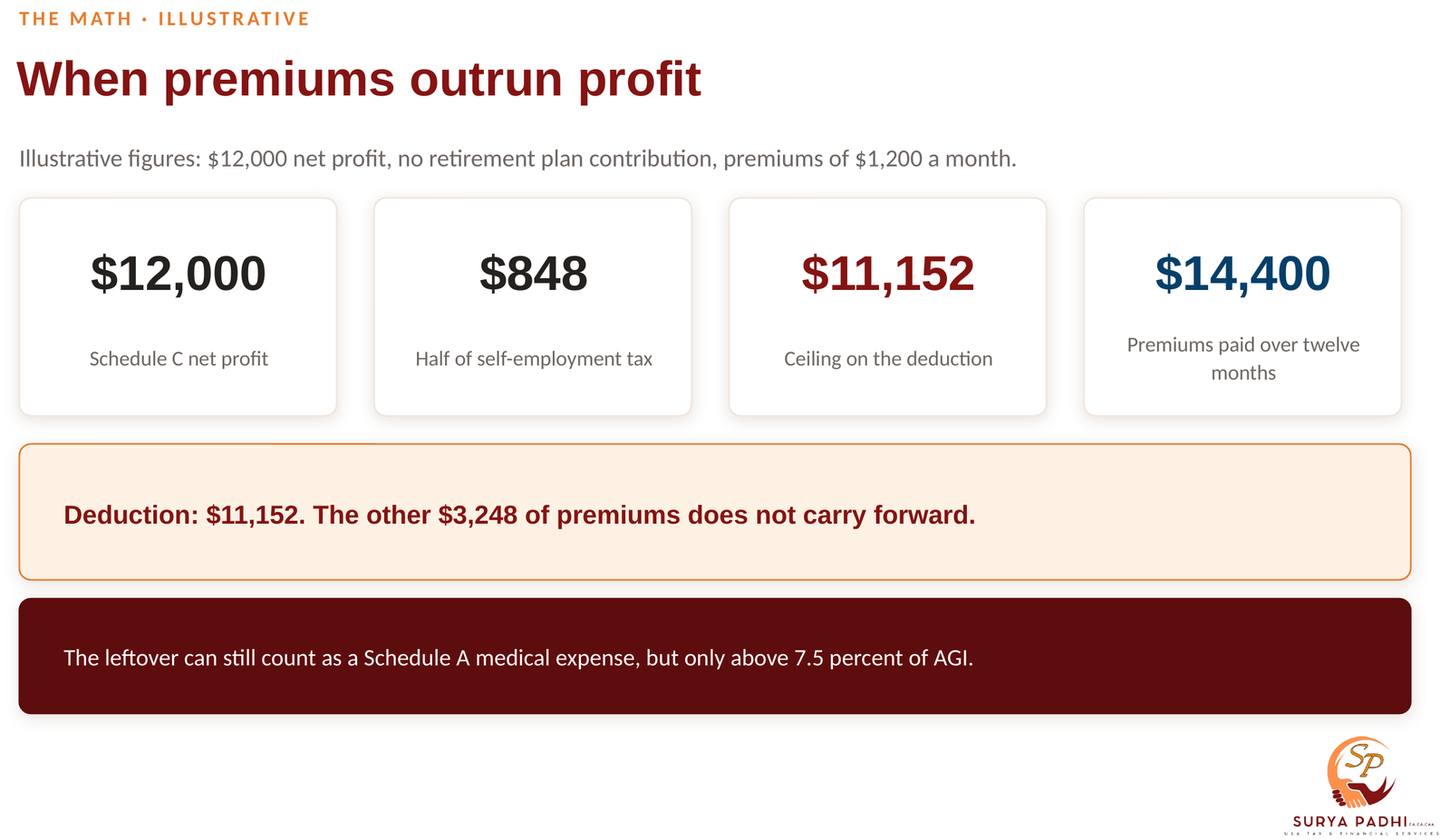
In a loss year the ceiling is zero. The leftover premium can still count as a medical expense on Schedule A, but only if you itemize and only above 7.5 percent of adjusted gross income, which is a high bar.
The employer plan test: one month at a time
The second limit surprises people most. You cannot deduct premiums for any month you were eligible to participate in a subsidized health plan maintained by an employer of yours or of your spouse. The Form 7206 instructions extend the same rule to the employer of a dependent, or of a child under 27 whose coverage you are claiming.
The test is eligibility, not enrollment. If your spouse’s employer offers a plan that it helps pay for and you decline it to buy a marketplace plan, those months do not qualify. The test also runs month by month, so a spouse who changes jobs mid-year, or a waiting period before coverage starts, can leave you with some months that count and some that do not.
- The date your spouse (or you) first became eligible for the employer plan.
- Whether the employer pays any part of the premium.
- The dates of any job or coverage change during the year.
Do not guess at the employer contribution
Whether a plan is subsidized depends on what the employer pays toward it. Get the plan details in writing before you claim months that a spouse’s job could have covered.
Situations at a glance
| Your situation | Deduction? | Why |
|---|---|---|
| Spouse’s employer plan offered; you decline | Not for those months | Eligibility is the test, not enrollment. |
| Marketplace plan, no premium tax credit | Yes, up to the profit cap | Premiums paid are the starting point. |
| Marketplace plan with a premium tax credit | Yes, on premiums net of credit | Deduction and credit are solved together. |
| Medicare Part B or a supplement | Yes, up to the cap | Medicare premiums can be included. |
| Sole proprietor with a loss | No deduction | The profit ceiling is zero. |
| Partner with box 14 code A earnings | Yes, up to the cap | The cap uses your partnership earnings. |
| S corporation owner above two percent | Different rules | Premiums run through W-2 wages first. |
Partners with self-employment earnings reported in box 14, code A of Schedule K-1 use the same rules, with the ceiling based on their earnings from the partnership. More-than-two-percent S corporation shareholders take a different route, because the premiums are reported in their W-2 wages first. That path deserves its own article.
When you also take the premium tax credit
If you bought coverage through the marketplace and receive advance premium tax credits, or claim the credit when you file, the deduction is calculated on the premium you actually paid, which is the full premium less the credit. The credit itself depends on household income, and the deduction lowers that income. A different credit changes the premium you paid, which changes the deduction, and around it goes.
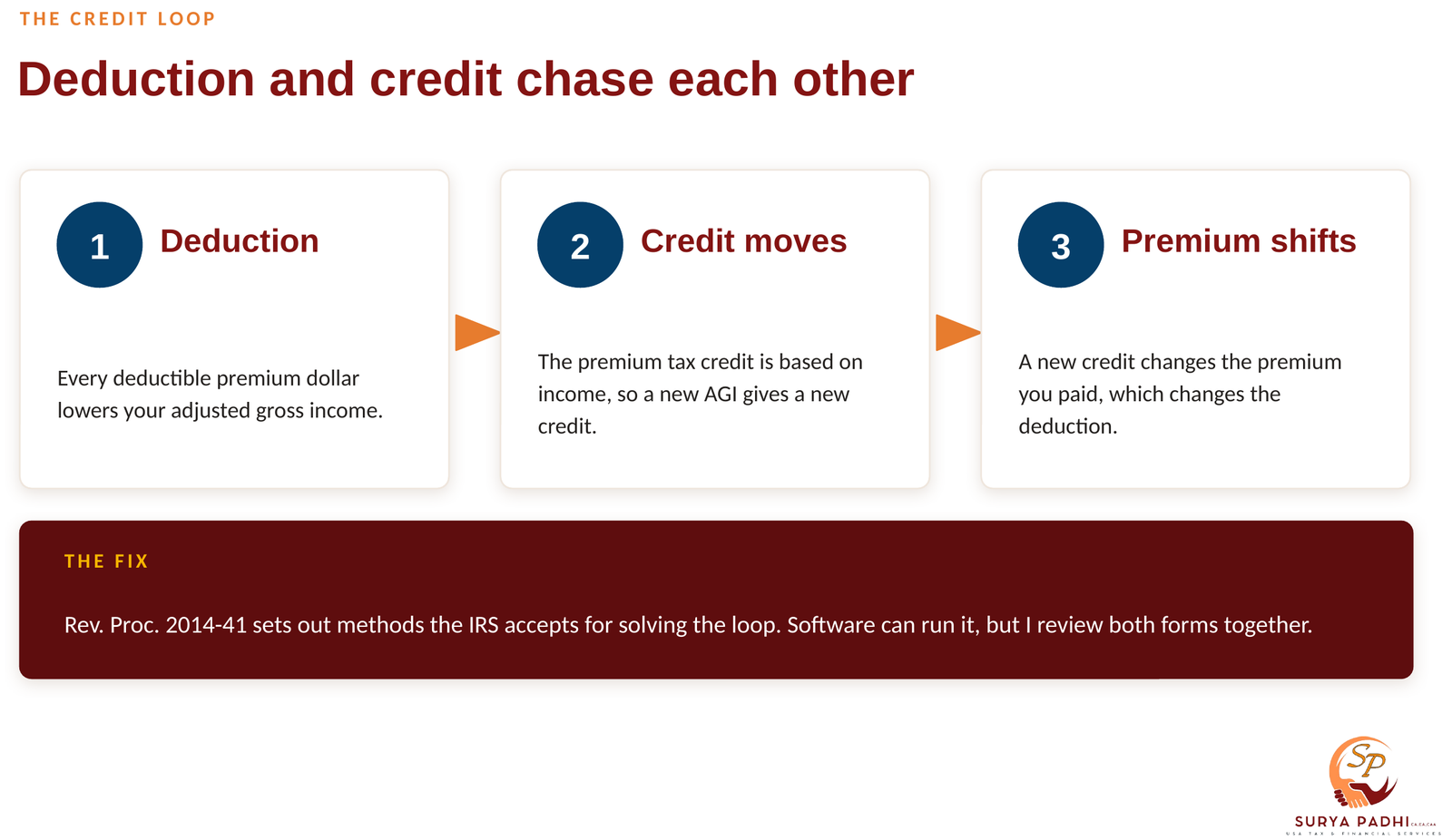
The IRS recognized the loop in Revenue Procedure 2014-41, which sets out methods a taxpayer may use to solve it. Good software can iterate it, but the answer feeds both Form 7206 and Form 8962, so I review the two forms side by side instead of trusting either one alone. That is also why I prepare the Schedule C and the Form 8962 together.
Net premium (illustrative)
| Full premium for the year | $12,000 |
| Premium tax credit, after reconciling | − $4,000 |
| Premium you actually paid | $8,000 |
| Most you can deduct, profit permitting | $8,000 |
Illustrative figures. The credit and the deduction are solved together, so this shows the end state of the calculation, not the first pass. Start from the Form 1095-A your marketplace sends and your Form 8962 reconciliation.
What the 2026 income line changes
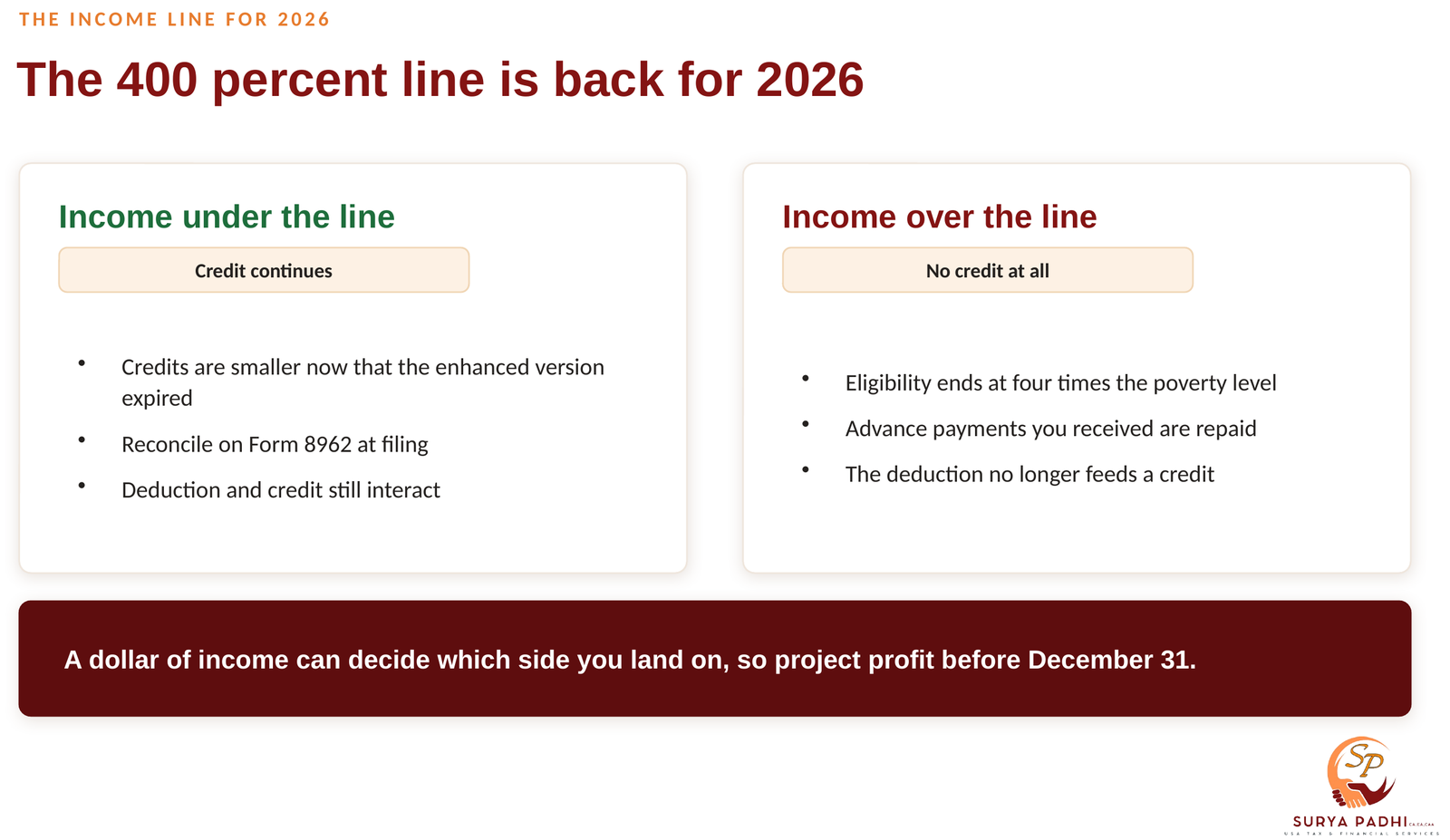
The premium tax credit has a harder edge for 2026. The enhanced credits that removed the income cap expired after 2025, which brings back the original limit at 400 percent of the federal poverty level. Households under the line can still receive a credit, though a smaller one. Over it, there is no credit at all, and any advance payments received for the year are repaid.
Confirm the rule when you file
Proposals to restore the enhanced credits have been debated. Check the Form 8962 instructions and Publication 974 for the law in force for 2026 before you rely on this section.
Because the self-employed health insurance deduction lowers adjusted gross income, it is one of the levers that can move a household under the line. A retirement contribution can do the same, which is why the order of your year-end moves matters.
Retirement contributions compete for the same profit
Every dollar you contribute to a SEP-IRA or solo 401(k) comes off the profit ceiling for the premium deduction. That does not make retirement saving a mistake. It does mean the two should be modeled together, not funded first and discovered at filing.
Same year, with a $3,000 retirement contribution (illustrative)
| Schedule C net profit | $12,000 |
| Half of self-employment tax | − $848 |
| Retirement plan contribution | − $3,000 |
| Ceiling on the premium deduction | $8,152 |
| Premiums paid | $14,400 |
| Premium left over, not deductible | $6,248 |
Illustrative. A $3,000 contribution cuts the premium deduction by $3,000, from $11,152 to $8,152.
Run both before you fund either
SEP and employer solo 401(k) contributions can generally be made up to the return’s due date, including extensions, so there is often time to model the combined effect first. Check your plan document for the exact rules.
Before December 31: four checks
The tax year closes on December 31, which makes the next few weeks the planning window. Work through these in order, because each answer feeds the next.
- Project full-year net profit from Schedule C, not just year to date. It sets the ceiling.
- List every month you or your spouse could have joined a subsidized employer plan, and get the plan details in writing.
- Total the premiums you paid, net of any premium tax credit, and compare them with Form 1095-A when it arrives.
- Model the retirement contribution and the premium deduction together, then solve Form 7206 and Form 8962 as one calculation.
Open enrollment for 2027 coverage opened on November 1. Closing dates differ by marketplace, so check yours instead of assuming a mid-January deadline.
Frequently asked questions
How much of my health insurance can I deduct on Schedule C?
You can generally deduct the premiums you paid up to the net profit of the business that carries the plan, after subtracting half of self-employment tax and any self-employed retirement plan contributions. Premiums above that ceiling are not deductible on Schedule 1 and do not carry forward.
Can I deduct health insurance if my spouse’s employer offers a plan?
Not for any month you were eligible to join a subsidized plan through your spouse’s employer, even if you declined it. The Form 7206 test is eligibility, and it is applied one month at a time, so a plan that became available mid-year affects only the months from then on.
Does the self-employed health insurance deduction reduce self-employment tax?
No. It reduces income tax only. Schedule SE is figured on your full net earnings, and the Form 7206 instructions do not allow this deduction to be subtracted when computing them.
What if I receive the premium tax credit?
You deduct the premium you actually paid, which is the full premium less the credit. Because the deduction lowers income and income sets the credit, the two are solved together on Form 7206 and Form 8962, using a method such as the one in Revenue Procedure 2014-41.
Have the numbers run for your return
Sure Financial and Tax Services prepares the Schedule C and the premium tax credit reconciliation together, so the deduction and the credit agree. A year-end review now costs far less than a surprise at filing.
This article is general tax education and does not constitute individualized tax, legal or financial advice. Figures are stated for the tax year shown and are subject to IRS adjustment. Consult a qualified professional about your own facts.