
A solo 401(k) must file Form 5500-EZ once the combined year-end assets of all your one-participant plans exceed $250,000, tested on December 31 for a calendar-year plan. The return is due July 31, extendable by Form 5558, and a late return carries a $250-a-day penalty, capped at $150,000 per plan year.
7:00. The written version, the figures and the sources are all below.
| Filing line | $250,000 | Combined year-end assets of all your one-participant plans. No return is required when the total does not exceed it, unless it is the plan’s final year. |
|---|---|---|
| Test date | Dec 31 | The last day of the plan year, so December 31 for a calendar-year plan. Read from line 6a(2) of the return. |
| Due date | Jul 31 | The last day of the seventh month after the plan year ends. The next business day applies when it falls on a weekend or legal holiday. |
| Extension | 2½ months | One time, by Form 5558 filed on or before the normal due date. October 15 for a calendar-year plan. |
| E-file rule | 10 returns | EFAST2 filing is mandatory for plan years beginning on or after January 1, 2025 when you must file at least 10 returns of any type that calendar year. |
| Late penalty | $250/day | Section 6652(e), up to $150,000 per plan year. |
| Late-filer program | $500 | Per delinquent return under Rev. Proc. 2015-32, capped at $1,500 per submission for the same plan. Paper filing only. |
Once a one-participant plan passes $250,000 at year-end, an annual return starts. Nothing on your plan statement will tell you, and the penalty runs by the day.
If you run a solo 401(k), the balance is probably the number you watch. The one you may not be watching is $250,000. Once a one-participant plan’s assets pass that mark at the end of the plan year, the IRS expects a Form 5500-EZ filing, and it expects one every year after that. For a lot of owners it is the first retirement plan return they have ever had to make.
Nothing on your plan statement announces the crossing, and a strong market year can carry a plan over the line with no extra contribution at all. This guide covers what gets counted, the dates, how to file, and what a missed year costs, so December 31 is a planned event and not a surprise in July.
Key takeaways
- The test is year-end assets of all your one-participant plans combined. Over $250,000 means a Form 5500-EZ for each plan.
- A plan’s final year requires a return at any balance.
- The return is due the last day of the seventh month after the plan year ends, July 31 for a calendar-year plan, and Form 5558 extends it.
- A missed year carries a $250-a-day penalty up to $150,000 per plan year. The IRS late-filer program costs $500 a return, capped at $1,500.
The $250,000 threshold for a solo 401(k): what gets counted
A one-participant plan is a retirement plan that covers only the business owner, or the owner and a spouse, and a partnership’s partners and their spouses are treated the same way. A solo 401(k) is the common example. The IRS requires an annual Form 5500-EZ from these plans once their assets are large enough, and the test works the same way for every one of them.
Here is the test. Take the value of every one-participant plan your business maintains on the last day of the plan year, which is line 6a(2) on the form, and add them together. If the total exceeds $250,000, Form 5500-EZ must be filed for each of those plans, including a plan that holds less than $250,000 by itself. If the total does not exceed $250,000, no return is required for that year, unless it is the plan’s final plan year.
| Your situation on December 31 | Do you file Form 5500-EZ? |
|---|---|
| One solo 401(k) holding $240,000 | No return for that year. Test again next December 31. |
| One solo 401(k) holding $262,000 | Yes, one return for that plan. |
| Two one-participant plans holding $160,000 and $120,000 | Yes. The $280,000 total is over the line, so each plan files its own return. |
| A plan being closed, with all assets distributed | Yes. A final-year return is required at any balance. |
Exactly $250,000? Read the wording
The IRS page on one-participant 401(k) plans says a plan is generally required to file if it has $250,000 or more at the end of the year. The Form 5500-EZ instructions say filing is not required if total assets do not exceed $250,000. The two differ at that one figure. The instructions are the form’s own rules, so they govern, but if your balance is sitting on the line, filing is the cheap side of the error.
How a plan crosses the line without trying
Most owners never decide to cross $250,000. The balance gets there through ordinary contributions and market growth, and the crossing happens on a date nobody circles on a calendar. A rollover into the plan can do it in a single transfer.
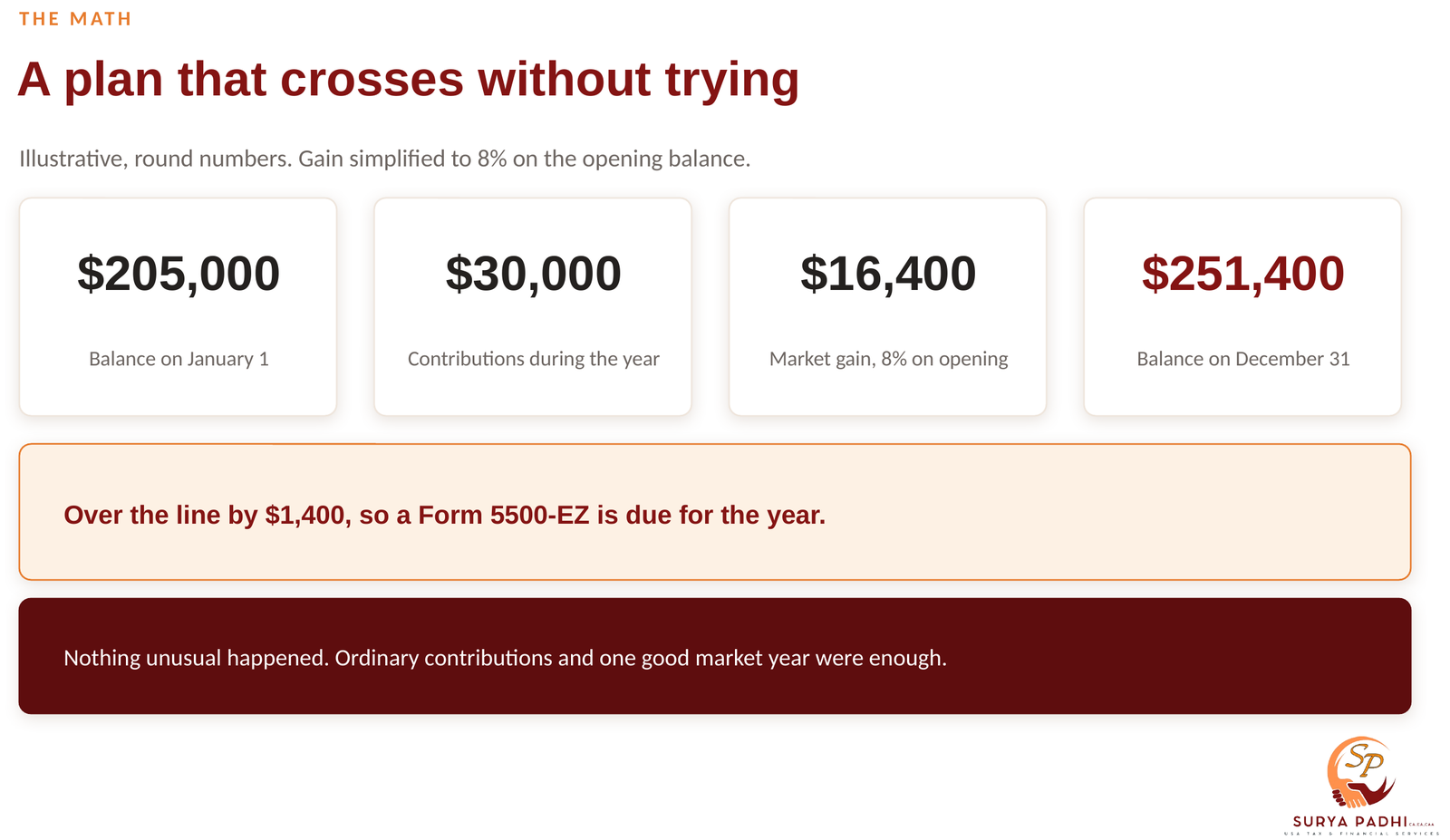
One ordinary year (illustrative)
| Balance on January 1 | $205,000 |
| Contributions during the year | $30,000 |
| Market gain, 8% on the opening balance (simplified) | $16,400 |
| Balance on December 31 | $251,400 |
| Over the $250,000 line by | $1,400 |
Round numbers for illustration, not a contribution target. A real plan’s gain depends on timing and holdings.
Whatever drives it, the test looks at one day. A plan that is $249,000 on December 30 and $251,000 on December 31 has crossed. A plan can also sit under the line for years and then cross in one strong year, which is why the check belongs on your calendar every December 31, not only when the balance feels large.
The dates: due date, extension and who must e-file
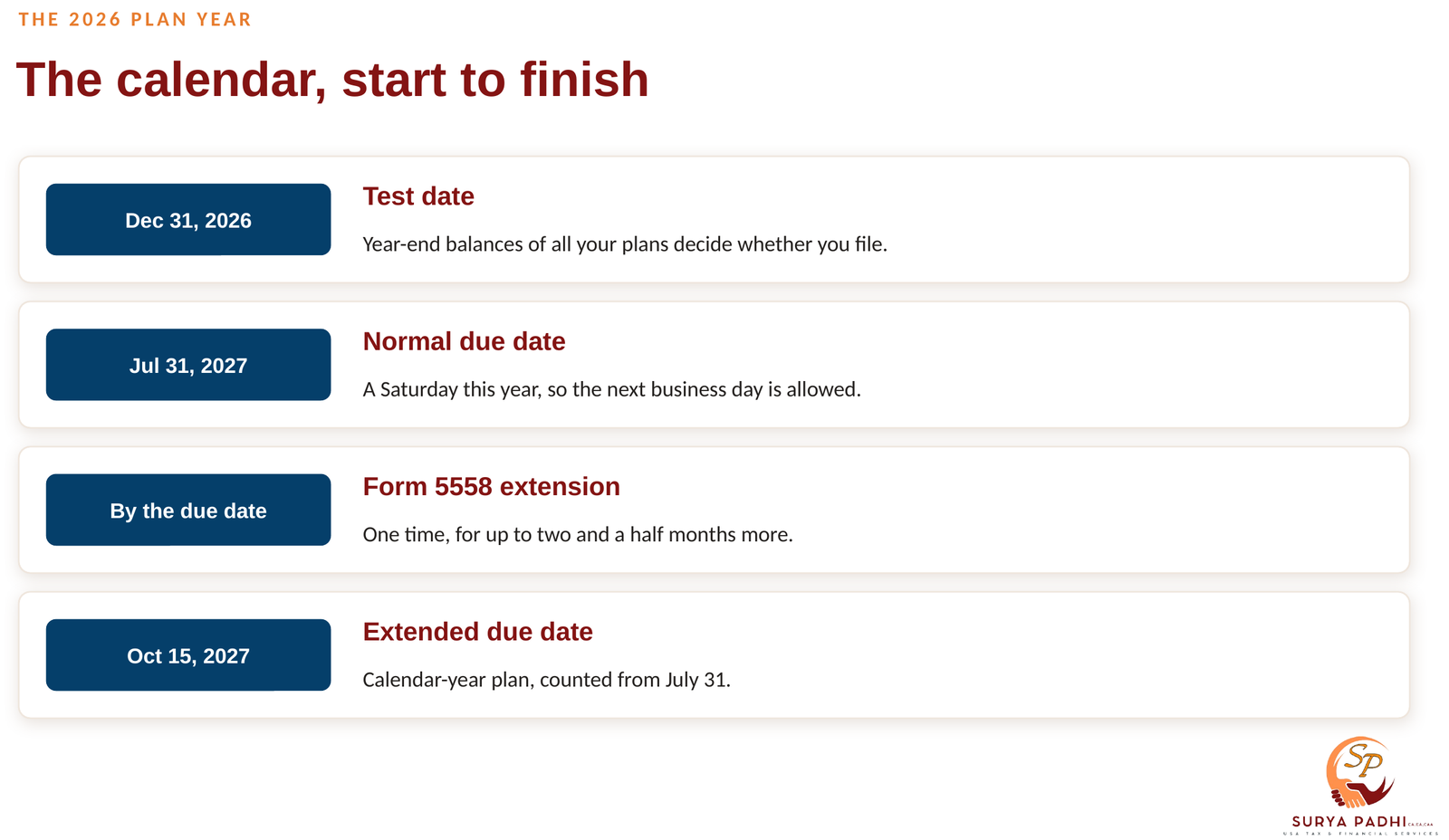
Form 5500-EZ is due the last day of the seventh month after the plan year ends. For a calendar-year plan that is July 31. For the 2026 plan year, July 31, 2027 falls on a Saturday, and the instructions allow filing on the next business day when a due date lands on a weekend or legal holiday.
If you need more time, Form 5558 filed on or before the normal due date gives a one-time extension of up to two and a half months, which runs to October 15 for a calendar-year plan. Check the Form 5558 box in Part I, line B of the return, keep a copy of the form with the plan records, and do not attach it to the return.
Paper or EFAST2?
A one-participant plan can file Form 5500-EZ on paper or electronically through the EFAST2 filing system. Electronic filing becomes mandatory for plan years beginning on or after January 1, 2025 when the filer must file at least ten returns of any type with the IRS during the calendar year that contains the first day of the plan year. The count includes information returns such as W-2s and 1099s, income tax returns, employment tax returns and excise tax returns.
Paper from a required e-filer counts as no filing
A filer who is required to file electronically and submits paper is treated as not having filed. If your business issues W-2s or 1099s, count your returns before you choose how to file.
What a missed year costs
The failure-to-file penalty under section 6652(e) is $250 per day, up to $150,000 per plan year. At $250 a day, the cap is reached after 600 days of delay, a little under twenty months. The cap applies to each plan year separately, so several missed years stack.
The IRS knows owner-only plans miss this filing. Revenue Procedure 2015-32 created a late-filer penalty relief program for one-participant plans. The fee is $500 per delinquent return, capped at $1,500 per submission for the same plan, paid by check to United States Treasury.
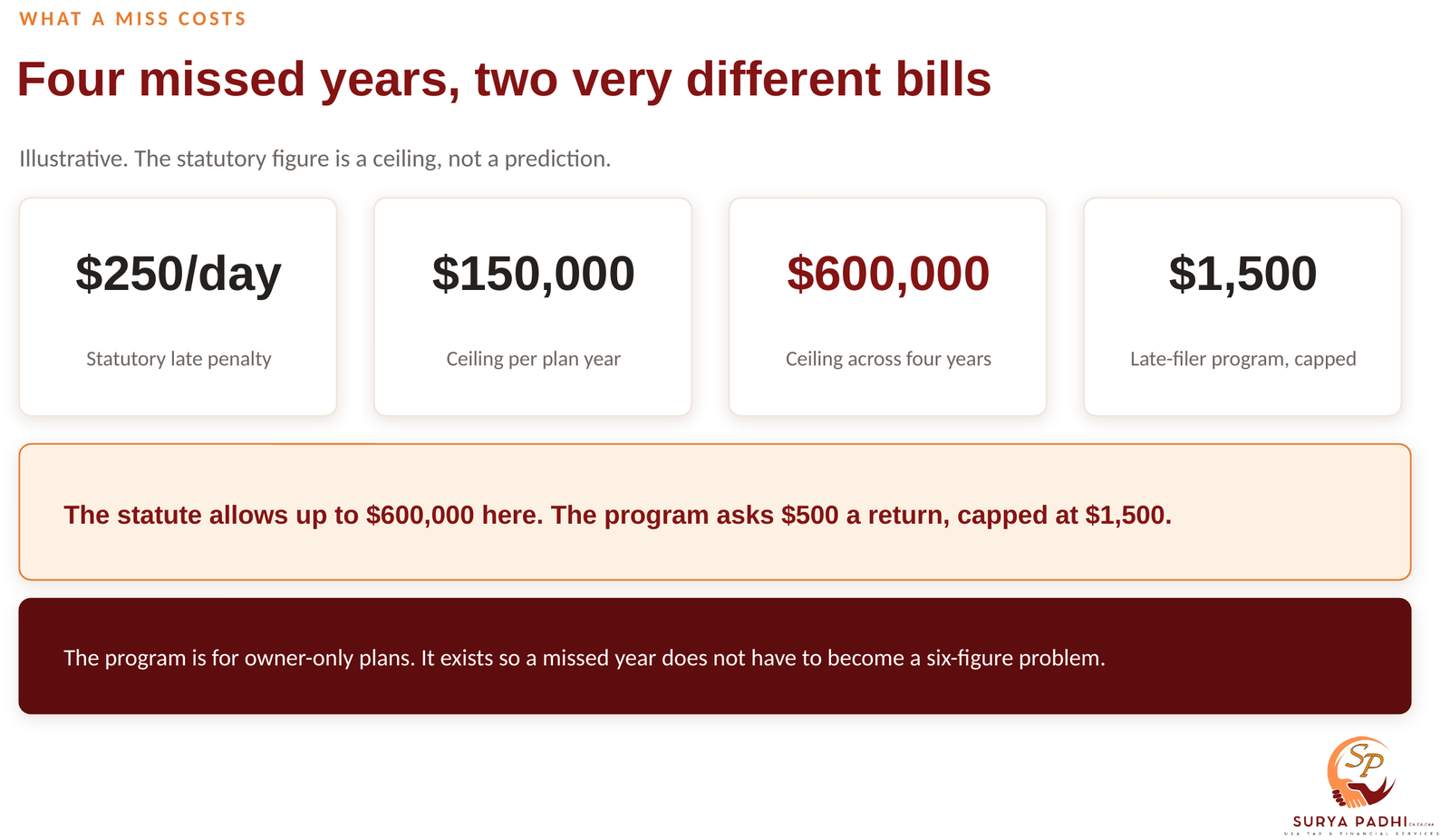
Four missed years (illustrative)
| Statutory ceiling per plan year | $150,000 |
| Ceiling across four missed years | $600,000 |
| Program fee, four returns at $500 | $2,000 |
| Program fee after the $1,500 cap | $1,500 |
The statutory figure is a maximum, not a prediction. Relief under the program also depends on meeting its requirements.
If you are already behind: the late-filer path
If you crossed the line in a past year and never filed, the late-filer program is the first place to look. It has hard edges, so read them before you assemble anything.
The program has hard edges
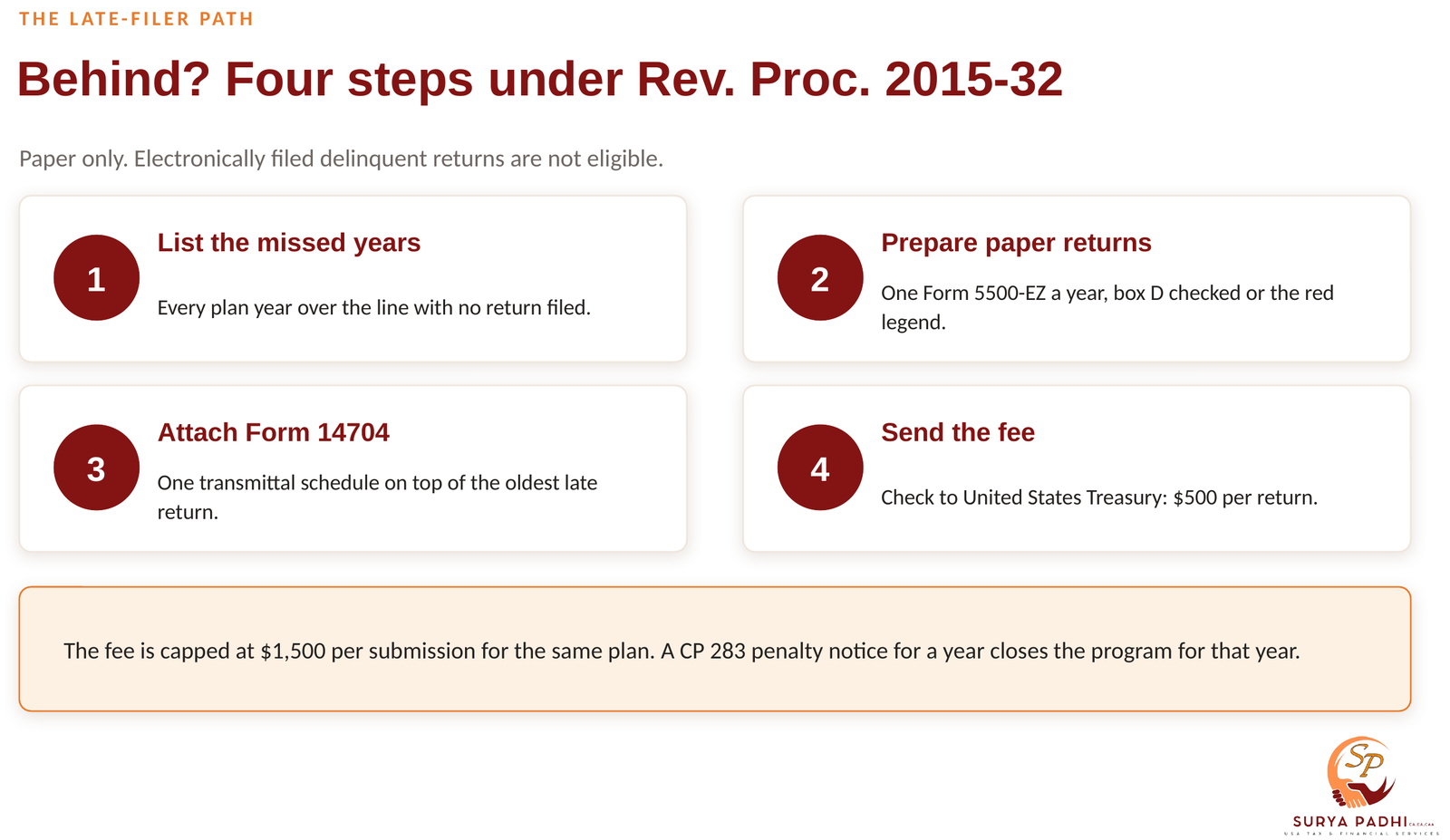
Delinquent returns must be filed on paper. Electronically filed delinquent returns are not eligible, so EFAST2 does not work for this program. Check box D in Part I of the return, or for a year whose form has no box D, write the Rev. Proc. 2015-32 legend in red at the top, using the wording on the IRS program page. Attach Form 14704 to the top of the submission. A CP 283 penalty notice for a year makes that year ineligible.
The four steps
- List every plan year in which you were over $250,000 and never filed.
- Prepare a paper Form 5500-EZ for each year, with box D checked or the red legend written in.
- Attach Form 14704 to the oldest delinquent return in the submission.
- Send the package with a check for $500 per return, up to $1,500, to the address on the IRS program page.
A reasonable-cause request is the alternative route, but if it is denied the IRS issues a CP 283 penalty notice and the return is no longer eligible for the program. For an owner who is simply behind, starting with the program keeps that door open.
What to do before and after December 31
- On December 31, or in the first days of January, pull the plan-year-end balance for every one-participant plan under your business.
- Add them and compare the total with $250,000. Write the result down even when you are under, so next year’s test starts from last year’s number.
- If you are over, mark July 31 and decide early whether you will extend with Form 5558.
- Count the returns your business files with the IRS in the calendar year that contains the plan year’s first day, to learn whether EFAST2 filing is mandatory.
- If you find a year you missed, move before a penalty notice does.
The one-hour habit
Put a plan balance test on your calendar for the first week of January. It takes about an hour and replaces a surprise in July.
Frequently asked questions
Do I have to file Form 5500-EZ if my solo 401(k) is under $250,000?
Generally not for that year. If the combined year-end assets of all your one-participant plans do not exceed $250,000, no return is required, unless it is the plan’s final plan year. You still test the balance every December 31, because the answer can change from one year to the next.
Is the $250,000 threshold per plan or for all my plans together?
It is for all of your one-participant plans together. If the combined total exceeds $250,000, a separate Form 5500-EZ must be filed for each plan, including a plan that holds less than $250,000 on its own.
What is the penalty for filing Form 5500-EZ late?
The penalty is $250 per day, up to $150,000 per plan year. The IRS late-filer program under Revenue Procedure 2015-32 instead charges $500 per delinquent return, capped at $1,500 per submission for the same plan, for eligible one-participant plans.
Can I e-file Form 5500-EZ for a solo 401(k)?
Yes, through the EFAST2 filing system. It is mandatory for plan years beginning on or after January 1, 2025 when you must file at least ten returns of any type with the IRS in the calendar year that contains the plan year’s first day. Otherwise, paper and electronic filing both work.
Is your solo plan near the line?
Surya Padhi, CPA, EA and the Sure Financial team help business owners plan for year-end tests like this one. Reach out before December 31.
This article is general tax education and does not constitute individualized tax, legal or financial advice. Figures are stated for the tax year shown and are subject to IRS adjustment. Consult a qualified professional about your own facts.