
Yes, it can be. Interest on an Indian home loan can qualify as home mortgage interest on Schedule A when the flat is your main home or the second home you choose, the loan is secured by the flat, and you itemize. Buying also affects account reporting, rupee conversions and who sits on the deed.
6:56. The written version, the figures and the sources are all below.
| Qualified home | Main home + one other | Publication 936: you choose the second home. Interest on debt secured by it can qualify. |
|---|---|---|
| Home under construction | Up to 24 months | Publication 936: only if it becomes your qualified home when ready for occupancy. |
| Foreign accounts | FBAR | Due April 15, with an automatic extension to October 15. Highest balance in the year counts. |
| Foreign gifts | Form 3520 | Required when gifts from a nonresident alien individual pass the reporting threshold. |
| Currency on personal funds | Section 988(e) | A small personal gain is excluded; a larger one is not. |
The loan interest can be deductible. The accounts, the rupees and the name on the deed need a plan.
Most guides to buying property in India cover the Indian side: registration, foreign exchange rules, tax deducted on the payment. They stop at the border. If you file a US return as a citizen, green card holder or resident, the purchase also does things to that return, and nobody on the Indian side is going to mention them.
This article covers four of them: the loan interest, the money trail, the rupees, and the name on the deed. If you are asking whether Indian home loan interest is deductible on a US tax return when buying property in India, the short answer is that it can be, and the rest of this piece explains when. It is about your US return only. Indian filings belong with a practising Chartered Accountant in India.
Key takeaways
- Interest on an Indian home loan can be home mortgage interest on Schedule A, if the flat is your main home or your chosen second home and the loan is secured by it.
- The flat itself is not an FBAR or Form 8938 item, but the accounts that paid for it can be.
- Rupees are foreign currency, so the exchange rate on each payment date is worth recording.
- A parent on the deed can bring FBAR reporting and a Form 3520 question.
Is Indian home loan interest deductible on your US return?
It can be. The tax code allows an itemized deduction for interest on debt used to buy a qualified residence. A qualified residence is your main home, plus one other home you choose to treat as your second home. The definition looks at how you use the home and how the loan is secured. IRS Publication 936, the guide to home mortgage interest, describes a qualified home by what it is and how you use it.
Four things have to be true
- You itemize. The interest is a Schedule A deduction, so it only helps if your itemized deductions beat the standard deduction.
- The flat is a home you use. You can choose it as your second home. If you never rent it out, you do not have to live in it during the year. If you rent it out part of the year, your own use has to pass a minimum-use test.
- The loan is secured by the flat. The loan documents have to make the flat the security for the debt, and that security has to be recorded under local law. Your Indian lender’s mortgage papers are what show this.
- The loan fits under the dollar cap. One cap covers the loans on your main home and this flat together, so a large US mortgage can use up the room.
| Your situation | Where the interest goes | Watch for |
|---|---|---|
| Chosen as second home, never rented | Schedule A | You must itemize |
| Chosen as second home, rented part of the year | Schedule A, if your own use passes the test | The minimum-use test |
| Rented out, your own use too small | Schedule E, as a rental expense | Passive loss and other rental rules |
| You already chose a different second home | Not as home mortgage interest | You pick one second home each year |
Buying before it is built
Many flats in India are bought under construction, with the builder paid in stages and the loan released in stages. A home under construction can count as a qualified home for up to 24 months, but only if it becomes your qualified home when it is ready for occupancy. So the builder agreement and the possession date both matter. If the flat never becomes a home you use or choose as your second home, the interest paid along the way does not qualify.
The money trail: what the FBAR and Form 8938 pick up
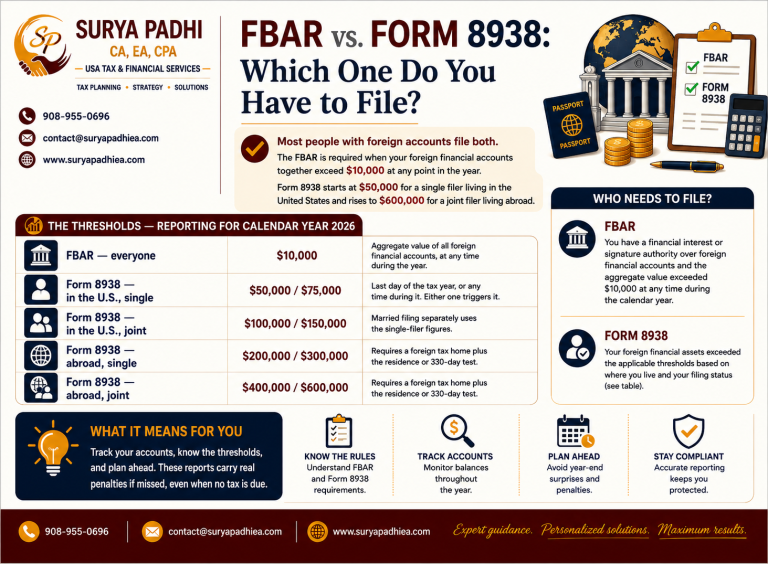
The flat itself is real property held directly. It is not a financial account, and the Form 8938 list of specified foreign financial assets does not include real property you hold directly. So owning the flat does not, by itself, put it on either form.
The accounts around it are a different story. The savings or NRO account that paid the builder is a foreign financial account, and for the FBAR what counts is the highest balance during the year. A balance that was large in March and gone by December still counts. A joint account opened to pay the monthly installments is reportable if you own it or can sign on it, even when a parent funds it.
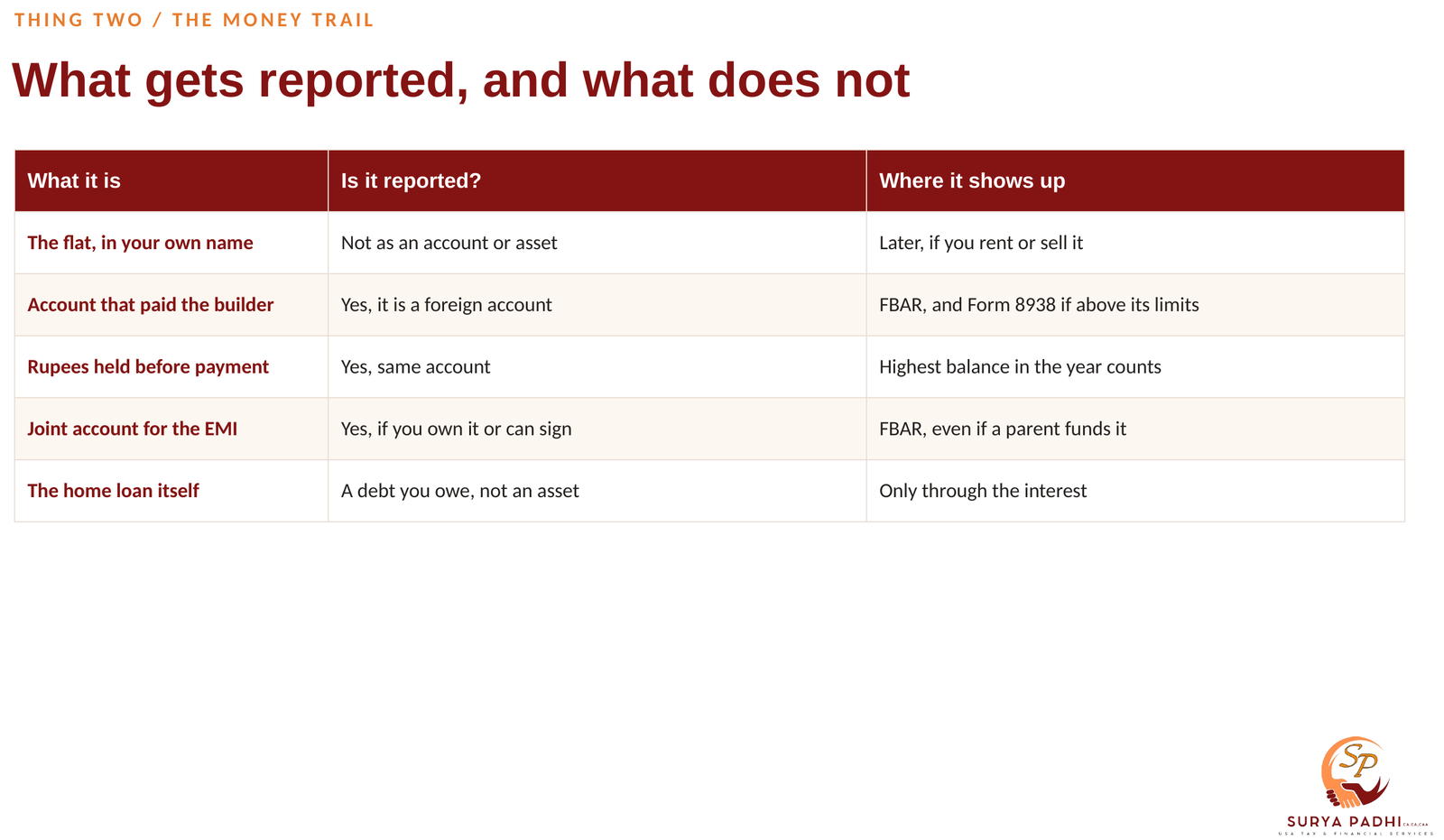
The FBAR is due April 15 of the following year and extends automatically to October 15. Form 8938 goes in with your return when your specified foreign assets are above its filing thresholds, which are higher than the FBAR’s and depend on where you live and how you file.
Rupees are foreign currency
To the IRS, rupees are foreign currency, not dollars in another form. If you convert dollars to rupees and the exchange rate moves before you pay the builder, you can end up with a currency gain or a loss on the money you were holding.
Section 988 deals with this, and section 988(e) carves out personal transactions. For an individual, a small gain on personal currency is excluded, and a larger one is not. A loss on money you held only to buy a home is generally not deductible. The risk grows with time: the longer rupees sit in an account before they go to the builder, the further the rate can move.
Your dollar cost in the flat is built from what each payment cost you in dollars, which is another reason to record the exchange rate every time money moves.
The rupee loan is a separate question
A loan denominated in rupees raises its own currency question, which depends on the facts. This article takes no position on it.
A parent on the deed: the convenience that creates paperwork
In India it is common to add a parent to the sale deed or the loan, sometimes to qualify for a larger loan, sometimes for estate reasons, sometimes because it was simply easier. On the Indian side that can be perfectly sensible. On the US side it opens questions.
- FBAR. A joint account opened to service the loan can be reportable if you own it or can sign on it.
- Form 3520. If a parent who is a nonresident alien pays part of the price, that money can be a foreign gift to you. Form 3520 is required when gifts from a nonresident alien individual pass its reporting threshold, and gifts from related foreign persons count toward the total.
- Who claims the interest. The deduction goes with the person who owns the home and owes the debt, so a name on the deed with no share of the loan does not help you.
It can run the other way too. If you pay for the flat and a parent holds title, you may have made a gift to them, and that raises its own review, separate from Form 3520. Think it through before the deed is signed, because changing a deed afterward is slower and harder than getting it right the first time.
Four documents, four questions
The useful part is that each of these four things traces back to a document you will already have in hand. Reading them before you pay is the whole trick.
- The sale deed. Who is on title, and the date. This decides who claims the interest and who might face a gift question, and the date starts your cost basis.
- The builder agreement. The payment schedule. Each stage payment is a date to pair with an exchange rate and the account the money left.
- The loan sanction letter. Who the borrowers are, whether the loan is in rupees, and what secures it.
- Form 26QB and the bank advices. Proof of what was paid and when.
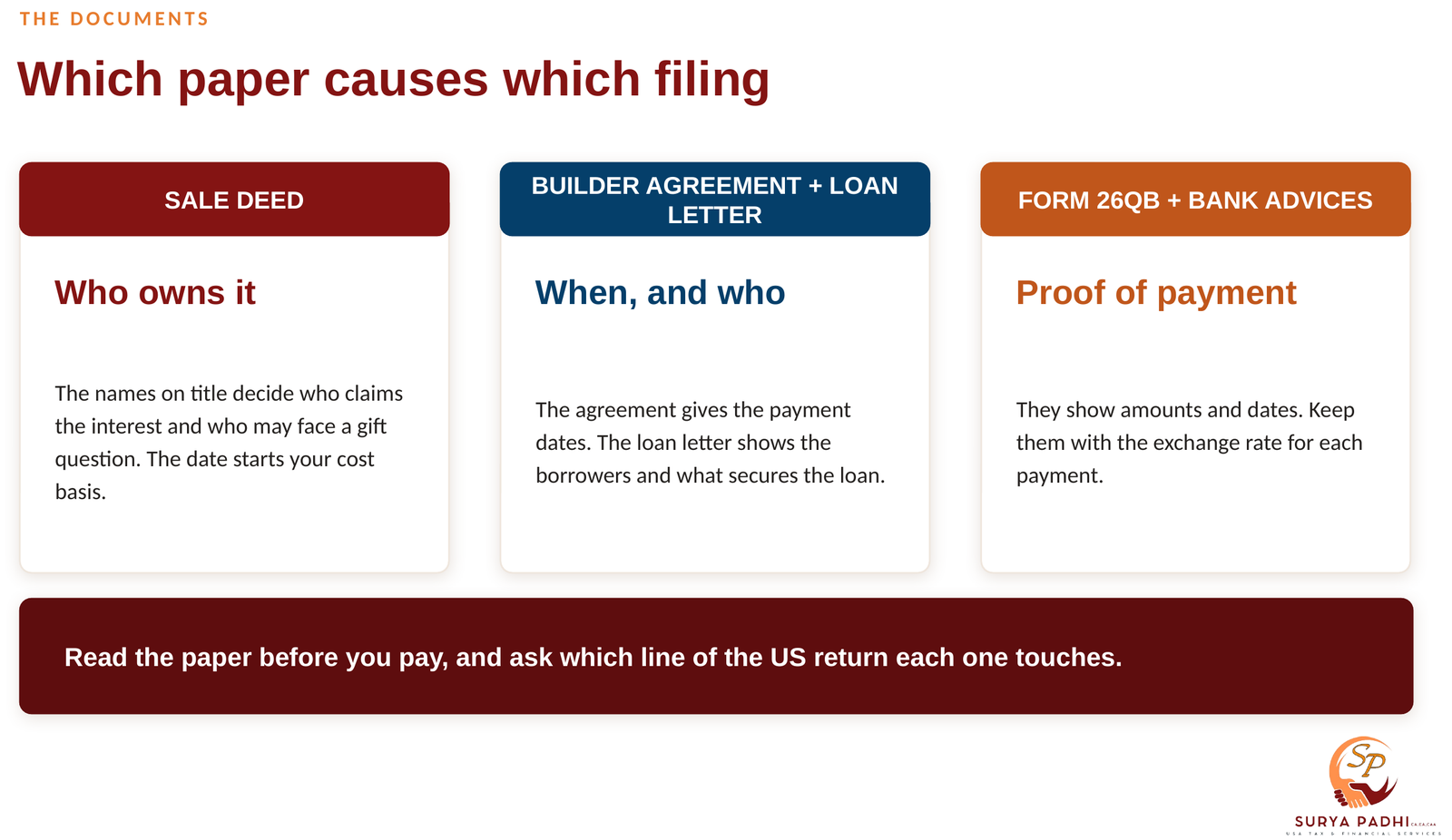
Knowing which line of an Indian document turns into a line on a US form is what the Indian Chartered Accountant background is for. It is a reading skill for the US return, not Indian filing advice.
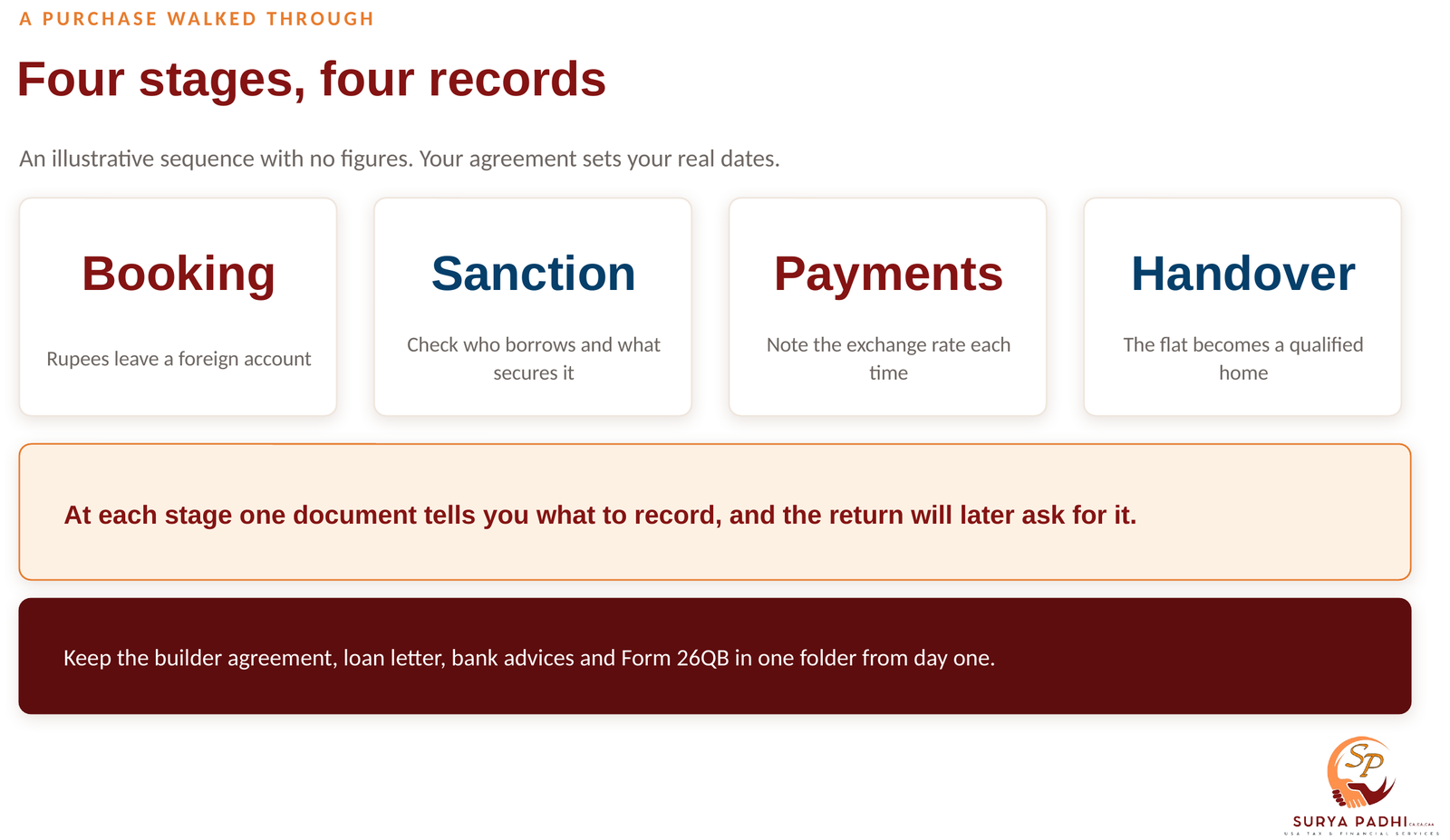
A purchase, walked through
An illustrative sequence, no figures
| Booking | Rupees leave a foreign account. Note the account and the date. |
| Loan sanction | Check who borrows and what secures the loan. |
| Stage payments | Record the exchange rate each time. |
| Handover | The flat becomes a qualified home. Choose it as your second home. |
This sequence is illustrative. Your agreement and loan letter set your real dates.
What to file, and when
For a purchase in 2026, your 2026 return and any Form 3520 or Form 8938 are due April 15, 2027. The FBAR is due the same day and extends automatically to October 15, 2027. After that, the interest, the accounts and any rent come back every year you own the flat.
Before you pay
Collect the deed draft, the builder agreement, the loan sanction letter and your bank details. Everything above is easier to settle before the money moves than after.
Frequently asked questions
Can I deduct Indian home loan interest on my US tax return?
Yes, it can be deducted as home mortgage interest on Schedule A if you itemize, the flat is your main home or the second home you choose, and the loan is secured by the flat. If the flat is a rental, the interest is a Schedule E expense instead.
Do I have to report a flat in India on the FBAR or Form 8938?
Not the flat itself. It is real property held directly, not a financial account. The bank accounts that paid for it can be reportable on the FBAR, and on Form 8938 if you are above its thresholds.
Is converting dollars to rupees to buy property taxable?
A small gain on personal currency is excluded under section 988(e), and a larger one is not. A loss on money held to buy a home is generally not deductible. Record the exchange rate at each payment.
Is it safe to put my parent on the sale deed?
It can be fine in India but still create US paperwork. A joint account may need an FBAR, and money from a parent toward the price can be a foreign gift that needs Form 3520 once it passes the reporting threshold. Review it before you sign.
Buying in India? Bring us the documents before you pay.
We read the sale deed, the builder agreement and the loan letter, and tell you which ones create a US filing. Planning, preparation and filing are what we do.
This article is general tax education and does not constitute individualized tax, legal or financial advice. Figures are stated for the tax year shown and are subject to IRS adjustment. Consult a qualified professional about your own facts. Surya Padhi holds the Indian Chartered Accountant qualification but is not licensed to practise in India and does not provide Indian tax filing or advisory services.