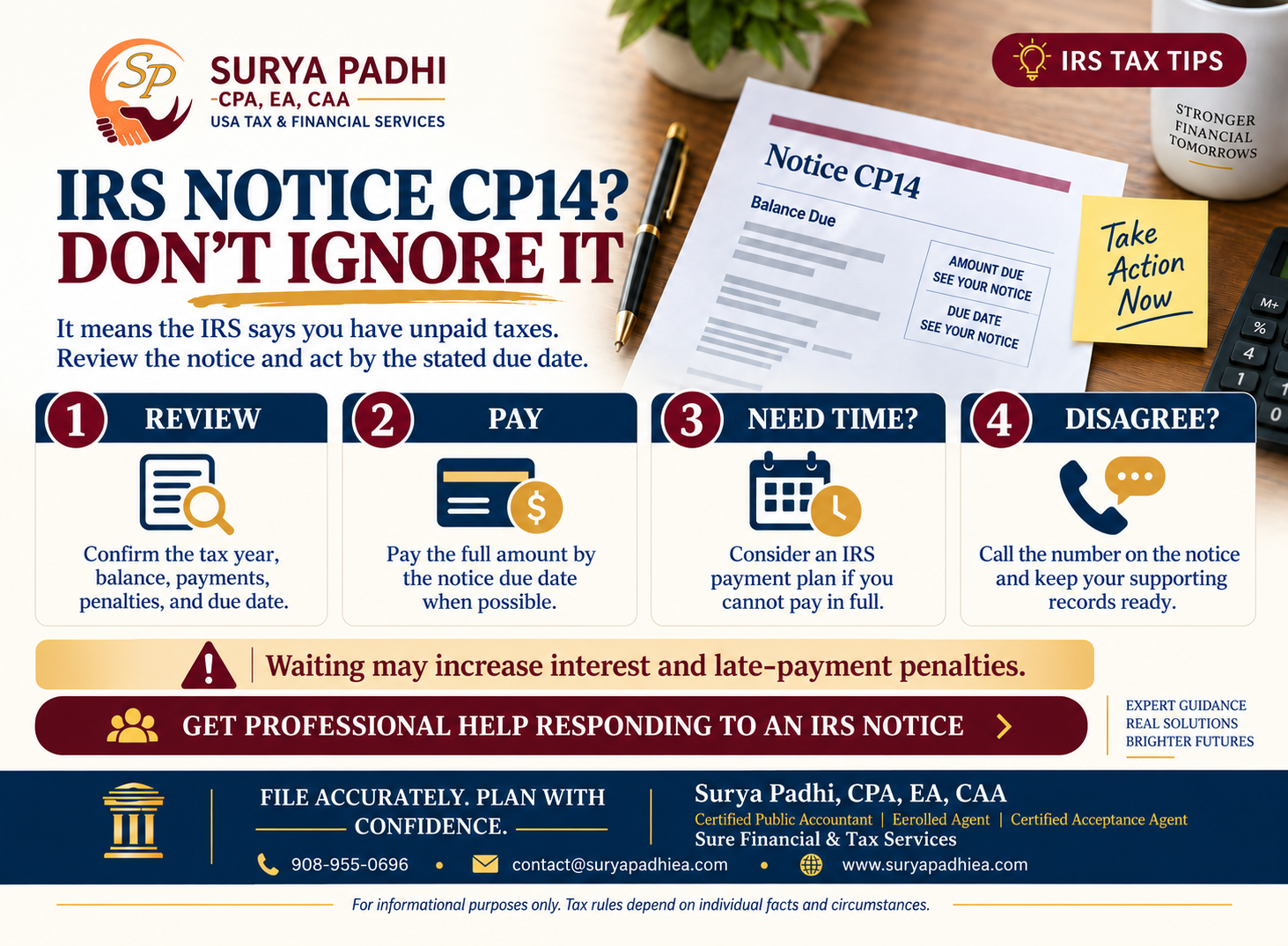
A CP14 is the IRS’s first bill: you filed a return, the tax was not paid in full, and this is the balance with penalty and interest to date. Pay within 21 calendar days of the notice date and no further interest is charged. It is not an audit, and it is not always right.
7:10. The written version, the figures and the sources are all below.
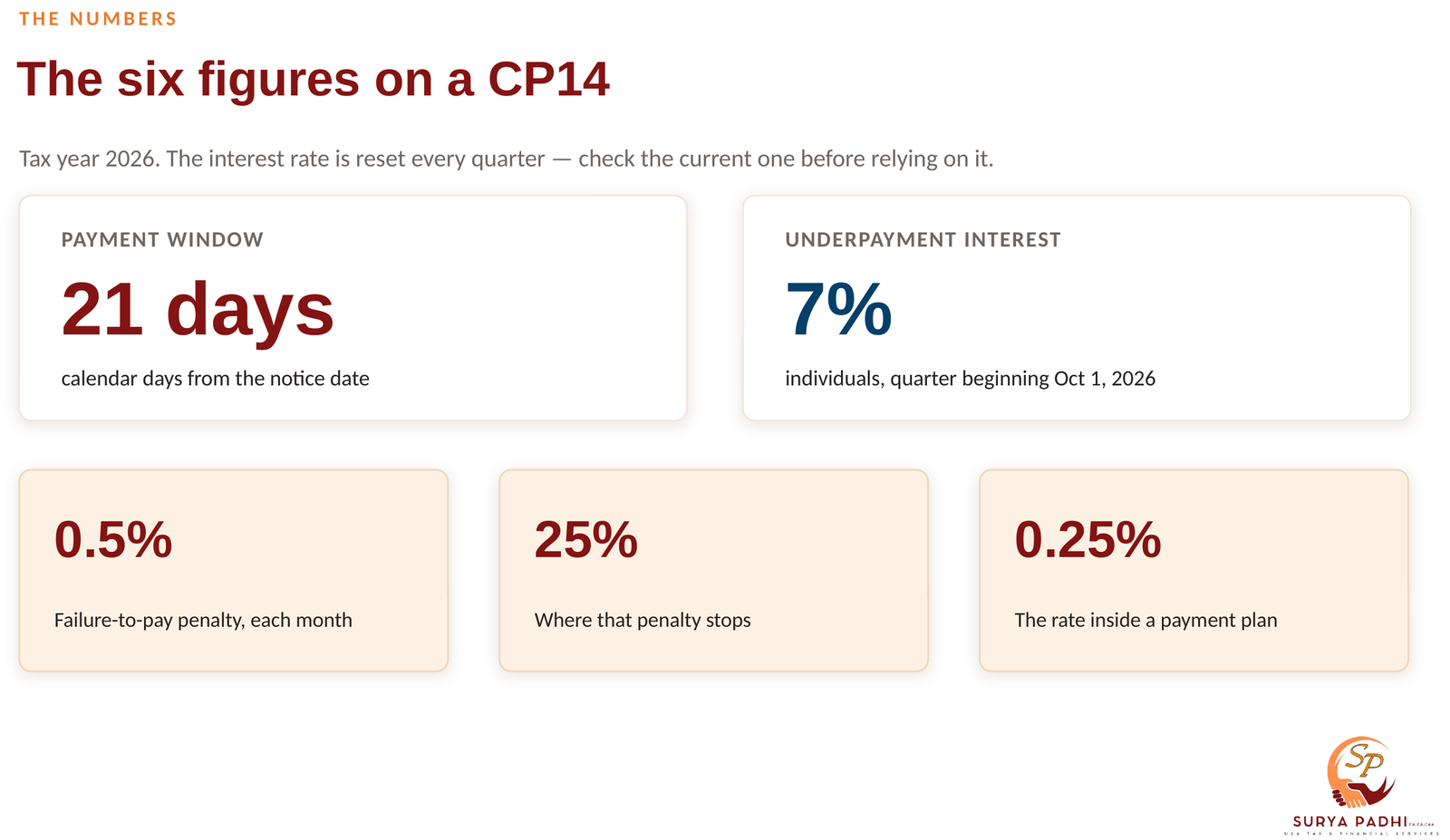
| Payment window | 21 calendar days | From the notice date. 10 business days if the balance is $100,000 or more. |
|---|---|---|
| Failure-to-pay penalty | 0.5% | Of unpaid tax, for each month or part of a month from the return due date. |
| Penalty ceiling | 25% | Where the failure-to-pay penalty stops. Interest does not stop. |
| Underpayment interest | 7% | Individual rate for the quarter beginning October 1, 2026. Compounded daily. |
| Rate inside a payment plan | 0.25% | The penalty rate while an approved agreement is in effect on a timely-filed return. |
| Rate after a levy notice | 1% | If the tax is still unpaid 10 days after a notice of intent to levy. |
A CP14 is the first bill, not an audit. The clock printed on it is twenty-one days, and what you do inside that window decides what the balance costs you.
If you are looking at an IRS CP14 notice and wondering what to do, start with what it is. A CP14 is a bill. You filed a return, the tax on it was not paid in full, and the IRS is telling you the balance, the failure-to-pay penalty and the interest that have accrued so far. It is generated automatically from your own return. Nobody has examined anything, and nothing about it means you are being audited.
The due date printed on it is usually twenty-one calendar days after the notice date, and that window is worth more than it looks. What you do inside it decides whether this stays a small, closeable item or turns into eight months of escalating notices with a levy warning at the end.
Key takeaways
- A CP14 is the first notice in the collection sequence, not an audit letter.
- Two separate charges ride on it: a penalty that caps at 25% and can be removed, and interest that compounds daily and almost never comes off.
- Pay in full within 21 calendar days of the notice date and no additional interest is charged for that period.
- An approved payment plan cuts the failure-to-pay penalty rate in half, from 0.5% a month to 0.25%.
What a CP14 actually is
A CP14 is a notice of tax due and demand for payment. It is issued when a return is filed showing tax owed and the money did not arrive with it. The IRS is not questioning the return — it is quoting the return back to you and adding what has accrued since the filing deadline.
That is worth saying clearly because the envelope frightens people into two opposite mistakes. Some assume it must be a computer error and ignore it. Others assume the government is never wrong and pay it without opening the return it came from. Both are avoidable, and the second one is more common than you would think.
It is the first notice, not the last
If a CP14 goes unanswered, the IRS follows it with a series of reminder notices — CP501, CP503, CP504 — and eventually a final notice of intent to levy. That last one, an LT11 or Letter 1058, carries a 30-day right to request a Collection Due Process hearing on Form 12153. A CP14 carries no such deadline, which is exactly why it is the cheap moment to deal with this.
Two charges, and only one of them is a penalty
The billing summary on a CP14 separates tax, penalty and interest, and the distinction is not cosmetic. The two charges are computed differently, they behave differently over time, and only one of them can realistically be removed.
The <strong>failure-to-pay penalty</strong> is 0.5% of the unpaid tax for each month or part of a month it stays unpaid, running from the original due date of the return. Part of a month counts as a whole month — the IRS applies full monthly charges even if you pay in full before the month ends. It stops at 25% of the unpaid tax, which on a $10,000 balance means $2,500, reached after fifty months. Two things move that rate: it drops to 0.25% a month while an approved payment plan is in effect on a return you filed on time, and it rises to 1% a month if the tax is still unpaid ten days after the IRS issues a notice of intent to levy.
<strong>Interest</strong> is a different animal. The individual underpayment rate is the federal short-term rate plus three percentage points, reset every quarter, and it compounds daily. It runs on the tax and on the penalty, and it has no ceiling. It also moves, which the fixed penalty rate does not.
| Quarter in 2026 | Individual underpayment rate | What it applies to |
|---|---|---|
| January – March | 7% | Balances outstanding in the first quarter. |
| April – June | 6% | The rate dropped for one quarter, then went back. |
| July – September | 7% | Back to seven percent. |
| October – December | 7% | Confirmed by the IRS on August 21, 2026 in Revenue Ruling 2026-15. |
Why the difference matters in practice
You can ask for a penalty to be removed and often get it. Interest is only reduced when it was charged because of an unreasonable error or delay by an IRS employee — or automatically, when the penalty it was calculated on comes off. So penalty relief is a live option. Interest relief, on its own, generally is not.
Read it before you pay it
Most CP14 notices are correct. Enough are not that fifteen minutes of checking is worth the time, and the errors follow a small number of patterns. Pull the return the notice refers to and your IRS individual online account, then work down three lines.
| What to check | Where to look | What goes wrong |
|---|---|---|
| The tax year | Top right of the notice, against your filed return | A payment applied to the wrong year produces a real notice for a balance you already paid. |
| Payments and credits | The billing summary, against your online account transcript | An extension payment or a final estimated installment posted late or to the wrong period. |
| The arithmetic | Tax, less credits, plus penalty, plus interest | The parts should reconcile to the total. If they do not, something upstream is wrong. |
If it does not reconcile, call the number on the notice inside the response window and say so. Paying a bill you believe is wrong does not preserve your position — it closes the account and leaves you filing a claim for refund to get it back.
The twenty-one day window inside the thirty
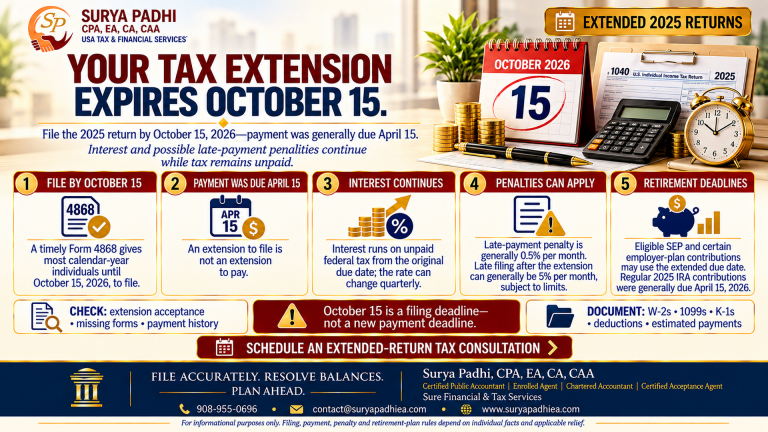
Here is the piece most people miss. IRS Notice 746, the insert that arrives with the bill, sets out the rule: if the amount you owe is less than $100,000, the IRS asks to receive payment within 21 calendar days from the date of the notice. If it is $100,000 or more, the window is 10 business days. Pay in full inside it and no additional interest is charged for that period.
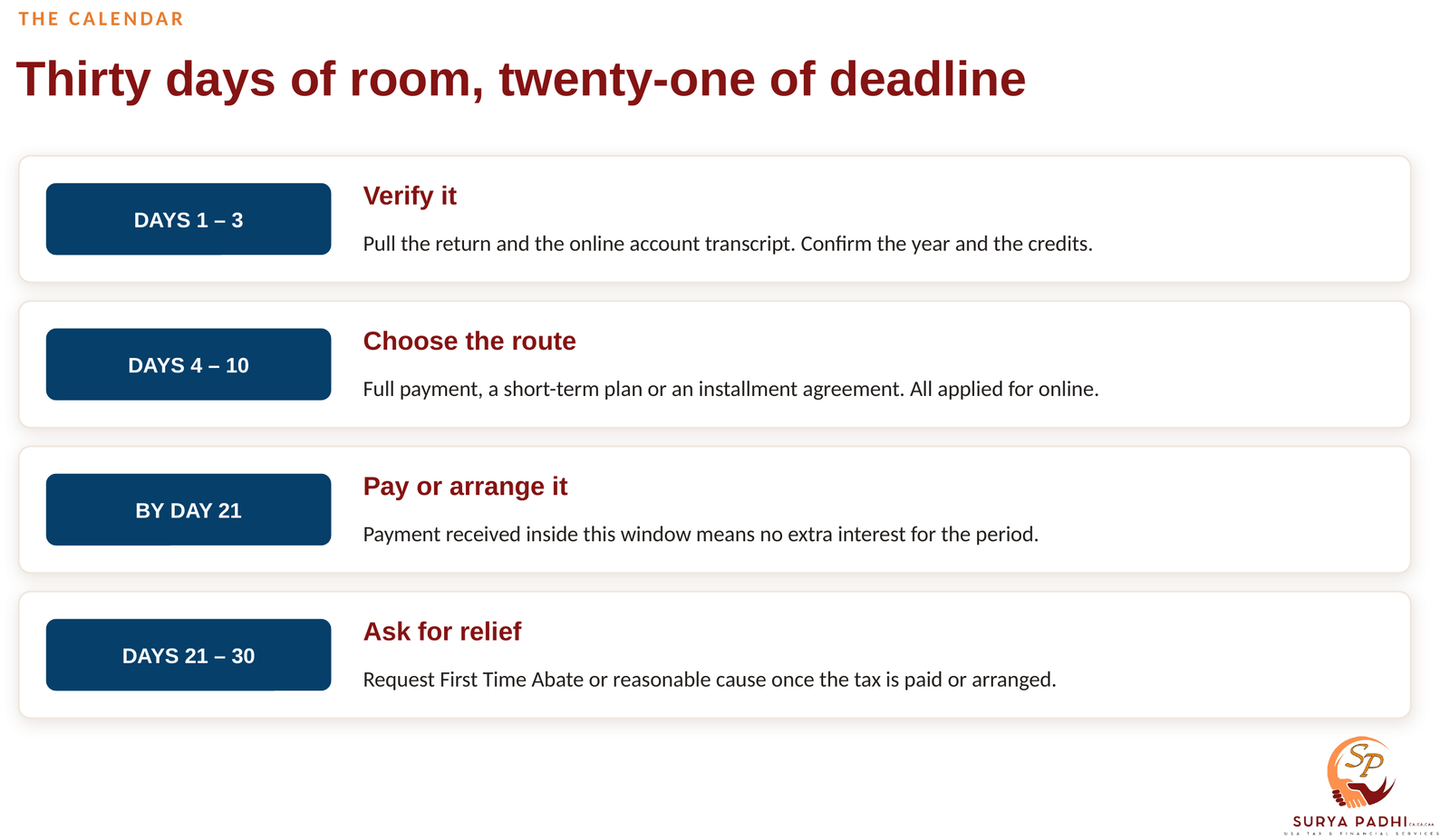
That is a real, if modest, discount, and it is the reason the response has a shape. Thirty days is the sensible planning horizon; twenty-one is the actual deadline.
- Days 1 to 3 — verify. Pull the return and the online account transcript, and confirm the year and the credits.
- Days 4 to 10 — decide. Full payment, a short-term plan, or an installment agreement. All three are applied for online.
- By day 21 — pay or arrange. Getting an agreement approved also drops the penalty rate to 0.25% a month going forward.
- Days 21 to 30 — ask for relief. Once the tax is paid or arranged, request First Time Abate or reasonable cause on the penalty.
Partial payment is not pointless
Both the penalty and the interest are computed on the unpaid balance. Paying half now halves the charge going forward. There is no rule that says you have to pay all of it or none of it.
What a year of silence costs
Take a taxpayer who filed a 2025 return on time in April 2026 showing $10,000 of tax due, and paid nothing. Because the return was filed on time there is no failure-to-file penalty — only failure to pay, and interest. A CP14 arrives that summer. It goes in a drawer.
A $10,000 balance, twelve months later
| Unpaid tax on the notice | $10,000 |
| Failure-to-pay penalty — 0.5% × 12 months | $600 |
| Interest on the tax — 7%, compounded daily | $725 |
| Added in twelve months | $1,325 |
| Same twelve months under an approved payment plan | $300 penalty |
| What the agreement saves | $300 |
Assumes the rate holds at 7% for the full twelve months — it does move, and it was 6% for the second quarter of 2026. Interest also runs on the penalty, so the real figure is a little above $1,325 either way. The setup fee for a long-term agreement paid by direct debit is $29.
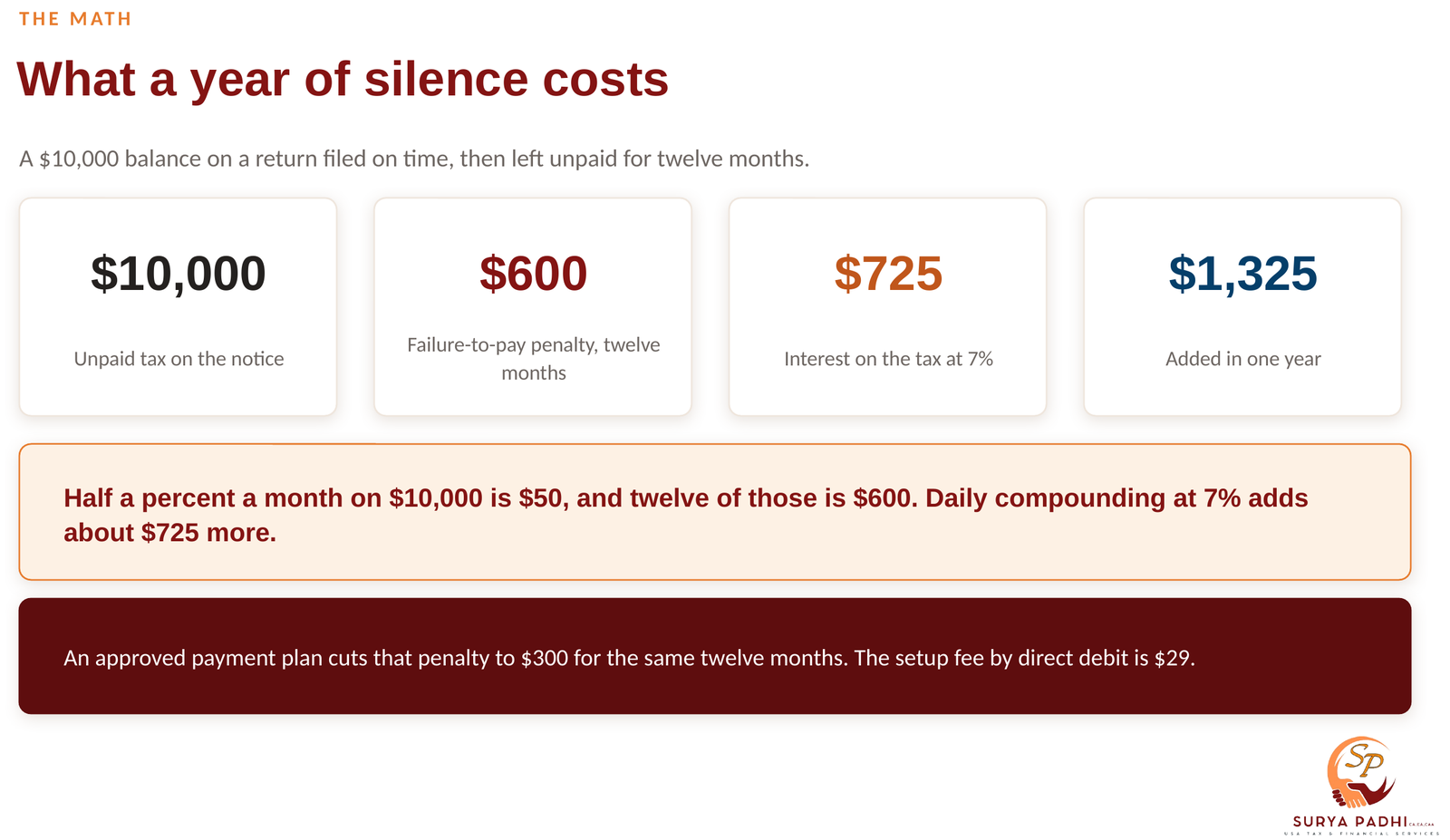
Half of one percent a month on $10,000 is $50, and twelve of those is $600. Daily compounding at 7% adds roughly $725 more on the tax itself. The penalty stops growing once it reaches $2,500 — 25% of the unpaid tax, which takes fifty months. The interest keeps going for as long as the balance does.
The failure-to-file penalty is the expensive one
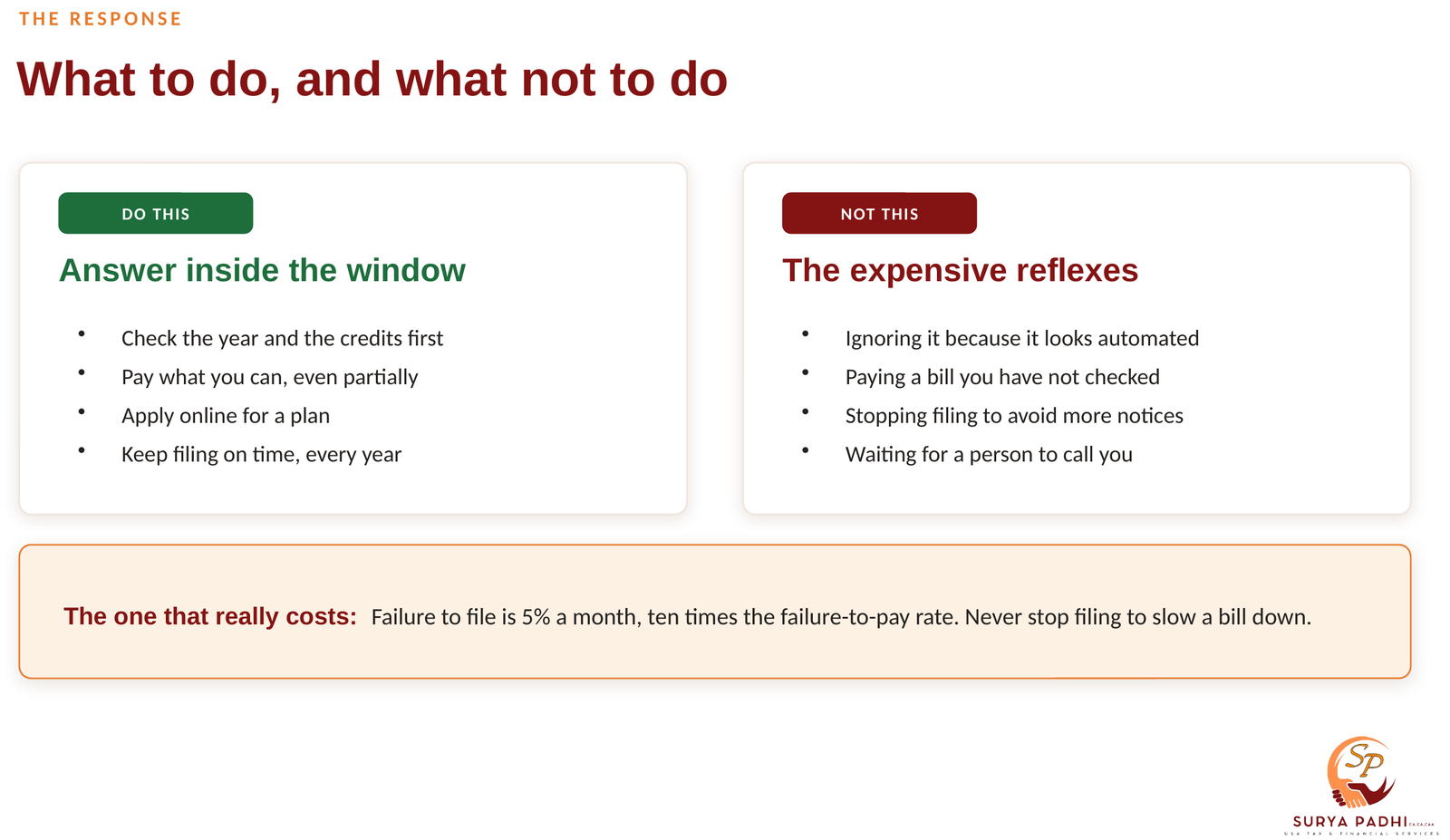
Failure to pay is 0.5% a month. Failure to <em>file</em> is 5% a month, ten times as much, also capped at 25%, with a minimum penalty for returns over 60 days late of the lesser of $525 (for returns required to be filed in 2026) or 100% of the tax owed. Never stop filing to slow down a bill. Filing on time and paying late is far cheaper than the reverse.
If you cannot pay in full
Nothing about a CP14 requires you to have the money. It requires you to respond. The IRS online payment agreement application handles all of the routine cases in about fifteen minutes, and approval is usually immediate.
- <strong>Short-term payment plan</strong> — for a combined balance under $100,000 in tax, penalties and interest, paid off within 180 days. No setup fee.
- <strong>Long-term installment agreement</strong> — you can apply online if you owe $50,000 or less in combined tax, penalties and interest and have filed all required returns. The setup fee is $29 by direct debit, $69 otherwise.
- <strong>Low-income applicants</strong> — the direct debit setup fee is waived, and the higher fee is reduced and may be reimbursed.
- Penalties and interest keep accruing under any plan until the balance is paid, but the penalty rate is halved to 0.25% a month while the agreement is in effect on a timely-filed return.
- New Jersey runs its own billing and payment plan process on state balances. A federal agreement does not touch a state notice.
Compare that with the alternative honestly. An agreement costs $29 and cuts the penalty rate in half. Silence costs 0.5% a month, then 1% a month once a levy notice issues, and ends with a notice that has a hard 30-day appeal deadline attached to it.
Asking for the penalty back
First Time Abate is administrative relief with published conditions, not a favour, and it is the most under-used thing in this whole area. Three conditions have to be met, and the IRS states them plainly.
- You either did not previously have to file a return, or you have no penalties for the three tax years before the year the penalty was assessed.
- You have filed all currently required returns, or filed a valid extension of time to file.
- You have paid, or arranged to pay, any tax due.
If all three are true, the usual route is a phone call to the number on the notice, and it is frequently granted on that call. When the penalty comes off, the interest that was calculated on it is reduced or removed automatically.
First Time Abate spends the clean record
It is available on the strength of a three-year clean history. Using it on a $600 penalty this year means it is not available for a larger one next year. If you already know a bigger problem is coming, reasonable cause relief — based on the facts and circumstances, such as serious illness, a death in the family or a natural disaster — may be the better argument to make first.
Full transcript
[PASTE THE CORRECTED TRANSCRIPT HERE — one paragraph per chapter. Download the auto-generated captions from YouTube Studio, fix the form numbers and dollar amounts, and paste the cleaned text. This is several hundred extra indexable words in your own voice, and it is what AI answer engines read.]
Frequently asked questions
Does a CP14 mean I am being audited?
No. A CP14 is generated from the return you filed, not from an examination of it. It says the tax reported on your own return was not paid in full and states the balance, the failure-to-pay penalty and the interest to date. An examination notice looks entirely different: it names a tax year and asks for specific records. A CP14 only asks for money.
How many days do I have to pay a CP14?
Pay by the due date printed on the notice, which is generally 21 calendar days after the notice date. IRS Notice 746, the insert that arrives with it, asks for payment within 21 calendar days if the balance is under $100,000 and within 10 business days if it is $100,000 or more. Pay in full inside that window and no additional interest is charged for the period.
What if the CP14 amount is wrong?
Call the number on the notice within the response window rather than paying it. The most common cause is a payment credited to the wrong tax year or period, which your IRS individual online account transcript will show. Have the return and your payment records in front of you when you call, and ask what documentation they need. Paying a bill you believe is wrong closes the account and leaves you filing a claim for refund.
Can I get the CP14 penalty removed?
Often, yes. First Time Abate applies if you had no penalties for the three tax years before the one penalised, you have filed all currently required returns or a valid extension, and you have paid or arranged to pay the tax. Reasonable cause relief is separate and depends on the facts — serious illness, a death in the immediate family, a fire or a natural disaster. Interest itself is only abated when the IRS caused an unreasonable error or delay, or when the penalty it was charged on is removed.
What happens if I just ignore it?
The failure-to-pay penalty keeps accruing at 0.5% a month up to 25% of the unpaid tax, interest keeps compounding daily with no ceiling, and the IRS moves through its reminder notices. Eventually a final notice of intent to levy — an LT11 or Letter 1058 — arrives, the penalty rate rises to 1% a month if the tax is unpaid 10 days after it, and you have 30 days from receipt to request a Collection Due Process hearing on Form 12153.
Got a notice you were not expecting?
We read the notice, check it against your return and your IRS transcript, and answer it — including the penalty relief request if you qualify for one. Bring the notice and the return it refers to.
This article is general educational information, not individualized tax or investment advice. Figures cited are subject to IRS adjustment. Consult a qualified professional about your own facts.