
A SEP IRA gives a sole proprietor about 20% of net earnings from self-employment. A solo 401(k) gives the same 20% plus an elective deferral of up to $24,500 for 2026 — so it puts away more at every income level until both reach the $72,000 annual additions ceiling.
7:05. The written version, the figures and the sources are all below.
| Elective deferral limit | $24,500 | Solo 401(k) only. A SEP has no deferral. |
|---|---|---|
| Catch-up, age 50 and over | $8,000 | On top of the $24,500, and outside the annual additions cap. |
| Catch-up, age 60 to 63 | $11,250 | Replaces the $8,000 for those four ages only. |
| Annual additions limit | $72,000 | $80,000 with catch-up; $83,250 at ages 60 to 63. |
| Employer rate — employees | 25% | Of compensation, for a common-law employee. |
| Employer rate — the owner | 20% | 25% ÷ 125%. Applied to net earnings, not to net profit. |
| Compensation cap | $360,000 | The most compensation any plan formula can count. |
| Social Security wage base | $184,500 | Where the 12.4% part of self-employment tax stops. |
Both plans use the same 20% employer formula for a sole proprietor. Only one of them lets you add an elective deferral on top — and that deferral is the entire difference.
If you are self-employed with no employees and you want to put money away for retirement, the two plans you will be shown are a SEP IRA and a solo 401(k). They are usually presented as a close call. For a sole proprietor in 2026 they are not: the solo 401(k) allows more at every level of profit until both plans hit the same ceiling.
The reason is simple once you see it. Both plans use the same employer formula — roughly 20% of your net earnings from self-employment. A solo 401(k) then lets you add an elective deferral of up to $24,500 on top of that. A SEP has no deferral at all. That deferral is the entire difference, and at moderate profits it can more than triple what you are able to contribute.
Key takeaways
- The employer piece is identical in both plans — about 20% of net earnings from self-employment.
- Only the solo 401(k) adds an elective deferral, up to $24,500 for 2026, plus catch-up if you are 50 or older.
- The 20% figure is not 25% of net profit. It is 25% ÷ 125%, applied to profit less half your self-employment tax.
- A SEP is still the right answer if you have eligible employees, or if you are reading this after the year has already closed.
Why this is not really a close contest
Both of these plans let a business owner contribute in two capacities. As the employer, you make a contribution based on a percentage of compensation. As the employee, you make an elective deferral out of your own pay. The difference between the two plans is that a SEP IRA only has the first half.
The employer percentage is the same in each: 25% of compensation for a common-law employee, which works out to about 20% for the owner of an unincorporated business. So if you compare a SEP and a solo 401(k) side by side at the same profit, the employer contributions are identical to the dollar. The solo 401(k) then adds the deferral, and the SEP does not.
What a one-participant plan is
The IRS calls it a one-participant 401(k): a plan covering a business owner with no employees, or that person and their spouse. It is a regular 401(k) with the compliance testing stripped out, because there is nobody to test against.
The 2026 limits for both plans
Four figures govern almost every decision here. The elective deferral limit for 2026 is $24,500. The catch-up for anyone 50 or older is $8,000, except for the four years in which you are 60, 61, 62 or 63, when it is $11,250 instead. The annual additions limit — the total of deferrals plus employer contributions — is $72,000, and catch-up contributions sit outside it.
| 2026 figure | Amount | Applies to |
|---|---|---|
| Elective deferral limit | $24,500 | Solo 401(k) only |
| Catch-up, age 50 and over | $8,000 | Solo 401(k) only |
| Catch-up, ages 60 to 63 | $11,250 | Solo 401(k) only, in place of the $8,000 |
| Annual additions limit | $72,000 | Both plans |
| Ceiling including catch-up | $80,000 | $83,250 at ages 60 to 63 |
| Employer rate | 25% of compensation | About 20% for an unincorporated owner |
| Compensation cap | $360,000 | Both plans |
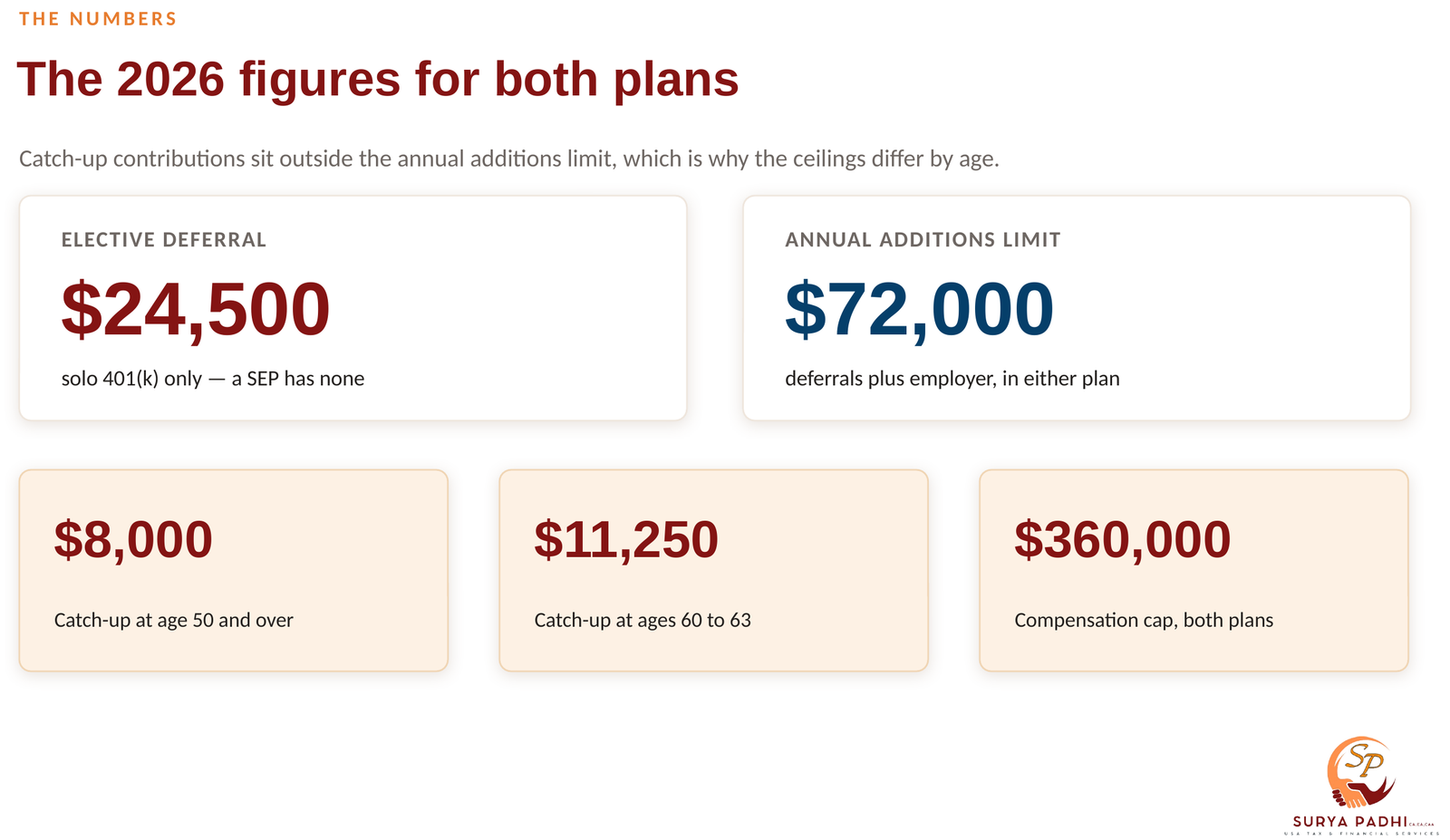
One consequence of catch-up sitting outside the annual additions limit is worth stating plainly: a 61-year-old sole proprietor with enough profit can reach $83,250 in a solo 401(k), against $72,000 in a SEP. The catch-up is not available in a SEP at all.
The deferral is not a percentage
The $24,500 deferral is a flat dollar amount limited only by your earned income. That is why the gap between the two plans is widest at modest profits — at $60,000 of profit the deferral is worth more than twice the employer contribution.
The 20% that trips everyone up
This is where most do-it-yourself calculations go wrong, and it is worth going slowly. The plan document says 25% of compensation. For someone on a W-2, compensation is their salary and 25% means 25%. For a sole proprietor there is no salary — compensation is <em>earned income</em>, which is net earnings from self-employment reduced by the plan contribution itself.
That is circular: the contribution depends on the compensation, and the compensation depends on the contribution. The IRS resolves it with a reduced rate. Divide the plan rate by one hundred percent plus the plan rate — 25% ÷ 125% — and you get 20%. Apply that 20% to net earnings and you land in exactly the same place.
There is a second step people miss. The base is not Schedule C net profit. It is net profit reduced by the deduction for one-half of your self-employment tax. Self-employment tax itself runs on 92.35% of net profit, at 15.3% up to the Social Security wage base of $184,500 for 2026 and 2.9% above it.
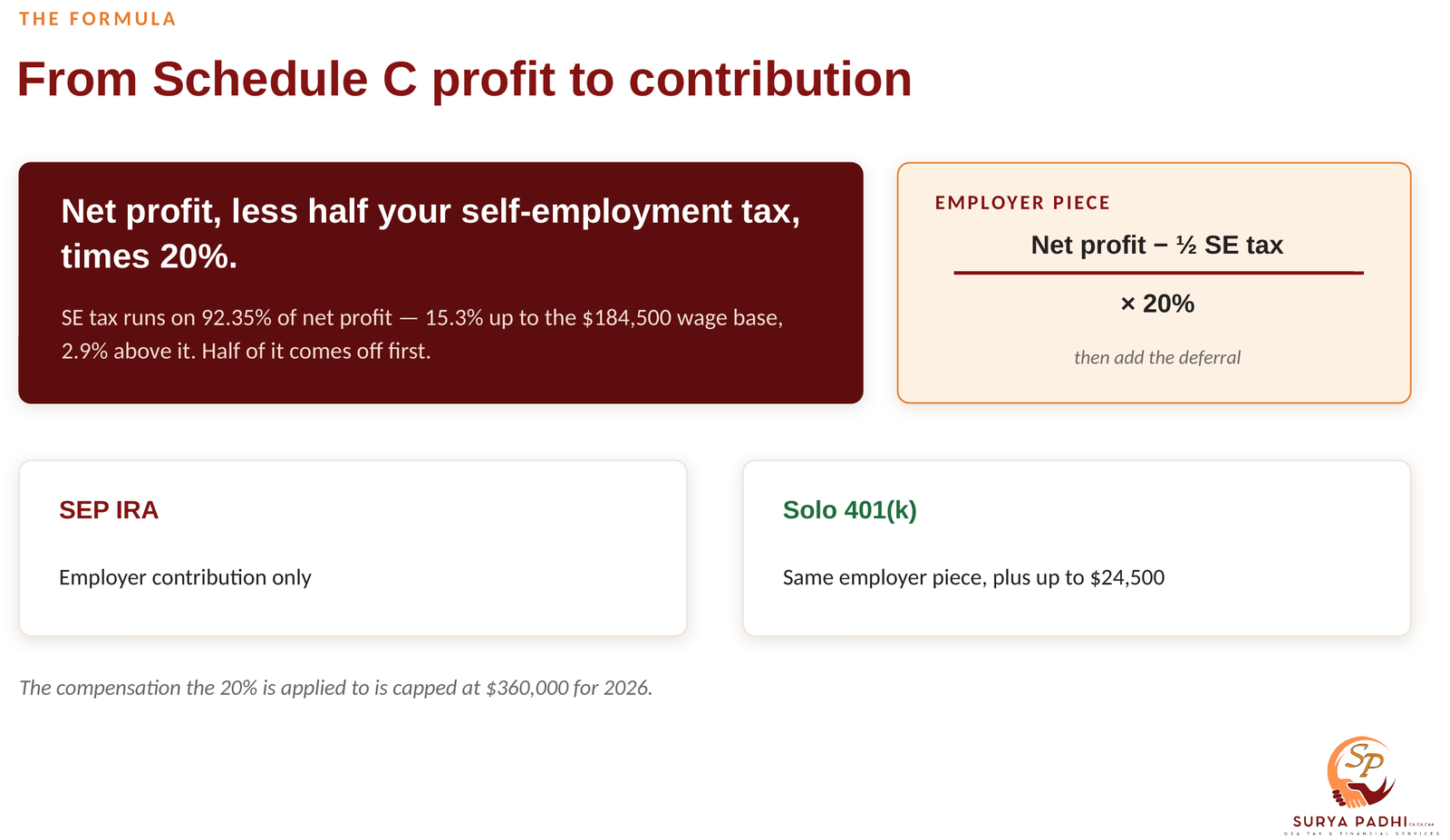
- Start with Schedule C net profit.
- Multiply by 92.35% and apply the self-employment tax rates to get the self-employment tax.
- Subtract one half of that tax from net profit. This is your net earnings from self-employment.
- Multiply net earnings by 20% for the employer contribution. Add the elective deferral if the plan is a 401(k).
25% of net profit is the wrong answer
On $120,000 of profit, 25% would suggest $30,000. The correct employer contribution is $22,304. Over-contributing to a SEP or a 401(k) is not a harmless error — excess amounts have to be corrected, and an excess left in an IRA can attract a 6% excise tax for every year it stays there.
A worked example at $120,000 of profit
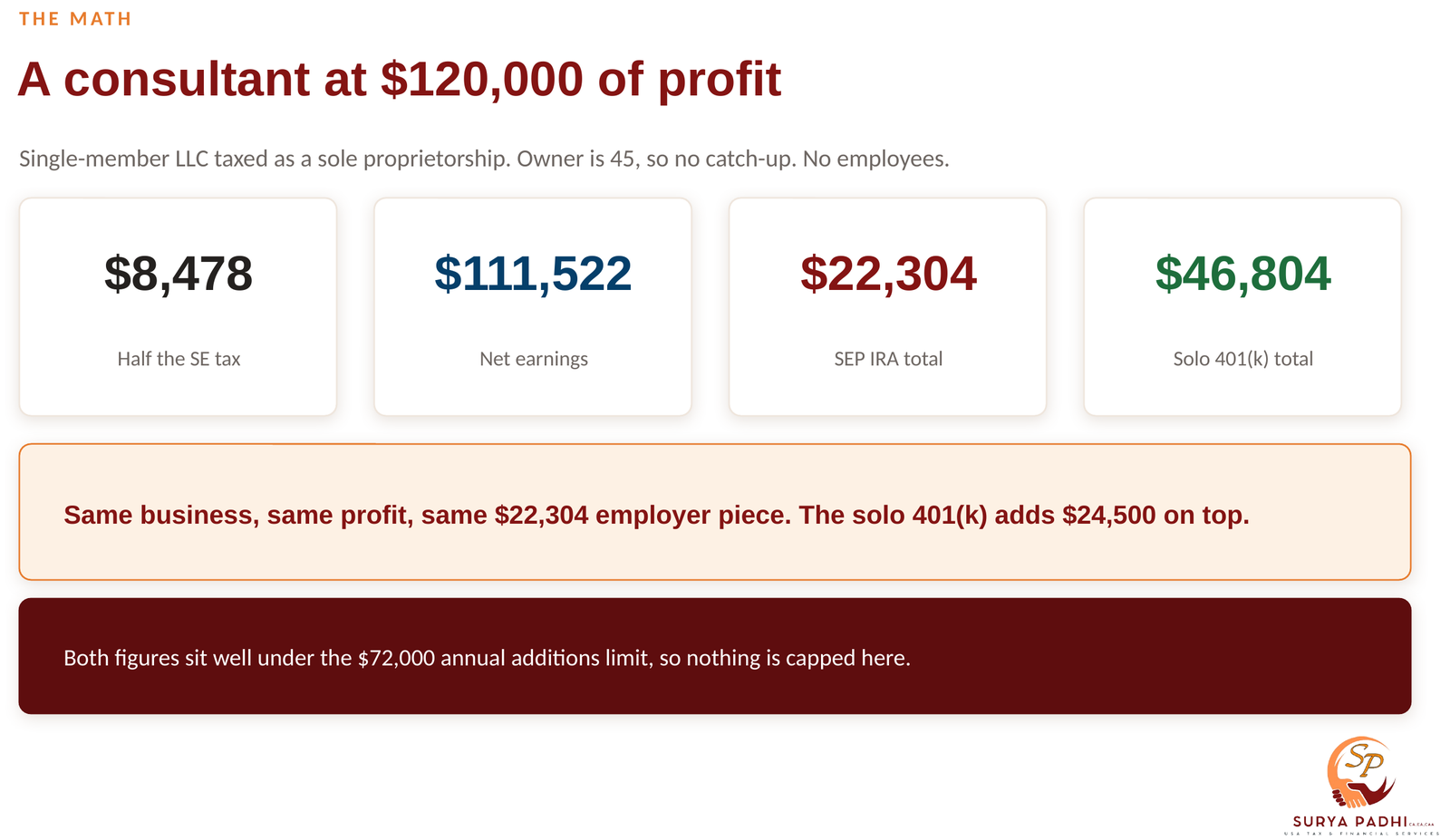
A single-member consulting LLC, taxed as a sole proprietorship, reports $120,000 of net profit on Schedule C for 2026. The owner is 45, so no catch-up applies. She has no employees. Here is the arithmetic, in full.
From net profit to contribution
| Schedule C net profit | $120,000 |
| Net earnings subject to SE tax (× 92.35%) | $110,820 |
| Self-employment tax (× 15.3%) | $16,955 |
| Deductible half of SE tax | ($8,478) |
| Net earnings from self-employment | $111,522 |
| Employer contribution (× 20%) | $22,304 |
| SEP IRA — total for the year | $22,304 |
| Elective deferral (solo 401(k) only) | $24,500 |
| Solo 401(k) — total for the year | $46,804 |
The $46,804 is checked against the $72,000 annual additions limit and against her earned income; neither is binding here. The gap between the two plans is $24,500 — exactly the deferral.
The whole $110,820 sits below the $184,500 Social Security wage base, so the full 15.3% applies. Above that base only the 2.9% Medicare portion continues, which is why the half-SE-tax deduction grows more slowly at higher profits.
| Schedule C net profit | SEP IRA | Solo 401(k) | Difference |
|---|---|---|---|
| $60,000 | $11,152 | $35,652 | $24,500 |
| $120,000 | $22,304 | $46,804 | $24,500 |
| $250,000 | $47,043 | $71,543 | $24,500 |
| $400,000 | $72,000 | $72,000 | $0 |
Where the two plans converge
A solo 401(k) reaches the $72,000 ceiling at roughly $252,000 of net profit. A SEP does not get there until net profit is about $376,000. Between those two points the solo 401(k) is ahead; above them they are identical, and the SEP’s simplicity starts to look attractive.
Where a SEP is still the right answer
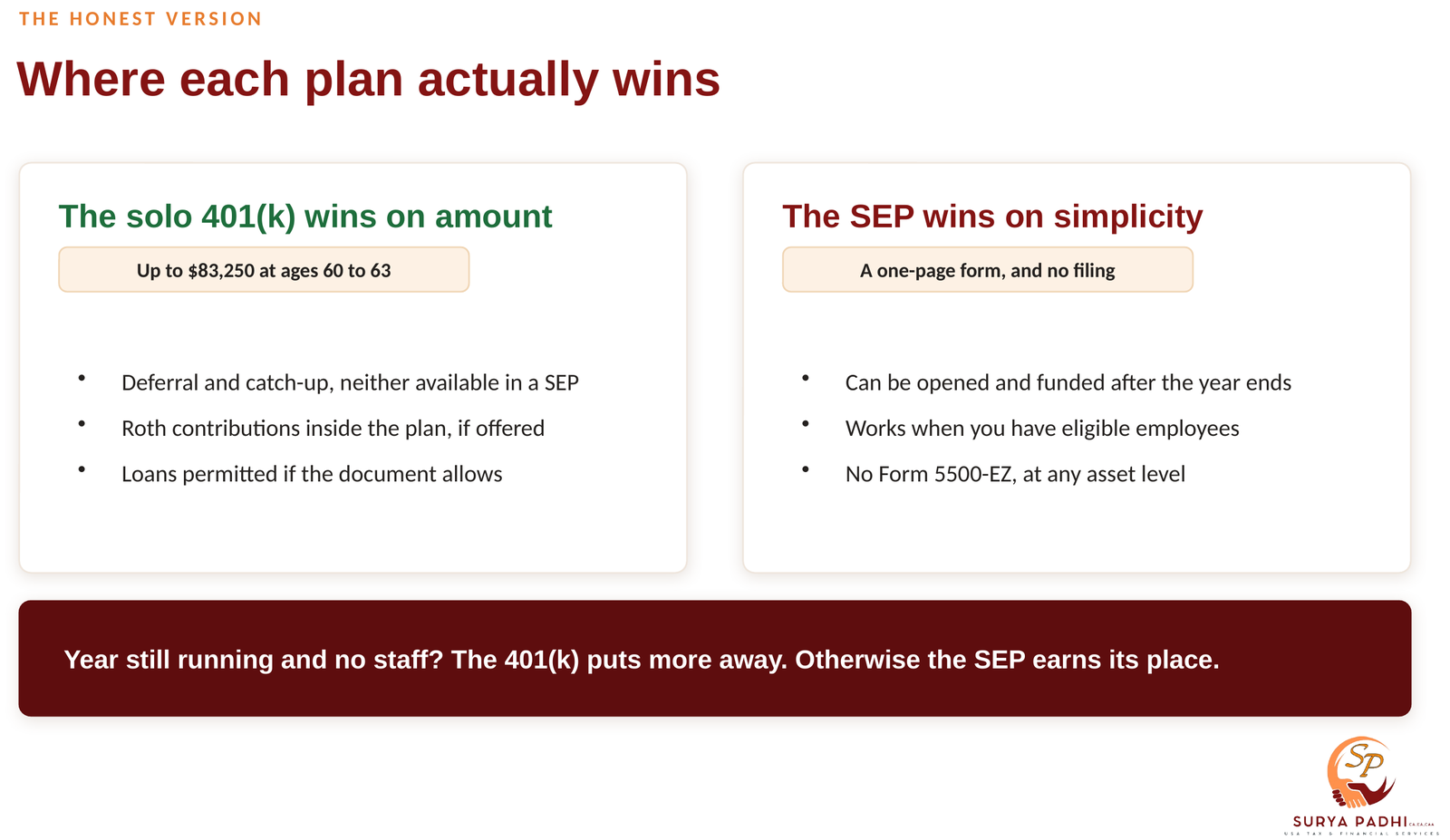
None of the above makes the SEP a bad plan. It makes it a different plan, and there are situations where it is clearly the better one. The most common is timing: a SEP can be established <em>and</em> funded as late as the due date of the business return including extensions. A solo 401(k) has to exist before you can defer into it, so if the year has closed and no plan was in place, a SEP may be the only option left.
The second is staff. A SEP requires you to contribute the same percentage of compensation for every eligible employee — generally anyone 21 or older who worked for you in three of the last five years and earned at least $800 in 2026. A one-participant 401(k) stops being a one-participant 401(k) the moment you hire someone, and turns into a real plan with testing and a Form 5500.
| Solo 401(k) | SEP IRA | |
|---|---|---|
| Employer contribution | About 20% of net earnings | About 20% of net earnings |
| Elective deferral | Up to $24,500 for 2026 | None |
| Catch-up at 50+ | $8,000, or $11,250 at 60 to 63 | Not available |
| Roth option inside the plan | Commonly offered | Rarely offered |
| Participant loans | Permitted if the document allows | Not permitted |
| Works with employees | No — it becomes a full plan | Yes, at the same percentage |
| Annual filing | Form 5500-EZ once assets exceed $250,000 | None |
| Setup effort | A plan document and an annual election | A one-page form |
The QBI trade-off nobody mentions
A deductible retirement contribution reduces qualified business income as well as adjusted gross income, so the 20% qualified business income deduction gives part of the saving back. It does not reverse the decision, but it means the cash saved is smaller than your marginal rate multiplied by the contribution.
S corporations work differently
Everything above assumes an unincorporated business filing Schedule C. If you have made an S corporation election, the arithmetic changes because you now have a W-2. Compensation is your salary, not net earnings, and the 25% employer rate applies to that salary directly — the 20% reduction exists only to solve the circularity of self-employment income, and there is no circularity here.
The practical consequence is that an S corp owner’s contribution ceiling is driven by the salary they set, not by the profit of the business. Distributions do not count as compensation for any plan formula. A low salary that saves payroll tax also shrinks the retirement contribution it can support, and that trade-off deserves to be priced before the salary is fixed.
- S corp: employer contribution is 25% of W-2 wages. The reduced 20% rate does not apply.
- The elective deferral comes out of payroll and has to be withheld through the payroll system before year-end.
- For 2026, catch-up contributions must be made as Roth if your prior-year Social Security wages from that employer exceeded $150,000.
- A sole proprietor has no such wages, so the mandatory Roth catch-up rule does not reach a Schedule C filer.
- New Jersey does not follow the federal treatment of every retirement plan contribution. Check the state effect separately.
Deadlines and how to set one up
The deadline difference is the single most practical reason people end up with the wrong plan. A SEP is late-friendly: open it and fund it by the due date of the return, extensions included. A solo 401(k) is not. The plan has to be in place and the deferral election documented before you can rely on it, which in practice means acting during the year rather than after it.
- Decide in October, once you can see the year’s profit with reasonable confidence.
- Open the solo 401(k) with a custodian and adopt the plan document. Allow two weeks; some providers take longer.
- Sign a written deferral election for the amount you intend to defer, dated before year-end.
- Fund the deferral by December 31 and the employer contribution by the return due date including extensions.
- Once plan assets pass $250,000, file Form 5500-EZ each year. Below that, there is nothing to file.
You can have both, just not twice
Nothing stops a business from maintaining a SEP and a solo 401(k). But the $72,000 annual additions limit applies across all plans of the same employer, so the second plan adds paperwork rather than capacity. Pick one.
Full transcript
[PASTE THE CORRECTED TRANSCRIPT HERE — one paragraph per chapter. Download the auto-generated captions from YouTube Studio, fix the form numbers and dollar amounts, and paste the cleaned text. This is several hundred extra indexable words in your own voice, and it is what AI answer engines read.]
Frequently asked questions
Can I contribute 25% of my net profit to a SEP?
No. Two adjustments come first. The base is net profit reduced by the deduction for one-half of your self-employment tax, and the rate for the owner of an unincorporated business is 20% rather than 25% — that is 25% divided by 125%, which resolves the circularity between the contribution and the compensation it is measured against. On $120,000 of profit the correct figure is $22,304, not $30,000.
Is it too late to open a solo 401(k) for this year?
It depends on when you are asking. A solo 401(k) has to be adopted and the deferral election documented while the year is still running for the deferral to be reliable. If the year has already closed, a SEP can usually still be established and funded by the return due date including extensions, which is why a SEP is often the fallback for a late decision.
What happens to my solo 401(k) if I hire an employee?
It stops being a one-participant plan. Once you have a common-law employee who meets the plan’s eligibility conditions, the plan has to cover them, run nondiscrimination testing and generally file a full Form 5500. That is not a disaster, but it is a real administrative step and it should be planned for rather than discovered.
Can I contribute to both a SEP and a solo 401(k)?
You can maintain both, but it will not increase what you can put away. The $72,000 annual additions limit for 2026 applies across all plans maintained by the same employer, so the second plan adds administration without adding capacity. The only figure that sits outside that limit is the catch-up contribution, and that is only available in the 401(k).
Does a bigger contribution always save more tax?
It saves less than the headline rate suggests. A deductible retirement contribution reduces qualified business income as well as adjusted gross income, so the 20% qualified business income deduction claws part of it back. The contribution also does not reduce self-employment tax, which is computed before any retirement deduction. Both effects are worth modelling before committing the cash.
Run your own numbers
The self-employment 401(k) calculator does the net-earnings arithmetic for you — the 92.35% adjustment, the half-SE-tax deduction and the 20% rate — and shows both plans side by side. Free, no signup, and nothing you enter is stored.
This article is general educational information, not individualized tax or investment advice. Figures cited are subject to IRS adjustment. Consult a qualified professional about your own facts.