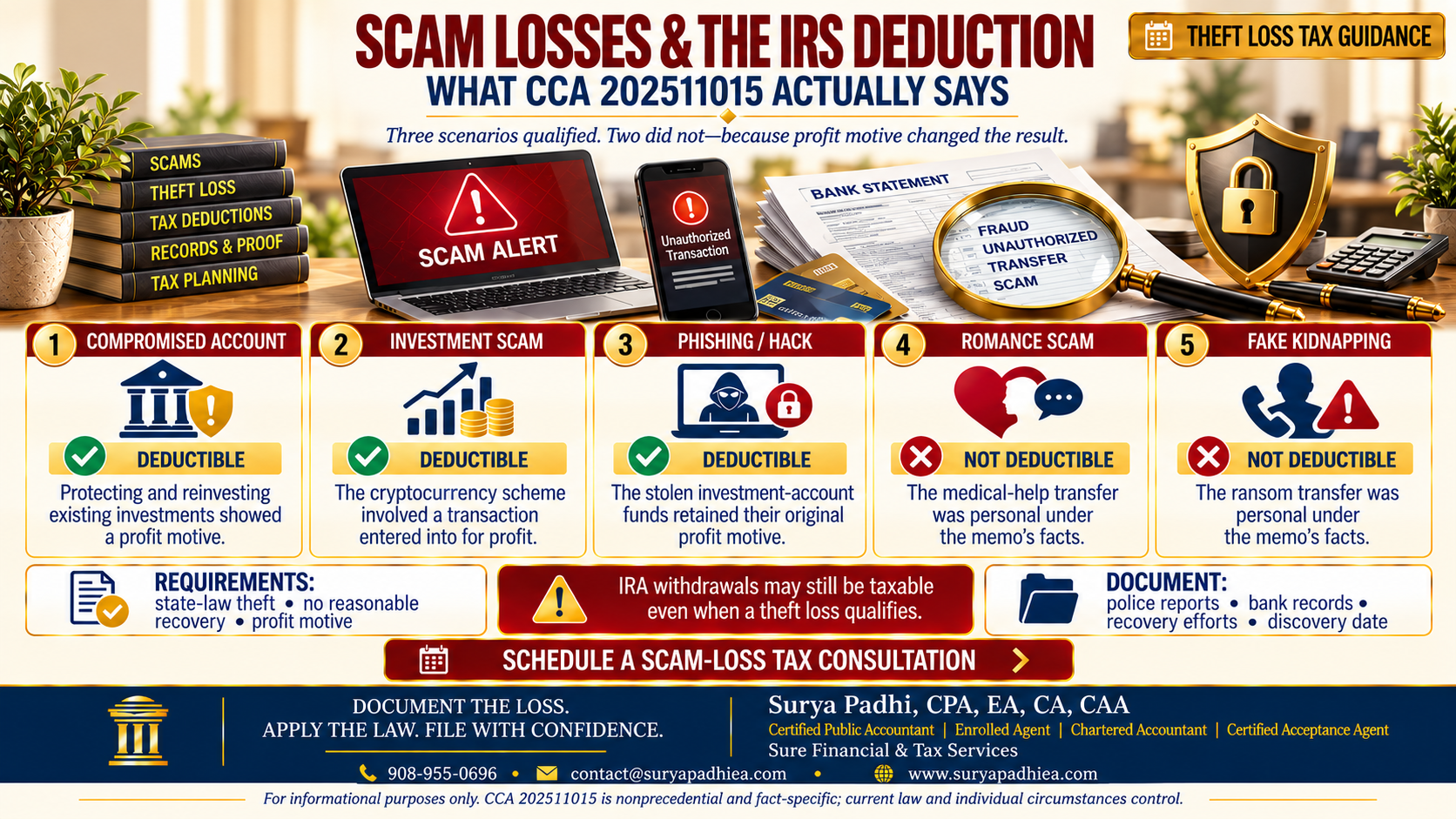
Sometimes. An IRS Chief Counsel memo allowed a theft loss deduction for compromised-account, pig butchering and phishing scams, because the money was tied to a transaction entered into for profit. It disallowed romance and kidnapping scams as personal casualty losses. You deduct your basis, in the year you discover the theft.
6:57. The written version, the figures and the sources are all below.
| Scams allowed | 3 of 5 | Compromised-account, pig butchering and phishing scams in CCA 202511015. |
|---|---|---|
| Personal loss limit | Permanent | Section 165(h)(5) applied from 2018 through 2025. The 2025 tax act made it permanent and added state-declared disasters from 2026. |
| Where it is reported | Form 4684, Section B | Individuals carry the income-producing property loss to Schedule A, line 16. |
| Allowed amount | Basis | What you paid. Never income or gains you did not report. |
| Ponzi safe harbor | 0 of 5 | None of the memo’s five scams qualified under Rev. Proc. 2009-20. |
An IRS Chief Counsel memo sorts five common scams into two groups. Three produced a deduction. Two did not, and the line between them is your motive.
If you were tricked into sending money to a scammer, the loss can feel like it should at least come with a tax deduction. Sometimes it does. An IRS Office of Chief Counsel memo, CCA 202511015, dated January 17, 2025 and released on March 14, 2025, explains when a scam victim can claim a theft loss under Internal Revenue Code section 165 and when the law shuts the door.
The memo walks through five scams. Three produced a deductible theft loss, and two did not. The deciding factor was not how convincing the fraud was or how much money disappeared. It was whether the money was tied to a transaction entered into for profit. This post explains how the memo reasons, what that means for a return, and where an IRA distribution makes the picture harder.
Key takeaways
- A scam loss is deductible only if it is theft under your state’s law and the money was tied to a transaction entered into for profit.
- In the memo, compromised-account, pig butchering and phishing scams qualified. Romance and kidnapping scams did not.
- You deduct your basis in the stolen funds, in the year you discover the theft and no reasonable prospect of recovery remains.
- An IRA distribution is still taxable income, and the theft loss sits below the adjusted gross income line.
What counts as a theft loss
Section 165(a) allows a deduction for losses sustained during the year that insurance or other compensation does not cover. For an individual, section 165(c) limits that to three kinds: losses in a trade or business, losses in a transaction entered into for profit, and personal casualty or theft losses.
Theft is defined broadly. It covers any criminal taking of someone else’s property, including swindling, false pretenses and other forms of guile. To claim the loss, you have to show an illegal taking, done with criminal intent, that counts as theft under your state’s law. In the memo, the scammer’s conduct was criminal fraud, larceny or embezzlement under state law. The scammer was never identified, the transfers could not be reversed, insurance did not cover the loss, and law enforcement saw little to no prospect of recovery.
What this memo is, and is not
It is Chief Counsel Advice written for IRS attorneys. It cannot be cited as precedent, and it assumes specific facts. Treat it as a strong signal of how the IRS reads the law, not a guarantee for your return.
Why your motive decides the deduction
Because of the personal casualty loss limit described below, an individual’s theft loss is generally deductible only if it was incurred in a transaction entered into for profit. Buying securities and other financial products is generally treated as showing a profit motive, so an investor starts in a good position. The memo then asks why the money moved.
If you approved the transfers to safeguard your investments or to reinvest them, the memo treats that as a profit motive, even if a scammer directed the intermediate steps. If you approved nothing, as in phishing or hacking, the memo looks at the stolen investments and why you held them. If you paid a scammer for a non-investment reason, such as a romance scam or a kidnapping scam, there is no profit motive and the loss is a personal casualty loss.
| Scam | Result | Why |
|---|---|---|
| Compromised account, impersonated fraud specialist | Deductible | Funds moved to safeguard and reinvest |
| Pig butchering investment scam | Deductible | Money was sent to invest |
| Phishing, or a hacked account | Deductible | Invested funds stolen, nothing authorized |
| Romance scam | Not deductible | Personal casualty loss, no profit motive |
| Kidnapping scam using a cloned voice | Not deductible | Paid under duress, no profit motive |
Being fooled does not change the label
A romance victim and a pig butchering victim were both defrauded. The tax results differ because one sent money to invest and the other sent it for a personal reason.
Which transaction the IRS looks at
The memo borrows a principle from older Supreme Court cases: the origin and character of the loss decide how it is treated, not what the loss does to your finances. In practice that gives three paths.
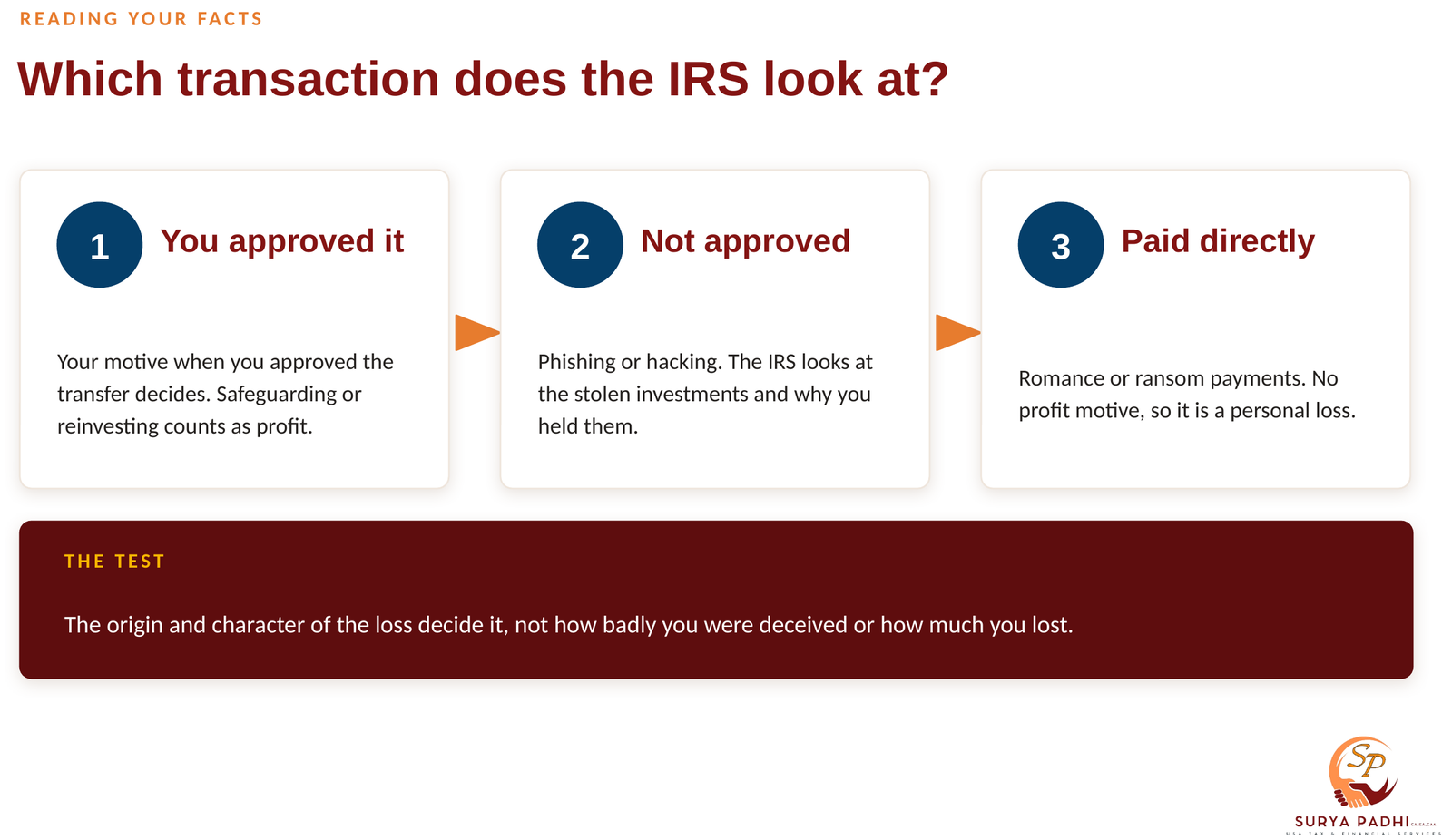
That is also why documentation matters. Your messages, statements and wire details show what you approved and why. A claim that rests on your motive is only as strong as the records behind it.
The year rules: 2018 through 2025 and after
The Tax Cuts and Jobs Act added section 165(h)(5), which disallows personal casualty losses from 2018 through 2025 except to the extent of personal casualty gains or a federally declared disaster. Personal theft losses fall under that limit. The 2025 tax act made the limit permanent and, beginning in 2026, added losses from state-declared disasters to the exceptions. A romance or kidnapping scam is not a disaster, so those losses stay disallowed.
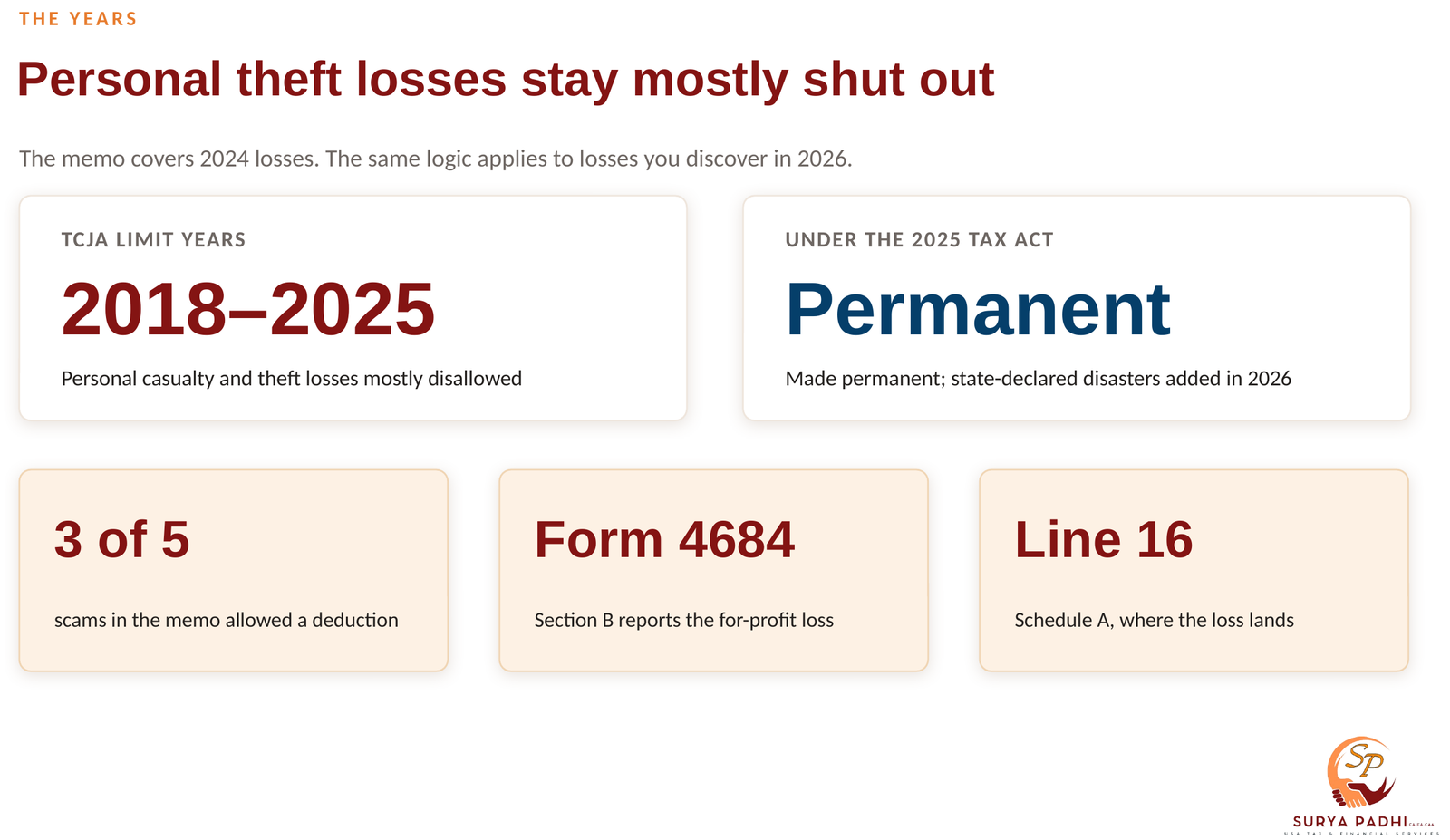
A for-profit theft loss is reported on Form 4684, Section B, Business and Income-Producing Property. For an individual, the Form 4684 instructions send the income-producing property loss to Schedule A, line 16. The memo also notes that theft losses under section 165(c)(2) are not miscellaneous itemized deductions, so the suspension of those deductions does not apply to them.
When to deduct it, and how much
A theft loss belongs to the year you discover it. But no portion is deductible if, at the end of that year, there is still a reasonable prospect of recovery. A bona fide claim against a third party with a substantial chance of success keeps the loss open. You do not have to prove there is no possibility of recovery. You judge it from the facts you have at year-end.
The amount is your basis in the stolen property, generally what you paid, and not its market value. That means you cannot deduct income or investment gains you never reported. When the stolen money came out of an IRA, your basis comes from the income you report on the distribution.
An IRA scam, in illustrative numbers
| IRA distribution taken during the scam | $100,000 |
| Added to taxable income | +$100,000 |
| Theft loss on Schedule A, line 16 (your basis) | -$100,000 |
| 10% additional tax on early distributions, generally | $10,000 |
| Effect on adjusted gross income | +$100,000 |
Illustrative only, not a client result. It assumes age 55, a traditional IRA with no basis, discovery in the same year, and that you itemize.
In that example the income tax can largely wash out. The additional tax does not, and neither does the higher adjusted gross income.
The IRA problem
Many scam victims are talked into moving retirement money. An IRA distribution is generally taxable income in the year it happens, and the memo treats the victims who authorized their distributions as liable for that tax. Where you authorized nothing, the memo’s conclusion is conditional, and courts have looked at whether the taxpayer authorized the withdrawal or received an economic benefit. That is a point to review carefully with your preparer.
Two costs sit outside the deduction. First, the 10% additional tax on early distributions can apply to a person under 59½ unless an exception fits, and the National Taxpayer Advocate has asked Congress to waive it for fraud victims. Second, the theft loss is an itemized deduction, so it does not reduce adjusted gross income. The higher AGI from the distribution can still affect items that key off it, such as Medicare premiums and how much Social Security is taxed.
The deduction only helps if you itemize
A for-profit theft loss goes on Schedule A. If your total itemized deductions, including the loss, are not larger than your standard deduction, you get no benefit from it.
Why the Ponzi safe harbor did not apply
Revenue Procedure 2009-20, as modified by Revenue Procedure 2011-58, offers an optional safe harbor for losses from a Ponzi-type investment arrangement. It requires a qualified investor with a qualified loss from a specified fraudulent arrangement. Among other things, the lead figure must have been charged by indictment or information, or be the subject of a criminal complaint with certain features.
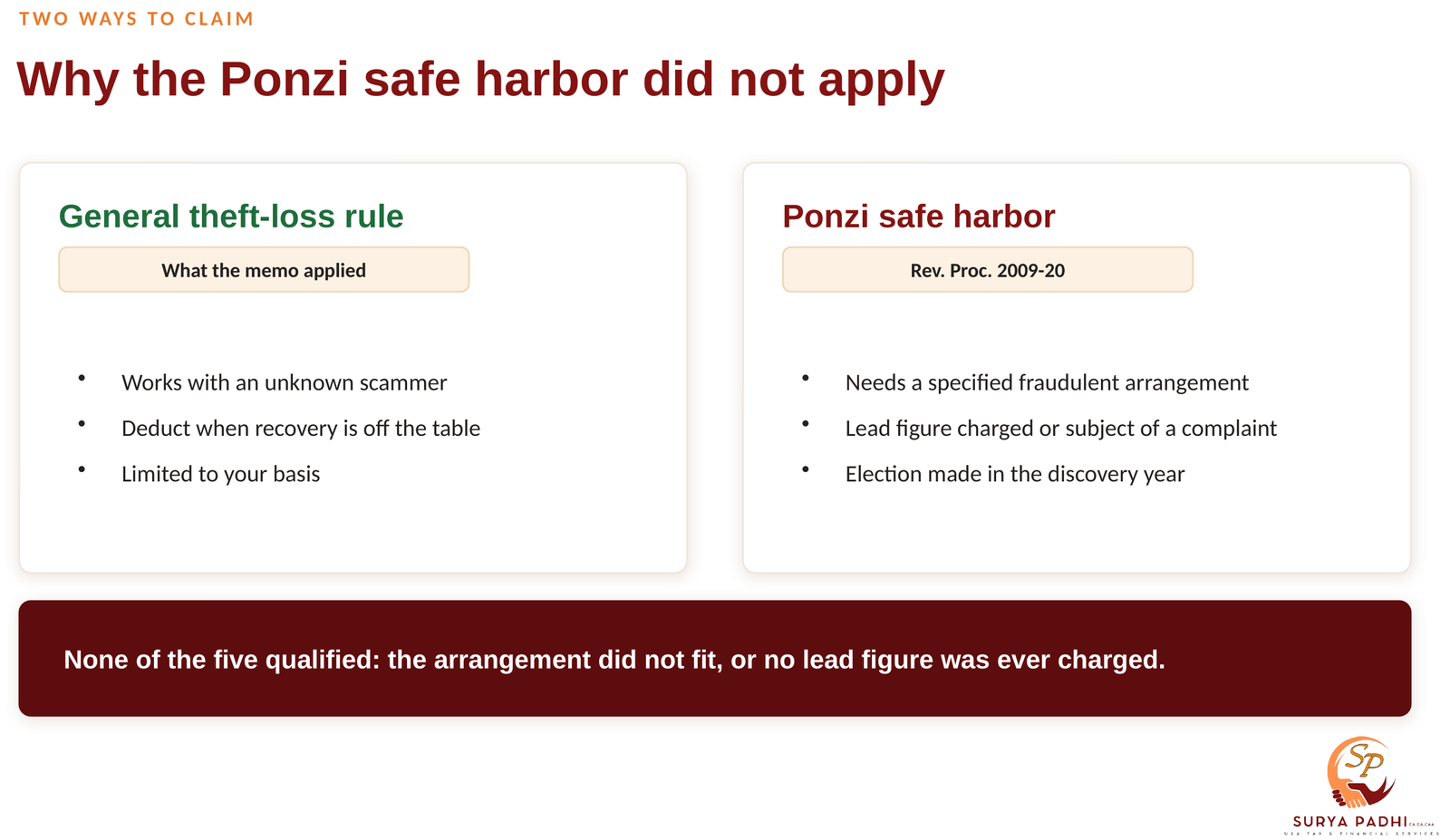
In the memo, four of the scams did not involve a specified fraudulent arrangement, and the pig butchering scammer was never identified or charged, so that loss was not a qualified loss. The victims who qualified had to rely on the general theft rule, which needs no charges against anyone.
What to do if you were scammed
- Report it to your financial institution and to law enforcement, and keep the report numbers.
- Save every statement, message, email, text and wire detail. They show what you approved and why.
- Note any recovery claims still open at year-end. A real claim can delay the deduction.
- Tell your preparer early. The loss goes on Form 4684, Section B, and IRA distributions need careful reporting.
- If you found a scam in an earlier year and did not claim a loss, ask whether an amended return is still available.
| Date | What to do |
|---|---|
| Right away | Report the scam and gather every record |
| December 31, 2026 | Recovery prospects are judged on the facts at year-end |
| April 15, 2027 | 2026 return due. Give your preparer time before it |
| October 15, 2027 | Extended 2026 return due. An extension gives more time to file, not to pay |
Frequently asked questions
Can I deduct money lost to a romance scam?
Under the Chief Counsel memo, generally no. A romance scam loss is a personal casualty loss, and the limit on personal casualty losses disallows it apart from narrow exceptions.
Are pig butchering and crypto investment scam losses deductible?
In the memo, a pig butchering investment scam produced a deductible theft loss because the money was sent to invest. Whether your facts match depends on your motive, your basis and whether any prospect of recovery remains.
Which tax year do I deduct a scam loss?
You deduct it in the year you discover the theft, provided there is no reasonable prospect of recovery at the end of that year.
Is the IRS Chief Counsel memo binding on the IRS?
No. Chief Counsel Advice cannot be cited as precedent, so it shows how the IRS reads the law but does not guarantee the result on your return.
Scammed? Let’s review your facts
The right answer depends on what you approved, why, and what you can document. Sure Financial and Tax Services can review your facts and prepare the return.
This article is general tax education and does not constitute individualized tax, legal or financial advice. Figures are stated for the tax year shown and are subject to IRS adjustment. Consult a qualified professional about your own facts.