
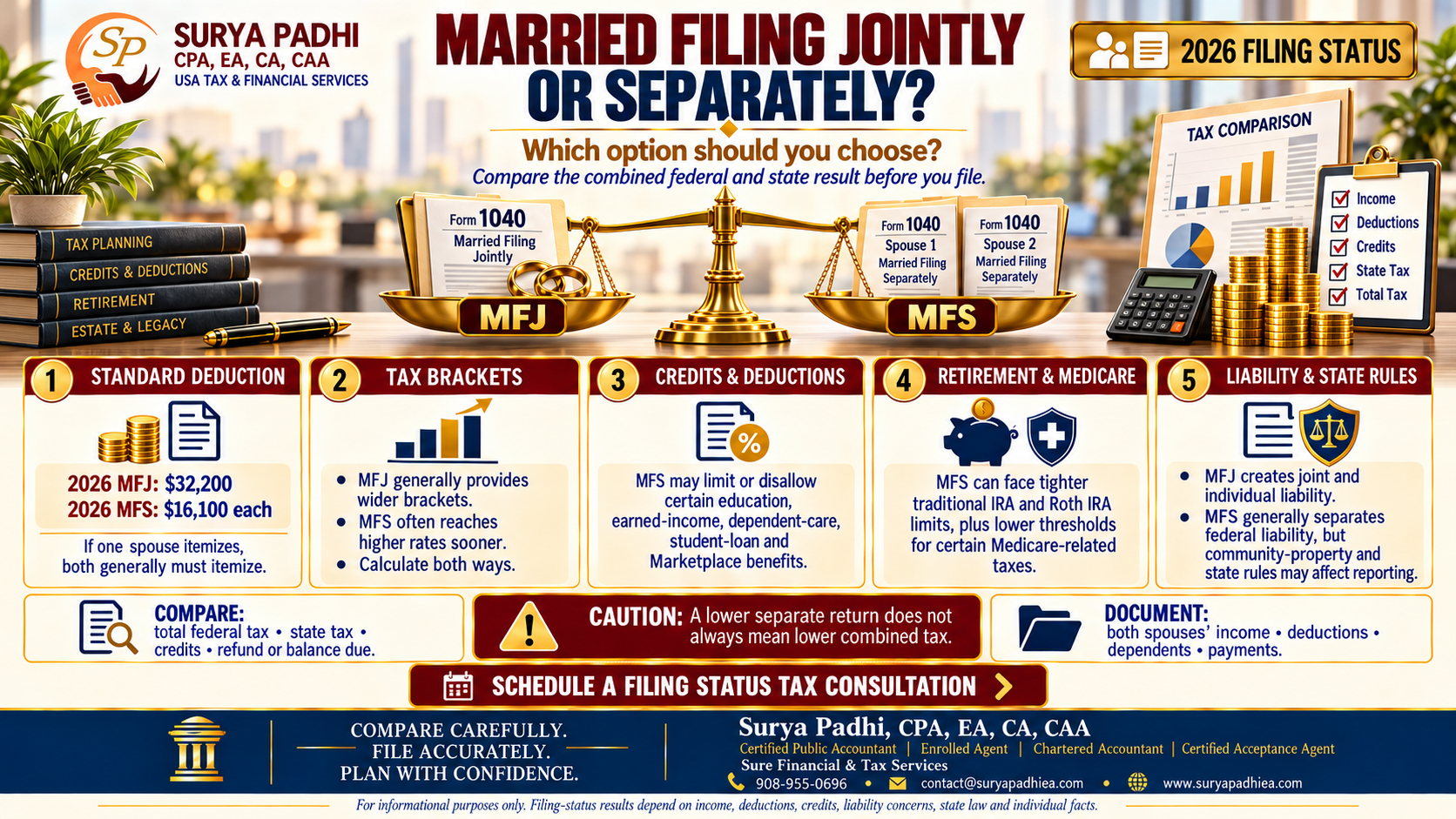
For most married couples, filing jointly costs less, because filing separately shuts off the education credits and the student loan interest deduction and shrinks Roth IRA room. Filing separately can win in narrow cases: large medical bills on a lower income, income-driven student loan payments, or a real concern about your spouse’s tax reporting.
7:09. The written version, the figures and the sources are all below.
| Standard deduction, filing jointly | $32,200 | Tax year 2026, from IRS Rev. Proc. 2025-32. |
|---|---|---|
| Standard deduction, filing separately | $16,100 | Per spouse, tax year 2026. Two of them add up to the joint amount. |
| Roth IRA phase-out, filing separately | $0 to $10,000 | Modified AGI, if you lived with your spouse at any time during the year. Set by statute, not indexed. |
| Capital loss deduction limit | $3,000 / $1,500 | $3,000 on a joint return, $1,500 on each separate return. |
| Education credit, per student | $2,500 | American opportunity credit maximum. Not available when you file separately. |
| Medical expense floor | 7.5% of AGI | Measured against your own AGI when you file separately. |
Filing together usually costs less, and filing apart has real uses. Here is how to tell which one you are before you file for 2026.
If you are married on December 31, you have to file your 2026 federal return one of two ways: jointly, on a single return that combines both incomes, or separately, on two returns that each report only one spouse’s numbers. Single is not an option for that year. Most couples choose out of habit, and that habit can cost real money.
This guide covers what each choice changes for tax year 2026, the credits and deductions that disappear when you file separately, the handful of situations where filing apart can actually win, and how to compare the two before you commit. It is general education, and your own facts can change the answer.
Key takeaways
- Filing jointly costs less for most married couples, because filing separately shuts off several credits and deductions.
- The 2026 standard deduction is $32,200 jointly and $16,100 per spouse separately, so the deduction itself is a wash.
- If one spouse itemizes on a separate return, the other must itemize too and can lose the standard deduction.
- You can turn separate returns into a joint one for three years, but a joint return cannot become separate after the due date.
What each filing status actually means
Married filing jointly means one return. Your incomes, deductions and credits are combined, you both sign it, and you are both responsible for everything on it. The IRS holds each spouse responsible, jointly and individually, for the tax, interest and penalties due on a joint return, even when only one of you earned the income.
Married filing separately means two returns. Each spouse reports only their own income, deductions and credits, and each is responsible only for their own return. It sounds like the cautious choice, and for a few couples it is. For most, it is the more expensive one.
One rule sets the frame: whether you are married is decided on the last day of the tax year. If you are married on December 31, 2026, you are treated as married for all of 2026. A narrow exception exists for spouses who lived apart and support a child, which can allow head of household status, but ask before you assume it applies to you.
The 2026 numbers that decide it
Start with the standard deduction. The IRS set it at $32,200 for married couples filing jointly for 2026, and at $16,100 for a married person filing separately. Two separate deductions add up to the joint amount, so the deduction itself does not favor either choice. The difference shows up in everything that gets switched off, capped or limited when you file apart.
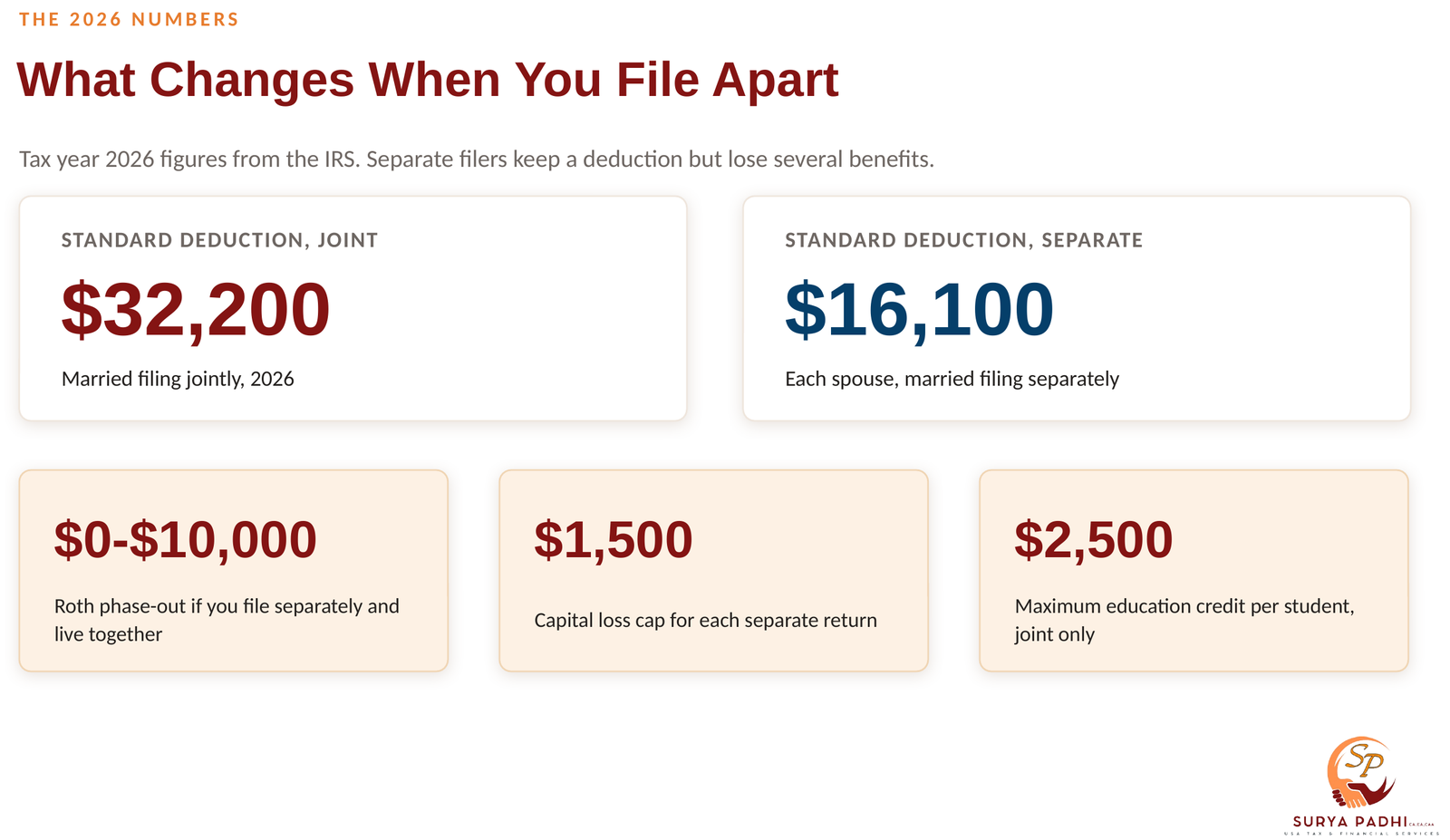
The tax brackets are built the same way: each separate bracket is exactly half as wide as its joint counterpart. For a couple with similar incomes, the rate tables produce about the same tax either way. Where the incomes are lopsided, the higher earner can be pushed into a higher bracket sooner. In both cases, the bigger cost of filing separately usually comes from what is taken away, not from the rates.
What filing separately switches off
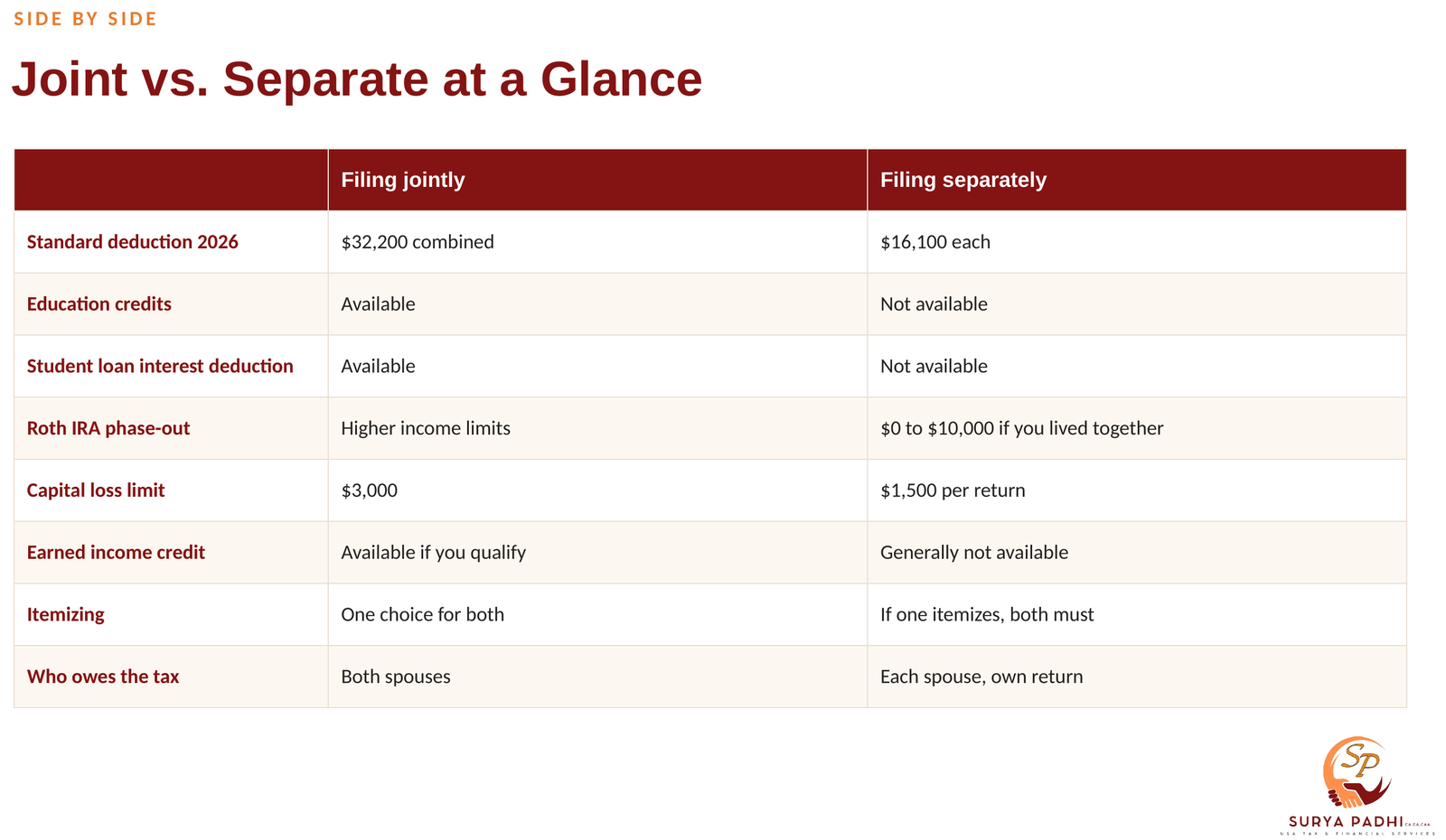
Several tax benefits are unavailable or sharply limited to anyone who files separately. IRS Publication 501 describes the main ones:
- Education credits. Neither the American opportunity credit, worth up to $2,500 per student, nor the lifetime learning credit can be claimed.
- The student loan interest deduction, capped at $2,500 on a joint return, is not available.
- The earned income credit is generally not available, and the credit for child and dependent care is unavailable in most cases.
- The premium tax credit for marketplace health insurance is generally not available, with narrow exceptions.
- Roth IRA contributions phase out between $0 and $10,000 of income if you lived with your spouse at any time during the year, which effectively closes direct Roth contributions for most working people.
- The capital loss deduction is capped at $1,500 per return instead of $3,000 on a joint return.
The itemizing trap
If one spouse itemizes deductions on a separate return, the other spouse must itemize as well. A spouse with few itemized deductions then ends up with far less than the $16,100 standard deduction. Check this before you decide, not after.
When filing separately can win
Filing separately is not a mistake in every case. Three situations come up most often.
Large medical bills on a lower income
Medical expenses are deductible only above 7.5% of your adjusted gross income. On a joint return that threshold is measured against both incomes. On separate returns, each spouse uses their own AGI, so a spouse with big medical bills and a modest income can sometimes clear the bar alone. You then have to weigh that against the itemizing rule above.
Income-driven student loan payments
Some income-driven repayment plans look at only your own income when you file separately, and at your combined income when you file jointly. That can mean a meaningfully lower monthly payment. The rules for these plans have changed repeatedly in recent years, so confirm with your servicer how a separate return is treated, then weigh the payment savings against the credits and deductions you give up.
Keeping your tax liability separate
If you have doubts about your spouse’s reporting, or your spouse owes back taxes, a separate return keeps you from being responsible for their return. Relief exists for people who signed a joint return without knowing about an error, but it is not automatic, so getting advice before you file is the better route.
If you live in a community property state, the math changes again. Separate returns there generally split community income between spouses, so each return may not reflect what each of you actually earned. Ask before you assume.
A worked example
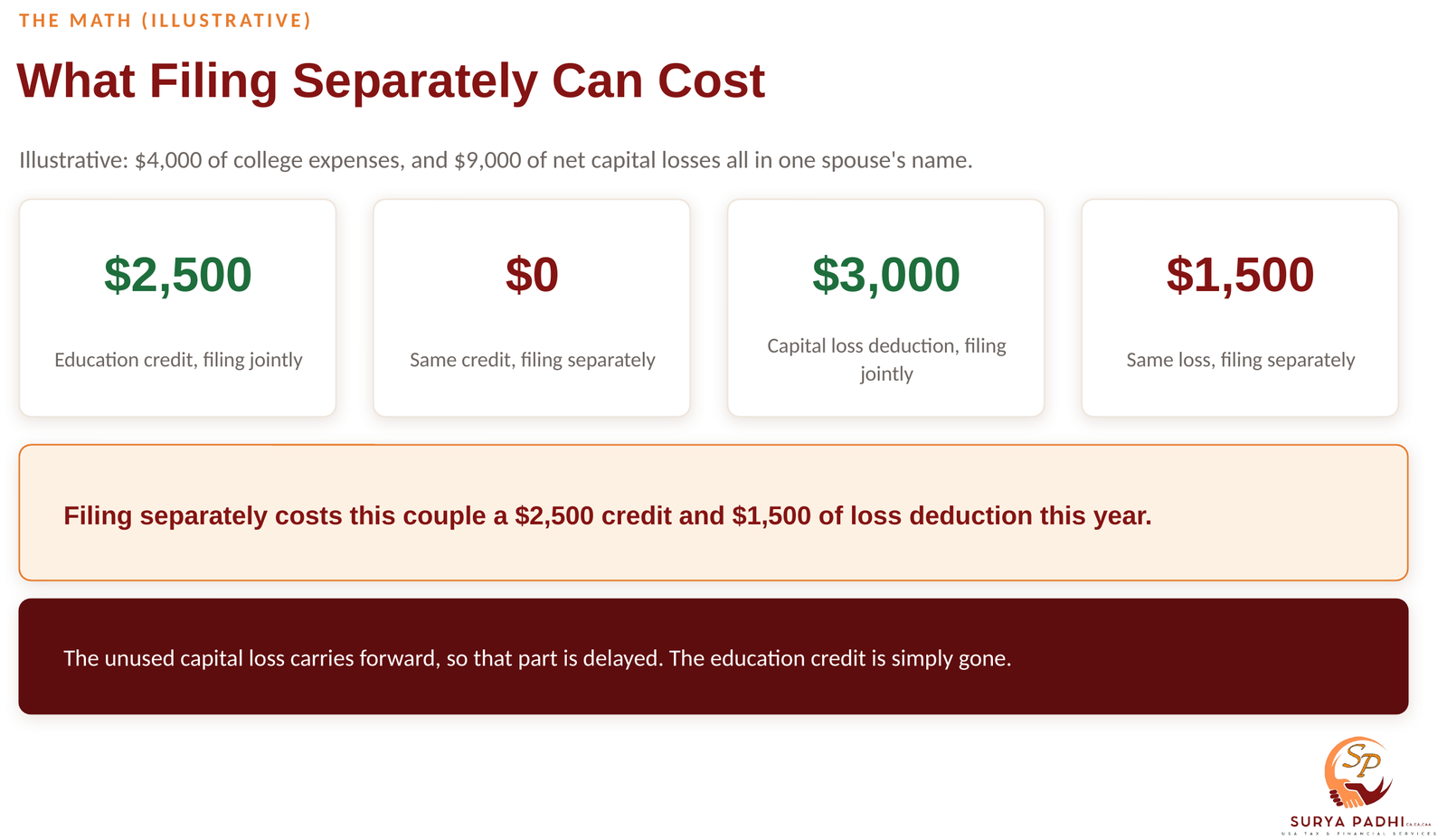
Here is an illustration, not a forecast. Suppose a couple has a child in the first year of college with $4,000 of qualifying expenses, and $9,000 of net capital losses, all in one spouse’s name. Their income is under the limits that phase out the education credit.
Same couple, two filing statuses (illustrative)
| Education credit, filing jointly | $2,500 |
| Education credit, filing separately | $0 |
| Capital loss deduction, filing jointly | $3,000 |
| Capital loss deduction, filing separately | $1,500 |
| Education credit lost by filing separately | $2,500 |
The unused capital loss carries forward to later years, so that part is delayed rather than lost. The education credit is gone.
Your own numbers will differ, and the tax value of a deduction depends on your bracket. The point is that the difference can be concrete and large, and it is easy to miss if you only compare the tax on one return.
How to decide, step by step
- Prepare the return both ways. Tax software and any preparer can show the total for each, so compare total tax rather than one refund against another.
- Add the costs that live outside the return, such as a higher student loan payment, lost Roth contribution room and credits the return does not show.
- Weigh the risk. Joint filing makes you responsible for everything on the return, so consider how well you know your spouse’s finances.
- Check your state. States can have their own filing status rules, and community property law can change how income is reported.
- Pick the status with the best total result, and keep a copy of the comparison with your records.
Dates and mistakes to avoid
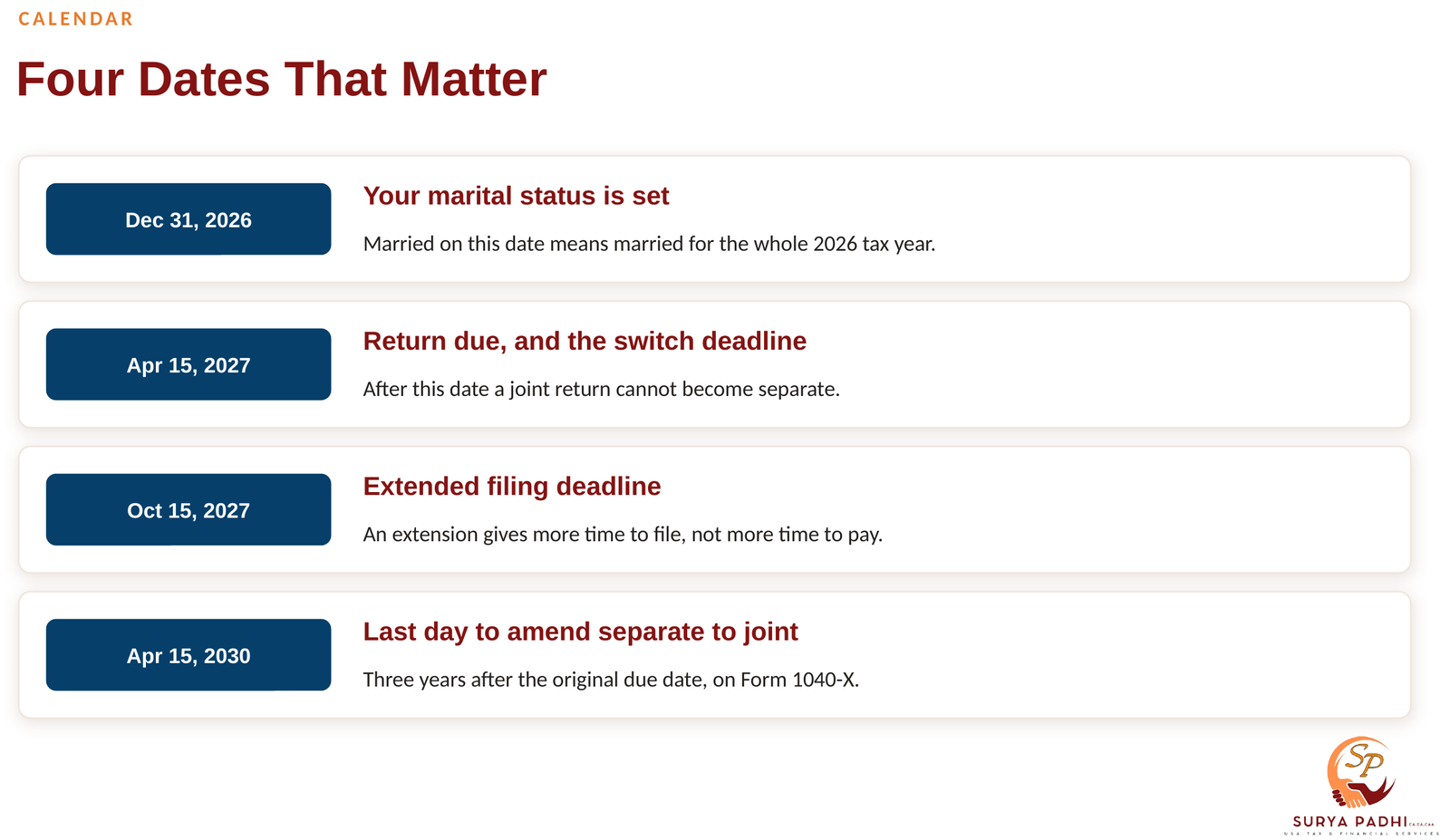
Four dates matter. December 31, 2026 fixes your marital status for the whole tax year. April 15, 2027 is when the 2026 return is due, and it is also the last day to change a joint return into two separate returns; after that date the switch is not allowed. October 15, 2027 is the extended filing deadline, but an extension gives more time to file, not more time to pay. If you file separately, you can amend into a joint return within three years of the original due date by filing Form 1040-X, so the choice is more forgiving in that direction.
- Filing separately by default, without ever running the joint numbers.
- Forgetting that one spouse’s itemizing forces the other to itemize.
- Assuming you can switch from joint to separate after the due date.
- Ignoring your state’s rules and community property law.
Frequently asked questions
Can I change from married filing separately to jointly later?
Yes. If you and your spouse filed separate returns, you can generally change to a joint return by filing Form 1040-X within three years of the original due date, not counting extensions.
Can I change from filing jointly to filing separately after I file?
No. Once the due date for the return has passed, a joint return cannot be changed into separate returns.
Is filing separately ever cheaper for married couples?
Sometimes. It can help when one spouse has large medical bills and a lower income, or when income-driven student loan payments drop, but most couples pay more when they file separately.
What if I am married but living apart from my spouse?
You are still treated as married for the year, so you must file jointly or separately. A narrow head of household exception exists for some spouses who lived apart and support a child, so ask a professional before relying on it.
Not sure which filing status fits?
We prepare both versions of your return and show you the difference in dollars, so you choose with the numbers in front of you.
This article is general tax education and does not constitute individualized tax, legal or financial advice. Figures are stated for the tax year shown and are subject to IRS adjustment. Consult a qualified professional about your own facts.