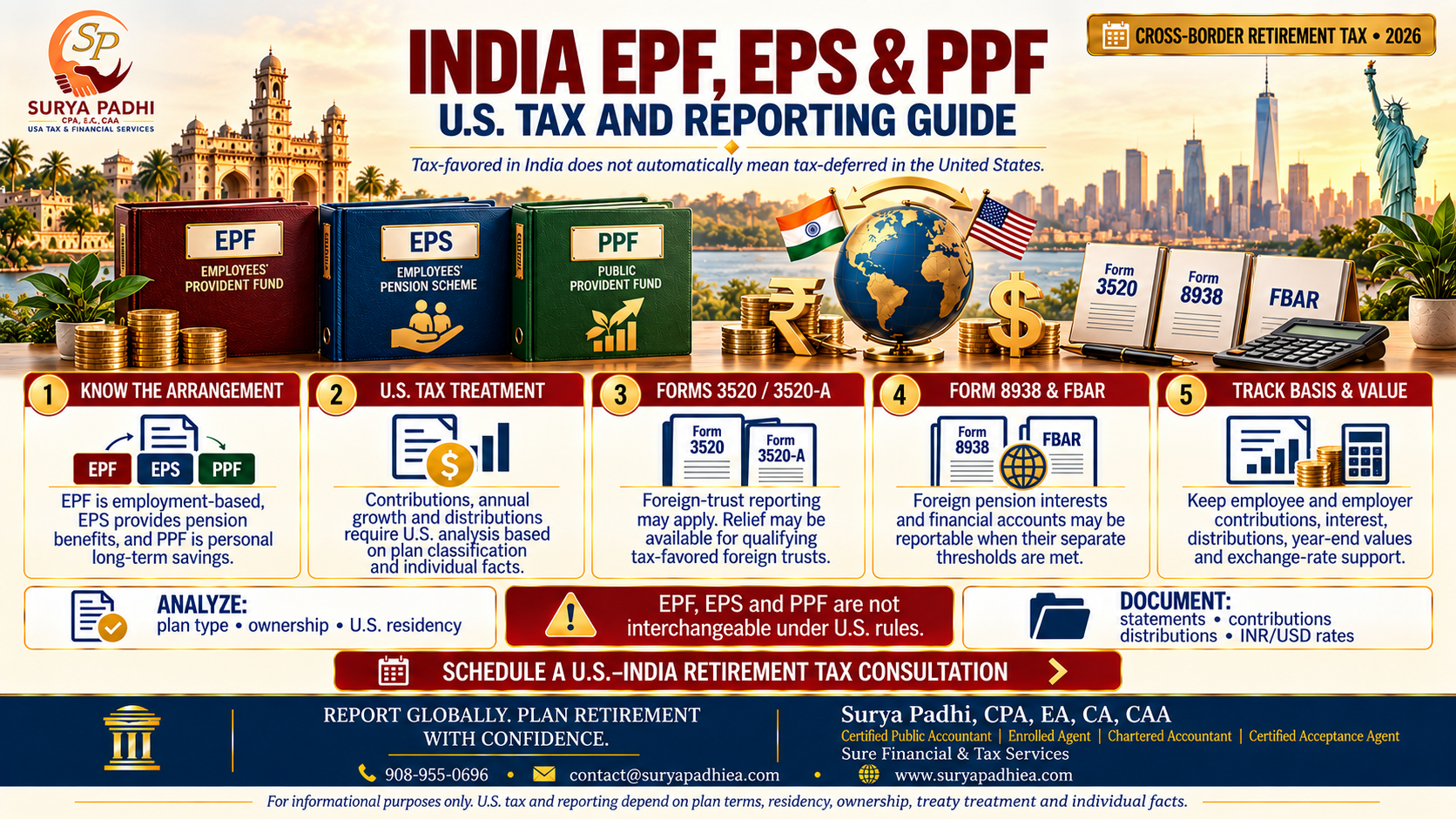
Tax-free in India does not mean tax-free on a US return. A US resident is taxed on PPF interest as it is credited. The EPF and the EPS are contested, with no IRS ruling, so document your position. The FBAR and Form 8938 are reported separately from any tax owed.
8:03. The written version, the figures and the sources are all below.
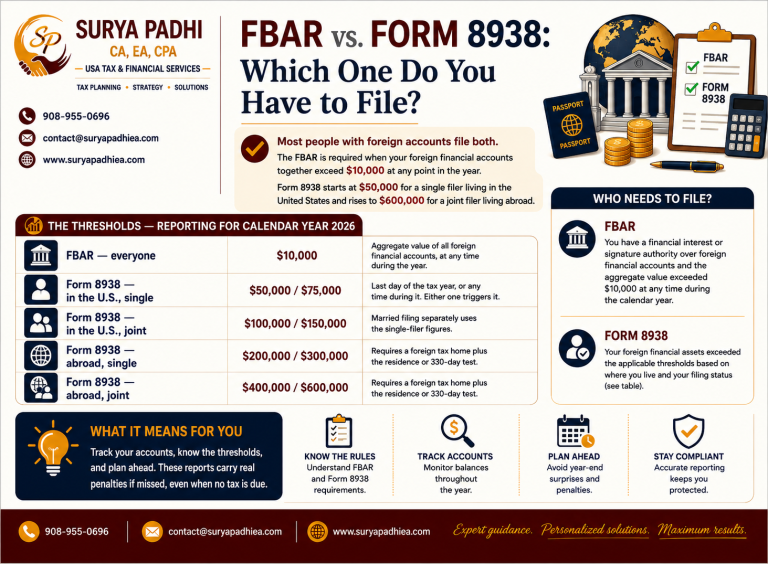
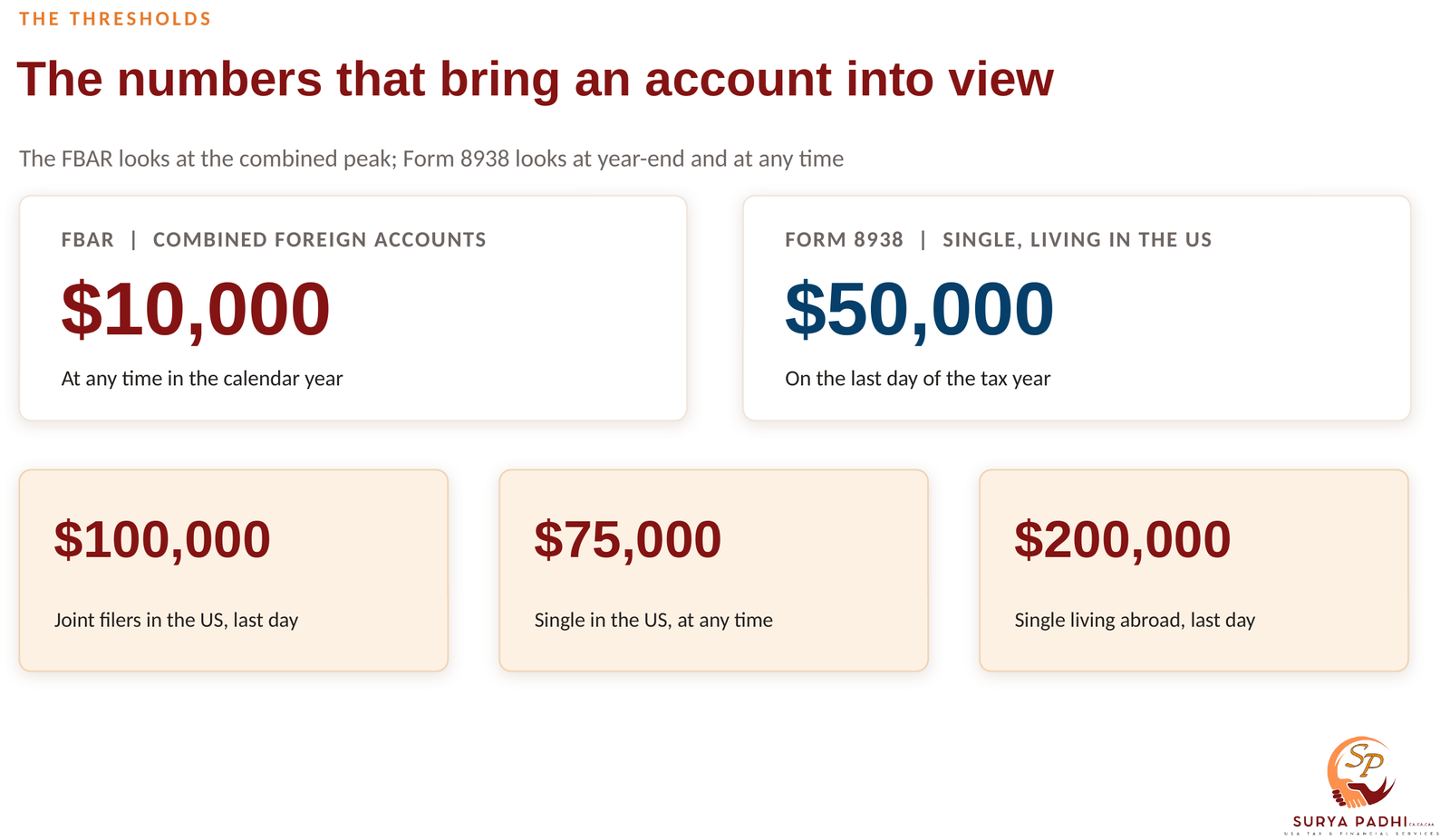
| FBAR trigger | $10,000 | Combined foreign accounts at any time in the calendar year. |
|---|---|---|
| Form 8938, single, living in the US | $50,000 | Value on the last day of the tax year; $75,000 at any time in the year. |
| Form 8938, joint, living in the US | $100,000 | Last day of the year; $150,000 at any time in the year. |
| Form 8938, single, living abroad | $200,000 | Last day of the year; $300,000 at any time in the year. |
| FBAR for 2025, extended due date | October 15, 2026 | Automatic extension from April 15. No request needed. |
Tax-free in India does not mean tax-free on a US return. Here is what each account asks of you, and where the rules are still unsettled.
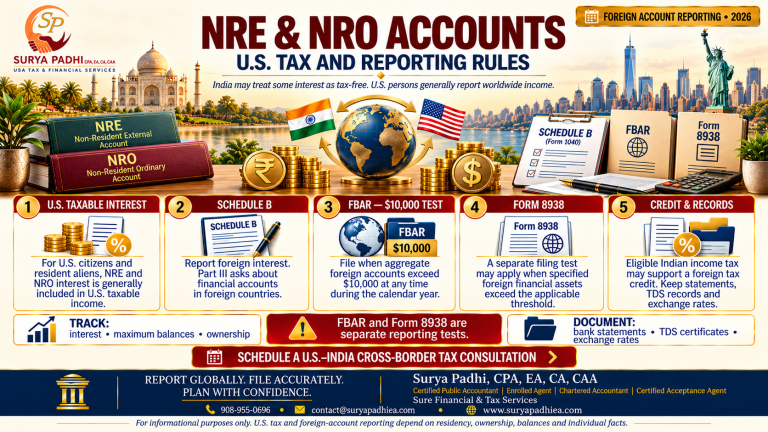
If you moved to the United States and left money in an Indian Employees’ Provident Fund (EPF), an Employees’ Pension Scheme (EPS) account or a Public Provident Fund (PPF), your US return has questions for you. India treats all three kindly. The United States does not borrow those exemptions, and it asks you to report these accounts on forms most people have never heard of.
This article sorts out what is taxed, what is reported, and where practitioners still disagree. It explains what your Indian documents mean for your US return and what to ask your Indian CA for. It does not cover the Indian filing itself, which stays with a practising Chartered Accountant in India.
Key takeaways
- A US tax resident is taxed on worldwide income, including growth inside Indian accounts.
- India’s tax exemption on these accounts does not carry over to your US return.
- Taxing an account and reporting it are separate questions with separate forms.
- PPF is the cleaner case. EPF and EPS are contested, so document your position and apply it every year.
EPF, EPS and PPF are three different things
The first mistake is lumping them together. The EPF is a balance built from your salary, with a contribution from you and one from your employer. The EPS is funded from part of the employer’s share and promises a pension later, with no personal balance to show. The PPF is an account you open yourself at a bank or post office, and interest is credited each year.
Those differences drive the US answer. A balance that earns interest raises a different question from a pension that pays later.
Worldwide income applies to residents
If you are a US citizen, green card holder or resident alien, the US taxes your worldwide income. An old Indian balance counts from your first resident year. A nonresident alien follows different rules, so confirm your status first.
Taxing an account and reporting it are different questions
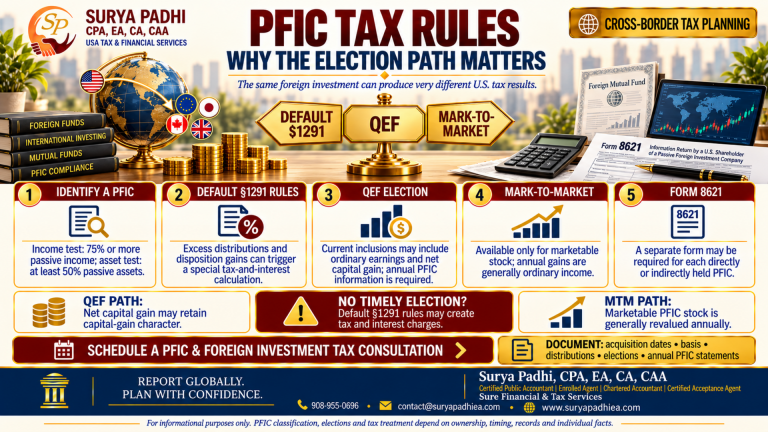
Three rules sit behind every answer. India’s exemption does not become a US exemption. Taxing an account and reporting it are separate, so an account can be reportable even when no tax is due. And how the IRS classifies each fund decides most of the rest.
Reporting comes in two forms. The FBAR is triggered when your combined foreign accounts top $10,000 at any time in the calendar year. Form 8938 starts higher: $50,000 on the last day of the year for a single filer living in the United States, or $100,000 for joint filers. Living abroad, the year-end thresholds are $200,000 for a single filer. They are separate tests, so you can owe one without the other.
PPF: the cleaner case
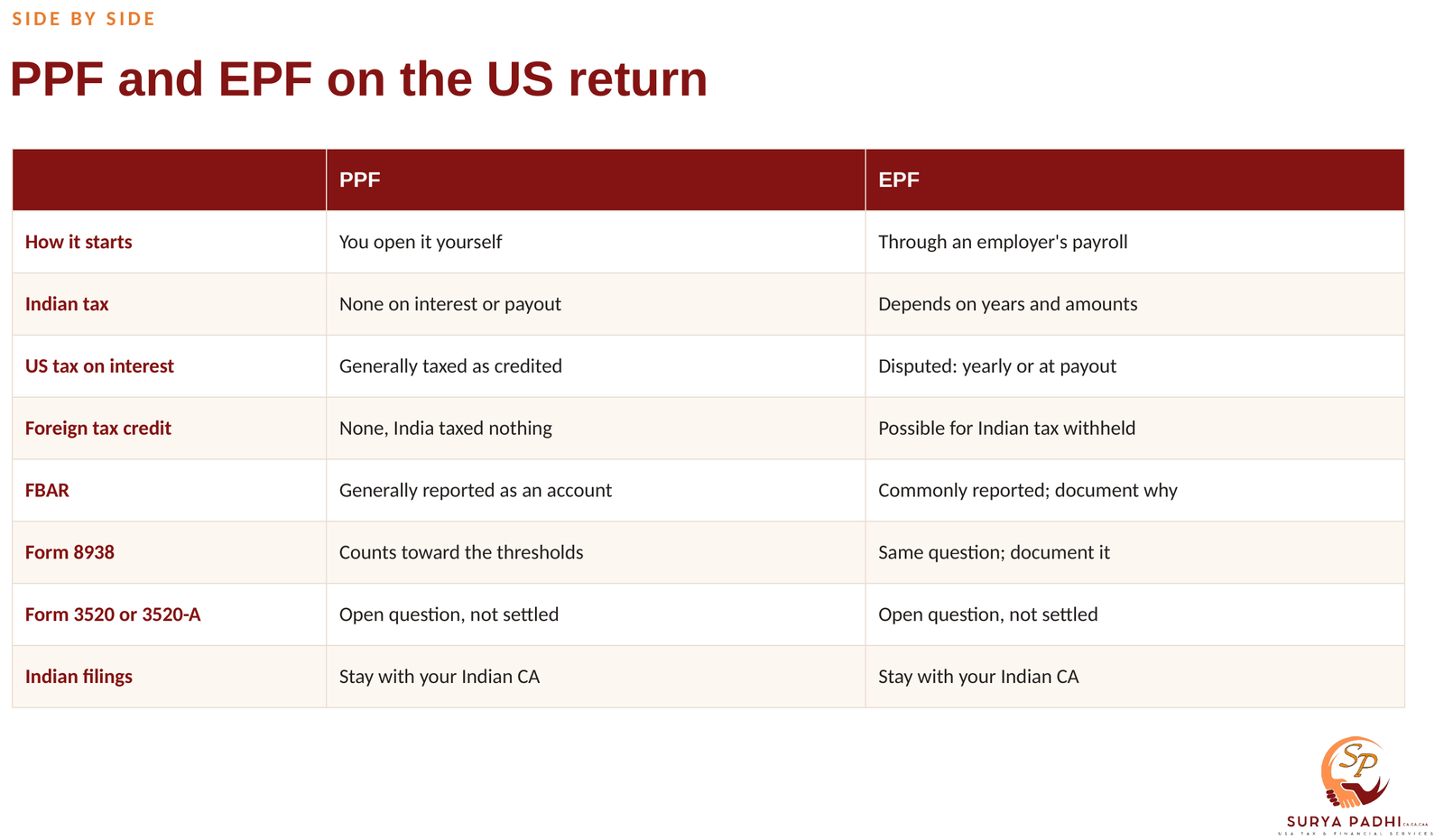
PPF interest is tax-free in India, but that does not carry over. For a US resident the interest is generally taxed as it is credited, whether or not you withdraw it. Because India taxed nothing, there is no Indian tax to claim as a foreign tax credit.
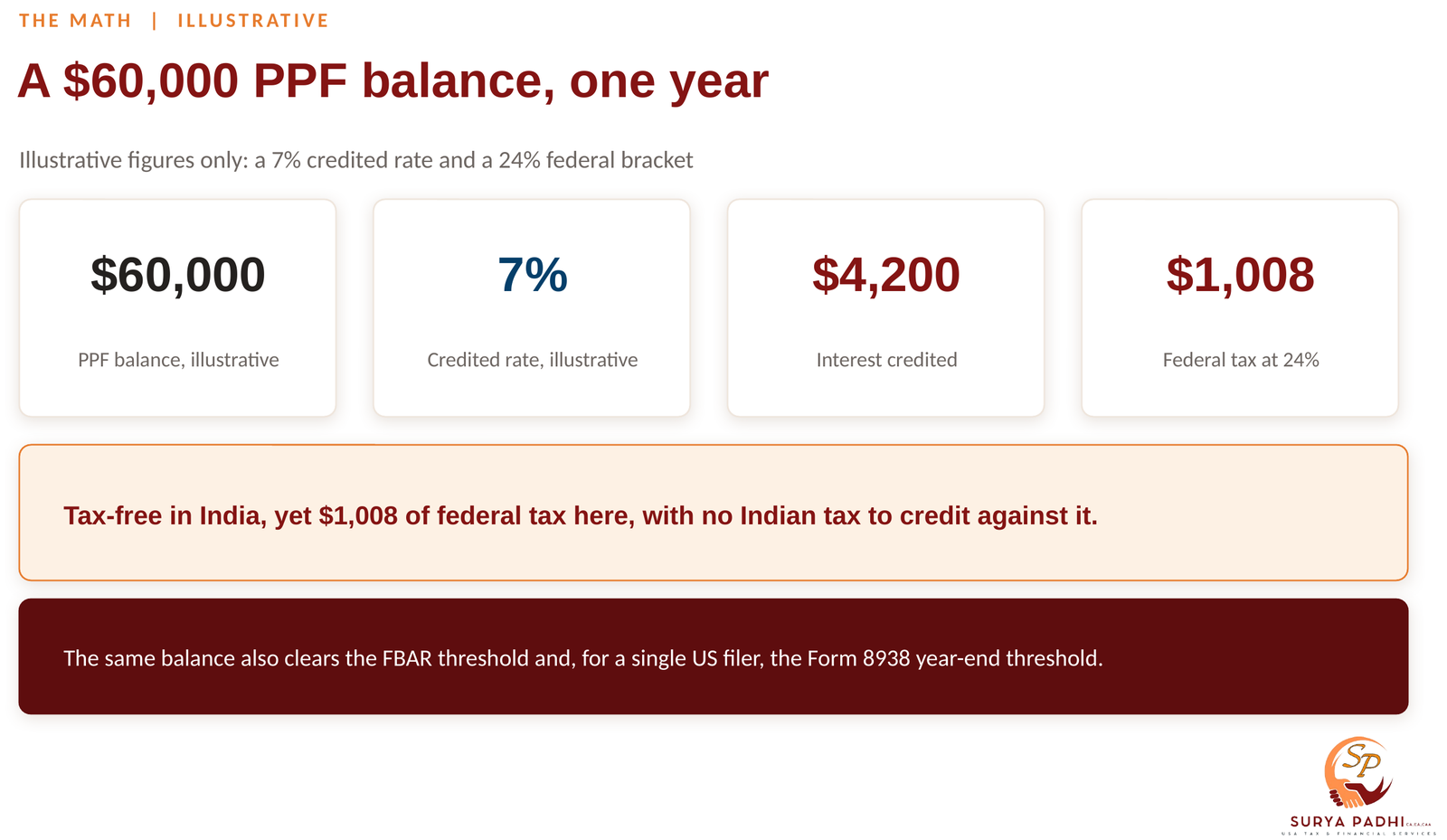
A $60,000 PPF balance, one year (illustrative)
| PPF balance | $60,000 |
| Credited rate (illustrative) | 7% |
| Interest credited | $4,200 |
| Federal tax at 24% (illustrative) | $1,008 |
Tax-free in India, yet $1,008 of federal tax here, and the same balance also clears the FBAR and, for a single US filer, the Form 8938 year-end threshold. All figures are illustrative.
EPF: two ways to tax it, and no ruling
The EPF is where practitioners genuinely disagree. One approach treats it like a foreign deposit and reports the interest every year, whether or not you withdraw. The other treats it like a foreign pension, taxing the payout after subtracting your basis. Some commentators add a treaty argument, but that needs a careful reading of the actual treaty text and should never be assumed. No specific IRS guidance settles it.
The question of employer contributions follows the same split. If the fund is treated like a deposit, the employer’s share raises the same question as your own.
Pick a position and document it
Whichever way you go, write down why, and apply it the same way every year. Treating the EPF one way this year and another way next year invites questions you cannot answer.
EPS: a pension, not a balance
The EPS is the one people forget they have. Of the employer’s 12% contribution, 8.33% goes to the EPS pension and 3.67% to the EPF balance, calculated on basic pay plus dearness allowance. Members generally draw the pension from age 58.
Because the EPS promises a pension rather than a balance, the yearly interest debate largely does not arise. The live questions are how the payments are taxed here, how the treaty reads, and whether Indian tax withheld can be credited. Practitioners are not aligned on the treaty point, and no regulation or case settles it.
Whether an EPS entitlement counts as a reportable foreign account is also unclear, since there is no personal balance to value. That is a position to take deliberately with your preparer, not by default.
Forms 3520 and 3520-A: the open question
Forms 3520 and 3520-A turn on whether a foreign fund counts as a foreign trust. Revenue Procedure 2020-17 relieves certain tax-favored foreign retirement trusts of those two forms, but it never relieves anyone of the FBAR or Form 8938. Whether the EPF or the PPF fits within it depends on conditions that need to be checked against the fund’s terms, so treat it as an open question and do not assume either answer.
Deadline: October 15, 2026
The FBAR for calendar year 2025 and an extended 2025 Form 1040 are both due October 15, 2026. Form 8938, and Form 3520 if it applies, travel with the return.
What to gather before you file
Good records make every one of these positions easier to defend. Ask your Indian CA or the fund for the following.
- The highest balance and the year-end balance for each account, from your passbook or EPFO statement.
- The exchange rate the form instructions call for, to convert to dollars.
- Interest credited each year, even if nothing was withdrawn.
- Certificates for any tax withheld in India on a payout, pension or withdrawal.
If earlier years have gaps, do not guess. Get the statements first, then decide how to handle the missing years.
Frequently asked questions
Is PPF interest taxable in the US?
For a US tax resident, PPF interest is generally taxable in the US as it is credited, even though it is exempt in India.
Do I have to report my EPF on the FBAR?
Many practitioners report an EPF balance on the FBAR once combined foreign accounts exceed $10,000, but the position is not settled by IRS guidance, so document the reasoning you use.
Is the Employees’ Pension Scheme taxable in the US?
EPS payments are taxable in India when received, and how the United States and the treaty treat them is unsettled, so the position should be discussed with your preparer.
Do I need Form 3520 for an Indian provident fund?
It depends on whether the fund is a foreign trust and whether Revenue Procedure 2020-17 applies, which is an open question that should be reviewed against the fund’s terms.
Questions about your Indian accounts?
We read your Indian documents for the US return and prepare the filing. Indian filings stay with a practising Chartered Accountant in India.
This article is general tax education and does not constitute individualized tax, legal or financial advice. Figures are stated for the tax year shown and are subject to IRS adjustment. Consult a qualified professional about your own facts. Surya Padhi holds the Indian Chartered Accountant qualification but is not licensed to practise in India and does not provide Indian tax filing or advisory services.