
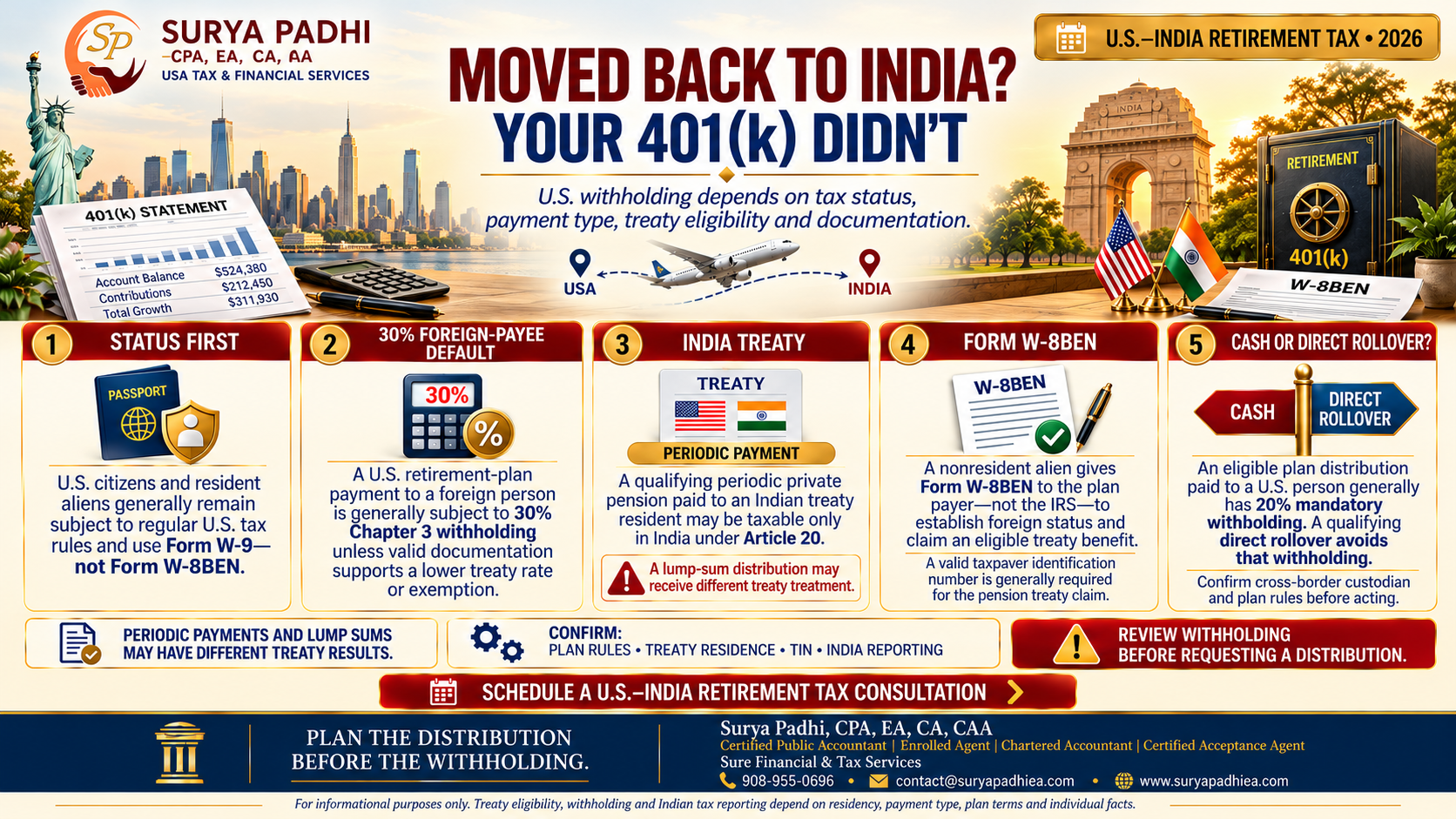
When you move back to India, your 401(k) and US brokerage account stay under US rules. Pension payments to nonresident aliens are generally withheld at a flat 30% unless a treaty exemption applies and is claimed on a W-8BEN. Citizens and green card holders follow different rules, so confirm your status and the payer’s written position before the first distribution.
6:51. The written version, the figures and the sources are all below.
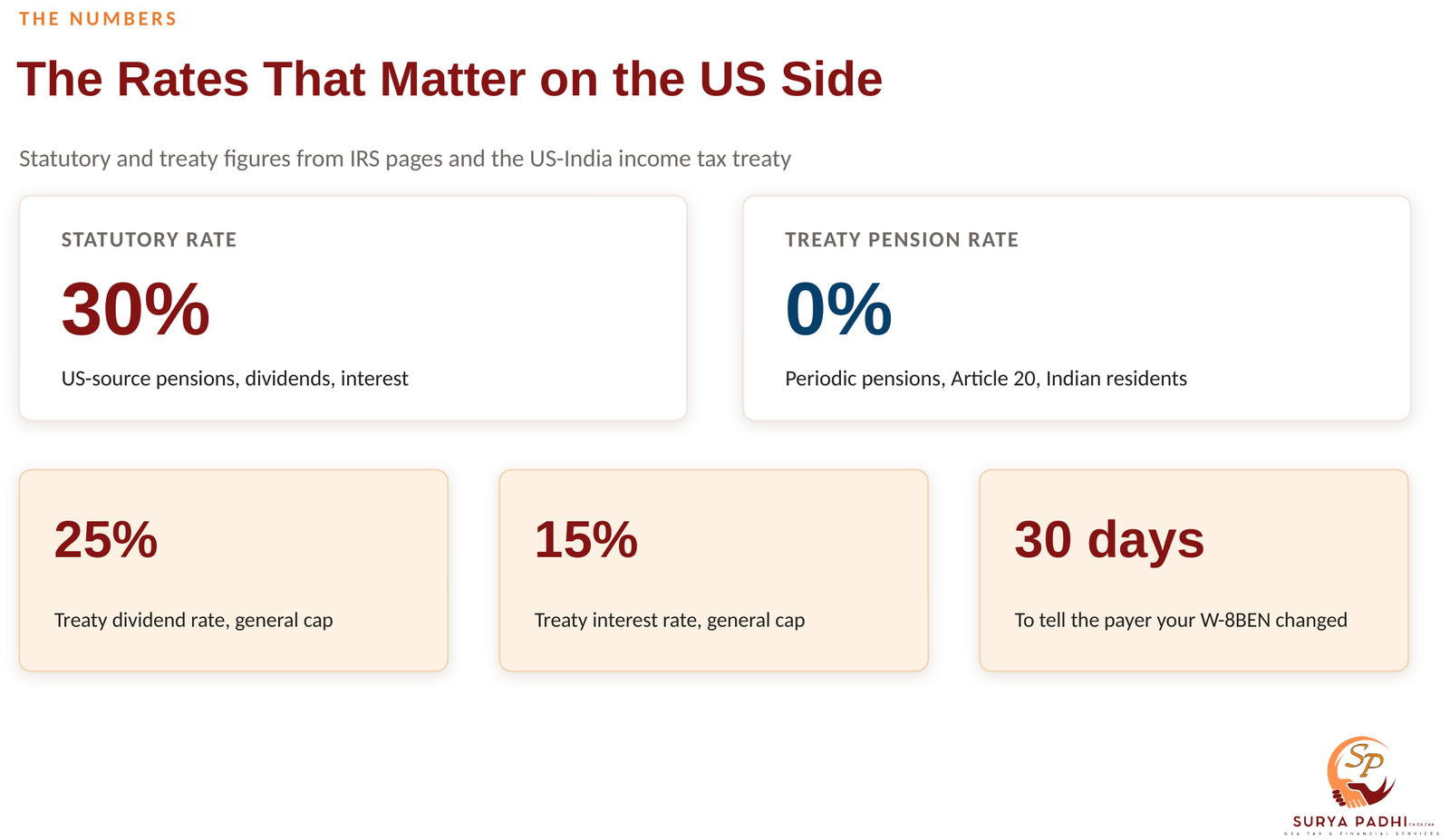
| Statutory Chapter 3 withholding | 30% | Flat rate on US-source pensions, dividends and interest paid to foreign persons. |
|---|---|---|
| Treaty rate on periodic pensions | 0% | US-India treaty Article 20 and IRS treaty Table 1, for Indian residents. |
| Treaty dividend cap (general) | 25% | Treaty Article 10(2). |
| Treaty interest cap (general) | 15% | Treaty Article 11(2). |
| Mandatory withholding on eligible rollover distributions | 20% | Applies unless the money moves as a direct rollover. |
| Early distribution additional tax | 10% | Generally before age 59½ (IRS Topic 558). |
| Time to report a W-8BEN change | 30 days | From the date the information becomes incorrect. |
Your US accounts still follow US rules. Here is who withholds, how much, which form changes the answer, and what to ask your Indian CA before the first distribution.
Moving back to India closes one chapter and leaves another one open. Your 401(k) and your US brokerage account did not move with you, and neither did the rules that govern them. If you are searching for how withholding works on a 401(k) when moving back to India from the USA, the short answer is that it depends on your US tax status, and the default for a foreign person is a flat 30%.
This article stays on the US side: who withholds, how much, and which form changes the answer. The India side, meaning how India taxes the same money and what you report there, belongs to your Indian Chartered Accountant. Most of the mistakes returnees make happen in the gap between the two.
Key takeaways
- Your status decides the rules: US citizen, green card holder, or nonresident alien.
- Chapter 3 withholding is a flat 30% on US-source pensions, dividends and interest paid to foreign persons, unless a treaty exemption applies.
- A Form W-8BEN claims a treaty rate, but it does not change your residency or settle how a lump sum is treated.
- Get the payer’s written position, and your Indian CA’s confirmation, before the first distribution.
Start with your status, not your address
The same account produces three different answers depending on who owns it. A US citizen is taxed on worldwide income, and the saving clause in the US-India treaty lets the United States tax its own citizens as if the treaty were not in force. A green card holder remains a US tax resident until the card is formally abandoned or taken away, which is a separate decision with its own rules. Someone who held only a visa and has left the country is usually a nonresident alien for these purposes.
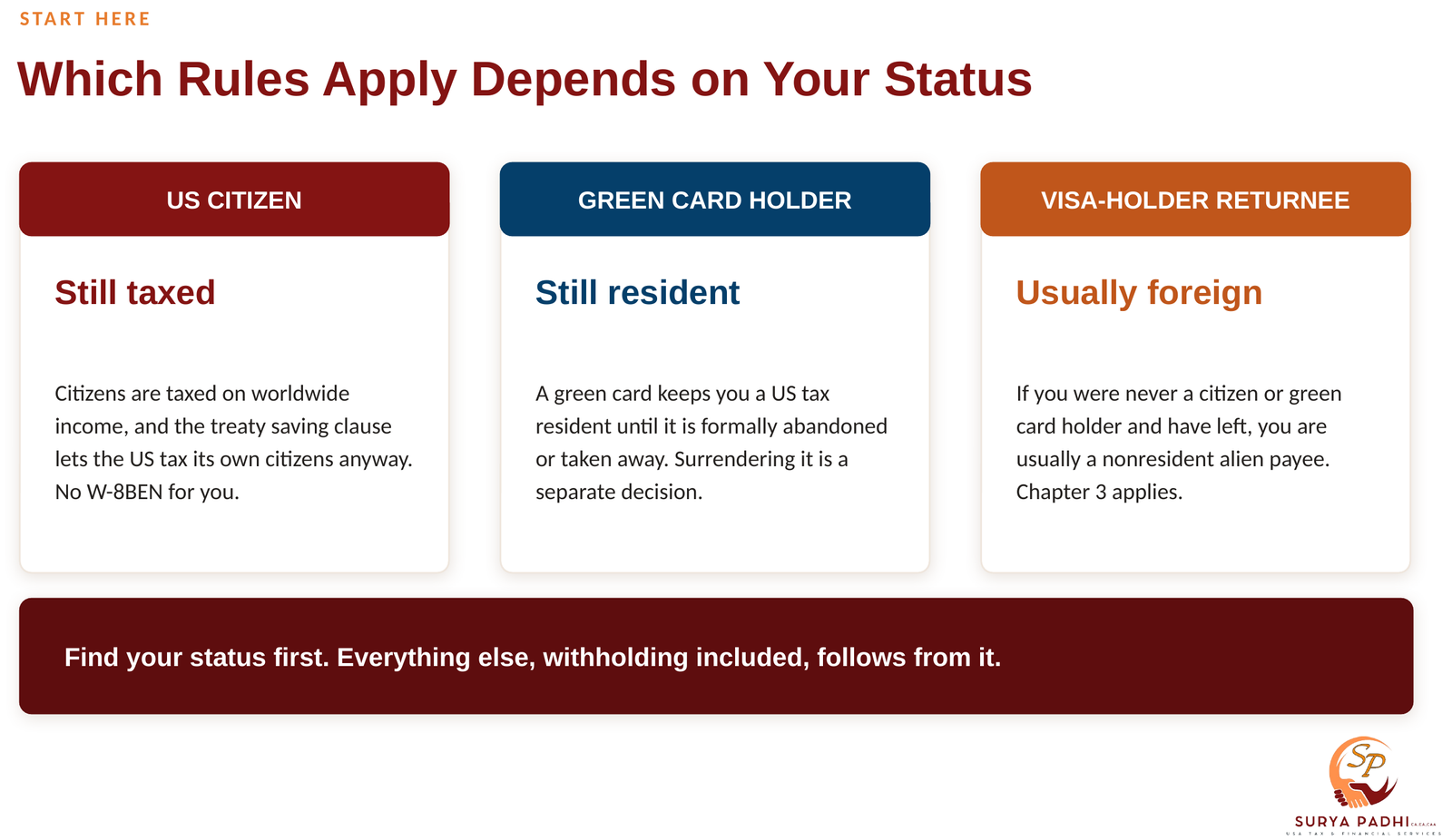
Why this matters in practice: a nonresident alien payee is subject to Chapter 3 withholding, while a citizen or resident alien is not, and a citizen or resident alien cannot elect out of withholding on payments delivered outside the United States. Moving to India changes your mailing address long before it changes your status.
401k when moving back to India from USA: how withholding works
Chapter 3 of the Internal Revenue Code is the withholding regime for foreign persons. The statutory rate is a flat 30% on US-source income such as pensions, dividends and interest. Pension and annuity distributions to nonresident aliens are generally subject to withholding under section 1441 unless a treaty exemption applies, and the payer, not you, deposits the tax and reports it on Form 1042-S.
A payer will not read your Indian return
The plan administrator withholds by US rules based on the status and address in its records. It does not check what India will do with the same money, and your Indian CA does not see the US forms. Your job is to make the two agree before money moves.
What a Form W-8BEN fixes, and what it does not
Form W-8BEN is how a foreign person certifies status and claims a treaty rate. It is valid through the last day of the third calendar year after you sign it, and you must tell the payer within 30 days if the information on it becomes incorrect.
- It fixes: foreign-status certification, and the treaty rate that fits the income.
- It does not change your US tax residency.
- It does not override the saving clause that lets the United States tax its own citizens.
- It does not settle how a lump sum is treated, and it does not replace your Indian CA’s confirmation.
A wrong or expired form sends the payer back to the 30% default. Recovering over-withheld tax then means filing a US return, which is slower and more expensive than getting the form right the first time.
Pension, lump sum or rollover: how each is treated
Article 20 of the US-India treaty says private pensions and annuities arising in one country may be taxed only in the country where the recipient lives. The treaty defines a pension as a periodic payment made in consideration of past services. For an Indian resident who is not a US citizen, periodic pension payments therefore sit at a 0% treaty rate in the IRS treaty table.
A one-time lump sum from a 401(k) is harder. The treaty text does not mention lump sums, and the IRS treaty table carries a footnote saying that in India the exemption does not apply to a lump-sum payment. How the payer will treat a lump sum on the US side is not something to assume. Ask for the payer’s treatment in writing before you request the money.
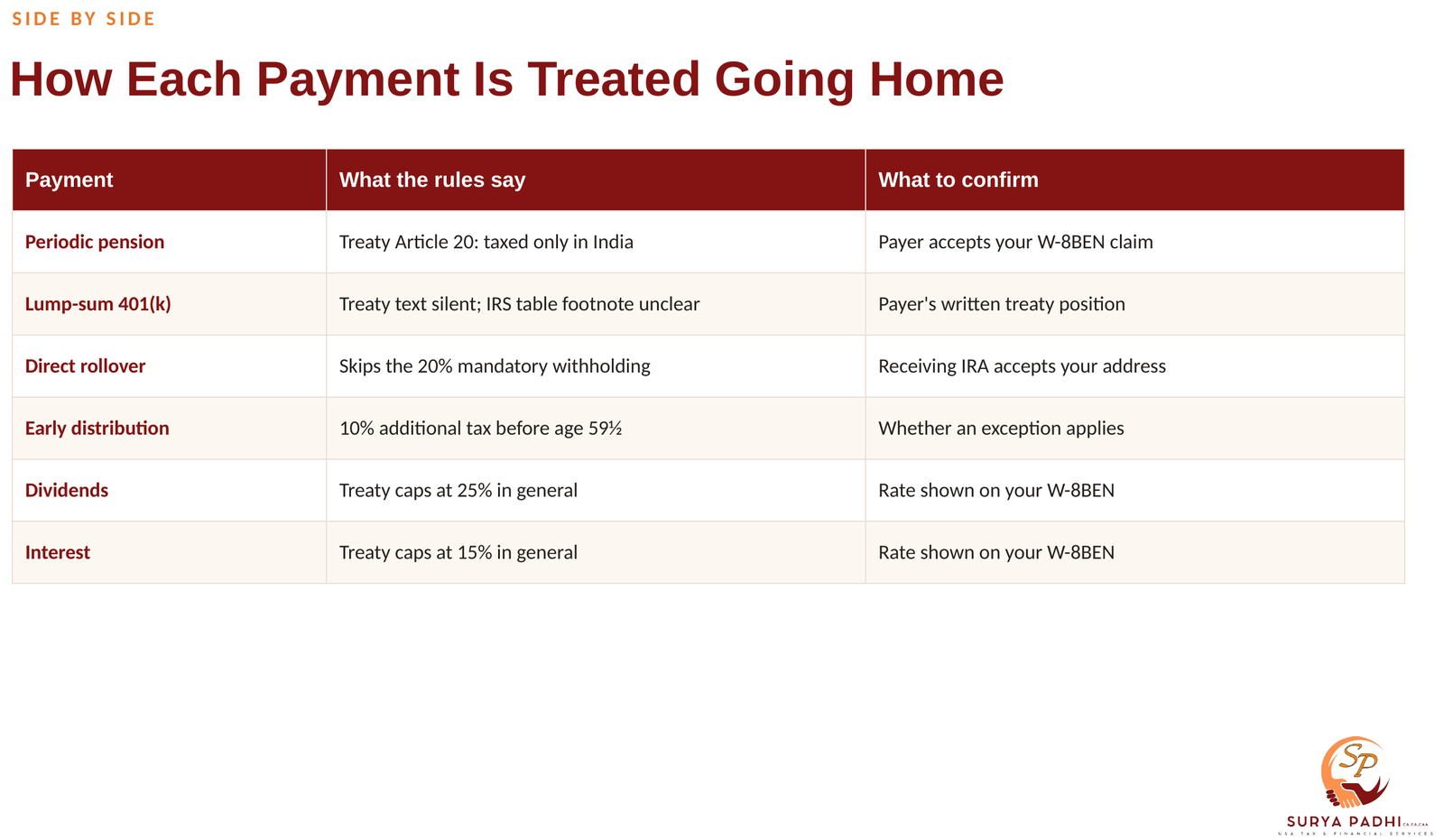
| Payment | What the rules say | What to confirm |
|---|---|---|
| Periodic pension | Treaty Article 20: taxed only in India | Payer accepts your W-8BEN claim |
| Lump-sum 401(k) | Treaty text silent; IRS table footnote unclear | Payer’s written treaty position |
| Direct rollover | Skips the 20% mandatory withholding | Receiving IRA accepts your address |
| Early distribution | 10% additional tax before age 59½ | Whether an exception applies |
| Dividends | Treaty caps at 25% in general | Rate shown on your W-8BEN |
| Interest | Treaty caps at 15% in general | Rate shown on your W-8BEN |
The brokerage account: what changes when your address does
A brokerage account is not a pension, so Article 20 does not carry over. Dividends and interest follow their own treaty caps: up to 25% on dividends in the general case, and up to 15% on interest, with lower rates for some categories. Those caps apply only if the account holds the right W-8BEN.
The practical issue is the address. When a mailing address moves to India, many firms ask for a fresh status form, and some restrict new purchases or close accounts for clients who live abroad. This varies by firm and changes over time, so there is no single rule to quote. Ask your broker in writing what it allows for an account holder living in India before you update the address, not after.
What the numbers look like
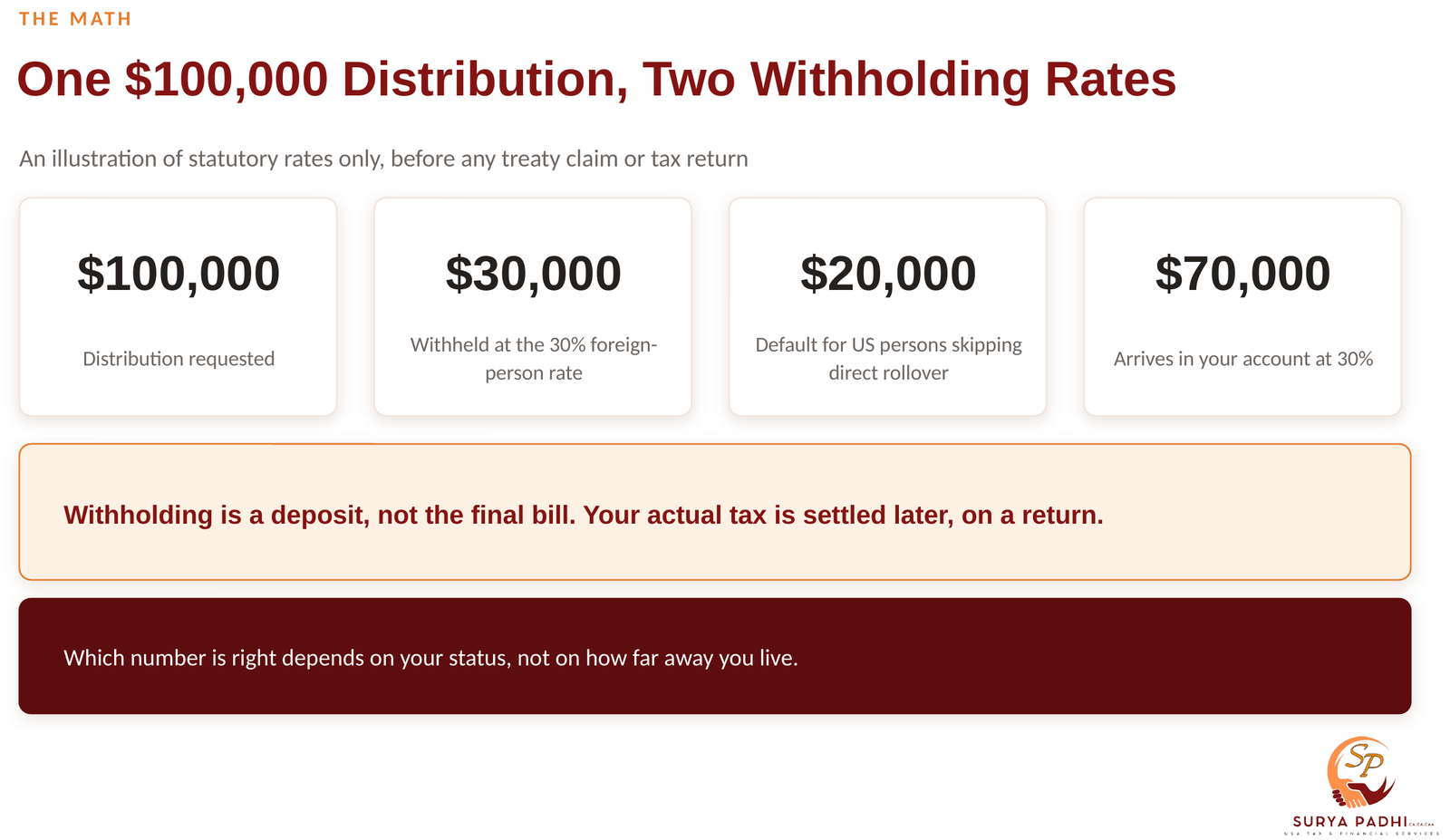
Here is an illustration using statutory rates only, before any treaty claim and before your actual return. It shows why the first question is always which rate applies to you.
One $100,000 distribution, two default rates
| Distribution requested | $100,000 |
| Withheld at the 30% foreign-person rate | −$30,000 |
| Arrives in your account | $70,000 |
| Default for a US person skipping a direct rollover (20%) | −$20,000 |
Withholding is a deposit, not the final bill. Your actual tax is settled on a return.
What to ask your Indian CA before the first distribution
Our lane is the US side. Before any money moves, take the answers you gather here to a practising Chartered Accountant in India and ask them to confirm the India side.
- How will India treat this payment, periodic or lump sum, and in which year does it arise?
- Does my residency position in India match the status I am giving the US payer?
- What Indian reporting or disclosure applies to a retirement or brokerage account held in the US?
- Is any US tax withheld creditable in India, and what paperwork supports it?
Do it in this order
Confirm your status, update each payer with the right address and form, request their written withholding and treaty position, then take everything to your Indian CA. Moving slowly costs nothing. Moving first can cost 30%.
Frequently asked questions
Is my 401(k) taxed when I move back to India?
Moving does not trigger tax on its own, but later distributions are taxed by both systems according to your US status and the treaty. A nonresident alien payee generally faces 30% withholding unless a treaty exemption applies and is claimed on a W-8BEN.
What is the withholding rate on a 401(k) distribution to a nonresident alien?
The statutory Chapter 3 rate is a flat 30% on US-source pension and annuity distributions to nonresident aliens, unless a treaty exemption applies. The US-India treaty exempts periodic pension payments, but its treatment of lump sums is unsettled, so ask the payer for its position in writing.
Can my US brokerage account stay open after I move to India?
Sometimes, but policies vary by firm and change over time. Some brokers ask for a new status form, restrict new purchases or close accounts when the address moves abroad. Ask your broker in writing what it allows before you update the address.
Moving back to India with US accounts?
Book a consultation before your first distribution and we will map the US side with you. Call 908-955-0696 or email contact@suryapadhiea.com.
This article is general tax education and does not constitute individualized tax, legal or financial advice. Figures are stated for the tax year shown and are subject to IRS adjustment. Consult a qualified professional about your own facts. Surya Padhi holds the Indian Chartered Accountant qualification but is not licensed to practise in India and does not provide Indian tax filing or advisory services.