
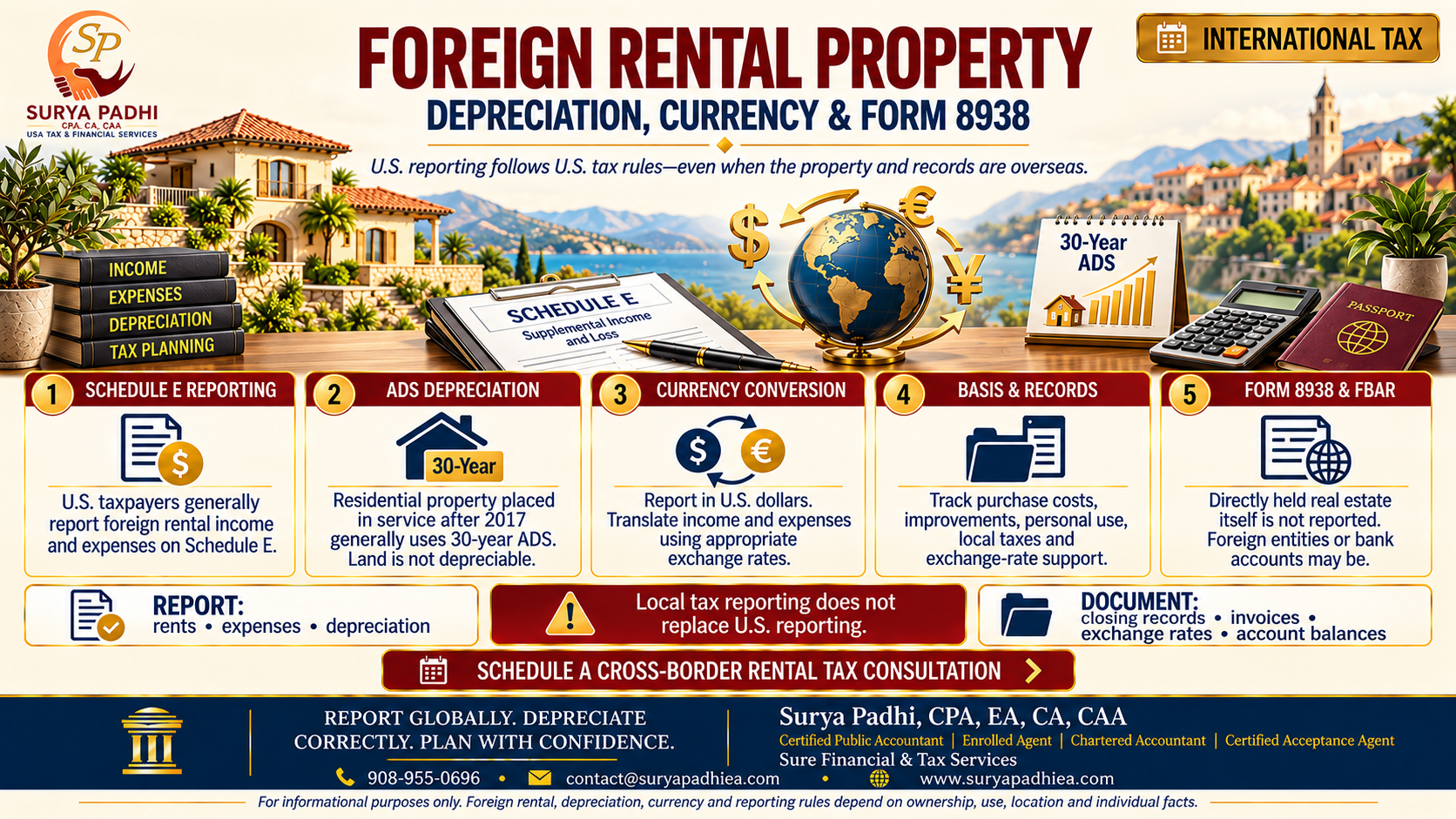
A rental abroad goes on Schedule E like any other rental, with three differences. The building is depreciated over 30 years under the alternative depreciation system, not 27.5. Every figure must be translated into dollars. And the property itself is not reported on Form 8938, though a foreign entity holding it is.
6:40. The written version, the figures and the sources are all below.
| ADS recovery period | 30 years | Residential rental property used predominantly outside the US, placed in service after 2017. |
|---|---|---|
| Pre-2018 property | 40 years | Foreign property already in service before January 1, 2018 stays on the old schedule. |
| Domestic comparison | 27.5 years | The GDS period. It does not apply to property used outside the US. |
| Functional currency | US dollar | For every taxpayer except certain qualified business units. |
| Form 8938 threshold | $50,000 / $75,000 | Single, living in the US. $100,000 / $150,000 filing jointly. |
| FBAR threshold | $10,000 | Aggregate across all foreign accounts, at any moment in the year. |
| IRS yearly average rate, 2027 | TK · 2027-yearly-average-rate | IRS posts a yearly average rate for each currency after the year closes. |
A rental abroad goes on Schedule E like any other rental. Three things change — the depreciation schedule, the currency, and who has to tell the Treasury about it.
A flat in Bengaluru, a house in Lisbon, an apartment in Warsaw that used to be a grandmother’s. Foreign rental property shows up in a US practice constantly, and the returns arrive with the same three errors so reliably that I now check for them before I read anything else. The rental itself is not exotic — it goes on Schedule E, income less expenses, exactly like a duplex in Somerville.
What changes is the depreciation schedule, the currency, and the reporting. Get those three right and the return is ordinary. Get the first one wrong and you have understated income every year the property has been rented, which is a problem that compounds quietly until the year you sell.
Key takeaways
- Residential rental property used predominantly outside the United States is depreciated over 30 years under ADS, not 27.5 years. Property in service before 2018 stays at 40.
- The US dollar is your functional currency. Translate income and expenses at the rate when received or paid; the building’s basis is fixed at the rate on the day you bought it.
- Foreign real property taxes are not deductible on Schedule A, but they remain fully deductible against rental income on Schedule E.
- Real estate held directly is not reported on Form 8938. An interest in a foreign entity that owns the real estate is.
It is still a Schedule E rental
US citizens and residents are taxed on worldwide income, so rent from a property abroad is reported the same way rent from a property in New Jersey is: Schedule E, gross rents at the top, ordinary and necessary expenses below, depreciation on Form 4562. Mortgage interest, insurance, management fees, repairs, utilities and travel to the property are all deductible on the same terms.
The passive activity loss rules apply unmodified too. A loss from the property is generally passive and suspended unless you qualify for the $25,000 active participation allowance or for real estate professional status. Nothing about the property’s location changes any of that.
What does not change
The 14-day personal use test, the repair versus improvement distinction, the requirement to allocate between rental and personal days, and the depreciation recapture that waits for you at sale all work exactly as they do at home.
So the question is only ever: what is different? Three things, and one of them is expensive.
The 30-year rule almost everyone misses
Section 168(g) requires the alternative depreciation system for any tangible property used predominantly outside the United States. That takes the property out of the 27.5-year general depreciation system entirely. Under ADS, residential rental property has a 30-year recovery period, straight line, and there is no bonus depreciation available on it.
| Rental in New Jersey | Rental in Portugal | |
|---|---|---|
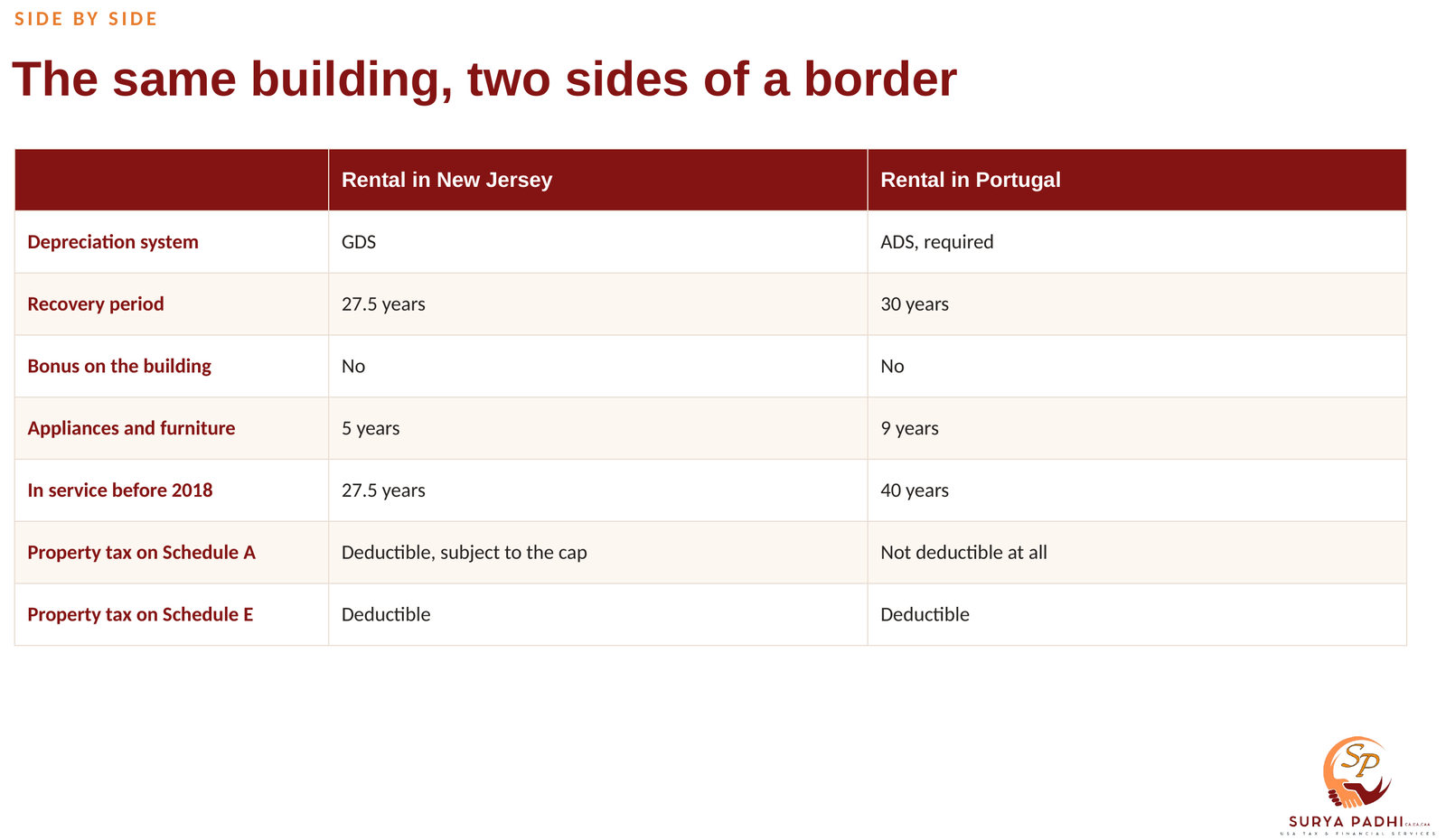
| System | GDS | ADS — required by §168(g) |
| Recovery period | 27.5 years | 30 years |
| Method | Straight line, mid-month | Straight line, mid-month |
| Bonus depreciation on the building | No | No |
| Appliances and furniture | 5 years | 9 years under ADS |
| Placed in service before 2018 | 27.5 years | 40 years |
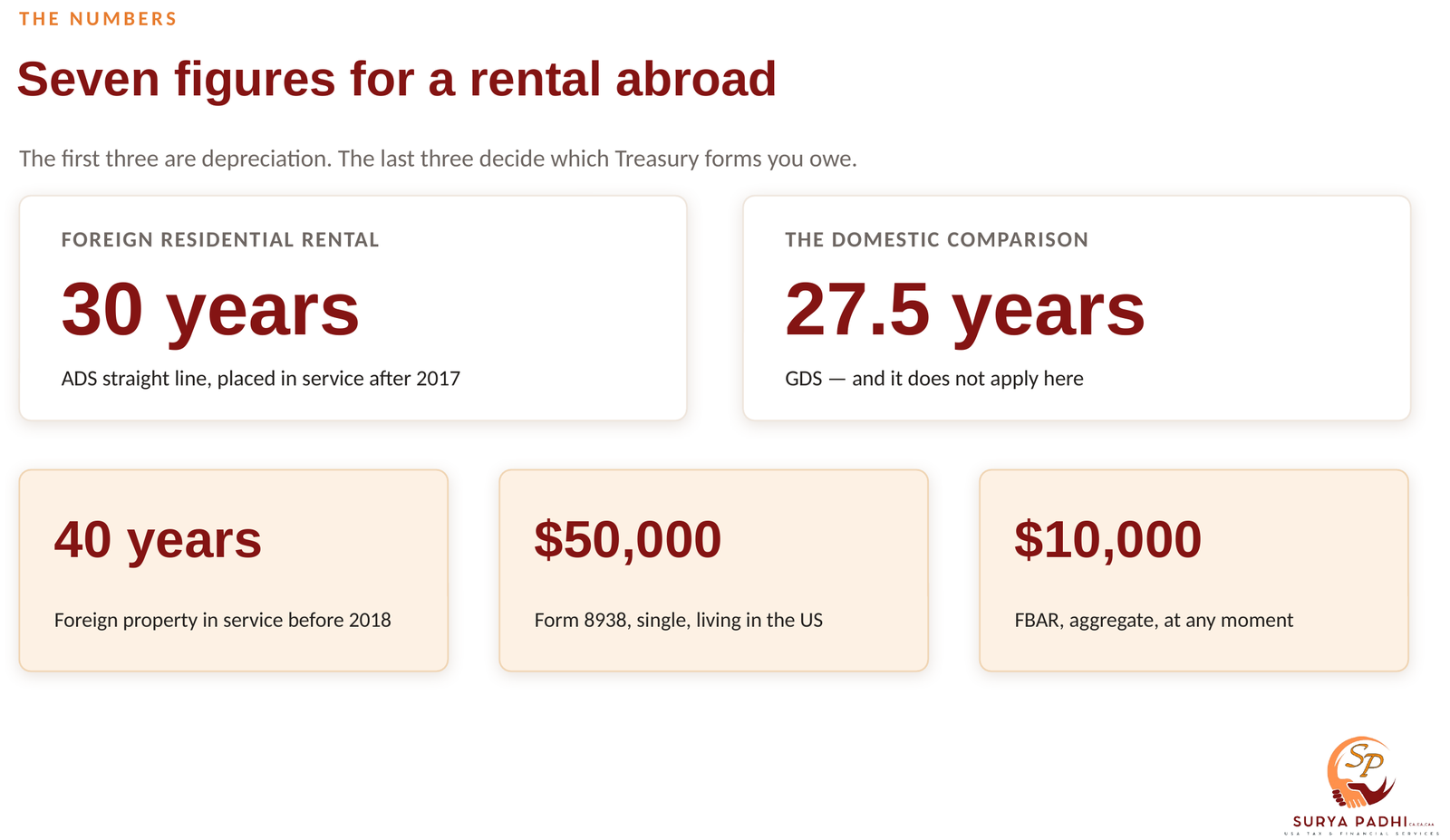
That 40-year figure in the last row matters if you inherited a return rather than starting one. IRS Publication 527 puts the ADS period for residential rental property at 30 years with a footnote: 40 years for property placed in service before January 1, 2018. The 30-year fallback for older property applies only to an electing real property trade or business whose property was not already caught by section 168(g)(1)(A) — and foreign-use property is exactly what 168(g)(1)(A) catches. So a foreign rental that went into service in 2015 stays on 40 years.
Why 27.5 is the expensive error
Depreciation is allowed <em>or allowable</em>. If a return has been claiming a 27.5-year schedule on foreign property, income has been understated every year — and at sale, basis is reduced by the depreciation that should have been claimed, not the amount actually taken. The error does not quietly disappear.
Foreign rental property and US taxes: the currency step
The IRS is blunt about this: you must express the amounts you report on your US tax return in US dollars, and the US dollar is the functional currency for all taxpayers except certain qualified business units. A personally owned rental abroad is not a QBU. So every euro, rupee or zloty has to be translated, and the general rule is to use the exchange rate prevailing when you receive, pay or accrue the item.
- Rent received monthly: translate at the spot rate on each date received, or use the IRS yearly average rate for that currency if receipts are spread evenly through the year.
- Expenses: translate at the rate on the date each one was paid. A single annual insurance premium is translated on its own payment date, not at the average.
- The building’s basis: fixed in dollars at the exchange rate on the day you acquired it, and never re-translated. Your depreciation deduction is the same dollar figure every year regardless of what the currency does.
- Foreign tax paid: translate at the rate on the date of payment if you are on the cash basis for foreign taxes.
Pick one defensible method, document the source, and use it consistently. The IRS says exchange rates are generally available from banks and US embassies and publishes a yearly average table of its own. What it will not accept is a rate chosen after the fact because it produced a better answer.
The mortgage nobody thinks about
If the property carries a mortgage denominated in the foreign currency, paying it down can generate a separate foreign currency gain or loss under section 988. That is beyond the scope of a rental return and is worth raising with your preparer before a refinance rather than after.
Property taxes: two different answers, and both are right
This is the one that sounds like a contradiction. Since 2018, an individual cannot deduct foreign real property taxes as an itemized deduction — section 164(b)(6)(A) removes them from Schedule A entirely, so the tax on a holiday home abroad is simply not deductible.
But the same paragraph ends with a sentence that saves the rental case. The disallowance does not apply to taxes paid or accrued in carrying on a trade or business or an activity described in section 212 — and holding property for the production of rental income is exactly a section 212 activity. Foreign property taxes on a rental therefore stay fully deductible against the rent on Schedule E.
The same €1,200 of municipal tax, two ways
| Property used personally — Schedule A | $0 deductible |
| Property rented all year — Schedule E | Fully deductible |
| Rented 8 months, personal 4 months | Allocate by days |
| Rental share of a €1,200 tax at 1.10 | $1,320 gross |
| Deductible portion (243 rental days ÷ 365) | $879 |
The personal share of $441 is not deductible anywhere. Allocation is by days, and the arithmetic here is $1,320 × 243 ÷ 365 = $878.63, rounded to $879.
The foreign tax credit, and the basket it lands in
Most countries tax rent at the source, so you will usually be paying tax twice and relieving it with a foreign tax credit on Form 1116. Rental income is passive category income unless the rents are derived in the active conduct of a trade or business, which a single let property normally is not. That means it goes in the passive basket, and credits in one basket cannot be used against income in another.
The credit is also capped. It cannot exceed your US tax multiplied by the ratio of foreign source taxable income to total taxable income — which in practice means it cannot exceed the US tax on that rental income. And here is the part that surprises people: the 30-year depreciation deduction reduces the US taxable income from the property, which reduces the ceiling, which strands credits.
A Lisbon flat, tax year 2027
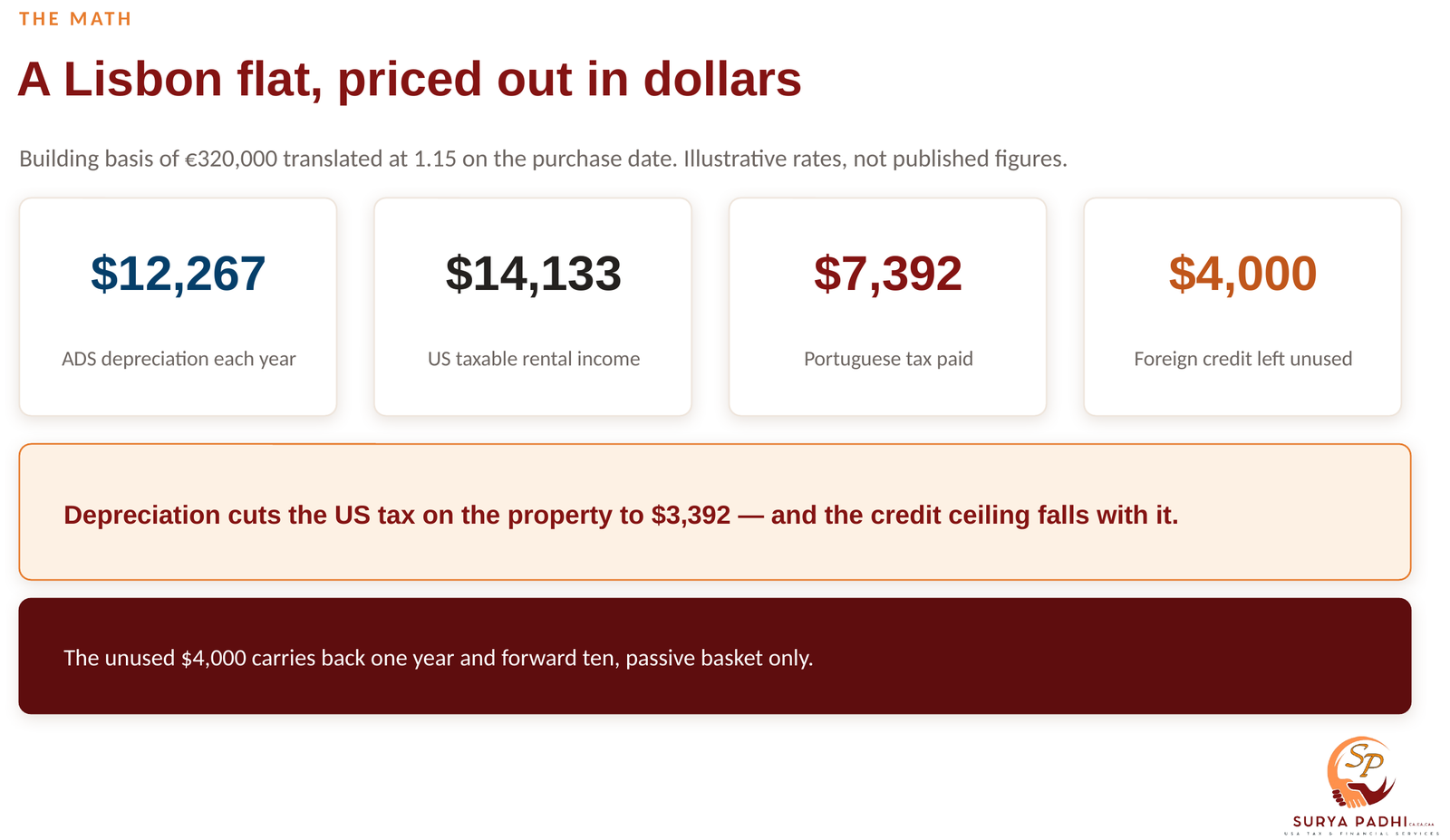
| Building basis: €320,000 at 1.15 on the 2021 purchase date | $368,000 |
| ADS depreciation ($368,000 ÷ 30) | $12,267 |
| Rent: €30,000 at the 1.10 average rate | $33,000 |
| Cash expenses: €6,000 at 1.10 | ($6,600) |
| Less depreciation | ($12,267) |
| US taxable rental income | $14,133 |
| US tax at a 24% marginal rate | $3,392 |
| Portuguese tax paid: €6,720 at 1.10 | $7,392 |
| Foreign tax credit usable this year | $3,392 |
| Excess credit carried, passive basket | $4,000 |
Exchange rates here are illustrative, not the published figures for any year. Portugal taxes the net rent without a depreciation deduction, which is why the foreign tax is larger than the US tax on the same property. The $4,000 of unused credit carries back one year and forward ten, and only ever against passive category income.
Note what happens if the return had used 27.5 years by mistake. Depreciation would be $13,382 rather than $12,267 — $1,115 too much every year. Taxable income drops, the credit ceiling drops with it, and the return looks fine because the foreign tax credit absorbs the difference. The error is invisible until the property is sold and basis is recomputed.
Form 8938: the distinction that decides whether you file
This is the question I am asked most often, and the answer is cleaner than people expect. The IRS states it directly: foreign real estate is not a specified foreign financial asset required to be reported on Form 8938. A personal residence or a rental property does not have to be reported.
The very next sentence is the one that matters. If the real estate is held through a foreign entity — a corporation, partnership, trust or estate — then the interest in the entity is a specified foreign financial asset, reportable if your total specified assets exceed the threshold that applies to you. Many countries encourage or require foreign buyers to hold property through a local company, so this is not an edge case.
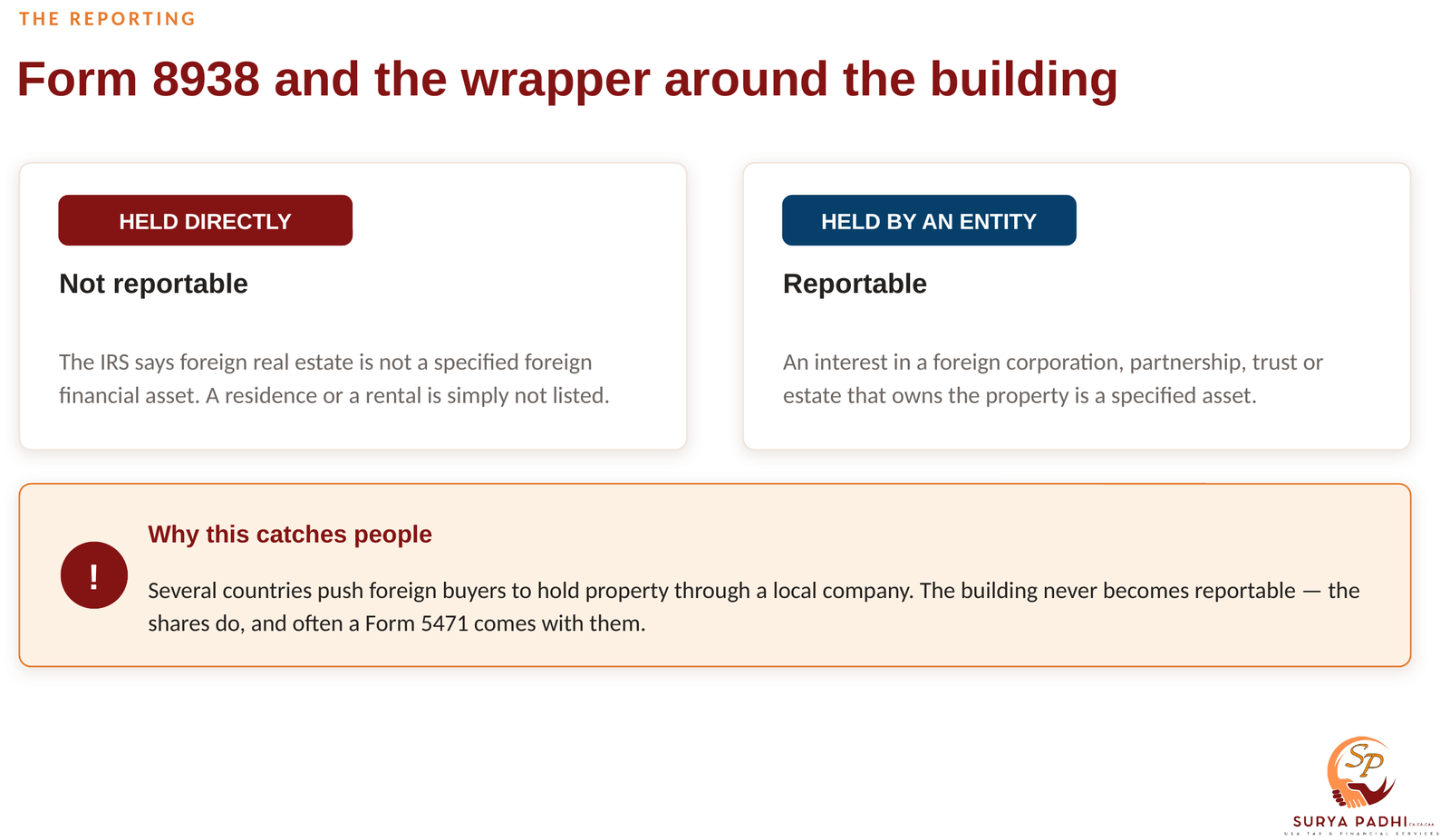
| How the property is held | Form 8938 | Other forms to expect |
|---|---|---|
| Directly, in your own name | Not reportable | Schedule E, Form 1116 |
| Through a foreign corporation | The shares are reportable | Possibly Form 5471 |
| Through a foreign partnership | The interest is reportable | Possibly Form 8865 |
| Through a foreign trust | The interest is reportable | Possibly Forms 3520 and 3520-A |
| Rent collected in a foreign bank account | The account is reportable | FBAR as well |
The thresholds
Living in the US: more than $50,000 on the last day of the year or $75,000 at any point, unmarried; $100,000 and $150,000 filing jointly. Living abroad: $200,000 and $300,000 unmarried, $400,000 and $600,000 jointly.
FBAR, and the account the rent lands in
Almost every foreign rental has a local bank account behind it, because that is how the tenant pays and how the management company is paid. That account is a foreign financial account, and if the aggregate value of all your foreign accounts exceeded $10,000 at any time during the calendar year, you file FinCEN Form 114 — the FBAR — electronically through the BSA E-Filing System.
- The threshold is aggregate and momentary. One day above $10,000 across all accounts triggers the filing for the whole year.
- It applies to accounts you control as well as accounts you own — including an account a property manager holds that you can direct.
- The FBAR is due April 15, with an automatic extension to October 15 that you do not have to request.
- It is a separate filing from Form 8938 and from the return itself. The same account can appear on both.
If a foreign rental has been sitting on returns for years with 27.5-year depreciation, no FBAR and no thought given to the property tax split, the fix is not to quietly change the schedule going forward. Episode 35 covered the streamlined filing compliance procedures for exactly this situation, and the choice between amending and using a compliance programme should be made deliberately.
Frequently asked questions
Is foreign rental property depreciated over 27.5 years or 30 years?
Thirty years, straight line, under the alternative depreciation system. Section 168(g) requires ADS for tangible property used predominantly outside the United States, and the ADS recovery period for residential rental property is 30 years. Property placed in service before January 1, 2018 remains on the older 40-year schedule.
Do I have to report my foreign house on Form 8938?
Not if you hold it directly. The IRS states that foreign real estate is not a specified foreign financial asset — a personal residence or a rental property does not have to be reported. If you hold it through a foreign corporation, partnership, trust or estate, the interest in that entity is reportable once your specified assets exceed your threshold.
Can I deduct the foreign property tax I pay?
Against rental income, yes. Section 164(b)(6) removes foreign real property taxes from Schedule A for individuals, but the disallowance does not apply to taxes paid in carrying on a trade or business or a section 212 activity. Property tax on a rental therefore remains fully deductible on Schedule E. On a purely personal home abroad, it is not deductible at all.
Which exchange rate should I use?
The rate prevailing when you receive, pay or accrue each item. For rent collected monthly, either the spot rate on each date or the IRS yearly average rate for that currency is defensible. The building’s basis is fixed in dollars at the rate on the acquisition date and is never re-translated, so your depreciation deduction does not move with the currency.
Do I need an FBAR for the account my tenant pays into?
If the aggregate value of all your foreign financial accounts exceeded $10,000 at any moment during the calendar year, yes. FinCEN Form 114 is filed electronically, is due April 15 with an automatic extension to October 15, and is separate from both your tax return and Form 8938. Accounts you can direct but do not own count too.
Have a rental abroad on a US return?
The depreciation schedule is worth checking before anything else, because it is the error that compounds. If the property has been on returns for several years, the conversation is about how to correct it, not whether to.
This article is general educational information, not individualized tax or investment advice. Figures cited are subject to IRS adjustment. Consult a qualified professional about your own facts.