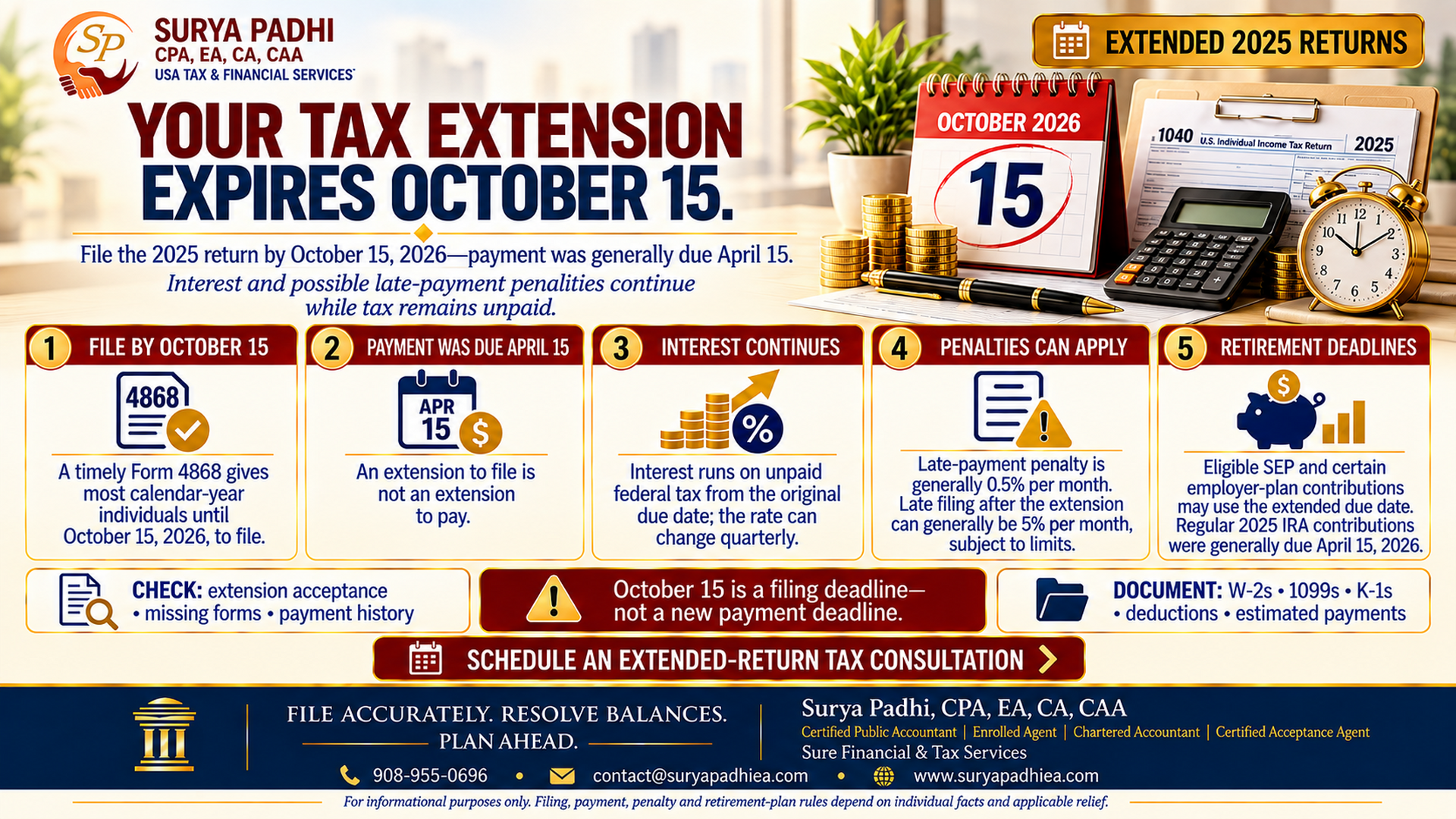
The extended tax deadline of October 15, 2026 only moves the date to file your 2025 return. Tax owed was still due April 15, so interest, compounded daily at 6% and then 7%, and the 0.5% monthly late-payment penalty have run since then. File by October 15 to avoid the 5% monthly late-filing penalty.
6:19. The written version, the figures and the sources are all below.
| Extended filing deadline | Oct 15, 2026 | For individuals who requested an extension by April 15 (IRS, IR-2026-52). |
|---|---|---|
| Interest, Apr 1 to Jun 30 | 6% | Individual underpayment rate, compounded daily (Rev. Rul. 2026-5). |
| Interest, Jul 1 to Dec 31 | 7% | Third quarter per IRB 2026-22; fourth quarter held at 7% (Rev. Rul. 2026-15, IR-2026-98). |
| Late-payment penalty | 0.5% a month | Up to 25% of unpaid tax; 0.25% under an approved plan if you filed on time (IRS). |
| Late-filing penalty | 5% a month | Up to 25%; $525 minimum or full tax after 60 days for returns due after 12/31/2025 (IRS). |
The extension moved your filing date, not your payment date. Here is what has been running since April 15, and the one move that keeps the bigger penalty from starting.
If you put your 2025 return on extension, the extended tax deadline is October 15, 2026. That date is close, and it is the one most people plan around. What they often miss is that the extension only moved the date to file. Any tax you still owed was due April 15, so interest has been running on it since then, and a late-payment penalty has been building alongside it.
This guide walks through what has been charged since April, what the penalties are, what a real balance costs, and what to do before October 15. The short version: file on time even if you cannot pay, and pay as much as you can today.
Key takeaways
- The extension moved the filing date to October 15, 2026. It did not move the payment date, which was April 15.
- Interest has run since April 15, compounded daily: 6% for April through June, then 7% from July 1, held at 7% for the fourth quarter.
- The late-payment penalty is 0.5% of the unpaid tax per month or part of a month, up to 25%. The late-filing penalty is 5% per month and starts only if you miss October 15.
- Filing on time, even with an unpaid balance, is always the cheaper path.
Why the extended tax deadline of October 15 is not a payment deadline
Form 4868 gives most individuals until October 15, 2026 to file their 2025 federal return, as long as the extension was requested by April 15. The IRS is direct about the limit: an extension gives more time to file, not more time to pay. Taxes owed were still due April 15.
That is why two clocks are running. The filing clock points to October 15. The payment clock started in April. If you owed tax in April and paid part or none of it, the unpaid portion has been late for more than five months.
The October 15 date is also not universal. Some taxpayers, such as those in federally declared disaster areas, have different dates. If you think that applies to you, check the IRS disaster relief page before relying on October 15.
What has been running since April 15
Three separate charges can apply to an extended return. They start on different dates, which is where the confusion comes from.
- Interest. Charged on unpaid tax from April 15 until you pay, compounded daily, at a rate the IRS resets every quarter.
- The late-payment penalty. Half a percent of the unpaid tax for each month or part of a month, up to 25%. It has been running since April.
- The late-filing penalty. Five percent per month, up to 25%. This one has not started. It applies only if you miss October 15.
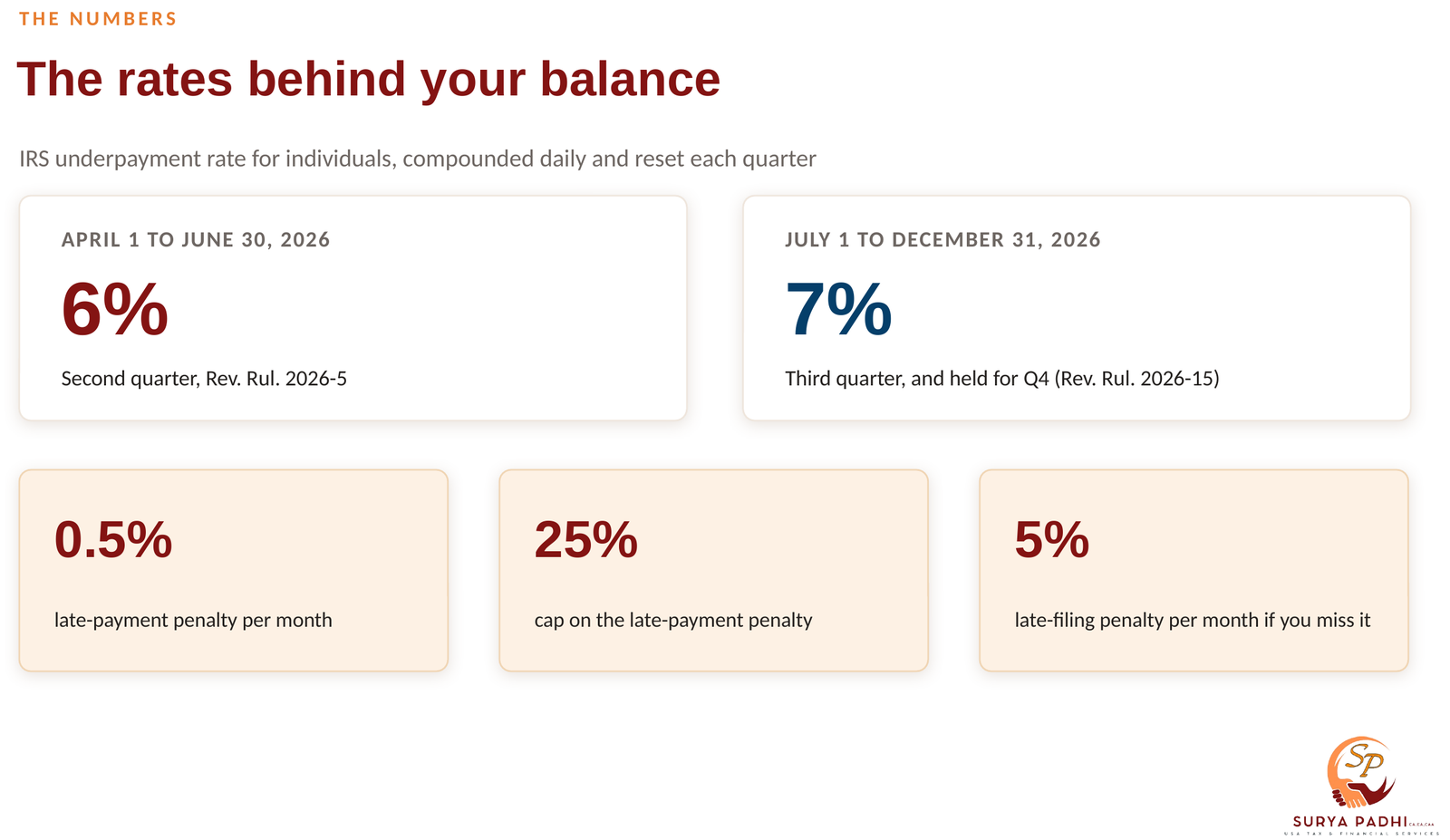
The interest rate for individuals was 6% for April 1 through June 30 (Rev. Rul. 2026-5). It moved to 7% on July 1, and the IRS announced in IR-2026-98 that 7% holds for the quarter beginning October 1 (Rev. Rul. 2026-15). Interest is also charged on penalties, so a penalty left unpaid grows too.
The rate was not 7% all year
You will see 7% quoted as the rate since April. The IRS rate for April through June was 6%. It reached 7% on July 1. The difference is small on a modest balance, but a figure you publish or quote to a client should match the quarter.
What a $10,000 balance costs by October 15
Here is a simplified illustration. Suppose you owed $10,000 for 2025, paid nothing in April, and pay everything on October 15. The numbers below use the IRS rates for each quarter and daily compounding, and they ignore interest on the penalty.
$10,000 unpaid from April 15 to October 15 (illustrative)
| Tax unpaid since April 15 | $10,000 |
| Interest at 6%, April 15 to June 30 (76 days) | $126 |
| Interest at 7%, July 1 to September 30 (92 days) | $180 |
| Interest at 7%, October 1 to 15 (15 days) | $30 |
| Late-payment penalty, 6 months at 0.5% | $300 |
| Approximate total added | $636 |
Simplified: no payments assumed, rounded to the dollar, before interest on the penalty. Not a quote for any return.
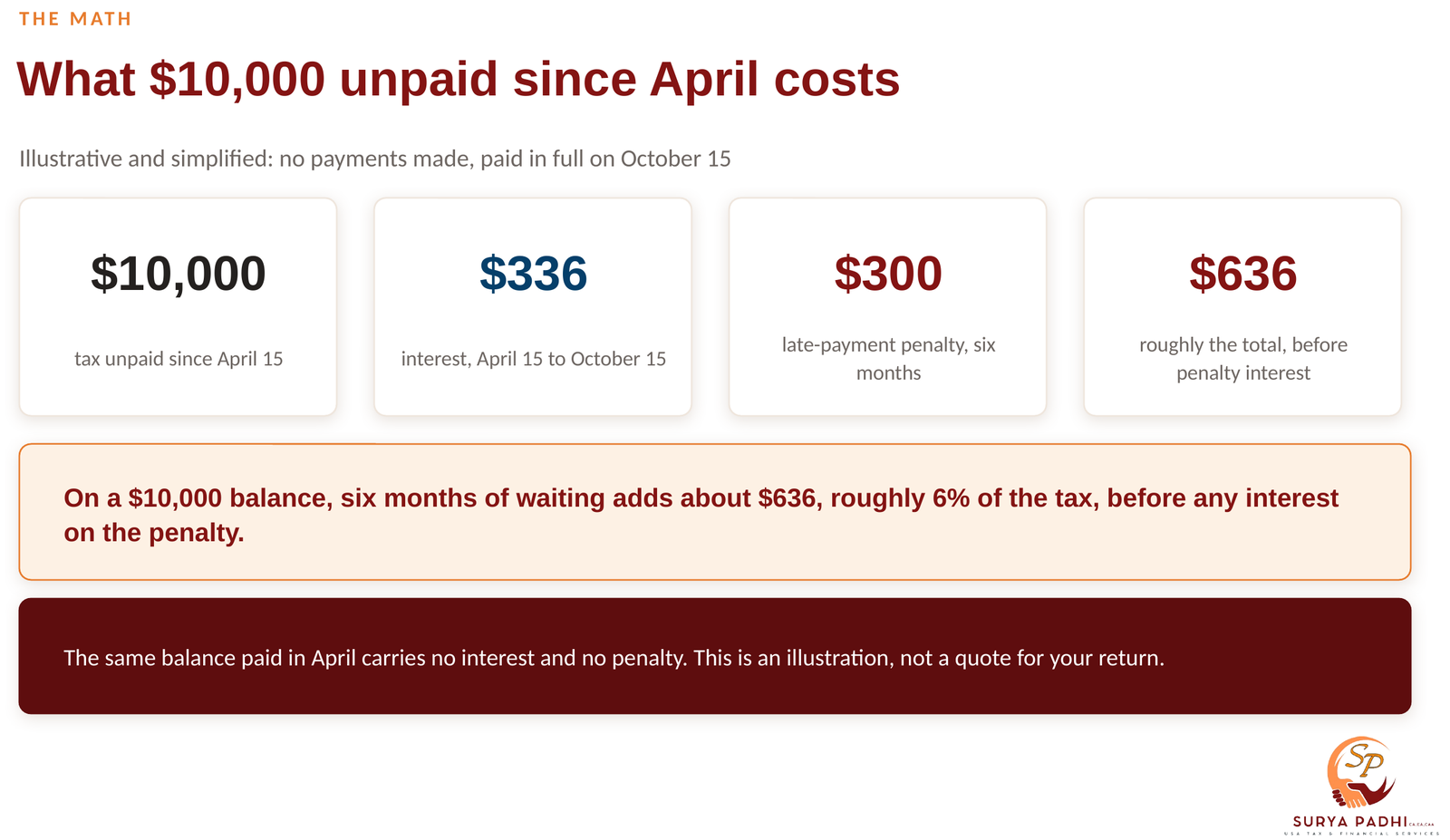
The same $10,000 paid in April would have cost nothing extra. The cost of an extension is the delay, and it is paid monthly.
File by October 15, even if you cannot pay
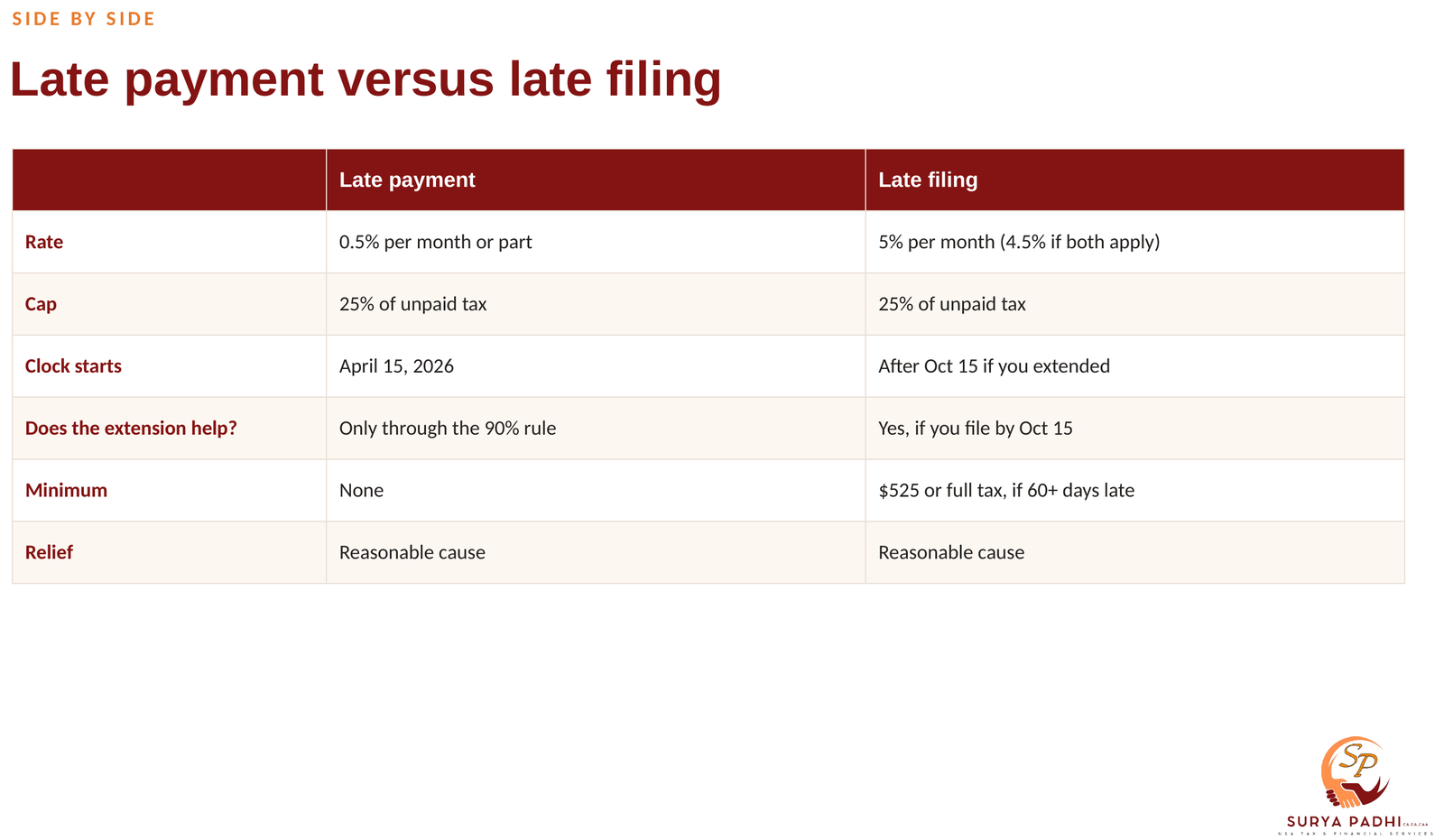
If you cannot pay in full, the most important decision is still to file. The late-filing penalty is 5% of the unpaid tax per month, ten times the late-payment penalty. In months when both apply, the filing penalty is reduced by the payment penalty, so the combined charge is 5% per month. Both stop at 25%, and the filing penalty reaches that cap in five months.
There is also a minimum. For a return due after December 31, 2025, if you file more than 60 days late the minimum late-filing penalty is $525 or 100% of the tax due, whichever is less.
| Late payment | Late filing | |
|---|---|---|
| Rate | 0.5% per month or part | 5% per month (4.5% if both apply) |
| Cap | 25% of unpaid tax | 25% of unpaid tax |
| Clock starts | April 15, 2026 | After October 15 if you extended |
| Extension helps? | Only through the 90% rule | Yes, if you file by October 15 |
| Minimum | None | $525 or full tax, if 60+ days late |
| Relief | Reasonable cause | Reasonable cause |
If you have an approved payment plan and filed your return on time, the late-payment penalty drops to 0.25% per month while the plan is in effect. Interest keeps running until the balance is paid.
The 90 percent safe harbor
There is one way an extension can protect you from the late-payment penalty. Under the Form 4868 instructions, if you paid at least 90% of your total tax by April 15, through withholding, estimated payments or a payment with the extension, and you pay the rest with your return, the IRS generally treats that as reasonable cause for the extension period.
Interest is not waived
The safe harbor addresses the penalty. Interest still runs on any balance you paid after April 15. Confirm the current wording in the Form 4868 instructions before relying on the rule for a specific return.
What to do before October 15
- Confirm the extension. Find the acceptance email or your payment record. Do not assume it went through.
- Get your real number. Finish the return, or estimate the tax now, so you know what you owe.
- Pay what you can. IRS Direct Pay and EFTPS both work. Each dollar paid stops interest and penalty on that dollar.
- File by October 15. E-file early. If a balance remains, request a payment plan the same week.
Partial payments count
You do not have to choose between paying everything and paying nothing. Paying part now reduces the base that interest and the late-payment penalty are charged on.
Which situation are you in?
| If you… | Do this | What it costs |
|---|---|---|
| Paid 90% or more by April 15 | File by Oct 15 and pay the rest with the return | Interest on the small balance; payment penalty generally waived |
| Owe more than 10% of your tax | Pay as much as you can now, then file | Interest plus 0.5% per month on what is unpaid |
| Cannot pay at all | File by Oct 15, then request a payment plan | Interest plus a penalty of 0.25% per month under a plan |
In every row, the return gets filed by October 15. That single step keeps the largest penalty from starting.
Frequently asked questions
Does filing an extension stop interest?
No. Interest runs on unpaid tax from April 15 until you pay it, even with a valid extension. It is compounded daily at a rate that resets each quarter.
What happens if I file after October 15?
The late-filing penalty starts: 5% of the unpaid tax per month or part of a month, up to 25%, reduced by 0.5% in months when the late-payment penalty also applies. After 60 days, the minimum for a return due after December 31, 2025 is $525 or the full tax due, whichever is less.
Can I avoid the late-payment penalty on an extension?
Generally yes, if you paid at least 90% of your total tax by April 15 and pay the rest with your return. The IRS treats that as reasonable cause for the extension period. Interest on any late portion still applies.
What if I cannot pay by October 15?
File by October 15 anyway, then request a payment plan. For someone who filed on time, an approved plan reduces the late-payment penalty to 0.25% per month, though interest continues until the balance is paid.
Is October 15 the deadline for everyone?
No. October 15, 2026 is the usual extended date for individuals who requested an extension by April 15. Taxpayers in disaster areas or with other special circumstances can have different dates.
Extended and still owe? Let’s sort it out before October 15
Sure Financial and Tax Services can finish your return, estimate what you owe, and help you set up a payment plan for the balance.
This article is general tax education and does not constitute individualized tax, legal or financial advice. Figures are stated for the tax year shown and are subject to IRS adjustment. Consult a qualified professional about your own facts.