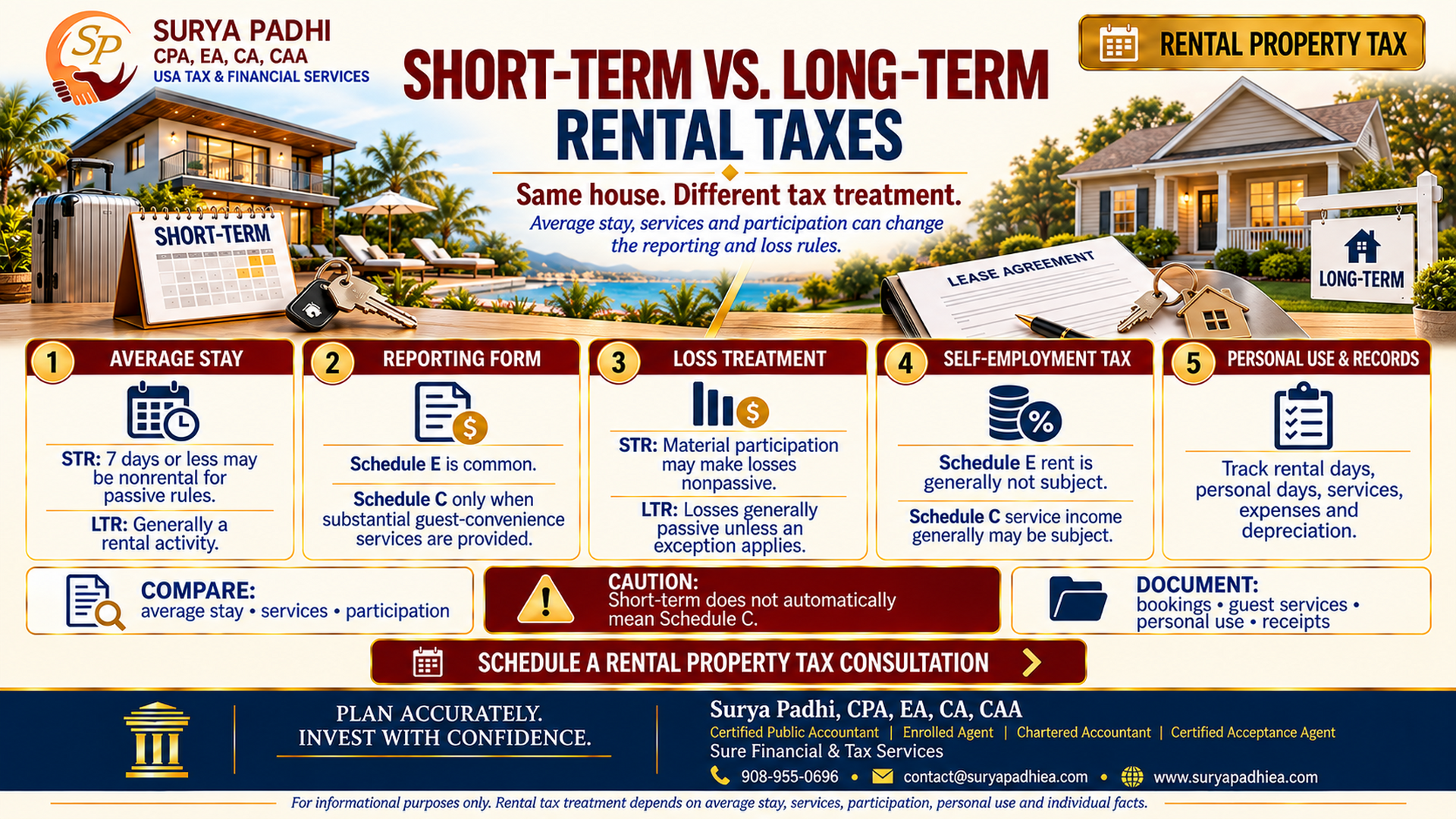
A short-term rental averages seven days or less per guest stay, which takes it outside the passive rental rules. If you also materially participate, its loss may offset wages. A long-term rental is passive by default: losses generally offset only passive income, with a $25,000 allowance for lower incomes.
6:28. The written version, the figures and the sources are all below.
| Average guest stay for the short-term rule | 7 days or less | Total days rented to customers divided by the number of separate stays, for the tax year. IRS Publication 925. |
|---|---|---|
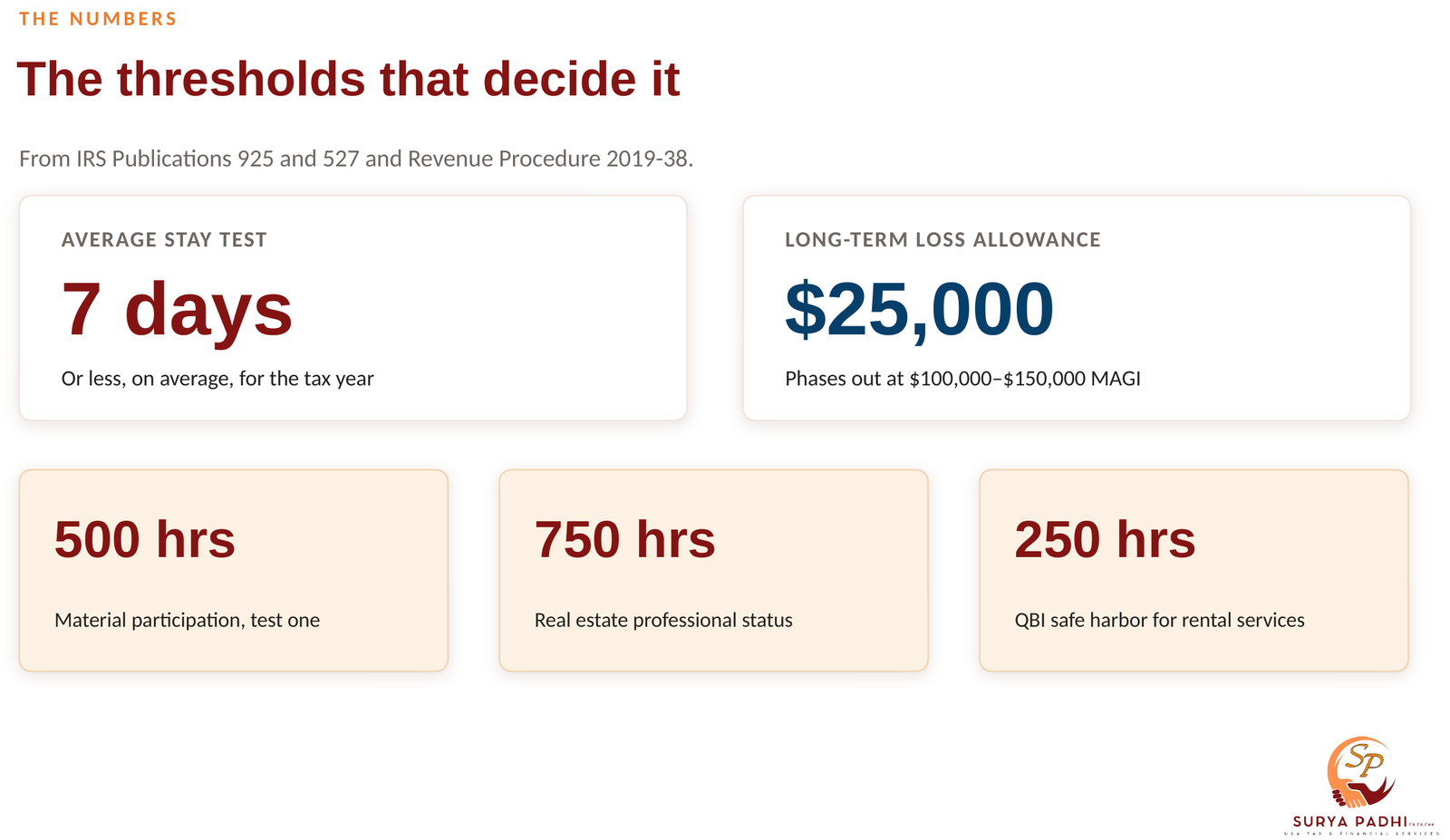
| Long-term loss allowance | $25,000 | For rental real estate with active participation. Reduced by 50% of MAGI above $100,000, so it is gone at $150,000. IRS Publication 925. |
| Material participation, test one | 500+ hours | One of seven tests. Test three is more than 100 hours and at least as much as any other individual. IRS Publication 925. |
| Personal-use limit | 14 days or 10% | A dwelling is a home if personal use exceeds the greater of 14 days or 10% of days rented at a fair price. IRS Publication 527. |
| Third-party platform reporting | $20,000 / 200 | Forms 1099-K are required only above $20,000 and more than 200 transactions. All income is taxable regardless. IRS Form 1099-K FAQs. |
| Bonus depreciation | 100% | Permanent for qualified property acquired after January 19, 2025. IRS Notice 2026-11. |
The average length of a guest stay decides your tax form, whether a loss is passive, and whether self-employment tax applies. Here is how the rules work for 2026, with one worked example.
Two people can buy identical houses on the same street and file completely different tax returns. One rents to tenants on a twelve-month lease. The other rents to guests a weekend at a time. The house is the same, but the average length of a stay changes which form the income goes on, whether a loss is passive, and sometimes whether self-employment tax applies.
This guide walks through the rules that separate a short-term rental from a long-term rental, using IRS Publications 925 and 527, and puts numbers on the difference with one worked example. It is general education, not advice on your specific facts, so treat the example as a way to see how the rules interact rather than a forecast of your own result.
Key takeaways
- A rental with an average guest stay of seven days or less is not a “rental activity” under the passive loss rules.
- To use that loss against wages, you generally must also materially participate, for example by working more than 500 hours.
- A long-term rental loss is passive by default. Only a $25,000 allowance for lower incomes gets around that.
- Cost segregation and 100% bonus depreciation create large year-one losses, and much of that depreciation is recaptured when you sell.
The average stay decides which rules apply
The tax code does not care whether you book through Airbnb, VRBO or a lease. It cares about arithmetic. Under the passive activity rules, IRS Publication 925 says a rental is not treated as a rental activity if the average period of customer use is seven days or less.
Two related exceptions exist. An average of thirty days or less also takes the activity outside the rental definition when you provide significant personal services with the rentals, and the same is true when you provide extraordinary personal services. Once an activity is outside the rental definition, it is tested like an ordinary trade or business instead of as a rental.
How to calculate the average stay
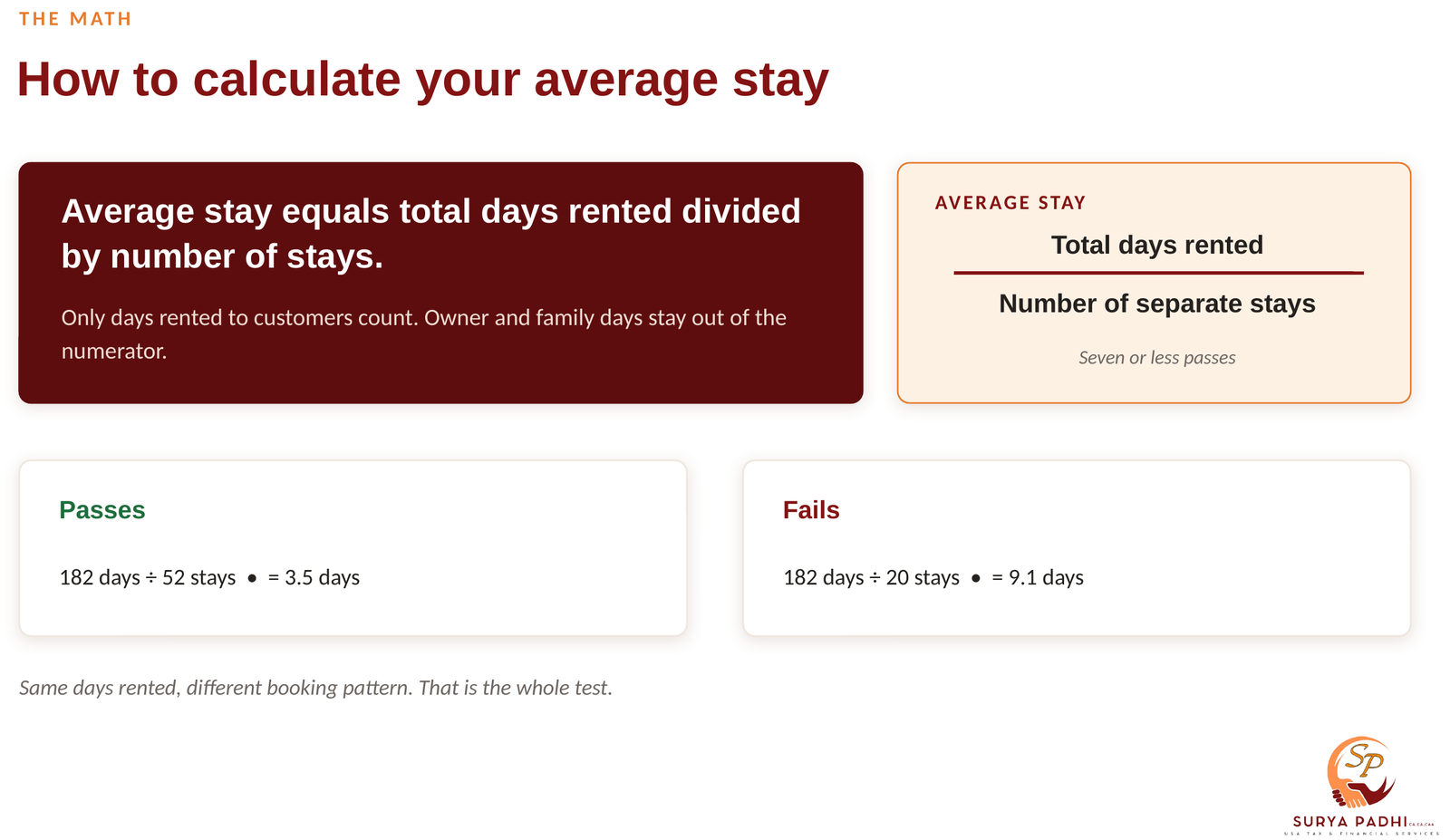
Divide the total days you rented to customers by the number of separate stays during the tax year. Only days rented to customers count. Your own days and vacant days stay out of the calculation.
| Booking pattern | Days rented | Stays | Average | Result |
|---|---|---|---|---|
| Weekend and midweek guests | 182 | 52 | 3.5 days | Passes (7 days or less) |
| Mostly weekly and longer stays | 182 | 20 | 9.1 days | Fails |
Do not sit at 6.9 days
Averages move. A few longer bookings can push a 6.5-day average past seven. Recalculate monthly from your platform reports instead of waiting until year-end.
Material participation: the second gate
Passing the average-stay test only removes the rental label. To treat the activity as non-passive, and to use a loss against wages, you generally must also materially participate. Publication 925 lists seven tests. Three of them do most of the work for short-term rental owners:
- You participated in the activity for more than 500 hours during the year.
- Your participation was substantially all of the participation in the activity of all individuals.
- You participated for more than 100 hours, and at least as much as any other individual.
The third test is where owners get caught. “Any other individual” includes your cleaner, your co-host and your property manager. If a cleaner works 300 hours and you work 200, you fail test three, and you are well short of 500 hours as well.
Keep a log as you work. Record the date, the task, the time and who else worked. A calendar built during the year is far more persuasive than an estimate reconstructed after a notice arrives.
Not the same as real estate professional status
That is a higher bar. You must perform more than 750 hours of services in real property trades or businesses in which you materially participate, and those must be more than half of all the personal services you perform in all trades or businesses during the year.
Where the loss goes: passive or non-passive
A long-term rental is passive by default. Its losses generally offset only passive income, and unused losses carry forward. Smaller owners get one exception: if you actively participate, you can deduct up to $25,000 of rental loss against non-passive income. That allowance is reduced by 50% of the amount your modified adjusted gross income exceeds $100,000, so it is gone entirely at $150,000.
A short-term rental that meets both the average-stay test and a material participation test is treated as non-passive. Its loss can offset wages and other income, subject to other limits such as the excess business loss limitation.
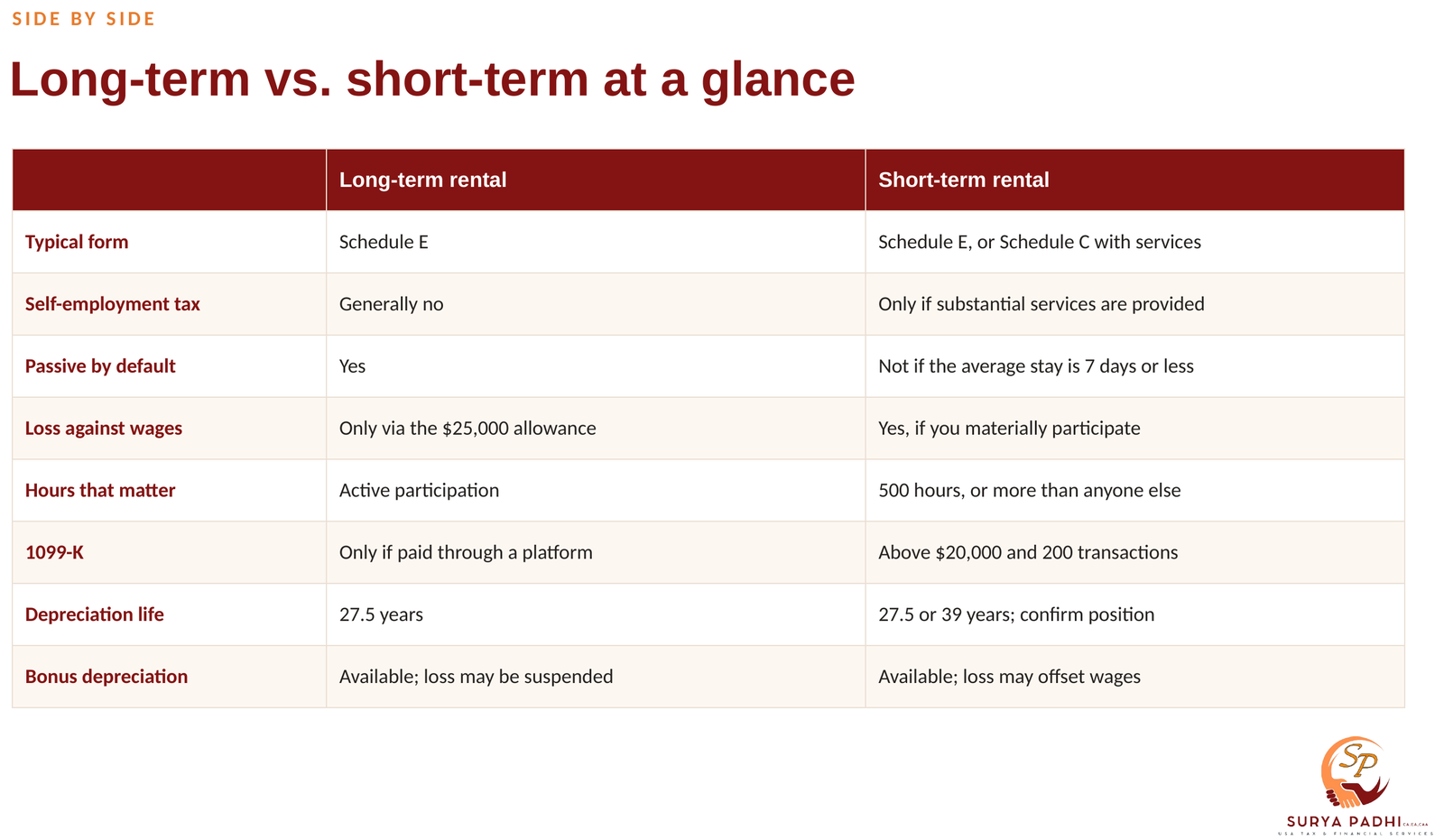
| Long-term rental | Short-term rental (qualifying) | |
|---|---|---|
| Passive by default | Yes | Not if the average stay is 7 days or less and you materially participate |
| Loss against wages | Only through the $25,000 allowance | Yes, subject to other limits |
| Typical form | Schedule E | Schedule E, or Schedule C with substantial services |
| Self-employment tax | Generally no | Only if substantial services are provided |
Schedule E or Schedule C, and self-employment tax
Passing the seven-day test does not decide self-employment tax. Publication 527 explains that rental income generally goes on Schedule E, where there is no self-employment tax. When you provide substantial services in connection with the rentals, Schedule C may apply instead, and the income is subject to self-employment tax of 15.3%.
Providing the space, utilities and ordinary upkeep is one thing. Daily housekeeping, meals and concierge-style services are another. If you run something closer to a small inn than a rental, tell your preparer at the start of the engagement.
Two different tests
The seven-day rule comes from the passive activity regulations. Whether rental income is subject to self-employment tax is a separate question, so you can meet the first and still land on Schedule C.
Personal use: the 14-day and 10% rules
If you use the property yourself, Publication 527 sets the thresholds. A dwelling unit is used as a home if your personal use exceeds the greater of 14 days or 10% of the days it is rented at a fair rental price. If you rent the property fewer than 15 days in the year, you do not report the income and you cannot deduct rental expenses.
Above the threshold, expenses must be divided between rental and personal use, and deductions are generally limited to the rental income. A long family stay at your own rental can quietly move it into that category.
Cost segregation and bonus depreciation: the year-one effect
Depreciation is where the two rental types look most different on paper. IRS Notice 2026-11 covers the permanent 100% additional first-year depreciation deduction for qualified property acquired after January 19, 2025. A cost segregation study reclassifies parts of a building, such as certain fixtures, finishes and land improvements, into shorter-lived categories that can qualify for that bonus.
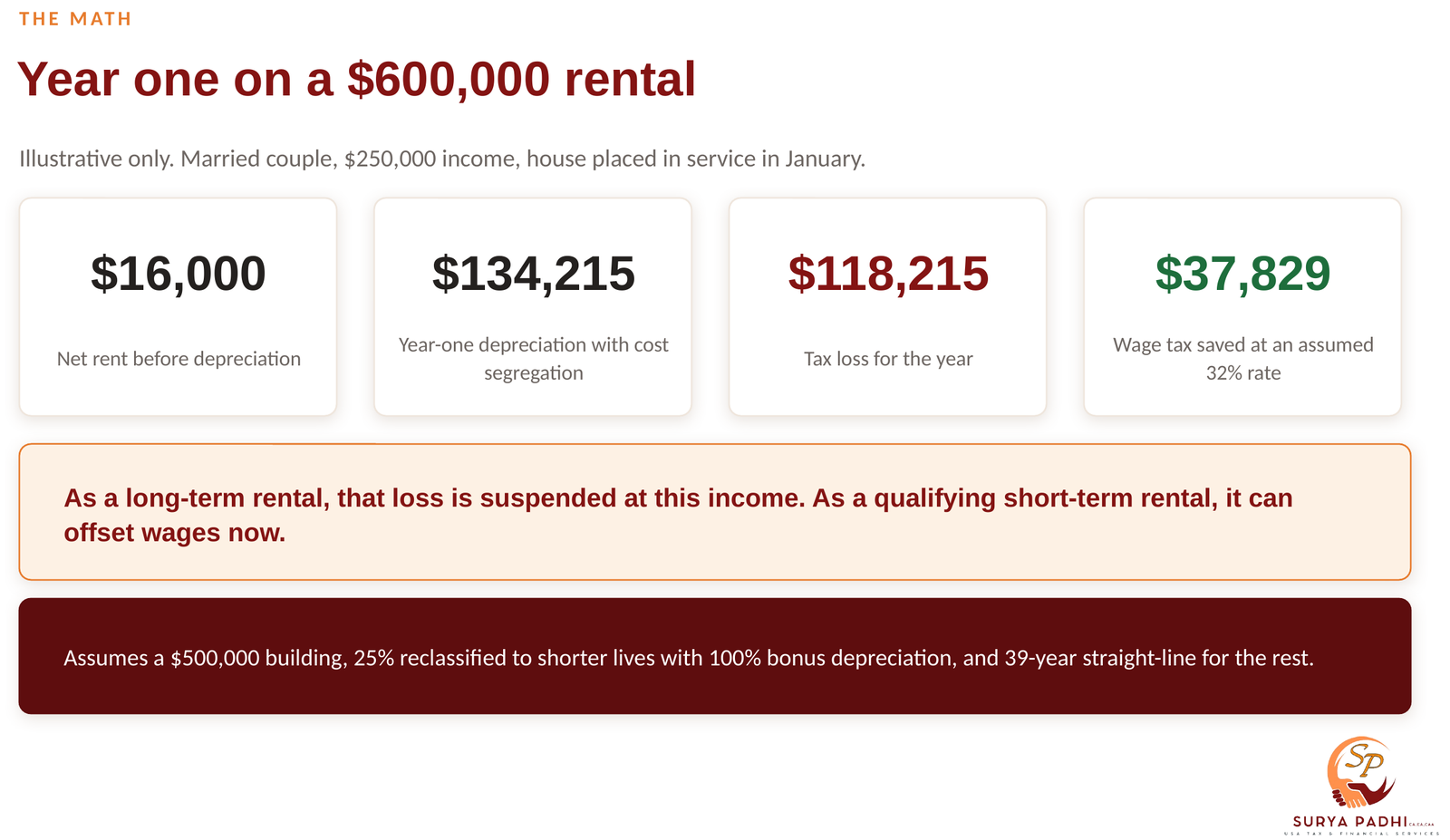
Year one on a $600,000 rental (illustrative)
| Purchase price | $600,000 |
| Building basis (land $100,000) | $500,000 |
| Reclassified by the cost study (25%) | $125,000 |
| Bonus depreciation on that property (100%) | $125,000 |
| 39-year depreciation on the other $375,000 (placed in service in January) | $9,215 |
| Year-one depreciation | $134,215 |
| Net rent before depreciation | $16,000 |
| Tax loss for the year | $118,215 |
Assumes a married couple with $250,000 of income and the 39-year life applied with the mid-month convention. As a long-term rental, the loss is passive and the $25,000 allowance has phased out, so the loss is suspended and carried forward. As a qualifying short-term rental, it can offset wages: at an assumed 32% federal rate, about $37,829 of tax this year. IRS depreciation tables round each month’s rate and can differ from this calculation by a few dollars.
These numbers are illustrative, and the depreciation life for a short-term rental is a point where practitioners disagree. Residential rental property is depreciated over 27.5 years. Many preparers use 39 years for a property rented to guests who stay 30 days or fewer, while others use 27.5 years for a single home. Decide the position with your preparer, document it, and apply it consistently.
Recapture is the price of the bonus
Bonus depreciation is a timing benefit, not a free deduction. When you sell, much of the depreciation you took is recaptured, and the portion tied to the shorter-lived property is taxed as ordinary income. Model the sale before you buy.
Reporting and other tax points
- Form 1099-K: Payment platforms must report only when payments exceed $20,000 and there are more than 200 transactions. All income is taxable even if you never receive a form.
- Qualified business income deduction: A rental can qualify as a trade or business for the section 199A deduction. Revenue Procedure 2019-38 offers a safe harbor built on 250 or more hours of rental services, separate books and records, and contemporaneous logs. Property used as a residence under section 280A(d) is excluded.
- State and local taxes: Many states and cities charge lodging or occupancy taxes on short stays. Check yours before the first booking.
Dates to know
| Date | What it means for a rental owner |
|---|---|
| October 15, 2026 | Extended 2025 returns are due. If you acquired a rental after January 19, 2025, confirm 100% bonus depreciation on the 2025 return. |
| December 31, 2026 | The rental must be placed in service for a 2026 depreciation deduction. Your hours and average stay are also counted on the tax year. |
| January 15, 2027 | Fourth-quarter 2026 estimated tax payment is due, if you owe. |
Which one is right for you?
Tax is only one input. A short-term rental usually asks for more work: turnovers, guest messaging, pricing and repairs. If you cannot credibly log the hours, the tax advantages may stay on paper, and the steadier pattern of a long-term rental may fit better. Whichever you choose, the return should match the facts.
Do not pick short-term or long-term for the tax break. Pick the rental you can actually run.
Frequently asked questions
Is a short-term rental loss always deductible against my W-2 income?
No. The rental must first meet the average-stay test of seven days or less, then a material participation test, and the loss remains subject to other limits such as the excess business loss limitation. If either test fails, the loss is passive.
What is the 7-day rule for short-term rentals?
It is the passive activity exception that treats a rental as not a rental activity when the average guest stay is seven days or less, calculated as total days rented divided by the number of separate stays.
Do I pay self-employment tax on Airbnb income?
Usually not, because rental income generally goes on Schedule E. If you provide substantial services, such as daily housekeeping or meals, the income may be reported on Schedule C and be subject to self-employment tax.
How many days can I use my own rental property?
Personal use above the greater of 14 days or 10% of the days rented at a fair price makes the dwelling a home for tax purposes, which limits deductions. If you rent it fewer than 15 days a year, the income is not reported and rental expenses are not deductible.
Get your rental numbers checked before you file
Sure Financial and Tax Services LLC prepares rental returns, models cost segregation and material participation, and plans the sale before you buy.
This article is general tax education and does not constitute individualized tax, legal or financial advice. Figures are stated for the tax year shown and are subject to IRS adjustment. Consult a qualified professional about your own facts.